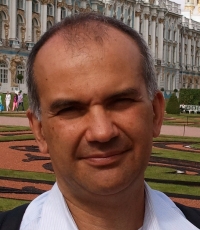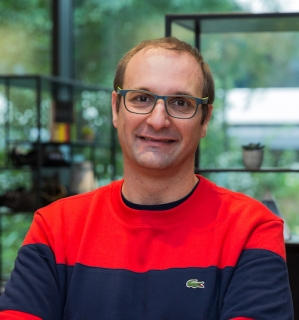
Usman Khan is a Professor of Electrical and Computer Engineering and Computer Science at Tufts University's School of Engineering. He directs the Signal Processing and RoboTic Networks (SPARTN) laboratory and holds editorial roles in IEEE Transactions on Signal Processing and related journals. His research focuses on optimization, machine learning, signal processing, and decentralized algorithms, with applications in autonomous systems, IoT, and smart cities. He received the NSF CAREER Award (2014) and is a Senior Member of IEEE. Education: Ph.D., Carnegie Mellon University (2009) M.S., University of Wisconsin–Madison (2004) B.S., University of Engineering and Technology Lahore (2002) Research Interests: Usman Khan's work spans data and network science, systems control, and optimization algorithms for autonomous systems, driverless vehicles, and smart infrastructure. Key areas include distributed optimization, electrocatalytic materials, and networked estimation techniques. Recent Contributions: His recent publications address distributed optimization under delays, electrocatalytic material synthesis, and robust consensus algorithms for multi-agent systems. Notable awards include the EURASIP Best Journal Paper (2022). Grants & Leadership: He has led NSF-funded projects on distributed monitoring systems and smart infrastructure. His professional activities include roles in conference organizing and journal reviewing across IEEE domains. Labs & Teams: The SPARTN lab at Tufts focuses on advancing networked signal processing and robotic systems for real-world applications.