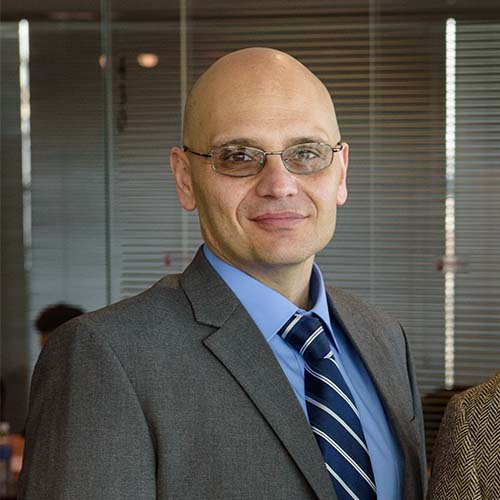
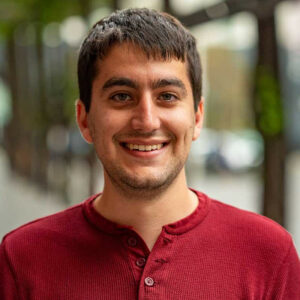
Partha Sarathi Roy is a Senior Lecturer in Cyber Security at the University of Wollongong's School of Computing and Information Technology. His research expertise spans code-based cryptography, lattice-based cryptographic schemes, and secure secret sharing mechanisms. Previously, he held positions at Kyushu University and KDDI Research, following his PhD in Cryptography from the University of Calcutta. Dr. Roy's work focuses on developing advanced cryptographic protocols including puncturable encryption, proxy re-encryption, and password-protected security systems. His contributions emphasize lattice-based solutions for post-quantum cryptography and secure data sharing frameworks. He coordinates courses in system analysis and project management and has secured funding for quantum-safe storage research. Dr. Roy actively contributes to academic peer review for major cryptography conferences and journals.
Martin Gagné is a Visiting Professor in the Computer Science Department at Swarthmore College since at least 2018. He holds a Ph.D. in Computer Science from the University of California, Davis (2008). His research focuses on cryptography and automated verification of cryptographic protocols, including work on symmetric encryption, message authentication codes, and public-key encryption systems. He is currently involved in verifying the Norwegian government's e-voting protocol and exploring hardware token-based solutions to eliminate pairing operations in cryptosystems. Education: Ph.D. in Computer Science, University of California, Davis (2008) Research Interests: Automated verification of cryptographic protocols Pairing-based cryptography Efficient attribute-based encryption and signature algorithms Privacy-preserving systems in healthcare and e-voting Teaching: Current courses (Spring 2018): CS35 (Data Structures and Algorithms), CS35B/C Labs Past courses at Swarthmore: CS31 (Computer Systems), CS35 (Data Structures and Algorithms), CS91 (Computer Security) Past courses at Wheaton College: Comp 115 (Robots & Problem Solving), Comp 121 (Computing Theory), Comp 215 (Algorithms), Comp 375 (Theory of Computation), Comp 398 (Network Security) Publications: 10+ peer-reviewed articles in journals like Journal of Automated Reasoning and conferences including ESORICS, SCC, and Pairing. Key themes include block cipher verification, proxy re-encryption, and attribute-based systems. Labs/Teams: Active in cryptographic protocol analysis and security system design, collaborating on e-voting and healthcare privacy projects.
Giuseppe Ateniese is a Professor and Eminent Scholar in Cybersecurity at George Mason University's College of Engineering and Computing, holding dual appointments in the Departments of Cyber Security Engineering and Computer Science. He previously held the Farber Endowed Chair at Stevens Institute of Technology, and has held academic positions at Johns Hopkins University, Sapienza University of Rome, and others. He received his PhD in Computer Science from the University of Genoa in 2000, and has been honored with the NSF CAREER Award, Google Faculty Research Award, and IEEE Technical Recognition Award. His research focuses on Cloud Security , Applied Cryptography , Blockchain Technology , and AI-driven Cybersecurity . Notable contributions include foundational work in provable data possession, proxy re-encryption, and password-guessing defenses using AI (e.g., PassGAN). Recent work explores privacy-preserving machine learning and blockchain scalability. Teaching includes graduate/undergraduate courses on Blockchains and Cryptofinance , Cryptography Fundamentals , and Secure Systems Design . He has advised numerous projects in decentralized systems and AI security. His articles span cryptographic protocols, blockchain innovations, and AI security. Key awards include recognition for contributions to cloud security (IBM Faculty Award) and privacy-preserving techniques (NSF CAREER). Labs/Teams: Active in GMU's Cyber Security Engineering initiatives and collaborates with industry on applied cryptography projects. Previously co-founded the Johns Hopkins University Information Security Institute.
Yuhong Liu is an Associate Professor in the Department of Computer Science and Engineering at Santa Clara University's School of Engineering. She holds a B.S. and M.S. from Beijing University of Posts and Telecommunications (2004, 2007) and a Ph.D. from the University of Rhode Island (2012). Her research focuses on trust, security, and privacy in emerging technologies including Generative AI, IoT, blockchain, and social media. She leads the Trustworthy Computing Lab, which develops solutions for IoT security, misinformation detection, and energy-efficient systems. Her research spans: Generative AI : Trustworthy synthetic data generation and multi-agent collaboration Blockchain : Multi-signature schemes and decentralized consensus IoT Security : Anomaly detection and lightweight cryptography Social Media : Misinformation mitigation and privacy preservation Recent publications emphasize blockchain-enabled security, IoT anomaly detection, and AI fairness, reflecting a trend toward practical, cross-domain solutions for cyber-physical systems. Her work frequently integrates machine learning with cryptographic techniques to address real-world vulnerabilities. Awards & Honors: IEEE Rising Star Service Award (2023) APSIPA Distinguished Lecturer (2021-2022) Researcher of the Year, Santa Clara University (2019) Best Paper Awards at IEEE SocialCom 2010 & UMEDIA 2016 She advises 7+ graduate students on IoT security, blockchain, and social media analytics. She co-leads the NSF-funded EuReCa Global Center for clean energy research and has organized panels on AI ethics and disinformation. Her lab collaborates with industry partners to deploy secure edge computing solutions.
Aloni Cohen is an Assistant Professor of Computer Science and Data Science at the University of Chicago. Previously, he served as a Postdoctoral Associate at Boston University, with a joint appointment at the Hariri Institute for Computing and the School of Law. He is also a former affiliate at the Berkman Klein Center for Internet & Society and a Fellow at the Aspen Tech Policy Hub. Aloni earned his PhD in Electrical Engineering and Computer Science from MIT, advised by Shafi Goldwasser, supported by a Facebook Fellowship and an NSF Graduate Student Research Fellowship. His research bridges theoretical cryptography, privacy, law, and policy, focusing on real-world applications like differential privacy, encryption, and legal frameworks such as GDPR and the Fifth Amendment. Key research themes include privacy-preserving data analysis, cryptographic watermarking, and ethical implications of AI. He explores tensions between cryptographic theory and legal regulations governing data privacy and surveillance. His recent publications address topics such as the societal impacts of differential privacy, legal challenges in compelled decryption, and policy questions around multiparty computation. Notable awards include the 2024 Outstanding Paper Award at the International Conference on Algorithmic Learning Theory and the 2022 Distinguished Paper Award at USENIX Security Symposium. Awards: 2024 Outstanding Paper Award, International Conference on Algorithmic Learning Theory 2022 Distinguished Paper Award, USENIX Security Symposium 2014 NSF Graduate Student Research Fellowship Aloni’s work involves interdisciplinary collaborations, addressing both technical and policy dimensions of modern computational challenges. Details on grants or specific advising roles are not explicitly listed in the provided texts.
Sudip Misra is a Professor in the Department of Computer Science and Engineering at the Indian Institute of Technology Kharagpur, West Bengal, India. With an extensive publication record of 168 publications and over 1,142 citations, he has established himself as a leading researcher in networking and sensor systems. His work spans multiple domains within computer science and engineering, with a particular focus on practical applications of theoretical concepts. Dr. Misra's research interests encompass Wireless Sensor Networks, Internet of Things (IoT), Mobile Networks, Routing Protocols, Network Security, Energy Efficiency, Underwater Sensor Networks, UAV Networks, and Machine Learning applications for networking. His work demonstrates a consistent focus on solving real-world problems through innovative networking solutions, particularly in resource-constrained environments. He has made significant contributions to security protocols, energy management, and connectivity solutions across various network paradigms. Analysis of his recent publications reveals a strong trend toward practical applications of networking technologies, with increasing focus on IoT security, vehicular networks, underwater communication systems, and UAV-enabled networks. His work shows evolution from fundamental networking protocols to more complex, application-specific solutions addressing contemporary challenges in smart transportation, precision agriculture, and secure cloud-based IoT services. Dr. Misra has mentored numerous students and researchers, as evidenced by his extensive co-authorship record. His collaborative work spans multiple institutions across India and internationally, demonstrating strong research leadership and networking capabilities. His research has been supported by various funding mechanisms, though specific grants are not detailed in the available information. His laboratory or research group appears to focus on sensor networks, IoT systems, and related communication technologies, with particular emphasis on security, energy efficiency, and practical deployment scenarios. The research output suggests a well-established team working on cutting-edge networking challenges with real-world applicability.