Patrick Bradleyمشاهده پروفایل
استادیار
- Human microbiome
- Bioinformatics
- Genomics
- +۴ مورد دیگر
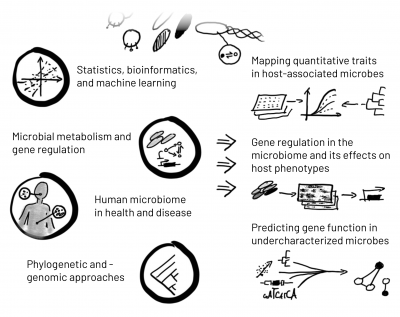
Patrick Bradley is an Assistant Professor of Microbiology at The Ohio State University, affiliated with the College of Arts and Sciences. He is also part of the Infectious Diseases Institute and the Center of Microbiome Science. His research focuses on understanding human microbiota (particularly the gut and oral microbiomes) using computational and experimental approaches. Bradley earned his A.B. from Harvard University (2005), Ph.D. from Princeton University (2012), and completed a postdoctoral fellowship at the University of California, San Francisco (2013–2020). Education: A.B., Harvard University, 2005 Ph.D., Princeton University, 2012 Postdoc, University of California, San Francisco, 2013–2020 His research interests include microbial gene function prediction, gene regulation in adaptive environments, and the role of microbiomes in drug metabolism and disease. Current lab projects involve leveraging natural genetic variation to identify genes influencing microbial colonization, understanding regulatory mechanisms in microbial adaptation, and developing machine learning tools for functional annotation. Recent work highlights the disproportionate impact of genomic misassembly in metagenomic studies and the shared metabolic pathways between hosts and microbes in cancer drug processing. Bradley’s lab actively collaborates on projects such as PanSweep (a tool to detect pangenome contamination) and Phylogenize2 (for phylogeny-corrected gene association analysis). Advising and grants: Bradley mentors PhD students (Christian J. Quiles Pérez, Stephanie Majernik, Nghi Tran, Alexis Young) and has contributed to studies exploring microbiome-modulating therapies. The Bradley Lab is part of interdisciplinary initiatives at Ohio State, emphasizing translational research in microbiome science. Lab activities include developing computational tools for microbiome analysis and maintaining collaborations with institutions like the Center for Microbiome Science. The lab’s work has implications for precision medicine and understanding microbial contributions to human health.