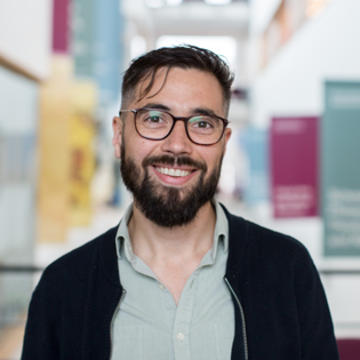
Professor Gillian C. Ramchand is affiliated with the Department of Language and Culture at UiT The Arctic University of Norway , under the Faculty of Humanities, Social Sciences and Teacher Education . Her research focuses on Semantics , Syntax-Semantics Interface , and cross-linguistic studies using eye-tracking and electrophysiological methods . Recent work explores grammatical aspect in Russian, English, and Spanish. Key collaborations include researchers like Sergey Minor , Natalia Mitrofanova , and Lia Calinescu . Projects: Preservation and Adaptation in Turkish as Heritage Language (PATH) . Her publications address event structure , auxiliaries , and meaning composition , with methodological innovations in visual world experiments . She contributes to debates on truthmaker semantics and lexical vs syntactic theories .
Nicholas K. Jones is an Associate Professor at the University of Oxford and an Official Fellow and Tutor in Philosophy at St John's College. His primary research focuses on the intersection of metaphysics, philosophy of language, and philosophy of logic, with special attention to objecthood, identity, and the application of formal tools in metaphysical theory. He holds a PhD from Birkbeck, University of London, an MA and BA from the University of Leeds, and previously held positions at the University of Birmingham as a Birmingham Fellow and Senior Lecturer. His research investigates higher-order languages' metaphysical status and applications, exploring foundational questions about reference, quantification, and conceptual frameworks. Jones employs formal logical methods to address traditional philosophical problems while critically examining the boundaries of representational systems. His recent publications demonstrate sustained engagement with metaphysical problems using logical formalization, particularly regarding absolute generality, truth valuation, and identity relations. The consistent thematic focus across his work reveals a systematic approach to resolving paradoxes in reference theory and ontological commitment.
Pritty Patel-Grosz is Professor of General Linguistics at the University of Oslo's Department of Linguistics and Scandinavian Studies, where she directs the Super Linguistics Research Group. She holds a PhD from MIT (2012) and completed habilitation at the University of Tübingen (2015). Her research bridges linguistics with non-verbal communication systems through the emerging field of Super Linguistics. Professor Patel-Grosz investigates the syntax-semantics-pragmatics interface across human and animal communication, with particular focus on gesture semantics, dance cognition, and primate linguistics. Her interdisciplinary approach combines formal linguistic theory with empirical studies of body movement in gibbons, chimpanzees, and human dancers to understand the evolutionary foundations of meaning construction. Publications demonstrate consistent exploration of cross-modal semantic transfer, with recent work analyzing narrative structures in electronic dance music, intentionality in primate gestures, and embodied reference systems in choreography. Her theoretical contributions advance understanding of anaphora resolution, pronominal typology, and comparative semantics across verbal and non-verbal domains. She leads research teams in Pragmatics: Theory & Experiments and Super Linguistics, mentoring emerging scholars in experimental methodologies. Courses taught include Morphology & Syntax, Semantic Theory, and specialized seminars applying linguistic frameworks to non-standard communication systems.
Dr. Bjørn Jespersen is a Lecturer in Theoretical Philosophy at the Department of Philosophy and Religious Studies, Faculty of Humanities, Utrecht University. He specializes in philosophical logic and analytic philosophy of language, with competencies spanning epistemology, metaphysics, logic, philosophy of science, technology, and mind. His research focuses on attitudes, modalities, theory of meaning, propositions, predication, modifiers, and hyperintensionality, primarily grounded in Transparent Intensional Logic (TIL). He held a Marie Curie Fellowship (2014–2016) at the University of Barcelona, researching the unity of propositions. Currently, he co-edits a special Inquiry issue on impossibility and serves as an Evaluator (Remote Reviewer) for the Czech Academy of Sciences’ 2025 Humanities and Arts Panel evaluation. In 2024, he delivered tutorials on impossibility at the University of Padova under an Erasmus exchange program, and in 2025 will present work on Vulcan’s procedural semantics at institutions including the University of Lodz and Università della Svizzera Italiana. Research Contributions: Co-authored/co-edited influential works like Procedural Semantics for Hyperintensional Logic (2010, awarded 2011) and Transparent Intensional Logic. Selected Recent Essays (2023). Editorships: Special issues of Synthese on structured propositions (2019, 2015), Inquiry on impossibility (forthcoming), and Festschrifts like Logically Speaking (2022). His teaching includes courses on Mind and World and Knowledge and Science . Jespersen’s work emphasizes interdisciplinary connections between formal logic, semantics, and philosophy, particularly through TIL’s framework. He actively collaborates on projects addressing technical malfunction, de re puzzles, and procedural isomorphism, blending theoretical rigor with applied logic challenges.
Torsten Odland is a Lecturer in the Philosophy Department at California State University Long Beach. His research focuses on philosophy of language, philosophy of mind, and philosophy of logic, with additional interests in Early Modern and Medieval philosophy. He has taught courses at UCLA and Cal State Long Beach, including Introduction to Philosophy and Upper Division Symbolic Logic. His work explores topics such as truth definitions, semantic underdetermination, and representational vehicles. Notable publications include analyses of sentential quantification and capacious pluralism about content. Odland’s current research addresses particularism about truth and Leibniz’s theory of symbolic thought. He has no listed awards or grants, but maintains active research on revenge paradoxes and the epistemological role of symbolic reasoning in Leibnizian thought.
Kai von Fintel is the Andrew W. Mellon Professor of Linguistics at MIT, part of the Department of Linguistics and Philosophy. His research focuses on semantics, pragmatics, and philosophy of language, with a particular emphasis on modality, quantification, and presupposition accommodation. He co-founded the open-access journal Semantics & Pragmatics and has contributed extensively to formal semantics and its intersections with logic and philosophy. Fintel’s work spans topics such as anankastic conditionals, generalized quantifiers, and the semantics of epistemic modals. He holds a PhD in Linguistics and has taught at MIT since 2000. His academic journey includes graduate studies at the University of Cologne and UMass Amherst, where he was influenced by pioneers like Angelika Kratzer and Irene Heim. Fintel is a vocal advocate for open-access publishing and has authored over 60 scholarly articles. His office is located in MIT’s 32-D882 building, and he actively participates in academic discussions on linguistics and philosophy.
Bas Kokshoorn is a Full Professor specializing in Forensic Science and Trace Dynamics. His research focuses on DNA transfer mechanisms, forensic evaluation methodologies, and Bayesian network applications in forensic analysis. He has supervised multiple graduate theses on topics like contextual DNA sampling and latent DNA recovery. Key research interests include activity level propositions, crime scene analysis, and improving forensic evidence interpretation through quantitative approaches. His recent work emphasizes inter-laboratory DNA recovery variability and sensitivity analyses in forensic evaluations. He has contributed to 25+ research outputs since 2021, including peer-reviewed articles and conference posters. His activities include invited lectures on Bayesian networks and supervising student theses.
Michael Rieppel is an Associate Professor and Undergraduate Director in the Department of Philosophy at Syracuse University , where he also coordinates the Logic Minor and the Logic and Language MA concentration. He holds a PhD from the University of California, Berkeley (2013) and a BA from the University of Wisconsin-Madison (2002). His research focuses on the philosophy of language, philosophical logic, and metaphysics, with a particular emphasis on predication, higher-order quantification, proper names, and the history of analytic philosophy. Education: - PhD in Philosophy, UC Berkeley (2013) - BA in Philosophy, University of Wisconsin-Madison (2002) Research Interests: Rieppel’s work explores topics such as properties and predication, predicative quantification, referential expressions, and attitude reports. He also engages with intersections between philosophy of language and philosophy of mind, as well as early analytic philosophy. Recent projects include analyses of Russell’s theories of meaning and description, Quinean predicativism, and the semantics of plural terms. Teaching: Rieppel teaches courses on logic (PHI 251), logic and language (PHI 451/651), and 20th-century analytic philosophy, including seminars on propositions, opacity, and properties. His textbook forallx@syr is used in introductory logic courses. Service: He has served on the Humanities Council, Department Executive Committee, and Graduate Admissions Committee. He organizes the Department Colloquium and the ABD Workshop. Rieppel also reviews for journals like Analysis , Philosophical Quarterly , and Synthese . Labs/Teams: Rieppel co-organizes the Creighton Club Conference and contributes to logic education initiatives. His work often bridges formal semantics and historical philosophy, reflecting his commitment to interdisciplinary research.
Miki Hermann is a CNRS Researcher at the Laboratory of Computer Science (LIX) at École Polytechnique, France. He is affiliated with the Algorithms and Complexity research group and maintains an active research program in theoretical computer science and computational logic. His research interests span computational complexity, constraint satisfaction problems, satisfiability, and logic in computer science. Hermann's work focuses on the theoretical foundations of computational problems, particularly examining complexity classifications, counting problems, and algorithmic solutions for logical and combinatorial structures. His research bridges theoretical computer science with practical applications in artificial intelligence and data analysis. The analysis of his recent publications reveals a consistent focus on computational complexity across various logical frameworks. His work demonstrates expertise in classifying the complexity of constraint satisfaction problems, propositional logic systems, and graph-theoretic problems. Notable research directions include minimal inference problems, counting complexity, and applications of satisfiability to big data transformation through his MCP project. Hermann is part of the Algorithms and Complexity research group at LIX (CNRS, UMR 7161), where he contributes to theoretical computer science research. He has developed significant software projects including MCP (Multi-Classification Project) for transforming datasets into propositional formulas and GYT (Generalized Young Tableaux) for solving variadic polynomial equations over non-negative integers.
Clemens Steiner-Mayr is Professor of Semantics and Pragmatics at the University of Göttingen's Department of English Philology, where he has been teaching since 2017. His office is located in Käte-Hamburger-Weg 3 (Room 0.252), and he can be contacted via phone (+49 551 39-27576) or email. Office hours are by appointment. Education includes a Mag. phil. in General Linguistics and Russian from the University of Vienna (2005), a Ph.D. in Theoretical Linguistics from Harvard University (2010), and Habilitation from Humboldt-Universität zu Berlin (2017). Research focuses on formal semantics and pragmatics, with emphasis on quantifier interpretation, question embedding, intervention effects, and semantic-pragmatic interfaces. Key projects include PI roles in Semantic constraints on interrogative embedding (ZAS Berlin, 2016-present), Questions and entailment (ZAS Berlin, 2013-2016), and the Emmy Noether Group Interpretation of quantifiers (ZAS Berlin, 2010-2012). Publications primarily explore semantics of questions, negation, quantification, and context dependence. Recent work (2016-2024) demonstrates consistent focus on formal analysis of interrogatives, exception phrases, and intervention phenomena using trivalent logic and cross-linguistic data. No awards or student advisees are documented. Professional history includes a visiting position at the University of Potsdam (2012).