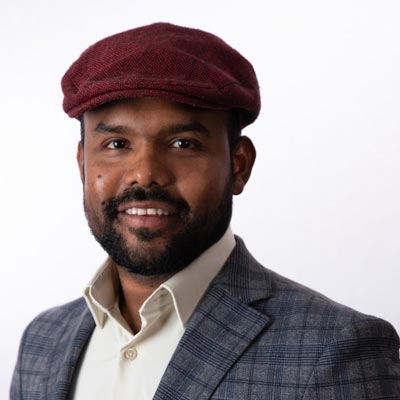
Dharanidhar Dang serves as Assistant Professor in the Department of Computer Engineering at the College of AI, Cyber and Computing, The University of Texas at San Antonio (UTSA), where he advances hardware-centric artificial intelligence solutions through photonic and memristor technologies. Education Ph.D., Texas A&M University His research program bridges hardware innovation and biomedical applications, with primary focus on photonic computing architectures for real-time AI acceleration and memristor-based neuromorphic systems. He investigates critical challenges in hardware reliability (particularly degradation in memristor crossbars), energy efficiency in photonic accelerators, and co-design methodologies that optimize both algorithms and physical implementations. His biomedical work applies machine learning to macrophage biology, identifying predictive signatures for inflammatory diseases through computational immunology approaches. Analysis of his 2020-2025 publications reveals three dominant research trajectories: 1) Silicon photonic accelerators (P-ReTI, P-ReTiNA, SOFTONIC) targeting real-time and energy-efficient AI, 2) Memristor reliability frameworks addressing aging effects in deep learning hardware, and 3) Translational biomedical applications where machine learning deciphers macrophage behavior in inflammatory bowel disease and preterm infant lung conditions. This tripartite focus demonstrates exceptional versatility across hardware engineering and life sciences.
Dr. Tillmann Rudolf Braun is a Lecturer at the Faculty of Law , Humboldt University of Berlin. He is also a Ministerial Official at the Federal Ministry for Economic Affairs and Energy. His academic career spans over a decade, with a focus on International Investment Law and its intersections with Public International Law , European Law , and Comparative Law . Research Interests : International and European Investment Law Investment Arbitration Legal implications of pandemics and armed conflicts on investment protection Comparative legal frameworks (German, European, Chinese) Sustainable development in investment agreements Teaching and Supervision : Teaches courses for the Master Programme International Dispute Resolution (IDR LL.M.) Supervises Master's theses on topics like investor-state accountability, data protection, and humanitarian law obligations Co-organized summer academies on international economic law and investment law Scientific Awards : Best Lecturer Award, IDR LL.M. Program 2018-2019 Recent Publications : 2022: 'State Responsibility and Investment Protection in the Time of Pandemic' (focus on health sector arbitration) 2020: 'International Law in Revolutionary Upheavals' (conflict zones and legal tensions)
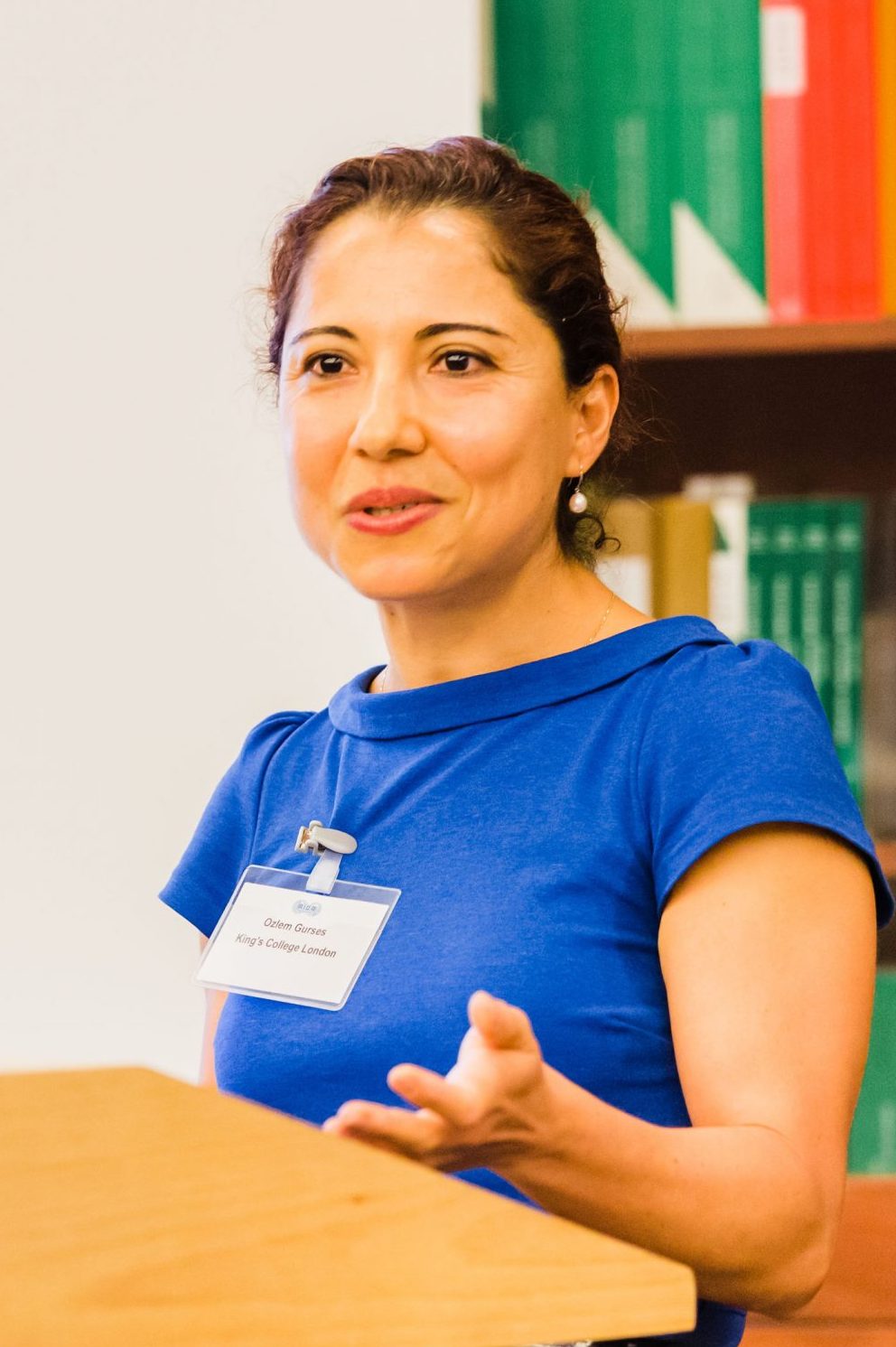
Professor Ozlem Gürses is a Professor of Commercial Law at King’s College London, specializing in insurance and reinsurance law. She concurrently serves as Visiting Professor at the Centre for Maritime Law (CML) at NUS Law, where she conducts seminars on marine insurance developments. Her academic career includes teaching roles at Norwich and Southampton Law Schools. Bachelor’s/Master’s in Law from University of Istanbul LLM in Maritime Law from University of Southampton PhD in Reinsurance Law from University of Southampton Her research focuses on marine insurance, compulsory motor vehicle insurance, and reinsurance clauses, reflected in major publications like Marine Insurance Law (2023) and Edward Elgar Research Handbook on Marine Insurance Law (2024). She actively contributes to legal communities through roles in the International Insurance Law Association (AIDA) and British Insurance Law Association (BILA), including chairing AIDA’s Reinsurance Working Party. Her recent academic activities include a public seminar on ‘Insurance and Marine Insurance Law – Recent Developments’ at NUS Law on 1 February 2024.
Professor Michael Goldhammer holds the Chair of Public Law at EBS Law School, focusing on administrative law, comparative law, and legal philosophy. He serves as Vice Dean and leads research on public law’s European and international dimensions. He earned his doctorate (2012) and habilitation (2018) from the University of Bayreuth, with postdoctoral research visits to Michigan, Melbourne, and Cambridge. His work emphasizes legal foundational questions and disciplinary openness, supported by awards such as the DFG and DAAD scholarships. In 2024, he is on research leave for the Volkswagen Foundation-funded project on 'Kommunikativer Realakt und Ethical Turn.' Educations: PhD in Public Law, University of Bayreuth (2012) Habilitation, University of Bayreuth (2018) LL.M. from the University of Michigan Research Interests: His scholarship bridges administrative law, legal philosophy, and comparative law. Key areas include prognostic decisions by public authorities, the interplay between German and European legal frameworks, and foundational questions in intellectual property law. He critically examines constitutional principles and their application to modern challenges like pandemic governance and AI’s legal status. Articles Overview: Recent works analyze legal reform dynamics (e.g., VwGO-Novelle II), state secrecy under IP law, and fundamental rights conflicts. His publications span administrative procedure law, EU constitutionalism, and ethical dimensions of legal decision-making. The 2025 essay on administrative law reform critiques procedural gaps in German public governance. Awards & Grants: Michigan Grotius Fellowship DFG and DAAD grants Volkswagen Foundation project (2024) Advising & Grants: Though no formal advisees are listed, he leads research initiatives and collaborates internationally. Grants fund projects like pandemic legal governance (2021) and AI legal subjectivity (2024). Teams/Labs: His research group focuses on public law’s epistemological foundations and multilevel governance. Collaborations include the Max Planck Institute for Collective Goods (Bonn) and the University of Melbourne’s constitutional studies center.
Professor Colin King is a Senior Associate Research Fellow at the University of Sydney, specializing in proceeds of crime law, anti-money laundering (AML), and financial crime regulation. His work bridges legal theory and practice, focusing on deferred prosecution agreements, corporate criminal liability, and transnational asset recovery mechanisms. Education: Completed a PG Certificate in Higher Education (2019) and is a Fellow of the Higher Education Academy. Previously held academic positions at the Universities of Sussex, Manchester, and Leeds, with an affiliation at the Honourable Society of the Inner Temple (2014–2017). Research Interests: Explores legal responses to organized crime, terrorism financing, and regulatory frameworks in financial markets. Key areas include AML compliance challenges in the art and property sectors, legitimacy of non-conviction-based asset recovery, and comparative analysis of civil/criminal procedural hybrids. Publications: Authored/co-authored major works such as Negotiated Justice and Corporate Crime (2018) and edited collections like Dirty Assets (2014). Over 20 peer-reviewed articles since 2014 address topics ranging from EU customs confiscation practices to the role of informants in asset recovery. Funding: Secured grants from AHRC Leadership Fellowship, British Academy, Modern Law Review Seminar Series, and others. Current projects examine AML implementation challenges and corporate accountability mechanisms. Advising: Supervises seven PhD students focusing on financial crime and criminal evidence. Actively involved in shaping legal education through pedagogical certifications and academic mentorship. Awards: Recognized as a Fellow of the Higher Education Academy (2019) for contributions to teaching excellence in legal studies.
Prof. K.J. (Kars) de Graaf is a Professor of Public Law and Sustainability at the University of Groningen's Faculty of Law, leading the Department of Constitutional Law, Administrative Law & Public Administration since 2020. His expertise spans administrative law, environmental law, and sustainability governance. Education: PhD in Comparative Administrative Law (2004). He has held roles such as Government Commissioner for the Environment and Planning Act (since 2024), Honorary Judge at the North Netherlands District Court (2005–present), and editorial board member of Dutch environmental law journals. He teaches administrative law and sustainability courses at the Grotius Academy and judicial training institutes. Research focuses on environmental law, administrative law reforms, and sustainable governance. Recent publications address environmental permits, legal procedures, and proportionality in environmental planning. His work bridges academic research and practical legal challenges in sustainability policy. Awards: None explicitly listed. Ancillary roles include VMR Dutch Environmental Law Association chair and board member of SBB Foundation. Grants/Advising: No specific grants listed; however, his advisory roles in government and legal institutions reflect impactful professional engagement. Labs/Teams: Active in the Department's research groups and collaborates with legal practitioners and policymakers through editorial and advisory roles.
Fiona M. Scott Morton is the Theodore Nierenberg Professor of Economics at the Yale University School of Management, where she has been a faculty member since 1999. She also holds appointments as Professor in the Health Policy & Management department and as an Adjunct Professor at Yale Law School. Her primary academic home is the School of Management, where she serves as a full Professor of Economics. Professor Scott Morton earned her BA in Economics from Yale University in 1989 and her PhD in Economics from the Massachusetts Institute of Technology in 1994. Her educational background has provided a strong foundation for her work at the intersection of economics, law, and public policy. Her research focuses on industrial organization, with particular expertise in competition policy and antitrust enforcement. Professor Scott Morton has become a leading voice on competition issues in digital markets and healthcare, with her work frequently cited by policymakers and practitioners. She has pioneered research on the economic implications of market concentration, platform regulation, and healthcare pricing dynamics. Her work bridges theoretical economic analysis with practical policy applications, making significant contributions to both academic discourse and real-world competition policy. A review of her recent publications reveals a strong focus on digital market regulation, particularly the implementation and enforcement of the European Union's Digital Markets Act. She has also continued her groundbreaking work on healthcare markets, examining issues like hospital acquisitions of physician practices and surprise medical billing. Her research demonstrates a consistent application of industrial organization theory to contemporary policy challenges across multiple sectors. Professor Scott Morton has received numerous accolades for her work, including: Yale School of Management Faculty Teaching Excellence Award (2020) Yale SOM Alumni Association Teaching Award (2015-16, 2006-07) Health Care Research Award for "The Effect of Medicare Part D on Pharmaceutical Prices and Utilization" (2011) National Science Foundation Research Grants (multiple awards) As Associate Dean from 2007-10 and through her founding of the Thurman Arnold Project at Yale, Professor Scott Morton has played a significant role in shaping competition policy education and discourse. Her government service as Deputy Assistant Attorney General for Economic Analysis at the U.S. Department of Justice (2011-12) provided practical experience that informs her academic work. She has secured substantial research funding, including grants from the Washington Center for Equitable Growth and multiple National Science Foundation awards. Professor Scott Morton directs the Thurman Arnold Project at Yale, which serves as a hub for competition policy research, education, and engagement. Through this initiative, she connects academic research with practical policy challenges, fostering dialogue between scholars, practitioners, and policymakers in the antitrust community.
Ralf Wilke is a Professor in Applied Econometrics and Microeconometrics at the Copenhagen Business School , with affiliations to ZEW as a research associate. His career spans multiple institutions including the University of Leicester, University of Nottingham, and University of York. Education: Diplom-Volkswirt (Bonn University), DEA (University of Toulouse I), Dr. rer. pol. (Dortmund University) Current Roles: Professor at CBS, Research Associate at ZEW Prior Roles: Lecturer/Associate Professor at Leicester/Nottingham, Readership at York Research Focus: Specializing in econometric methods for analyzing duration data, competing risks, panel models with group structures, and applications in industrial life modeling. His work addresses complex censoring mechanisms and spatial diffusion patterns in historical economic contexts. Recent Publication Trends: Recent articles emphasize duration modeling with dependent censoring, copula-based competing risks frameworks, and structural econometric approaches to panel data. Key disciplines include computational statistics, quality engineering, and cliometrics.
Dr Darren Harvey is a Senior Lecturer in Law (Education) at The Dickson Poon School of Law, King's College London. He holds a PhD from the University of Cambridge, an LLM in European Law from Saarland University, and an LLB from Edinburgh Law School. Prior to King's, he was an Early Career Fellow at Edinburgh Law School and a Stagiaire at the General Court of the CJEU. His research focuses on European Union Law, Constitutional Law, and Public Law with a particular emphasis on judicial review, Brexit legal implications, and the rule of law in the EU. Recent work includes analyses of the CJEU's judicial review mechanisms, post-Brexit legal frameworks, and the role of national parliaments in EU governance. Teaching spans EU Law, Public Law, and European Law across undergraduate and postgraduate levels. He has contributed to conferences such as the Young European Law Scholars Conference, emphasizing EU treaty reforms and legal dimensions of Brexit. Publications span peer-reviewed journals, book chapters, and legal commentaries addressing EU fundamental rights, process-oriented federalism, and legal challenges posed by Brexit. His work highlights intersections between EU law and national legal systems, particularly in post-Brexit contexts.
Alessandra Amore is a permanent faculty member at the University of Palermo's Department of Law , holding the academic rank of Researcher (GIUR-06/A). Her research focuses on public contract law, administrative liability, constitutional principles, and anti-mafia legislation. She maintains regular office hours and can be contacted via email at alessandra.amore@unipa.it. Research Interests Amore's work explores the intersection of administrative law with contemporary governance challenges, including: Public contract law anomalies and jurisdictional review Administrative liability for lawful acts Anti-mafia interdiction legal frameworks PNRR implementation in socio-health sectors Privacy vs. transparency in judicial proceedings Human dignity in vaccination-related liability Publications Trends Her publications (2017–2024) reflect deep engagement with Italian administrative law, particularly: Evolution of public procurement regulations Balancing constitutional principles in anti-mafia enforcement State responsibility in health policy Interplay between administrative discretion and judicial review Human rights protection in migration governance Procedural autonomy in EU contexts
Gina Masullo is an Associate Professor in the School of Journalism and Media at The University of Texas at Austin, where she also serves as Associate Director of the grant-funded Center for Media Engagement. She previously held an Assistant Professor position at the University of Southern Mississippi and has extensive experience as a journalist, working for newspapers like The Post-Standard in Syracuse, NY, where she covered crime, governance, and later parenting topics. Her formal education includes a Ph.D. and M.A. in Mass Communication from Syracuse University and a B.A. in Communication from Franciscan University of Steubenville. Her research focuses on digital media’s role in societal connection/division, online incivility’s effects, and how journalists can improve democratic engagement. She has co-edited works like Scandal in a Digital Age and authored Online Incivility and Public Debate . Current projects include the Knight Foundation-funded Connective Democracy Initiative, exploring solutions to societal polarization. Her work emphasizes bridging divides through empathetic communication and platform design. Dr. Masullo has won multiple awards for her research, including the 2023 Top Faculty Paper for LGBTQ+ discourse analysis and the 2019 AEJMC Research Prize for Professional Relevance. She teaches courses like Social Media Journalism and Fundamentals of Statistics. Notably, she has advised projects on protest coverage, news labels, and hate speech moderation, with grants totaling over $3 million through collaborations with institutions like Google News Initiative and the Hewlett Foundation.
Richard Storrow is a Professor of Law at the City University of New York School of Law, where he has taught since 2008. His academic career spans over 25 years, with previous positions at Hamline University, the University of Illinois, Penn State, and Texas Wesleyan Law Schools. His research focuses on reproductive justice, human rights, and family law, particularly in the context of assisted reproductive technologies and cross-border legal challenges. He has been recognized as an outstanding teacher five times and was a Fulbright Scholar in Spain (2010), researching assisted reproductive technology regulations. Education and Professional Background: After earning his law degree, Storrow clerked for Minnesota Court of Appeals Judge Edward J. Parker and practiced family law in Minneapolis. His early career included internships with the ACLU, Lambda Legal Defense, and the National Commission for Human Rights in Togo. He later served on the ACLU of North Texas Board. Research Interests: Storrow’s work bridges law and bioethics, addressing issues like surrogacy rights, international child citizenship, and legal frameworks for reproductive technologies. Notable contributions include critiques of marital status discrimination in adoption and advocacy for human rights-centered approaches to reproductive justice. Publications Overview: His articles span topics from cross-border wills to the legal status of children born via surrogacy. Recent work includes analyses of pandemic-era legal attestation practices and the intersection of gender identity with birth certificate policies. These publications reflect a focus on evolving legal responses to technological and social changes. Awards and Recognition: Beyond teaching accolades, Storrow’s Fulbright Scholarship highlights his international scholarly impact. His work has been cited in bioethics journals and law reviews, emphasizing practical and ethical dimensions of legal frameworks.
Robin Geiss is an Affiliate Professor at the School of Law, University of Glasgow, and Director of the United Nations Institute for Disarmament Research (UNIDIR). Previously, he held roles as Professor of International and European Law at the University of Potsdam and Legal Adviser to the International Committee of the Red Cross (ICRC). He leads research groups such as the Glasgow Center for International Law and Security (GCILS) and directs projects like the EU-sponsored 'Transnational Security Law.' His education includes a PhD from Kiel University (2003) and an LLM from NYU (2004). Research Focus: International law, security governance, human rights, cybersecurity, armed conflict law, and transnational organized crime. Key Roles: Advised UN, NATO, and governments on legal matters; member of the ILA Study Group on IHL challenges. Publications: Over 130 works, including books like Piracy and Armed Robbery at Sea and editor of the Yearbook of International Humanitarian Law . His work bridges legal scholarship and policy, addressing modern challenges like autonomous weapons systems and cyber warfare. He has contributed to landmark projects like the Tallinn Manual on cyber law. Awards/Honors: Former scholar of the German National Merit Foundation. Grants/Advisory: EU-FP7 consortium on counter-narcotics consequences; multiple international advisory mandates.
Emanuel Coman is an Associate Professor in the Department of Political Science at Trinity College Dublin. He holds a Ph.D. from the University of North Carolina at Chapel Hill (2012) and previously served as a Lecturer at the University of Oxford (2014-2016) and a Postdoctoral Prize Fellow at Nuffield College, Oxford (2012-2014). His research focuses on electoral systems, party politics, and legislative behavior, with a particular emphasis on European democracies and Central/Eastern Europe. Key research interests include the impact of electoral reforms on political representation, the role of local leaders in resource distribution, and the effects of university education on political attitudes. Coman has also explored gender dynamics in voter turnout and the relationship between ideology and fiscal policies in post-communist states. His work has been published in prestigious journals such as European Union Politics , Journal of Politics , and Electoral Studies . Notable contributions include analyses of Euroskepticism in Italy, the sociopolitical impact of higher education, and the implications of Romania’s 2008 electoral reforms. Awards: Postdoctoral Prize Fellowship (Nuffield College, 2012), Kenan Presidential Fellowship (UNC, 2006-2012), and an ASSBF Grant (2018). Grants: Funded research on local elections across national contexts, reflecting his focus on comparative politics and institutional design. Coman’s interdisciplinary approach bridges political science with sociology, addressing themes such as health behaviors among adolescents and the intersection of education with cultural liberalism.
Michael Hawley is an Assistant Professor and Director of Undergraduate Students at the School of Civic Life and Leadership (SCiLL) at the University of North Carolina. Specializing in political theory, his research focuses on classical republicanism, Roman political thought, and the rhetorical dimensions of political discourse. He holds a BA from Tufts University and a PhD in Political Science from Duke University, with prior teaching roles at Duke University, the University of Notre Dame, Bowdoin College, and the University of Houston. His work bridges ancient and modern political philosophy, particularly through examining Cicero’s influence on early modern liberalism and the American Founding. His first book, Natural Law Republicanism, Cicero’s Liberal Legacy , explores Cicero’s impact on liberal thought, while his current project analyzes rhetoric designed to motivate rather than persuade. His articles appear in journals such as The American Journal of Political Science , Political Research Quarterly , and Polity . Research interests include comparative political philosophy, just war theory, and the ethical dimensions of rhetoric. He teaches courses on classical texts and enduring questions in political thought.