
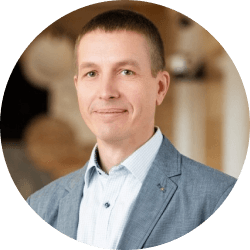
Assoc. Prof. Dr. Saulius Šimkonis serves as an Associate Professor at the ISM Executive School (ISM University of Management and Economics) and currently holds the position of Project Portfolio Manager at Swedbank. With over 20 years of experience, he specializes in Project, Program, and Portfolio Management (PPM), risk management, and lessons learned processes. He holds certifications such as IPMA-A, PMP, and PRINCE2, and is an IPMA Assessor in Lithuania. His academic roles include leading the Project Management Program at ISM Executive School and teaching at Vilnius University Business School. Education: Graduated from ISM University of Management and Economics and earned a PhD from Vilnius University with a dissertation on 'Factors influencing lessons learned processes in innovative projects'. Research focuses on governance of interorganizational project networks, balanced leadership transitions, and ESG implementation frameworks. Recent work explores multi-level governance models, collaboration in distributed teams, and horizontal leadership dynamics. Teaching areas include PPM, risk management, and lessons learned methodologies. He contributes to professional bodies like the Project Management Institute and Lithuanian Project Management Association.
جستجوی استاد راهنمای دانشگاهی
برای مسیر پژوهشیتان، استاد راهنما، استاد دانشگاه و پژوهشگر مناسب را پیدا کنید و با آنها ارتباط بگیرید.
نمایش ۱-۵ از ۵ استاد راهنما
اطلاعات پروفایلها از صفحات عمومی دانشگاهها گرفته شده و ممکن است بهروز نباشد.

Alfredas Chmieliauskas is a Professor at ISM University of Management and Economics, where he teaches project, program, and portfolio management, innovation, and change management. He co-founded ISM in 1999 and served as its Rector from 2014 to 2018. His academic background includes a mathematics degree from Vilnius University (1978), a doctoral degree in computer systems from the Latvian Academy of Sciences (1989), and an MPA from Hamline University (1994). He holds IPMA Level A certification and is an accredited IPMA assessor. Chmieliauskas has advised over 250 organizations through his consulting firm and serves on the board of Lithuania's Strategic Analysis Center (STRATA). His research focuses on project work organizations, governance of interorganizational networks, and leadership dynamics. Notable contributions include studies on ESG implementation governance, multi-level governance frameworks, and balanced leadership. He co-authored the award-winning Analysis of Balanced Leadership Phenomenon in Projects (2019) and contributed to the 2025 Governance of ESG Implementations paper. Chmieliauskas also lectures internationally and chairs conferences on project management. Education: Bachelor's in Mathematics, Vilnius University (1978) Doctorate in Computer Systems, Latvian Academy of Sciences (1989) Master's in Public Administration, Hamline University (1994) Affiliations: Founder and Former Rector of ISM University Board Member, Strategic Analysis Center (STRATA) President, Lithuanian Project Management Association (2004–2015) His awards include the ISM Researcher of the Year Team Award (2018) and the IPMA Award (2019). Current research explores ESG governance, agile methodologies in globally distributed teams, and multi-level project network frameworks.
Tadeusz Trzaskalik is a Professor at the University of Economics in Katowice, specializing in the Department of Operations Research. His work focuses on multiobjective dynamic programming, decision support systems, and stochastic optimization. Research Interests: Development of bipolar methods for multistage decision processes Multiobjective dynamic programming applications in project portfolio selection Stochastic programming for resource allocation and reliability analysis Interactive decision-making procedures with hierarchical criteria Preference modeling in complex economic systems Operations research in business and industrial applications Academic Contributions: Published extensively in journals like Annals of Operations Research, Central European Journal of Operations Research, and Croatian Operational Research Review Authored textbooks on linear programming, integer programming, and decision support systems Developed interactive procedures for multiobjective allocation and scheduling problems
Dr. Feliksas Kuliešius serves as an Associate Professor at Vilnius University's Physics Faculty, specifically affiliated with the Institute of Chemical Physics (ICP). His academic work uniquely bridges IT and Physics disciplines, with research spanning computer networking, cybersecurity, and structural relaxation. His primary research interests focus on Software Defined Networking (SDN) technologies, including hybrid network control systems and advanced authentication mechanisms. Dr. Kuliešius has made significant contributions to campus network security through SDN-enhanced authentication systems while also maintaining active research in physics, particularly in NMR studies and computational modeling of molecular structures. His interdisciplinary approach demonstrates how networking principles can be applied to physics research problems and vice versa. Dr. Kuliešius has received the Vilnius University Rector's acknowledgement in 2016 for his academic contributions. He serves on the editorial board of "ICT Express" journal and participates in technical committees for international ICT conferences. He has supervised 5 Master's and 58 Bachelor's students throughout his career. Dr. Kuliešius has led significant projects including FP6 project "CEEC IST NET" 015942 (as board member and head of Lithuanian team), FP6 project "BASNET" 017170 (as head of monitoring and information systems group), and the EU project HOPE (Horizons of Physics Education) as administrator of Information Systems. Dr. Kuliešius is actively involved in university governance as a member of the commission for cybersecurity at Vilnius University and the study program committee for "Computational Physics and Modelling." He also serves as the administrator of software implementation and licensing at the Physics Faculty. His teaching portfolio includes courses on Cybersecurity, Internet of Things, and various computer networking courses at CCNA and CCNP levels.

Assoc. Prof. Dr. Audronė Lupeikienė serves as an Associate Professor and Group Leader at the Cybersocial Systems Engineering Group within Vilnius University's Institute of Data Science and Digital Technologies (formerly Institute of Mathematics and Informatics). Holding a Doctor of Science degree, she has established herself as a leading researcher in information systems engineering with over two decades of scholarly contributions. Her academic profile demonstrates sustained excellence in research, teaching, and service within the Lithuanian and international academic community. Dr. Lupeikienė's research expertise spans Information Systems Engineering , Computer Service Systems Engineering , Knowledge Systems Engineering , and Software Systems Engineering . Her work explores both theoretical foundations and practical applications of information systems, with particular emphasis on service-oriented architectures, business process management systems, and ontology-based component programs. She investigates how these systems can be optimized for performance, quality of service, and effective business-IT alignment in digital environments. Her recent scholarly output (2020-2024) reveals a clear evolution in research focus from foundational work on component-based systems to contemporary investigations of digital business transformation. Notably, her research has expanded into interdisciplinary applications including telemedicine systems for cardiac rehabilitation and energy harvesting technologies, demonstrating versatility across domains while maintaining core expertise in information systems engineering. This trajectory reflects her ability to adapt theoretical frameworks to emerging technological and societal challenges. Dr. Lupeikienė has successfully led and participated in significant research projects including the EU structural support project "Theoretical and engineering aspects of the development and use of Internet of Services technologies in high-performance computing platforms" (2012-2015), the "PEN: Production Effectiveness Navigator" EuroStars project (2011-2014), and earlier work on "Engineering problems of ontology-based component programs" (2003-2005). She has served on organizing committees for numerous international conferences and is an active member of the Lithuanian Computer Association. As an educator, Dr. Lupeikienė has taught a comprehensive range of courses reflecting the evolution of information systems education: Agent technologies (2005-2008), Decision-making systems (since 2003), Information systems (since 2002), Database Theory and Practice (2000-2003), and Computerization of management processes (1995-2002). Her teaching portfolio demonstrates adaptation to technological advancements while maintaining focus on core principles of system design and implementation. Her leadership of the Cybersocial Systems Engineering Group focuses on the intersection of social systems and technological infrastructure, exploring how to design, implement, and optimize systems that effectively serve both organizational and social needs in today's increasingly interconnected digital landscape.