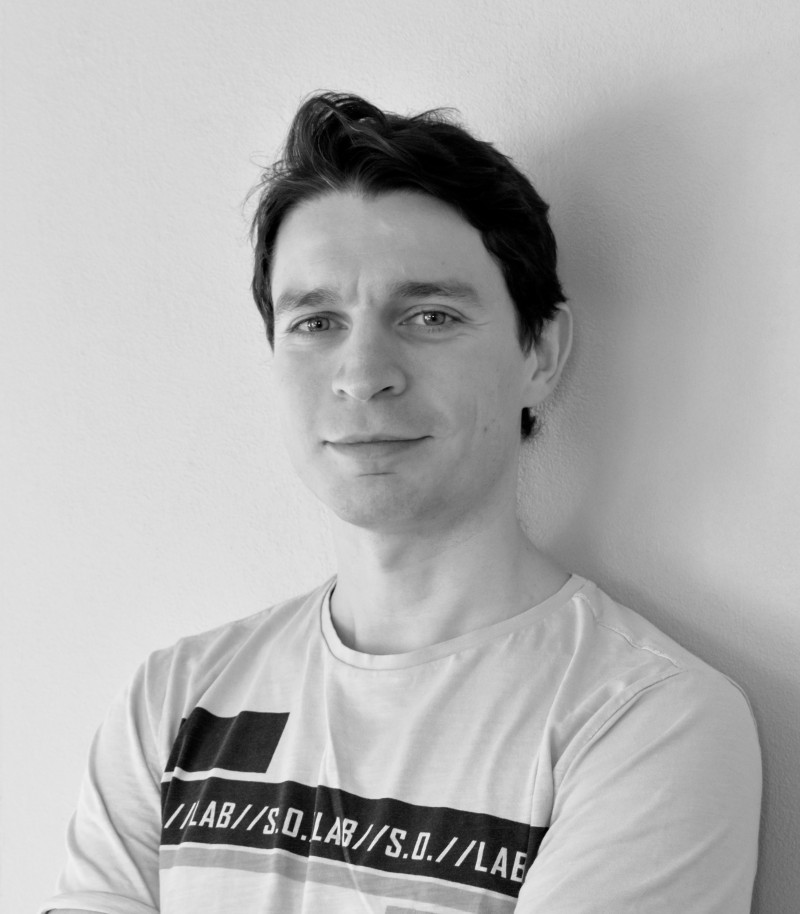
Eduard Kamburjan is an Assistant Professor in the Department of Software Engineering at the IT University of Copenhagen. His research focuses on integrating Semantic Web technologies with formal methods to develop and analyze data-heavy computational systems, particularly Digital Twins. He is the creator of the SMOL language for knowledge graph integration and Crowbar, a deductive verification system for Active Objects. His current work explores novel approaches to modularity in program verification, emphasizing contracts for distributed and hybrid systems. In 2024, he contributed to a publication on probabilistic dynamic logic proof systems. Eduard's research is affiliated with the Software Quality Research (SQUARE) group. His ORCID profile (0000-0002-0996-2543) and contact details, including his office in Copenhagen (Denmark), are publicly accessible.
Henrik Bulskov is an Associate Professor in the Department of People and Technology (Programming, Logic and Intelligent Systems) at Roskilde University. He holds an MSc and PhD. His work focuses on natural logic systems, database querying, and ontology-based information retrieval. He has contributed to projects such as SEAFACTS (digital maritime history platform) and NorDigHealth (regional digital health solutions). Education: MSc and PhD (specific disciplines not explicitly stated) Research interests include formal logic systems integration with databases, machine learning applications in bioinformatics, and semantic summarization through ontologies. Recent work explores query optimization in natural logic knowledge bases and disparity analysis in neural networks. His publications highlight advancements in computational logic for knowledge management and biomedical text analysis. Bulskov has participated in international conferences and contributed to media discussions on big data applications. Advising: No explicit student advisees listed Grants: Principal/Co-investigator in multiple projects including SIABO (2007–2012) and Duuoo Analysis (2021) Labs/Teams: Involved in interdisciplinary teams focusing on bioinformatics, health tech, and digital humanities through collaborative projects.
Ekkart Kindler is an Associate Professor in the Department of Applied Mathematics and Computer Science at DTU Compute, Technical University of Denmark. His research focuses on model-based software engineering, process mining, and road condition assessment using vehicle sensor data. He leads the Competence Centre for Model-Based Software Engineering, supporting industry adoption of advanced software development methodologies. Education: M.Sc. (1990), Ph.D. (1995) from Technische Universität München; Habilitation in Computer Science (2001) from Humboldt-Universität zu Berlin. He held visiting professorships at German universities (2000–2007) and has extensive experience in formal methods, business process modeling, and Petri nets. Research interests include declarative process modeling, complexity metrics for cognitive load assessment, and the integration of formal methods into industrial software development. His work contributes to UN Sustainable Development Goals related to sustainable infrastructure (SDG 9) and innovation (SDG 9). Notable collaborations include road condition assessment projects using vehicle sensor data (LiRA-CD dataset) and contributions to Petri net standards (PNML). He has supervised PhD students such as K. I. Simonsen (protocol software) and A. Skar (road assessment). Grants and projects: Live Road Assessment with Vehicle Sensors (2019–2022), Model Transformation Tools (2013–2016), and waste management modeling (2012–2016). Active in open-source datasets and tool development for indoor climate control (climify.org).
Willard Rafnsson is an Associate Professor in Programming Logic and Semantics at IT University of Copenhagen. His research develops formal methods for security and privacy, particularly probabilistic programming approaches for quantifying privacy risks. Research investigates privacy risk assessment methodologies, attacker knowledge modeling, and formal verification techniques. Recent work examines privacy vulnerabilities in genetic data and develops tools for leakage quantification. Rafnsson leads projects on practical static analysis and reliable AI for autonomous systems, focusing on security foundations.
Fabrizio Montesi is Professor of Computer Science at the University of Southern Denmark, Department of Mathematics and Computer Science. He leads the Section of Artificial Intelligence, Cybersecurity, and Programming Languages and holds leadership roles in the Microservices Community, SDU Digital Democracy Centre, and SDU eScience Center. His work focuses on programming languages and systems, cloud/edge computing, microservices, choreographic programming, and cybersecurity.
Amin Timany serves as an Associate Professor in the Department of Computer Science at Aarhus University, Denmark. His research focuses on foundational aspects of programming languages and formal verification systems, with particular expertise in logical frameworks for program correctness. His primary research interests span: Programming Languages Theory Formal Methods and Verification Type Systems and Type Soundness Separation Logic for Concurrency Logical Relations and Denotational Semantics Mechanized Proof Systems Analysis of Timany's recent publications (2022-2025) reveals a strong emphasis on separation logic extensions for distributed systems, guarded recursion techniques, and type soundness proofs. His work frequently bridges theoretical foundations with practical verification challenges, particularly in capability-based security and CRDT verification. The publications demonstrate consistent contributions to top venues including POPL, PLDI, and CPP. Timany actively participates in academic service, having served as conference chair for CPP 2025. His research involves significant collaboration with international teams, particularly with researchers at Aarhus University and other European institutions. The publication record shows steady output with 40+ research items, including 2 PhD supervisions noted in his profile.
Theresia Veronika Rampisela is a PhD student and Guest Researcher in the Department of Computer Science at the University of Copenhagen's Faculty of Science, specializing in Machine Learning. She actively contributes to the Algorithms, Data, and Democracy (ADD) project (https://algorithms.dk/), which investigates the societal implications of algorithmic decision-making systems. Her academic background includes a Master's degree in Computer Science from the University of Indonesia, providing foundational expertise in computational methods and data analysis. This education has enabled her transition from early work in information retrieval to specialized research in algorithmic fairness. Rampisela's research program critically examines fairness evaluation in machine learning applications, with particular focus on recommender systems. She investigates both group and individual fairness metrics, exploring their practical implementation challenges and limitations. Her work addresses the fundamental tension between recommendation relevance and equitable treatment of diverse user populations. Earlier research included academic expert finding using semantic techniques and medical applications involving schizophrenia classification with SVMs. Analysis of her publication trajectory reveals progressive sophistication in algorithmic fairness research. Starting with foundational work on expert finding systems, she has advanced to developing novel frameworks like Pareto optimization for balancing competing objectives in recommendation algorithms. Her publications in top venues including ACM Transactions on Recommender Systems and the ACM SIGIR Conference demonstrate growing recognition in this critical field. Mensa International Scholarship (2024) Rampisela collaborates extensively with Maria Maistro, Tuukka Ruotsalo, and Christina Lioma through the ADD project. Her research has significant practical implications for technology companies developing recommendation systems and policymakers regulating algorithmic fairness. She maintains an active scholarly profile documented through her ORCID (https://orcid.org/0000-0003-1233-7690) and demonstrates growing influence with mentions across academic social platforms.
Karolina Ewa Stanczak is a PhD fellow and Guest Researcher at the Department of Computer Science, Faculty of Science, University of Copenhagen, specializing in Natural Language Processing. Based at Universitetsparken 1, 2100 København Ø, she conducts research on bias detection and mitigation in language models with a multilingual focus, collaborating closely with the NLP research group. Her core research interests include gender bias in language models , fairness benchmarking , and distributional semantics . She investigates how linguistic structures like grammatical gender propagate social biases across cultures, employing causal inference methods to develop robust probing frameworks. Her work bridges computational linguistics and social sciences to address intersectional biases in digital diplomacy, historical texts, and political discourse. Analysis of her 2022-2024 publications reveals a cohesive research trajectory centered on quantifying gender bias in cross-lingual settings. She has pioneered methodologies for measuring bias against women ambassadors in digital diplomacy, politicians in multilingual models, and marginalized groups in historical documents, establishing herself as an emerging expert in fairness-aware NLP. Stanczak is supervised by Professor Isabelle Augenstein and collaborates with researchers including Ryan Cotterell and Yaroslav Golovchenko. Her doctoral work is funded by the University of Copenhagen's PhD fellowship program, and she actively contributes to the department's Natural Language Processing research initiatives through publications in top venues like EMNLP, ACL, and AAAI.
Hyun Joo Choi serves as a Teaching Associate Professor in the Department of Cross-Cultural and Regional Studies at the University of Copenhagen's Faculty of Humanities. She teaches Korean language courses across beginner, intermediate, and advanced levels, including Speaking for beginners, Speaking and Reading for intermediates/advanced, and Practice Academic Reading for BA/MA students. Her educational background includes an MA in Aesthetics from Hongik University (2005) and completion of the Korean Language Teaching Course at Hongik University's International Language Institute (2009). Research focuses on Korean language, literature, translation, semantics, culture, philosophy, aesthetics, and society, with emphasis on cultural studies and philosophical aesthetics. She actively bridges linguistic pedagogy with Korean cultural philosophy through her teaching and translation work. As a member and former Vice-president (2016-2020) of the European Association for Korean Language Education (EAKLE), she participates in international workshops including the Overseas Translation Workshop Program (2019-present) and Nordic Baltic Korean Studies Days (2024). Recent engagements cover AI-literacy pedagogy and digital teaching tools for Korean language instruction. No scientific awards were documented. Information regarding student advising or research grants was not provided in available materials.
Daniel Gratzer is an Assistant Professor at the Department of Computer Science, Aarhus University. His research focuses on theoretical computer science, particularly in type theory, modal logic, and programming language semantics. He has contributed to foundational work in multimodal type theory, cubical type systems, and separation logic frameworks like Iris. His work often bridges categorical logic, homotopy type theory, and formal verification techniques. Gratzer's research interests include: Dependent and modal type theories Formal verification of concurrent systems Semantics of programming languages Proof assistants and logical frameworks His recent publications explore topics such as idempotent resources in separation logic, univalent reference types, and proof systems for multimodal logics. Gratzer collaborates on projects like the mitten proof assistant and has developed syntactic/semantic frameworks for categorical type theories. His work emphasizes foundational formalizations, with contributions to both theoretical results (e.g., normalization proofs, categorical semantics) and practical tools (e.g., Iris implementations).
Magnus Madsen is an Associate Professor at the Department of Computer Science, Aarhus University. He specializes in programming language design, compilers, and type and effect systems, and is the lead developer of the Flix programming language. His research focuses on advancing static analysis techniques and declarative language constructs for effectful and data-driven programming. Research Interests : - Programming language design - Type systems and effect systems - Static program analysis - Datalog and declarative programming - Compiler optimization and implementation Awards & Grants : - 2023: Sapere Aude Grant (Independent Research Fund Denmark) - 2022: Dahl-Nygaard (Junior) Prize (ECOOP) - 2022: STEM Grant (Stibo Foundation) - 2021: Amazon Research Award (collaboration with Jaco van de Pol) - 2020: DFF Project One (Independent Research Fund Denmark) Advising & Collaboration : - Supervises four current PhD students (listed above). - Active in academic service: PC member for ECOOP, OOPSLA, PLDI, and other conferences. - Collaborates with industry (e.g., Google, Systematic) and academia on tool development and language research. Labs & Projects : - Core contributor to the Flix programming language and the CASA (Center for Advanced Software Analysis) initiative. - Involved in interdisciplinary projects combining declarative programming with domain-specific applications.
Bas Spitters is an Associate Professor in the Department of Computer Science at Aarhus University, Denmark, specializing in the rigorous intersection of programming languages, formal methods, and cryptography. His work prioritizes mathematical precision in software verification, particularly for security-critical systems like cryptographic protocols and blockchain applications. His research focuses on Programming Languages , Formal Verification , and Cryptology , with deep expertise in Type Theory , Homotopy Type Theory , and Blockchain . Key themes include verified compiler backends (e.g., WebAssembly), formal security analysis of Rust implementations, and foundational verification of cryptographic primitives. His fingerprint reveals dominant associations with Smart Contracts (100%), Type Theory (99%), and Blockchain (47%), reflecting his commitment to eliminating vulnerabilities through formal proofs. Analysis of his 15 most recent publications (2022-2025) shows a consistent trajectory toward end-to-end verification of high-assurance systems. He bridges theoretical foundations (e.g., homotopy type theory) with practical implementations in Rust, targeting real-world problems in blockchain consensus, zero-knowledge proofs, and side-channel-resistant cryptography. His work increasingly integrates multiple verification tools (e.g., Coq, hax) to address complex security properties. Scientific awards: None documented in available sources. Dr. Spitters has supervised 2 PhD students and led the project Verifiable Cryptographic Software (2019-2023), developing foundational tools for verifying cryptographic implementations. His research group collaborates globally on formalizing decentralized exchanges, optimizing verified cryptographic libraries, and advancing proof automation for security protocols. Current efforts focus on Rust-based verified pipelines and formal specifications for zero-knowledge protocols like halo2, with implications for blockchain scalability and security.
Bent Thomsen is a Professor in the Department of Computer Science at Aalborg University's Technical Faculty of IT and Design. He directs the Integrated Composites Laboratory (ICL) and serves as editor-in-chief of Advanced Composites and Hybrid Materials. His research focuses on sustainable software development challenges, energy-efficient computing systems, and programming language design. Key interests include green computing paradigms, formal methods for software verification, and optimizing energy consumption in distributed systems. Recent publications demonstrate a strong focus on environmental sustainability in computing, particularly developing methodologies for measuring and reducing energy footprints of IT systems. This aligns with his leadership in the 'Teaching AI green coding' project funded by The Villum Foundation. Professor Thomsen leads multiple research groups including the Center for Embedded Software Systems (CISS) and Center for Data-intensive Systems (Daisy), fostering collaborations across distributed systems and intelligent embedded technologies.
Sebastian Alexander Mödersheim is an Associate Professor at the Department of Applied Mathematics and Computer Science, Technical University of Denmark (DTU). He specializes in security protocols, formal verification, and privacy-preserving technologies. His research focuses on developing automated methods for analyzing and ensuring the security and privacy of cryptographic protocols, including topics such as privacy properties, protocol compositionality, and accountability mechanisms. His work contributes to UN Sustainable Development Goals by addressing privacy and security challenges in digital systems. Key research areas include formal methods for protocol verification, privacy models like Alpha-Beta Privacy, and secure authentication mechanisms. Mödersheim has authored over 59 publications, including peer-reviewed articles in prestigious conferences such as IEEE Computer Security Foundations Symposium (CSF) and journals like ACM Transactions on Privacy and Security. His recent work emphasizes privacy in authentication protocols, stateful protocol composition, and automated verification tools using theorem provers like Isabelle/HOL. He supervises PhD students in projects such as secure cloud-edge computing (TaRDIS), logical approaches to privacy, and formalization of security protocols. His contributions also extend to tools like AVISPA and AIF framework for protocol analysis.
Michael Kirkedal Thomsen is an Associate Professor in the Programming Languages and Theory of Computation section at the Department of Computer Science (DIKU), University of Copenhagen's Faculty of Science. His research focuses on reversible computation and programming language theory, with significant contributions to invertible functional programming languages. He maintains an active research profile with numerous publications in the field of reversible computing. Thomsen's research interests center around reversible computation , programming languages , and functional programming . His work explores the theoretical foundations and practical implementations of reversible systems, with particular attention to program transformations, semantics, and energy efficiency implications. His research bridges theoretical computer science with practical applications in programming language design. His recent publications demonstrate a clear trend toward developing practical reversible programming languages like Jeopardy and analyzing their properties. The research spans theoretical aspects of reversible semantics to practical considerations like energy overhead when executing reversible programs on conventional hardware. His work connects computer architecture, programming language theory, and formal methods. Marie Curie Fellowship Thomsen has presented his research at conferences including talks on 'Reversible Functional Programming Languages' and 'Programming in Reversible Computing and its application to speculative execution.' His research has garnered significant academic attention with multiple publications receiving numerous citations. He collaborates internationally across various institutions, contributing to the global advancement of reversible computing research. Thomsen maintains an active research profile with regular publications in specialized conferences on reversible computation. His work appears to be centered in the Programming Languages and Theory of Computation research group at DIKU, where he contributes to advancing theoretical computer science with practical implications for energy-efficient computing and language design.