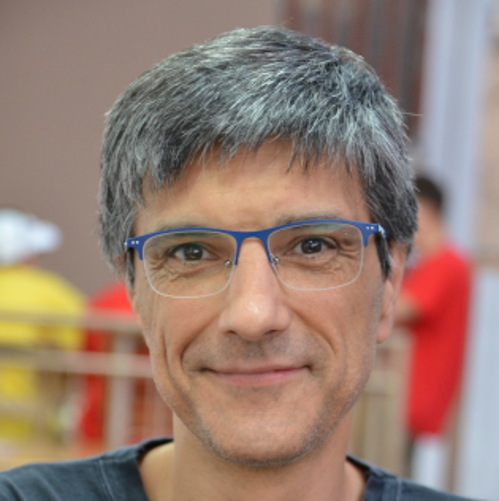
Joan Francesc Cánovas Tomàs is a Part-time Lecturer at the Universitat Pompeu Fabra (UPF) Barcelona School of Management and an Associate Professor at the UPF Faculty of Communication. He serves as Academic Director of the Master in Corporate and Strategic Communication and the Postgraduate in Digital Transformation of Organizations. Additionally, he is a consultant specializing in crisis communication and spokesperson training, and a Board Member of the Catalan Corporation of Radio and Television (CCRTV). His professional experience includes co-directing international programs such as the Master in Communication Management (with Diego Portales University) and the Postgraduate in Digital Journalism in Buenos Aires. He has held roles like Director of the Communications Office in prior positions. Research interests include digital transformation, crisis communication, and effective online communication practices. His publications focus on communication strategies, non-verbal language in digital contexts, and corporate training methodologies. While no formal advising relationships or grants are explicitly listed, his roles in academic program direction and corporate consultancy imply significant contributions to professional education and organizational communication practices.
Dr. Marta Rivera Zurita is a Juan de la Cierva Researcher in the Department of Spanish, Modern, and Classical Languages at the University of the Balearic Islands (UIB). She is actively involved in teaching and research, contributing to programs in Spanish Language and Literature, Labour Relations, Philosophy, and Primary Education. Her research is centered on language acquisition and bilingualism, particularly within the context of Spanish language development. She is a member of the Consolidated R&D&I Group Bilingualism and Spanish Language Acquisition (BASLA) , which supports interdisciplinary research in multilingual education and linguistic cognition. Dr. Rivera Zurita teaches courses such as Psycho-Linguistics of Spanish , Teaching Spanish as a Foreign Language , and Oral and Written Expression Techniques , reflecting her expertise in both theoretical and applied linguistics. Her pedagogical focus spans communication strategies and language instruction across diverse academic disciplines. While no publications or scientific awards are listed in the provided text, her affiliation with a recognized research group and active teaching load indicate a strong commitment to academic and research excellence. She advises students through Final Degree Projects and offers tutoring sessions by appointment. Though no formal advisees are listed, her role involves guiding undergraduate research and language development. She does not appear to lead a lab or independent research team but contributes to the collaborative BASLA research structure.
Melania Sánchez Masià is an Associate Professor in the Department of Spanish, Modern and Classical Languages at the University of the Balearic Islands, within the Faculty of Philosophy and Letters. She is actively engaged in teaching and research, with a strong background in cognitive science and linguistics. Her work bridges theoretical and applied aspects of language, particularly in educational contexts. Her educational background includes a Bachelor’s degree in Spanish Philology from the University of the Balearic Islands (2010), a Master’s in Cognitive Science and Language from the University of Barcelona (2011), and a PhD in Cognitive Science and Language from the Universitat Autònoma de Barcelona (2017). Her doctoral research was conducted at the Linguistics and Cognitive Science group of the Spanish National Research Council (CSIC). Her research focuses on the semantics and pragmatics of modification, particularly concerning gradability, vagueness, and subjectivity, as well as on language acquisition and discourse structure in both typical and atypical development. She explores how reference is acquired across different populations, contributing to both theoretical linguistics and educational applications. She is a member of two active research groups: the Bilingualism and Spanish Language Acquisition (BASLA) group and the Sociolinguistic Research Group of the Balearic Islands (GRESIB), both at UIB. These affiliations reflect her commitment to both cognitive and sociolinguistic dimensions of language study. Melania has taught at several institutions, including the Universidad Complutense de Madrid (2017–2019) and the Universitat de València (2020–2022), before joining UIB. From 2016 to 2022, she also worked as a computational linguist at Google, indicating strong interdisciplinary and industry-relevant expertise. At UIB, she teaches courses such as Introduction to the Study of the Spanish Language , Description and Analysis of Spanish: Study of Meaning , Teaching Spanish in Primary Education , and supervises Final Degree Projects in Early Childhood and Primary Education. Her teaching spans degrees in Spanish Language and Literature, Catalan Language and Literature, and teacher training programs. She is involved in research grants and projects through her membership in BASLA and GRESIB, though specific grants are not detailed. Her interdisciplinary background suggests potential involvement in cognitive, developmental, and educational linguistics funding initiatives. Melania Sánchez Masià maintains a professional presence through her personal website and academic profiles (ORCID, Scopus, ResearcherID, Dialnet), supporting open research and academic visibility.
François Dupressoir is an Associate Professor in the Cryptography Research group and School of Computer Science at the University of Bristol (UK). He received his PhD from the Open University in 2013, focusing on verifying cryptographic C programs using general-purpose tools. His doctoral research was conducted under Andy Gordon, Jan Jürjens, and Bashar Nuseibeh, supported by a Microsoft Research PhD Scholarship. He worked extensively at Microsoft Research labs in Cambridge, Aachen, Redmond, and the Open University. After his PhD, he focused on developing and applying the EasyCrypt proof assistant for cryptographic proofs, particularly those involving real-world adversary models. This research continued during his roles as lecturer and senior lecturer at the University of Surrey. His research emphasizes proving cryptographic and side-channel security properties of implementations, especially under partial compromise scenarios. He works on adversary modeling, proof methodologies, verification tools, and efficient code verification. He leads the Cryptography research group at Bristol, supporting Chloe Martindale and Dan Page's labs. He is a core developer of EasyCrypt, contributing to its cryptographic libraries and innovative applications, and a core member of the Formosa Crypto project promoting practical machine-checked cryptography. He supervises PhD and internship candidates interested in machine-checked cryptography, high-assurance cryptography, or verified software security. He emphasizes student independence, framing PhD supervision as a co-discovery process where both student and advisor learn collaboratively.
Iratxe Gomez Piñeiro is a lecturer at the University of the Balearic Islands (UIB), teaching in programs delivered in Ibiza through a center affiliated with the Island Council of Ibiza. She is actively involved in the Degree in Tourism and the Degree in Primary Education (including the double degree with Early Childhood Education), delivering English language and teaching methodology courses. English II, III, IV – Degree in Tourism English Language and its Didactics I – Primary and Double Degree Programs Her academic work focuses on language education within professional and pedagogical contexts, particularly in multilingual and tourist environments. Her research interests center on English language didactics, with applications in teacher training and tourism education. She contributes to curriculum development in bilingual instruction and practical language acquisition for professional fields. The available data does not include recent publications; however, her teaching portfolio suggests a strong orientation toward applied language learning and educational methodology rather than theoretical or experimental research. No scientific awards or honors are mentioned in the available information. Iratxe Gomez Piñeiro advises students through tutorial appointments, though no formal advisees or graduate students are listed. There is no mention of research grants or funded projects. She is affiliated with academic teams delivering education in Ibiza, particularly in programs coordinated by UIB with local institutional support, contributing to higher education accessibility in the Balearic Islands.
Iratxe Gomez Piñeiro is a Lecturer at the University of the Balearic Islands (UIB), affiliated with the Faculty of Education, where she teaches English language and didactics courses at the Ibiza campus. She is involved in both the Degree in Tourism and teacher education programs, including the Double Degree in Early Childhood and Primary Education. Her academic work focuses on English language instruction and pedagogy. Key areas include: English for Specific Purposes (ESP) in Tourism Language Teaching Methodologies Curriculum Design in Bilingual Education Didactics of English as a Foreign Language The available data does not include recent publications, making it difficult to assess research trends. However, her teaching portfolio suggests a strong commitment to language education across disciplines. There are no listed scientific awards or honors in the provided information. Iratxe Gomez Piñeiro advises students through scheduled tutoring sessions and contributes to academic training in multilingual contexts. While formal advisees are not listed, her role includes mentoring future educators and tourism professionals in language competence. She is part of the teaching faculty at the UIB-affiliated center in Ibiza, collaborating with programs linked to the Consell Insular d'Eivissa, focusing on regional educational development and language proficiency.
Javier Arroyo Gallardo is an Associate Professor at the Department of Computer Science (Ciencias de la Computación) at Universidad de Alcalá (UAH), Spain. His research focuses on machine learning applications in finance, blockchain technologies, cryptocurrency analysis, and decentralized autonomous organizations (DAOs). He holds a PhD from Universidad Pontificia Comillas with a thesis on time series prediction methods. Research Interests: His work spans predictive modeling for interval/histogram time series, credit risk assessment using machine learning, blockchain governance structures, cryptocurrency market dynamics, and open collaboration platforms. Notable contributions include developing automated correction systems for programming practices (UnitJudge) and analyzing DAO ecosystems' power dynamics. Recent Trends in Publications: Recent work emphasizes interdisciplinary applications combining AI with financial systems, including P2P lending risk modeling, cryptocurrency portfolio optimization, and blockchain-based governance mechanisms. Over 50% of his 2020+ publications focus on blockchain-related topics. Awards & Recognition: No specific awards mentioned, though his work has been presented at high-profile events like the International Symposium on Open Collaboration. Grants & Advising: Advised multiple research projects on DAOs, crypto markets, and agent-based modeling. Active in collaborative frameworks with industry partners in financial technology and blockchain ecosystems. Labs & Teams: Associated with CSRG-UAH and the Cognitive Science Research Group, focusing on computational methods applied to complex systems analysis.
Adrián Domínguez Díaz is an Assistant Professor at the University of Alcalá's Department of Computer Science. He specializes in educational technology, cybersecurity, and artificial intelligence applications. His research focuses on gamification in education, dark web content analysis, and machine learning methodologies. He is affiliated with the PMI (Intelligent Mobile Platforms) and TIFyC (Information Technologies for Training and Knowledge) research groups. He earned his Ph.D. from the Universidad de Alcalá in 2018 with a thesis on gamification and social networks' impact on academic performance. His work bridges computer science with pedagogical innovation, emphasizing data-driven solutions for education and cybersecurity challenges. Research interests include: - AI-driven content analysis (ChatGPT, GPT-3.5) - Dark web threat detection and classification - Gamification strategies for student engagement - Sustainability in high-performance computing His recent publications (2023–2025) highlight advancements in automated content analysis, cybersecurity threat modeling, and gender detection algorithms. No scientific awards have been explicitly noted. Advising: Supervised theses on gamification and e-learning (e.g., 2018 thesis). No grants listed, but active in collaborative projects like μDevOps. His research groups develop mobile technologies and educational platforms.
María Elena García Barriocanal is a Professor in the Computer Science Department at the University of Alcalá, Spain. She specializes in Artificial Intelligence, Data Management, and Health Informatics, leading the I4 research group focused on intelligence, innovation, internet, and information systems. Her work integrates semantic web technologies, blockchain, and quantum computing with interdisciplinary applications in healthcare, education, and social media analysis. Education: She holds a Doctorate from the University of Alcalá (2004) with a thesis on knowledge models for usability evaluation using questionnaires. Her research spans over two decades, with a focus on developing practical frameworks for data-driven decision-making and educational technology. Research Interests: Her work bridges theoretical computer science with real-world problems. Key areas include AI ethics, biomedical decision support systems, blockchain-based metadata, quantum software engineering, and social media-driven epidemiological modeling. She also explores semantic integration in disaster management and learning analytics. Publications: Her recent work emphasizes AI tool development (e.g., madmpy library), trustworthy AI practices, and innovative applications like quantum code analysis. She frequently publishes in data science, cybersecurity, and health informatics domains. Labs/Teams: As part of the I4 group, she collaborates on projects like decentralized persistent identifiers and ontology-driven educational frameworks. Her work often involves cross-disciplinary teams addressing societal challenges through technological innovation.
Daniel Rodríguez García is an Associate Professor (tenured) at the Department of Computer Science, University of Alcalá, Madrid, Spain. He also serves as a visiting researcher at Oxford Brookes University, UK, and previously held roles as an online tutor at the Universitat Oberta de Catalunya (UOC) and lecturer at the University of Reading (2001–2010). His academic credentials include a Computer Science degree from the University of the Basque Country and a PhD from the University of Reading (2003), complemented by a Postgraduate Certificate in Academic Practice (2005). His research focuses on data mining and software engineering , particularly applying machine learning techniques to software engineering challenges like defect prediction, classifier optimization, and cybersecurity. He leads the PROGRESSUS (Programming & Sustainability) and TIFyC (Information Technologies for Training & Knowledge) research groups, emphasizing sustainable software practices and educational technology innovation. His work spans topics such as DevOps monitoring, inclusive e-learning platforms, and AI-driven threat analysis in manufacturing industries. Notable contributions include the POEMA personal cloud system for education and studies on ransomware patterns in the Dark Web. His articles reflect trends in multi-objective optimization, imbalanced data handling, and ethical AI integration. He actively participates in workshops like RAISE (Realizing AI Synergies in Software Engineering), fostering cross-disciplinary collaboration.
Álvaro Somolinos Yagüe is a Visiting Professor at the Department of Computer Science, Universidad de Alcalá. He is affiliated with the GEC Grupo de electromagnetismo computacional (Computational Electromagnetic Group) , focusing on research areas including computer languages and systems. His academic background includes a doctoral degree from Universidad de Alcalá, awarded in 2019 for his thesis titled Diseño e implementación de un motor gráfico para la creación y visualización de objetos complejos en programas de simulación electromagnética , supervised by Dr. Iván González Diego. Research interests revolve around computational electromagnetism, simulation software development, and computer graphics integration within scientific applications. His work bridges theoretical electromagnetism with practical visualization tools, emphasizing interdisciplinary approaches in computer science and engineering. No scientific awards or academic grants are explicitly mentioned in the provided information. His professional profile highlights active participation in the GEC research group, though no specific lab leadership or team roles are detailed beyond his affiliation.
Abdelhamid Tayebi Tayebi is an Associate Professor in the Department of Computer Science at the University of Alcalá, Spain. His research focuses on computer science, artificial intelligence, antenna design, numerical simulation techniques, and educational technology. He leads the Climate Physics Group (CPG) and the Group of Advanced Numerical Techniques (GTNA), specializing in interdisciplinary projects combining computational methods with real-world applications. He earned his Ph.D. in 2011 with a thesis on antenna design methodologies using the method of moments, supervised by Dr. Manuel Felipe Cátedra Pérez and Dr. Iván González Diego. His work bridges theoretical research with practical tool development, including web-based simulators for antenna optimization and gamified educational platforms. Key research areas include 3D reconstruction using OpenStreetMap and LiDAR, medical imaging classification challenges, and wireless network propagation modeling. He actively explores gamification strategies to improve student engagement in STEM education, particularly in programming courses. His publications span disciplines from antenna engineering to AI-driven healthcare solutions, demonstrating a commitment to both technical innovation and pedagogical excellence. He collaborates on projects such as the EDISON initiative for data analytics and contributes to open-source tools like the NewFasant Suite.
Luis Usero Aragonés is a Professor at the Department of Computer Science at Universidad de Alcalá (UAH). He is affiliated with research groups including CSRG-UAH (Cognitive Science Research Group) and previously HCIS (Health computing and Intelligent Systems). His research focuses on computational intelligence applied to wildfire prevention, computer vision technologies, and educational software development. He holds a PhD from UAH on computational intelligence techniques for monitoring forest fuel moisture using satellite imagery. His academic background includes work in neural networks, machine learning, and cloud governance frameworks for higher education institutions. Notable contributions include development of the LearningRlab educational R package, drone detection algorithms using thermal imaging, and outlier detection models for wind tunnel sensor data. Publications span topics such as semi-supervised video segmentation, R package comparisons for text mining, and trust models in e-commerce systems. His research integrates contextual information analysis for applications in health informatics, aviation systems, and library user guidance.
Estela Saquete is a Full Professor in the Department of Software and Computing Systems at the University of Alicante, affiliated with the Escuela Politécnica Superior. She teaches in the Computer Engineering program and contributes significantly to research in Human Language Technologies and Natural Language Processing. Her research focuses on temporal information recognition and normalization , question answering systems , and textual information extraction . She is an active member of the Natural Language Processing Group (GPLSI), where she has led research since 2003. Dr. Saquete earned her European PhD in Computer Engineering from the University of Alicante in 2005, following a Degree in Computer Engineering from the same institution (1993–1998). Her academic journey reflects a deep integration of theoretical and applied computing. Although specific publications are not listed in the provided text, her research trajectory shows consistent engagement with major international conferences such as COLING/ACL, EVALITA, TERN, and EACL, indicating strong scholarly output in computational linguistics and NLP. Professional Experience: University of Alicante (2003–present): Professor and Researcher Sub-director of Communication, EPS (2008–2013) Multimedia Lab, UA (1998–2000): Analyst & Programmer Mediterranean Savings Bank (2000–2002): Programmer She has been involved in teaching a range of courses including Database Fundamentals, Information Management, Object-Oriented Programming, and Concurrent Programming at the undergraduate level, as well as specialized master's courses in Web Services, XML, and Textual Information Extraction. She mentors students through research and advises on advanced topics in language technology. She is associated with the Natural Language Processing Group (GPLSI) , a research team focused on advancing technologies for understanding and processing human language, particularly in temporal and contextual contexts.
Juan Carlos Meléndez Rodríguez is an Interim Substitute Lecturer at the University of Pablo de Olavide. He teaches in the Department of Business Organization and Marketing under the Faculty of Business Sciences. His academic roles include course coordination for programs such as Business Administration, Law, and Human Resources. He is affiliated with multiple academic units including the Faculty of Law and Faculty of Business Sciences. His teaching focuses on business management disciplines, including Quality Management, Operations Management, and interdisciplinary programs combining Law and Business Administration. He contributes to both undergraduate and double-degree programs, often integrating English-language instruction for international tracks like the Torun-La Rochelle program. No academic awards or research publications are explicitly listed in the provided materials. His professional activities are centered around pedagogical responsibilities in business education without documented involvement in research grants or student supervision.