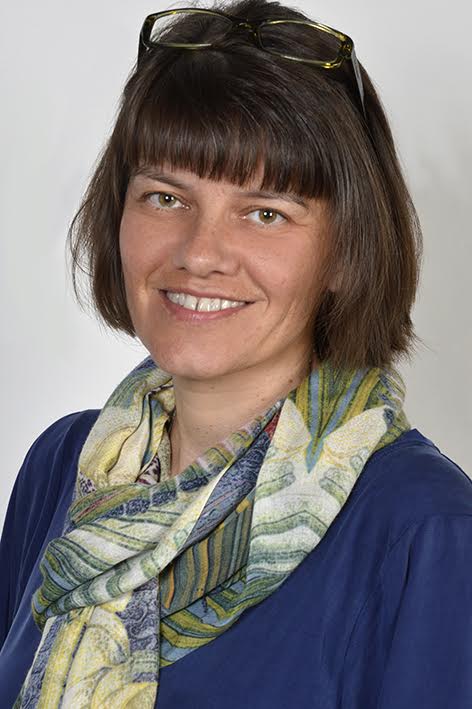
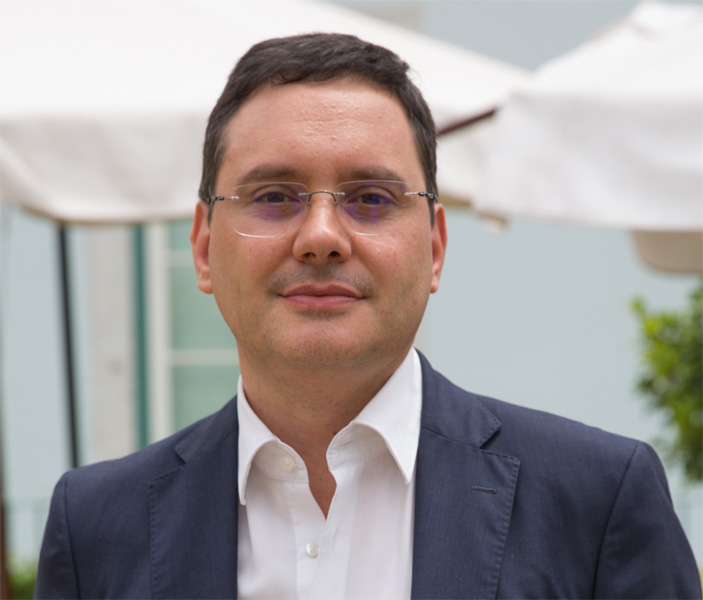
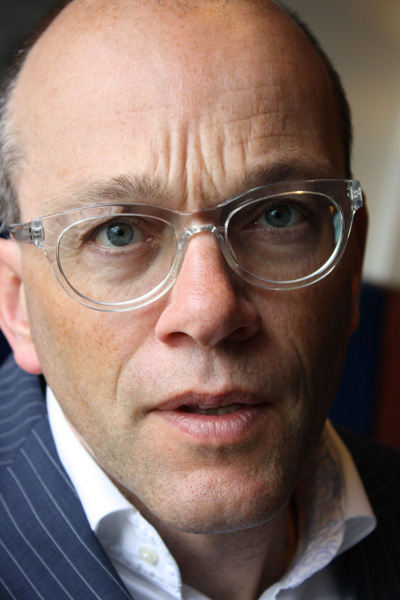
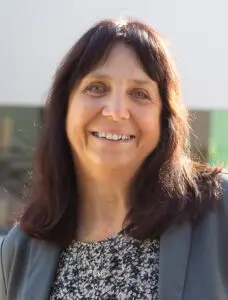
Ana Sokolova is a Professor in the Department of Computer Science at the University of Salzburg. She is affiliated with the Faculty of Digital and Analytical Sciences and actively contributes to research in theoretical computer science. University: University of Salzburg Faculty: Faculty of Digital and Analytical Sciences Department: Computer Science Email: ana.sokolova@plus.ac.at Her research focuses on probabilistic systems , concurrency theory , convex algebras , and formal verification . This work bridges theoretical foundations with practical applications in distributed computing and programming semantics. Recent publications highlight advancements in trace semantics , determinization , probabilistic anonymity , and coalgebraic modeling . Key trends include the integration of Markov chains , nondeterministic systems , and algebraic structures for formal verification.
Nelson Ribeiro is a Full Professor and Vice-Rector for Transformation, Collaboration, and International Affairs at Universidade Católica Portuguesa. He serves as Dean of the Faculty of Human Sciences (2016–2025) and coordinates the Doctoral Program in Communication Sciences and the research group 'Media Narratives and Cultural Memory' at the Center for Communication and Culture Studies (CECC). As a member of Academia Europaea (elected 2023) and ethics committee member at the International Panel on the Information Environment (IPIE), he holds leadership roles in academic governance. His research spans Media history Propaganda and disinformation Media and colonialism Journalism studies Political economy of media . He has authored extensively on radio broadcasting in authoritarian regimes, transnational media history, and disinformation frameworks. Recent publications focus on Media propaganda in the digital age Colonial broadcasting models Political media manipulation Historical radio analysis Crisis journalism Transnational media diplomacy , reflecting his interdisciplinary approach to communication history. Scientific accolades include: 2022 Hoover Institution Fellowship 2022 CAPES-Brazilian University Grant 2015 University of Augsburg Fellowship 2004 & 2000 Institute for Social Communication Prizes . He founded the Lisbon Winter School for Communication Study, partnering with global institutions like Annenberg and Helsinki University.
Maria-Dolores Garcia-Ramon is a Full Professor of Geography at the Universitat Autònoma de Barcelona (UAB), where she held academic leadership roles including Chair of the Department of Geography (1977–78, 1995–97) and Chair of the Doctoral Program in Human Geography (1986–94). She has been a visiting scholar at institutions such as the University of Arizona, Cornell University, and the London School of Economics. Her research focuses on rural geography, gender studies, and colonialism, with a particular emphasis on gendered spatial practices and women’s narratives in colonial contexts. Education: PhD in Geography and History (1975, University of Barcelona), MA in Geography (1970, UC Berkeley), BA in Philosophy and Letters (1966, University of Barcelona). Research Interests: Garcia-Ramon pioneered gender studies in Spanish geography, analyzing women’s roles in agriculture, urban public spaces, and colonial travel narratives. Her work critiques colonial discourses and explores how gender shapes spatial experiences. Key themes include the invisibility of women’s labor in rural economies, postcolonial geographies, and feminist methodologies in geographical research. Publications: Over 90 peer-reviewed articles and 12 authored/edited books, including Mujer y agricultura en España (1994) and Geografía Rural (1992). Recent articles address urban planning’s gendered impacts and colonial travel narratives. Awards: Recipient of the Jan Monk Award (2008), Premi Narcís Monturiol (2003), and membership in prestigious academies like Academia Europaea. She has led 31 funded research projects on gender, rural development, and colonial geographies. Advising & Grants: Supervised 19 PhD theses and secured grants from the European Commission, Spanish Ministry of Science, and Catalan Government. Her work on gendered labor and urban spaces has influenced policy debates on work-life balance and inclusive urban design. Labs/Teams: Active in the UAB’s Gender and Geography Research Group, contributing to international networks like the Association of American Geographers and editorial boards of journals such as Gender, Place & Culture .
Nelson Nicolas Higuera Ruiz is a PreDoc Researcher at the Vienna University of Technology, affiliated with the Faculty of Informatics' Knowledge-Based Systems research group. His work bridges logic programming and deep learning for explainable AI. Research Focus: Neurosymbolic AI, Visual Question Answering (VQA), Answer Set Programming (ASP), and hybrid reasoning systems Projects: Leads optimization research in the LCS (2017–2025) project, developing neurosymbolic approaches for intelligent systems Key Contributions: Pioneering adaptive large-neighbourhood search algorithms for ASP optimization, modular neurosymbolic architectures, and contrastive explainability frameworks for VQA Collaborations: Active in international workshops and conferences including IJCAI, AAAI, and CLeaR, frequently collaborating with researchers like Thomas Eiter and Johannes Oetsch Publications: Focus on neurosymbolic integration, optimization algorithms, and explainability across AI, logic programming, and computer vision domains
Joost-Pieter Katoen is a full Professor at RWTH Aachen University and Head of its Computer Science Department since 2012. He also holds a part-time (20%) Professorship at the University of Twente . His research focuses on model checking , probabilistic verification , formal semantics , and software verification , with applications in aerospace systems. His work has led to significant tools like MRMC (probabilistic model checker), COMPASS (AADL analysis tool-set), and libalf (learning automata library). He has authored over 18 international projects (total €5.2 million) and graduated 12 PhD students. Scientific Awards : Member, German National Academy of Sciences (Leopoldina), 2024 ACM Fellow, 2020 ERC Advanced Grant, 2018 Honorary doctorate, Aalborg University, 2017 Teaching Award, RWTH Aachen, 2010 Philips Early Career Development Award, 1988 Research Trends (from articles): His recent work spans probabilistic program verification , quantitative game theory , Markov chain analysis , and parameter synthesis for stochastic systems, with applications in AI, quantum computing, and fault tree analysis. Leadership & Service : Katoen co-founded the QEST conference , chairs ETAPS steering committee, and has led numerous program committees (CONCUR, TACAS, QEST). He has served on editorial boards and organized conferences/seminars globally.
Prof. Martin Teufel is a Professor at the University of Teacher Education Styria, Austria, affiliated with the Institute for Digital Media Education. He specializes in educational technology with a focus on mobile learning, digital competency, and innovative teaching methodologies. His work includes developing MOOC-based learning systems and analyzing student digital preparedness. Key projects include the Styrian University Conference digital competency analysis and the Digital Learning Lab initiative. He holds a BEd from the University of Graz and actively contributes to teacher training programs integrating emerging technologies. Research interests span digital pedagogy, seamless learning environments, and computational thinking tools like BBC micro:bit. His publications highlight patterns in online learning behaviors and institutional digital transformation strategies. He advises on educational technology policy and has led cross-institutional studies on student readiness for digital education. His work often bridges theory and practice through collaborative formats like the Hochschuldidaktik-Café for educators' professional development. Teaching responsibilities include courses on digital media in education and technology-enhanced learning design. He manages educational technology projects and serves as a consultant for digital learning infrastructure. His GPG public key (F361ADE9) indicates active engagement in secure academic communication.
Brendan Dooley is a Professor of Renaissance Studies at University College Cork (UCC), Ireland. He holds additional roles, including Adjunct Professor of History at Jacobs University Bremen and served as Distinguished Visiting Professor of Italian at the University of Virginia. His academic journey includes positions at Harvard University, Notre Dame, and the Medici Archive Project in Florence. He earned his PhD in History from the University of Chicago in 1986. Education: PhD in History, University of Chicago, 1986 Research Interests: Dooley specializes in Renaissance Studies, with a focus on cultural history, knowledge transmission, digital humanities, and media history. His work explores topics such as book history, the history of education, and the intersections of science, religion, and politics in early modern Europe. Awards and Grants: 2019 Irish Research Council Advanced Laureate Award (EUR 1 million) 2010 PRTLI Grant (EUR 1.6 million) 2009 Distinguished Visiting Professorship, University of Virginia 1994 Rome Prize, American Academy in Rome Extensive fellowships from institutions including the Institute for Advanced Study (Princeton) and the Fulbright Commission Grants and Projects: He leads the EURONEWS project on early modern newsletters and co-founded UCC’s Digital Arts and Humanities program. His research spans the history of communication, cultural transitions, and interdisciplinary digital humanities. Labs/Teams: Active in the Digital Arts and Humanities program at UCC, fostering transdisciplinary collaboration and innovation in humanities research.
Lars Ole Sauerberg is a distinguished Professor of Literature in English at the University of Southern Denmark's Institute for Literature, Media and Cultural Studies, where he has held a professorship since 1992. His academic career spans over five decades, beginning as a Teaching Assistant at Århus University in 1973, progressing through Lecturer and Senior Lecturer positions at Odense University, and culminating in his current professorship following his Dr.phil. degree in 1986. He has held significant administrative roles including Pro-Vice-Chancellor of Odense University (1990-92) and Dean of the Faculty of Humanities (1993-97). His educational background includes a Cand. phil. (BA) in English Language and Literature (1973) and Cand. mag. (MA) in English and German Languages and Literatures (1975), both from Århus University. Sauerberg has maintained active engagement with academic governance as a member of the SDU University Senate, Humanities Faculty Board, and English Study Board. Sauerberg's research spans multiple interconnected domains with particular emphasis on British literature , 20th century book history , crime fiction , and the innovative intersection of literature and music . His current research program focuses on Book and Cognition, Intermediality, Music and Literature, and the Verse Novel, demonstrating his commitment to interdisciplinary approaches. He leads or participates in research initiatives including NTSMB, Fiction, and The Gutenberg Parenthesis Research Forum at the University of Southern Denmark. Analysis of his 15 most recent publications reveals consistent exploration of narrative boundaries, particularly in verse novels and intermedial representations. His work frequently examines historical representation (especially post-9/11 literature and historiographical fiction), musical-literary connections, and genre evolution in contemporary British and American writing. The publications demonstrate methodological sophistication across literary theory, cultural studies, and genre analysis. Knight of the Order of Dannebrog Research prize of University of Southern Denmark (1986) Sauerberg has supervised PhD candidates and served on numerous selection committees while maintaining active roles in academic publishing as General and English Editor of Orbis Litterarum since 2000 and editorial board member for Journal of Music and Meaning since 2003. His professional activities extend to public intellectual work as a book reviewer for Morgenavisen Jyllands-Posten since 1987 and consultant editor for the Danish National Encyclopedia. He is affiliated with professional organizations including the Danish Academy for Crime Fiction and the James Joyce Society of Copenhagen.
Axel Polleres is a full professor at the Institute for Data, Process and Knowledge Management in Vienna University of Economics and Business (WU Wien). He leads the department of Information Systems and Operations Management while maintaining active research in knowledge graphs, semantic web technologies, and ontology engineering. PhD and Habilitation from Vienna University of Technology Former positions at University of Innsbruck, Universidad Rey Juan Carlos, DERI Ireland, and Siemens AG Co-chair of W3C SPARQL working group Editorial board member for Semantic Web Journal and IJSWIS His research focuses on: Querying and reasoning over ontologies Graph schema languages (SHACL, SPARQL) Wikidata constraint formalization Ontology reuse in collaborative platforms Crisis management knowledge graphs FAIR data principles implementation Recent publications analyze knowledge graph evolution, constraint validation methodologies, and semantic web standardization efforts. Key topics include: OWL/RDF interoperability solutions Unit conversion systems for Wikidata Partition-based query processing frameworks Network resilience analysis for urban planning Open data platform discovery tools Temporal analysis of collaborative knowledge graphs He has co-organized major conferences like ISWC2023 and ESWC workshops while maintaining active roles in European research projects. Current work involves spatiotemporal knowledge graphs for city resilience and semantic web infrastructure development.
Barbara Schober is a full Professor in the Department of Developmental and Educational Psychology at the University of Vienna's Faculty of Psychology. Her research focuses on adolescent development, educational processes, and psychological well-being in school contexts. Key areas include motivation dynamics, self-regulated learning, gender role socialization, and pandemic-related educational challenges. She leads major research initiatives such as the COMET for Kids mental health literacy program and the 'Lernen unter Covid-19' project addressing pandemic learning disruptions. With 263 publications and 232 professional activities, her work bridges academic research with practical educational policy. Notable contributions include frameworks for school improvement, teacher competence development, and evidence-based policy implementation strategies. Her projects emphasize interdisciplinary collaboration, having partnered on initiatives funded by Austrian Science Funds and EU programs. Media engagement includes expert commentary on digital learning challenges and pandemic education strategies. Schober's work consistently addresses UN SDG 4 (Quality Education) through interventions promoting equitable educational opportunities and student well-being.
Federica Bessone is a Full Professor of Latin language and literature at the University of Turin, where she has been teaching since 2000. She holds a PhD in Greek and Latin Philology from the University of Pisa (1994) and has held prestigious academic positions including Visiting Fellow at Clare Hall, University of Cambridge (2021-2022). Her academic career at the University of Turin progressed from Researcher (2000-2005) to Associate Professor (2005-2015) and finally to Full Professor (2015-present). Her educational background includes: PhD, Greek and Latin Philology, University of Pisa (1994) Diploma, SNS Pisa, Humanities (1984-1988) Laurea, Faculty of Humanities, University of Pisa (13/4/1989) Bessone's research focuses on Latin literature of the Augustan and Flavian periods, with particular expertise in Ovid and Statius. Her scholarly interests encompass imperial ideology, gender roles in ancient literature, poetic memory, literary genres, and the reception of classical texts through later periods. She has made significant contributions to understanding how ancient authors engaged with and transformed literary traditions, particularly examining the interplay between poetic form and political power in imperial Rome. Her work bridges traditional philological methods with contemporary theoretical approaches, especially in gender studies. Analysis of her publication record reveals a consistent focus on Flavian poetry, particularly Statius' Thebaid, and its reception through later periods including Dante's Divine Comedy. Her scholarship demonstrates sophisticated attention to intertextuality and the transmission of classical motifs across centuries. As co-director of a four-volume critical edition of Statius' Thebaid for the Fondazione Lorenzo Valla, she has significantly advanced the field of Flavian studies. Her notable honors include: Life Member, Clare Hall, University of Cambridge (2022) Visiting Fellowship, University of Cambridge, Clare Hall (2021-2022) Fondo Progetto Giovani Ricercatori, University of Turin (2000) Fondation Hardt Research Fellowship (1998) NATO-CNR Senior Fellowship, University of California, Berkeley (1995) As an academic mentor, Bessone has supervised numerous PhD theses in Classics and served as external examiner for doctoral candidates. She has coordinated the Curriculum in Greek, Latin and Byzantine Philology at the University of Turin's PhD program since 2019 and previously served as President of the BA program in Humanities (2015-2018). Her editorial work includes serving on the boards of Eugesta (2011), Rivista di Cultura Classica e Medioevale (2014), Materiali e Discussioni per l'analisi dei testi classici (2018), Frammenti sulla scena (2019), and Aevum (2022), as well as co-directing the 'Millennium' series and the 'Oxford Commentaries on Flavian Poetry'. Bessone is a co-founder of EuGeStA (European network on Gender Studies in Antiquity, established in 2009), demonstrating her commitment to interdisciplinary approaches to classical studies. She actively participates in international research networks including the International Ovidian Society and the Réseau Poésie Augustéenne, and has co-organized numerous international conferences that have resulted in significant edited volumes advancing scholarship in Flavian studies.
Barbara Herzog-Punzenberger is the current Rector of the Vienna University of Education (since 2022). Previously, she held the position of Professor of General Didactics and School Pedagogy at the University of Innsbruck (2018–2022) and served as Head of the Department of Education and Migration at Johannes Kepler University Linz (2014–2018). She has extensive academic expertise in migration studies, intercultural education, and educational policy, with a focus on social inequality, multilingualism, and teacher education for diversity. Her educational background includes a Habilitation in Educational Sciences (2021, Johannes Kepler University Linz), a Doctorate in Sociology (2011, Freiburg University of Education), and a Diploma in Cultural and Social Anthropology (1995, University of Vienna). She has authored numerous publications on migration, education, and integration, including works on second-generation youth, multicultural policies, and equity in education systems. Her research has been supported by prestigious organizations like the European Commission, the Austrian Science Fund, and the OECD. She has received awards such as the Dr.-Maria-Schaumayr-Preis für Frauen in der Wissenschaft and held visiting professorships at institutions like the University of Vienna and University of Calgary. She is an active member of international academic networks, including the American Educational Research Association (AERA) and the Comparative and International Education Society (CIES). Her recent work emphasizes the role of teacher education in addressing cultural diversity, the impact of migration on education systems, and policy frameworks for inclusive education. She contributes to national and international initiatives, such as the Austrian UNESCO Commission and the EU’s NESET expert network.
HS-Prof. Dr. Elisabeth Sieberer is Vice Rector for Teaching and Learning at the University of Teacher Education Vienna (PH Wien) since October 2023. She holds a professorship in teacher professionalization with a focus on Urban Diversity Education. Her academic background includes a PhD in Philosophy/German Didactics (2020) from Alpen-Adria-University Klagenfurt. She previously served as Head of Study Management (2017–2021), Chair of the University College (2015–2023), and held leadership roles in Quality Management and School Development at PH NÖ. Her research focuses on writing didactics, narrative competence development, and educational transfer. She coordinates the Writing Center (SchreibLAB) and has published extensively on writing instruction in primary and secondary education. Education: Studied German Philology/Mathematics at University of Vienna (1986–1991), with a semester abroad at Philipps University of Marburg. Completed advanced training in educational leadership (LEA program), quality management (EBIS), and German didactics (PFL program). Research highlights include exploratory studies on narrative competence acquisition and writing process support in classrooms. She actively contributes to national and international conferences on German didactics and educational research. Her work bridges theory and practice, emphasizing teacher training and learning-friendly educational environments.
Prof. Georg Jäggle is a Professor of Vocational Education at the University College of Teacher Education Vienna (PH Wien), specializing in educational robotics, STEM pedagogy, and sustainability education. He leads the Department of Vocational Education within the Institute for Secondary Level Vocational Education (I:SBB). His work integrates technology-enhanced learning environments, focusing on project-based methodologies to bridge gaps between education and industry needs. Key projects include the Recycling Heroes initiative (2022–2024), which employs citizen science to promote circular economy awareness, and the EU-funded ER4STEM project (2017–2018), fostering STEM engagement through robotics. Prof. Jäggle holds a Dipl.-Ing. (FH) and a Dr. in engineering education, with prior industry experience as an engineer and vocational school teacher. His research emphasizes digital competence development, intergenerational learning, and inclusive education strategies. He has coordinated interdisciplinary teams across 10+ EU and national projects, including RoboCoop (2018–2022) and Makers@school (2017–2019), which implemented robotics and maker culture in schools. His teaching spans applied mathematics, engineering, and automation technology at both academic and vocational levels. Research interests include technology integration in vocational training, lifelong learning frameworks, and the impact of educational robotics on student motivation. Recent publications (2022–2024) explore STEM career self-efficacy, sustainability curriculum innovation, and cross-generational robotics collaboration. He currently serves in the Center for Research Management (Zentrum Forschungsmanagement) at PH Wien, advancing applied research in MINT (STEM) education and educational technology.
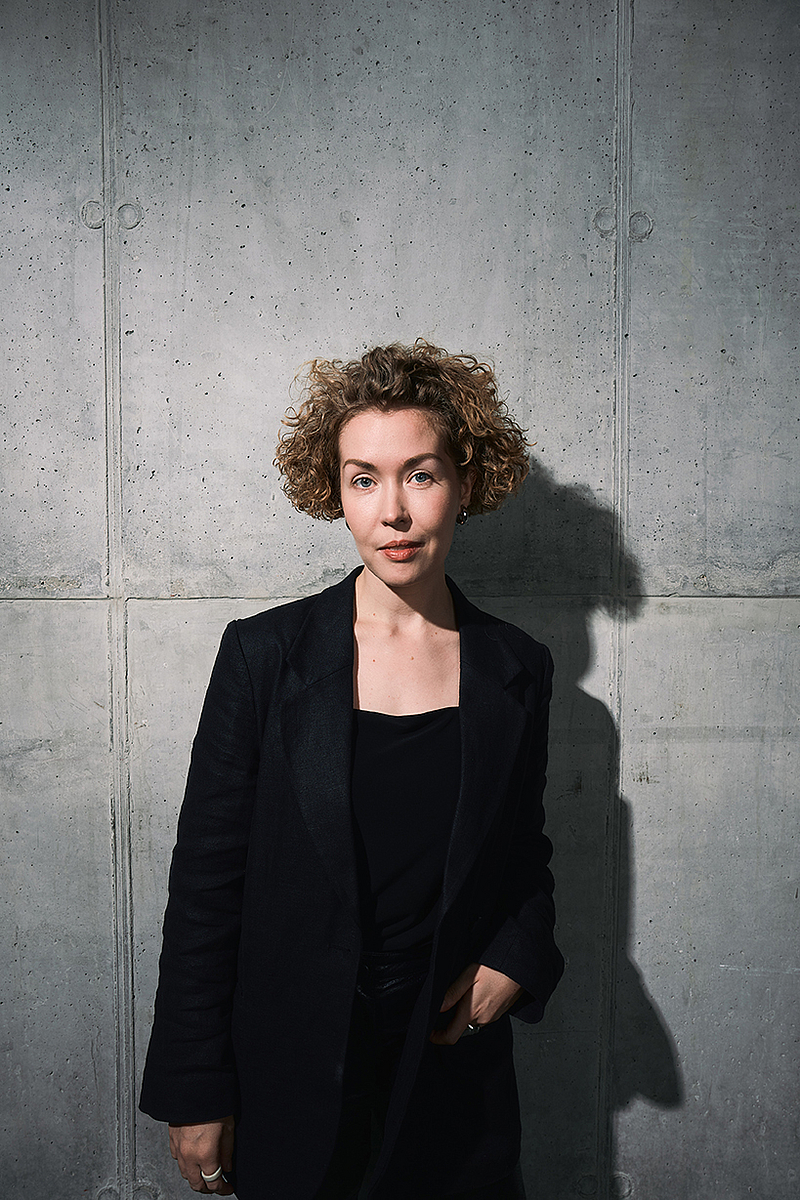
Freda Fiala is a postdoctoral researcher working as a University Assistant at the Institute of Fine Arts and Cultural Studies, University of Arts Linz. She is currently a key member of the ERC Consolidator Project OLFAC ("Olfactormativity: Exploring The Intervening Performativity Of Smell") led by Prof. Dr. Silke Felber, where she contributes her expertise in performance studies and East Asian cultural analysis. Her academic background combines theater, film, and media studies with East Asian studies (Sinology), shaped by extensive study periods in Vienna, Berlin, Hong Kong, and Taipei. Fiala completed her doctorate funded by a DOC scholarship from the Austrian Academy of Sciences (2020-2023), focusing on contemporary performance in Taiwan and its regional networks and cultural policy implications. Her dissertation, "Curating Communities, Staging Liveness: Contemporary Performance in Taiwan's Quest for Identity," is set to be published in 2025 as the first English-language monograph on the role of contemporary performance in Taiwan's informal cultural diplomacy. Freda Fiala's research critically examines questions of decentralization and centralization across macro- and microhistorical contexts, with particular attention to how cultural infrastructure influences artistic and institutional processes. Her work spans performance theories and aesthetics, East Asian cultural studies, transmodern artistic networks, art and cultural diplomacy, and infrastructural criticism, with a focus on relationships between Central Europe and East Asia. Her scholarly publications reveal a trajectory exploring digital performance, blockchain applications in art, institutional histories of performing arts centers, and transnational artistic networks. Fiala has received significant recognition including the 2025 Young Scholar Award from the European Association of Taiwan Studies (EATS) for her outstanding research contributions. 2025 Young Scholar Award of the European Association of Taiwan Studies (EATS) Guest lecturer at Academy of Fine Arts Vienna and University of Vienna Theory mentor at PARTS School for Contemporary Dance in Brussels Curator of "The Non-fungible Body" and "HYBRID BODIES" at OK Linz Organizer of symposia including "Performance Besides Itself" and "Curatorial Tipping Points" Fiala has established meaningful international connections through projects like the first museum-supported residency program between Taiwan and Austria, connecting the Yingge Ceramics Museum in New Taipei City with the Academy of Ceramics Gmunden. Her work demonstrates a commitment to fostering cross-cultural dialogue and examining how cultural institutions narrate histories, shape publics, and negotiate cultural politics in an increasingly interconnected world.