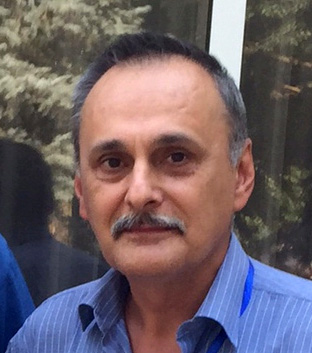
Christoph Kirsch is a Professor and Chair of the Department of Computer Science at the University of Salzburg. He also serves as Chair of the Programming Research Laboratory at the Faculty of Information Technology, CTU Prague. His research focuses on systems, concurrency, memory management, and formal methods, with notable contributions including the Selfie educational software project and work on symbolic execution. He is a prolific author with over 50 publications in top venues like LCTES and EMSOFT. Education: Ph.D. in Computer Science (details not specified). His teaching includes courses on elementary computer science concepts and curricula development. He advises students such as Anna Bolotina and has graduated over a dozen PhD students. Research highlights include the Selfie system (self-referential C compiler and emulator), work on concurrency primitives like Scal and Timestamped Stack, and contributions to real-time systems (Logical Execution Time, Variable-Bandwidth Servers). His recent focus includes teaching digital thinking and evaluating eval in R programs. He has organized conferences like MPLR’24 and served on program committees for EuroSys and RTNS. His book Elementary Computer Science emphasizes foundational concepts for broad audiences.
Jürgen Cito is an Associate Professor in the Department of Software Engineering at the Faculty of Informatics, TU Wien, where he leads research in probabilistic programming, security, and configuration management. His work is supported by major grants from the Austrian Science Fund (FWF), European Commission, and Meta Platforms, Inc., with active projects spanning 2022-2027. His research focuses on the intersection of software engineering and machine learning, particularly in static analysis of probabilistic programs, AI-driven penetration testing, and infrastructure security. Key contributions include identifying secret exposure in configuration files, grammar inference for ad hoc parsers, and performance prediction from source code, often combining empirical studies with tool development. Analysis of his 15 most recent publications (2020-2024) reveals three dominant trends: (1) Security vulnerabilities in configuration management systems, especially secret leakage in dotfiles; (2) Application of large language models to offensive security testing; and (3) Machine learning techniques for performance prediction and AutoML optimization in software contexts. Cito has supervised 22 Master's students on cutting-edge topics including AI security, infrastructure as code, and program analysis. His current research portfolio includes: Types4Strings (FWF, 2024-2027): Type systems for string processing Cloud Open Source Research Mobility Network (EU, 2023-2026): Open-source cloud infrastructure Software Assistants for Probabilistic Programming (Meta, 2022-2026): AI tools for probabilistic code He is embedded in TU Wien's Institute of Software Technology and Interactive Systems (E194), collaborating on cross-institutional projects focused on software security and developer tooling, with particular emphasis on empirical validation of security practices and configuration management systems.
Reinhard Pichler is a Full Professor at the Vienna University of Technology (TU Wien), affiliated with the Faculty of Informatics and the Department of Databases and Artificial Intelligence . His research focuses on Database Theory , Computational Logic , and Parameterized Complexity . He leads multiple research projects like DeConquer (2023–2027) and HyperTrac (2018–2022), addressing challenges in query optimization and hypergraph decompositions. He holds the prestigious START Prize (2014–2022) for young researchers. His work spans theoretical foundations (e.g., hypertree decompositions) and practical applications (e.g., SPARQL query processing systems like SparqLog). He contributes to academic governance, serving on faculty councils and curriculum commissions. His research innovations bridge algorithmic theory and real-world database systems, emphasizing efficient query evaluation and tractability analysis. Key contributions include advancing fractional hypertree decompositions , SPARQL query optimization , and consistent query answering . His projects often involve collaborations with industry and international funders like the Austrian Science Fund (FWF) and Vienna Science and Technology Fund (WWTF). He actively publishes in top venues like Journal of the ACM , ACM Transactions on Database Systems , and Proceedings of the VLDB Endowment . His academic leadership extends to course design, teaching advanced topics like Complexity Theory and Theoretical Computer Science . He mentors doctoral students and oversees research teams exploring cutting-edge areas like uncertain databases and cloud-based computational social choice .
Gabriel Ciobanu is a Professor at Alexandru Ioan Cuza University of Iasi, Romania, and a Senior Researcher at the Romanian Academy, Iasi. He has held various academic positions internationally including as a Visiting Professor at Newcastle University (UK) from 2010-2015 and as a Research Fellow/Professor at the National University of Singapore (2000-2004). His educational background includes PhD studies at A.I.Cuza University and Edinburgh University (1990-1994) under the mentorship of Robin Milner, and his undergraduate studies in the Faculty of Mathematics and Computer Science at A.I.Cuza University of Iasi (1977-1982). Professor Ciobanu's research focuses on Membrane Computing and Natural Computing , Distributed Systems Models including process calculi with emphasis on semantics, behavioral equivalences, logics, and verification. He has made significant contributions to bridging membrane computing and process calculi, and to the Foundations of Mathematics and Computer Science through his work on Finitely Supported Mathematics. His research has applications in theoretical computer science, formal methods, and computational biology. His publication record shows a consistent research trajectory focusing on theoretical computer science with applications to natural computing, membrane systems, process calculi, and finitely supported structures. Recent work (2023-2025) continues to explore these areas with increasing focus on multi-agent systems, continuation semantics, and applications to medical systems and reaction systems. Scientific Awards and Recognition 2013 Grigore Moisil Award, Romanian Academy (as co-author of "Mobility in Process Calculi and Natural Computing", Springer) 2010-2013 Member of the National Research Council (CNCS) in Romania 2008-2010 Royal Society of London Joint International Project (Newcastle University, School of Computing) 2004 Octav Mayer Award for Scientific Achievements, Romanian Academy of Sciences, Iasi branch 2000 Grigore Moisil Award of the Romanian Academy of Sciences for results in Theoretical Computer Science 1995-1996 Japan Society for the Promotion of Science Fellowship (Tohoku University and Kyoto University) 1994 DAAD Research Fellowship (Institute of Computer Science, University of Kiel) 1991-1992 Royal Society of London and Romanian Academy Fellowship (University of Edinburgh) Professor Ciobanu has supervised 8 PhD students and numerous master's students. He has served as Editor-in-Chief of the Scientific Annals of Computer Science since 2006 and has been a guest editor for special issues of several international journals. He has collaborated with researchers from numerous countries including UK, France, Netherlands, Spain, Italy, Russia, China, Singapore, and India. He has been involved in various research projects and has spent research periods at prestigious institutions worldwide including Edinburgh University, Universite de Paris XI, CWI and VU Amsterdam, Tohoku and Kyoto University, National University of Singapore, and Newcastle University.
Christian Fibich is a Researcher and Lecturer at the Department of Electronic Engineering, University of Applied Sciences Technikum Wien, Austria. He leads the Research Group Embedded Systems, focusing on FPGA reliability and high-level synthesis. His roles include project management for R&D initiatives like VECS (2013-2018), INES (2018-2023), and the 2024 Drohnentechnik integration project. Fibich holds an MSc in Embedded Systems from Technikum Wien and has been active in the field since 2010. Research interests include fault-tolerant FPGA design, reliability analysis of SRAM-based FPGAs, and high-level synthesis optimization. His work emphasizes practical applications of open-source tools and automated design exploration. Recent projects explore temperature-dependent fault effects and drone integration in academic programs. Publications span FPGA reliability, fault injection methods, and embedded systems design, with a focus on open-source IP cores and hardware security. His contributions include Fiji (a fault injection tool) and HLShield (a reliability framework for HLS).
Krishnendu Chatterjee is a Professor at the Institute of Science and Technology Austria (IST Austria) , Department of Computer Science. His research spans formal verification, probabilistic systems, game theory, and evolutionary dynamics, with over 300 peer-reviewed publications in top venues such as DISC, AAAI, LICS, PNAS, Nature , and Journal of the ACM . His research focuses on developing theoretical foundations and practical algorithms for analyzing complex systems, including Markov decision processes, stochastic games, probabilistic programs, and evolutionary models. He has made significant contributions to topics such as reachability analysis, termination of probabilistic programs, synthesis of controllers, and evolutionary game dynamics. Chatterjee's work is highly interdisciplinary, bridging computer science, mathematics, and biology. He has collaborated extensively with leading researchers worldwide and has been involved in editorial roles and program committees for major conferences in formal methods and theoretical computer science.
Georg Simhandl is affiliated with the Faculty of Computer Science, specifically within the Research Group Software Architecture. His work focuses on advancing theoretical and practical aspects of software engineering with a strong emphasis on cybersecurity, microservices, and empirical studies. Research Interests: His core research spans Microservices Architecture , Cybersecurity in Software Systems , Formal Methods , and Empirical Software Engineering . He investigates topics such as secure firmware updates, threat modeling for microservices, and developer cognition in system maintenance. Recent work highlights include leveraging TPMs for cryptographic anchoring and analyzing how dataflow diagrams enhance security analysis. Activities: He has presented at conferences like the ACM SIGPLAN International Conference on Software Language Engineering (SLE '24) and participated in workshops such as the IEEE/ACM International Workshop on Eye Movements in Programming (EMIP). His research bridges theoretical frameworks with practical software development challenges. Labs/Teams: Works within the Research Group Software Architecture, contributing to projects on secure architecture design and empirical evaluation of software practices.
Martin Pirker serves as a Professor and Senior Researcher at the Institute of IT Security Research within the Department of Computer Science and Security at St. Pölten University of Applied Sciences in Austria. His academic profile demonstrates extensive expertise in IT security, trusted computing, and blockchain technologies, with a particular focus on Trusted Platform Modules, boot integrity, and secure systems development. His research interests span multiple critical areas of modern cybersecurity including Trusted Computing, blockchain-based security solutions, boot integrity verification, secure system design, privacy-preserving technologies, and information security auditing. Dr. Pirker's work consistently addresses practical security challenges in contemporary computing environments, with numerous publications exploring the intersection of hardware security, software implementation, and cryptographic verification mechanisms. His recent publications reveal a strong focus on blockchain applications for security auditing, Trusted Platform Module implementations, and secure boot processes. The research trends show progression from foundational trusted computing work toward more distributed security solutions using blockchain technology and addressing emerging challenges in AI security. His publications demonstrate consistent contributions to major security conferences including ARES (International Conference on Availability, Reliability and Security) and ICISSP (International Conference on Information Systems Security and Privacy). Dr. Pirker leads or participates in several significant research projects including the Josef Ressel Center for Blockchain-Technologies & Security Management, Josef Ressel Center for Unified Threat Intelligence on Targeted Attacks (TARGET), RPM- Rusted Plattform Module, and E³UDRES² Ent-r-e-novators. These projects reflect his commitment to addressing real-world security challenges through collaborative research initiatives. He actively contributes to the academic community through teaching in the IT Security (BA) and Cyber Security and Resilience (MA) programs at St. Pölten University of Applied Sciences. His work bridges theoretical security concepts with practical implementation challenges, making significant contributions to the field of applied cybersecurity research.
Aniello Murano is a Professor in Computer Science at the Department of Electrical Engineering and Information Technology of the University of Naples Federico II. He serves as Scientific Director of the ASTREA (Automated Strategic REAsoning) Laboratory and has been actively involved in numerous research projects including H2020-MSCA project SEAL as Principal Coordinator and PNRR Research Unit Coordinator on Resilient Strategic Reasoning in AI (2023-2025). His primary research interests focus on Artificial Intelligence, Formal Aspects for Strategic Reasoning in Multi-Agent Systems under Perfect and Imperfect Information, Specification, Verification, and Synthesis of Reactive Systems, Model Checking and Module Checking, Formal Languages, Automata Theory, Real-time Systems, Pushdown and Hierarchical Systems, Temporal and Modal Logics, Logics for Strategic Reasoning in AI, Game Theory, Parity Games, Solution Concepts, and Automated Mechanism Design. His work bridges theoretical computer science with practical applications in AI systems. Murano has published extensively in top-tier venues, with recent publications spanning KR, IJCAI, AAAI, AAMAS, and other premier conferences. His research shows strong trends in strategic reasoning frameworks, verification techniques for multi-agent systems, and applications of game theory to mechanism design. He has made significant contributions to Strategy Logic and its extensions. JPMorgan Faculty Research Award 2022 Best Paper Award PRIMA 2015 Vigevani Research Project Prize 2010 In KR Top 100, best AI-2000 world researchers Italian Scientific Abilitation as Full Professor in Engineering Computer Science (March 2018) Italian Scientific Abilitation as Full Professor in Computer Science (April 2017) Royal Society Award 2016 Murano has supervised numerous PhD students including Silvia Stranieri, Antonio Di Stasio, Vadim Malvone, and Giuseppe Perelli. He has served as Program Chair for major conferences including ECAI 2025 (Program co-chair), KR 2024 (Area chair), and CSL 2024. His research has been supported by significant grants including Horizon 2020 projects, JPMorgan funding, and Italian national research programs. He leads the ASTREA Laboratory focused on automated strategic reasoning and has been instrumental in establishing collaborative research initiatives with institutions worldwide.
Pedro Bernardo is a PreDoc Researcher in the Security and Privacy group at TU Wien, focusing on formal security analysis of web platforms. His work develops automated tools like WPT for vulnerability detection and WebSpec for machine-verified analysis of browser security mechanisms. Research investigates Spectre vulnerabilities across programming language implementations and execution environments.
Ezio Bartocci is a Full Professor in Formal Methods for Cyber-Physical Systems Engineering at TU Wien's Faculty of Computer Science. He leads the Trustworthy Cyber-Physical Systems (TrustCPS) Group within the Cyber-Physical System Research Unit. His research focuses on formal verification, probabilistic systems, and runtime monitoring, with applications in autonomous systems, safety-critical software, and embedded systems. Roles & Affiliations: Full Professor, TU Wien (100% research focus) Principal Investigator in projects funded by EU, WWTF, FFG, and industry partners Chair of the Curriculum Commission for Computer Engineering Editor-in-Chief of the Formal Methods in Outer Space series Research Interests: Formal methods for CPS: verification, synthesis, and runtime monitoring Probabilistic programming and loop analysis Temporal logic specifications and mining Automated tools for safety-critical systems (e.g., Polar, MoonLight) Applications in healthcare, robotics, and autonomous vehicles Key Projects: ProbInG (2020–2025): Analyzing probabilistic loops ARTIST (2021–2026): AI and robotics safety EdgeAI (2022–2025): Optimizing embedded processing TAIGER (2023–2027): Trustworthy AI and CPS Grants & Funding: €10M+ secured from EU Horizon 2020, WWTF, FFG, and industry partners like TTTech Auto AG. Academic Leadership: Teaches courses on logical methods, CPS engineering, and scientific research at TU Wien. Supervises PhD students in formal methods and CPS domains. Tools Developed: Polar (probabilistic loop analyzer), MoonLight (spatio-temporal monitoring), and FIM (fault injection tool).
Jens Knoop is a Full Professor at TU Wien, leading the Department of Information Systems Engineering (E194) and the Research Unit Compilers and Languages (E194-05). His roles include Head of Institute for Information Systems Engineering and membership in the Curriculum Commission for Informatics. He specializes in compiler design, program analysis, and embedded systems, with a focus on worst-case execution time (WCET) analysis and formal methods. His research interests span optimizing compilers, programming languages, and real-time computing. Notable contributions include the Platin tool suite for WCET analysis and contributions to the T-CREST project on time-predictable multi-core architectures. He has authored and edited multiple influential publications, including proceedings of international conferences such as Code Generation and Optimization (CGO) and ARCS. Professor Knoop has supervised numerous theses, including works on effect systems in Haskell, mutation testing in Rust, and robotic systems. He has received the Most Influential PLDI Paper Award (2002) for foundational work in compiler optimization.
Alexander Beiser is a Researcher at TU Wien's Department of Databases and Artificial Intelligence, part of the Faculty of Informatics. His work focuses on neurosymbolic reasoning, logic programming systems like Answer Set Programming (ASP), and hybrid grounding techniques to optimize computational workflows. He teaches the 2025S Algorithms and Data Structures course (186.866) as a VU lecture. His research bridges formal methods with practical applications in AI, emphasizing user interaction frameworks (e.g., clinguin) and improving efficiency in logic-based systems. Key areas include advancing neurosymbolic integration with LLMs, optimizing ASP-driven systems through hybrid grounding, and developing tools for interactive logic programming. Recent contributions address bottlenecks in grounding processes via splitting and rewriting strategies, aiming to enhance scalability in complex reasoning tasks. Alexander is based at Favoritenstrasse 9, Room HA0302, and can be reached via alexander.beiser@tuwien.ac.at. His work reflects a blend of theoretical advancements and applied systems engineering in AI and database technologies.
Markus Böck is a PreDoc Researcher at the Software Engineering department of Technische Universität Wien (TU Wien), Austria. His academic work focuses on the intersection of software engineering and machine learning , particularly in performance prediction and probabilistic program analysis . He contributes to automated code analysis and intelligent software systems research. Role: PreDoc Researcher Department: Software Engineering, TU Wien Contact: markus.h.boeck@tuwien.ac.at His research explores: Language-agnostic static analysis of probabilistic programs Context-dependent performance prediction from source code Interactive machine learning systems for software engineering Distributional reinforcement learning applications Code-based performance modeling Program analysis for probabilistic systems Key publication trends include: Advancing probabilistic program analysis (2024-2025) Performance prediction techniques (2022-2023) Reinforcement learning innovations (2020-2022) Application of machine learning to software engineering challenges Game theory algorithm optimization (2025)
Alexis de Colnet is a PostDoc Researcher at the Vienna University of Technology , affiliated with the Faculty of Informatics and the Algorithms and Complexity department. Their work focuses on overcoming intractability in knowledge compilation, computational complexity, and model counting. Research Interests: Knowledge Compilation Computational Complexity Artificial Intelligence Model Counting Answer Set Programming Theoretical Computer Science Recent Publications explore trends in proof systems, compilation efficiency, and translations between machine learning models for explainability. These works are deeply rooted in theoretical computer science and AI, addressing challenges in knowledge representation and computational hardness. Projects: Overcoming Intractability in the Knowledge Compilation Map (2022–2025) QBFPC (2022–2025) Funded by the Austrian Science Fund (FWF).