Dr. C. (Chrysa) Papagianni is an Assistant Professor at the Informatics Institute within the Faculty of Science, Mathematics and Computer Science at the University of Amsterdam . She holds a Ph.D. in Electrical and Computer Engineering from the National Technical University of Athens and has held academic and research positions at institutions including the University of Maryland, Hellenic Open University, and Nokia Bell Labs (Belgium). Ph.D., Electrical and Computer Engineering, NTUA (2009) M.Sc., Information Systems (2017-2019), Hellenic Open University Her research focuses on network softwarization , SDN , network slicing , and AI/ML-driven network intelligence for next-generation networks. Recent work explores machine learning for resource allocation , programmable data planes , and intent-based networking . Her publications span journals like IEEE Transactions on Network and Service Management and conferences including IEEE ICC and IEEE CoNEXT . Key projects include NSF FABRIC , H2020 FED4FIRE+ , and 5Growth platform development. She contributes to technical standards in edge computing and cloud-native networks via 5GPPP white papers.
Dr. Nicholas Banovich serves as Associate Professor and Director of the Bioinnovation and Genome Sciences Division at the Translational Genomics Research Institute (TGen), while also leading the Center for Spatial Multi-Omics (COSMO). His work bridges advanced genomic technologies with clinical applications across multiple disease contexts. His research leverages single-cell and spatial transcriptomics to decode gene regulatory mechanisms in pulmonary fibrosis, neonatal lung injury, and cancer immunotherapy. The lab specializes in mapping cellular heterogeneity in diseased tissues, identifying novel biomarkers, and developing computational tools like SpatialRNA for spatial data analysis. Key collaborations with City of Hope drive translational work in CAR T-cell therapy for brain cancers. Recent publications demonstrate dominant trends in spatial multi-omics applications across pulmonary, oncological, and cardiovascular diseases, with emphasis on microenvironmental dysregulation and therapeutic resistance mechanisms. His NIH-funded pulmonary disease research program has secured over $8.2 million in grants, supporting collaborative projects with clinicians to advance precision medicine approaches. As COSMO Director, he oversees core spatial biology services for TGen and City of Hope researchers, driving innovation in high-resolution tissue mapping.
Lauri Lovén is a tenure-tracked Assistant Professor at the University of Oulu's Faculty of Information Technology and Electrical Engineering. As vice-director of the Center for Ubiquitous Computing (UBICOMP) and leader of the Future Computing Group (20+ researchers), he coordinates the Distributed Intelligence strategic research area within Finland's 6G Flagship program. Education: D.Sc.(Tech.) 2021, Docent (Edge Intelligence) 2025, University of Oulu Prior Affiliations: TU Wien (2022), ETH Zürich (2023) Research Focus: Specializing in edge intelligence and distributed AI, his work explores cognitive computing continuums across 6G networks, IoT systems, and industrial metaverse applications. Recent Trends: Recent publications reveal two key directions: 1) AI optimization for 6G wireless networks (handover management, semantic slicing), and 2) intelligent data management frameworks (data fabric, message brokers) for distributed systems. Industry Experience: Combines 20 years of software industry expertise with academic research, having served as founder, CTO, and advisor in AI startups.
Squirrel Eiserloh serves as Professor of Practice in Programming at SMU Guildhall, Southern Methodist University, where he teaches video game programming with a focus on interdisciplinary connections between mathematics, design, physics, and creative expression. His educational foundation includes a BA in Physics from Taylor University, informing his analytical approach to game systems. Professional expertise spans 17 shipped titles across genres including action/adventure ( Anachronox , 2001), shooters ( Quake 4 , 2006), and casual games ( Luxor 3 , 2007), developed during technical director roles at Ion Storm, Ritual Entertainment, and MumboJumbo. Research integrates game development with music theory and experimental design principles, evidenced by his leadership in 48-hour game jam sessions exploring novel mechanics. Community engagement includes board membership with Dallas IGDA and advocacy for game-based educational frameworks. Current initiatives emphasize collaborative prototyping environments where students develop vertical slices for experimental genres, bridging academic theory with industry pipelines through SMU Guildhall's project-based curriculum.
Ramiz SALAMA is a Lecturer in Software Engineering at the Engineering Faculty's Computer Engineering Department, Near East University (NEU). He has been teaching and supervising students since 2009, with courses including Computer Networking & Data Communication, Mobile Computing, Cyber Security, and Introduction to Computer Programming. Education He earned his BSc in Computer Engineering from NEU in 2002, commenced his MSc in the same department in 2005, and is currently preparing for his PhD. Research Focus His research spans: Core areas: Computer Networking, Cyber Security, Mobile Applications, and Learning Management Systems Emerging domains: IoT, Cloud Computing, Blockchain, and AI-driven solutions for healthcare, smart grids, and urban infrastructure Publications Recent articles (2023-2025) emphasize securing next-generation technologies—blockchain, 6G networks, and IoT systems—with applications in healthcare, smart cities, and education. Trends show strong convergence of AI, cybersecurity, and sustainable computing. Advising & Service He actively supervises: Graduation projects Summer training programs and serves as an exam coordinator. No grants or lab affiliations are mentioned.
Hugh C Hemmings is a leading academic in anesthesiology and pharmacology, currently serving as the Joseph F. Artusio, Jr. Professor and Chair of Anesthesiology at Weill Cornell Medical College. He also holds appointments as Professor of Pharmacology and Senior Associate Dean for Research at Weill Cornell Medicine, and as Anesthesiologist-in-Chief at NewYork-Presbyterian Hospital. Education : B.S. in Biochemistry (Yale University, 1978), M.D. and Ph.D. in Pharmacology (Yale University, 1987) Training : Postdoctoral work at The Rockefeller University, residency at Massachusetts General Hospital, and cardiac anesthesia fellowship at Weill Cornell His research focuses on synaptic mechanisms of general anesthetics , particularly how they modulate neurotransmitter release (glutamate, GABA, dopamine) through interactions with presynaptic ion channels and signaling proteins. He employs biochemical, imaging, and electrophysiological techniques in animal models, brain slices, and isolated nerve terminals. Recent publications analyze the 2025 centenary editorials on anesthetic science integrity, X-ray crystallography of anesthetic binding sites , and genetic polymorphisms influencing anesthetic-induced synaptic depression. His 2024 work on astrocyte-modulated thalamocortical circuits and 2023 studies on ivermectin's antiviral mechanisms demonstrate interdisciplinary impact. Scientific Awards : Phi Beta Kappa (1977), Medical Scientist Training Program Fellowship (1978-1984), Foundation for Anesthesia Education and Research Young Investigator Award (1992-1994) Leadership Roles : Editor-in-Chief of the British Journal of Anaesthesia , Vice Chair for Research at Weill Cornell (1999-2013) He has secured NIH funding for projects like Synaptic Mechanisms of General Anesthetic Action (2020-2025) and collaborates with institutions including the Karolinska Institutet and University of Colorado Denver. His clinical expertise spans vascular, neuro-, and cardiothoracic anesthesia .
Will Crichton is an Assistant Professor of Computer Science at Brown University, where he leads the Cognitive Engineering Lab. His academic journey includes a PhD from Stanford University (2022) advised by Pat Hanrahan and Maneesh Agrawala, and a BS from Carnegie Mellon University (2016). Prior to his current position, he completed a postdoc at Brown with Shriram Krishnamurthi. PhD, Stanford University (2022) BS, Carnegie Mellon University (2016) Crichton's research uniquely bridges programming language theory and cognitive psychology, focusing on making programming more usable, learnable, and powerful. His work spans three interconnected domains: cognitive theories of computational abstractions, technical foundations of technical communication, and radical teaching tools. He develops systems like program slicers (Flowistry), document languages (Nota), and type system visualizers (Aquascope), with his Rust research having been adopted by over 100,000 developers worldwide. His publication record reveals a consistent focus on the intersection of programming languages and human factors. Recent work shows increasing emphasis on Rust programming language tools (2022-2025), document representation systems (2021-2024), and educational methodologies for programming language learning (2023-2024), demonstrating how theoretical programming language concepts can be made practically accessible to developers. Distinguished Paper award for Profiling Programming Language Learning (OOPSLA 2024) SIGPLAN Research Highlight for A Grounded Conceptual Model for Ownership Types in Rust (OOPSLA 2023) Crichton actively contributes to the Rust ecosystem through tools like Flowistry (a program slicer for Rust) and an experimental Rust textbook. His teaching philosophy emphasizes grounded approaches to programming language education, as evidenced by his work on the Rust Book Experiment. He has presented his research at venues including Jane Street (2025), P99 CONF (2024), and IWACO (2024), demonstrating practical applications of his theoretical work. At Brown University, Crichton's Cognitive Engineering Lab serves as the hub for his research on how cognitive principles can inform programming language design and implementation. The lab develops tools that help programmers understand complex systems through visualizations and interactive interfaces, with particular focus on Rust's ownership model and document representation systems.
Gang Tan is an Associate Professor at the Pennsylvania State University's College of Engineering, Department of Computer Science and Engineering. He also holds the James F. Will Career Development Professorship and is affiliated with the Institute for Computational and Data Sciences (ICDS). His research focuses on binary reverse engineering , cybersecurity , Internet of Things (IoT) security , machine learning fairness , and information flow security . He has led numerous NSF-funded projects, including work on precise binary analysis, IoT policy enforcement, and automated fairness repair in AI systems. Recent work trends include memory safety validation , pseudocode extraction , and control-flow integrity mechanisms. His 127+ research outputs reflect deep engagement with static program analysis , cache side-channel detection , and secure kernel-driver interfaces . Scientific Awards: James F. Will Career Development Professorship Gang Tan has secured multiple grants from the National Science Foundation (NSF) and U.S. Navy for projects like Sliver (information flow verification) and Semantics-Directed Binary Reverse Engineering . His work involves advising teams on IoT safety, and he has 19 active or completed grants since 2008.
Holly Colognato is a Professor in the Department of Pharmacological Sciences at the State University of New York at Stony Brook, where she also serves as Director of the Molecular and Cellular Pharmacology Graduate Program. Her research focuses on understanding the molecular mechanisms controlling oligodendroglia development and function, with particular emphasis on the role of extracellular matrix proteins in brain development and neurodegeneration. Dr. Colognato received her Ph.D. from Rutgers University in 1999 followed by post-doctoral training at the University of Cambridge. Her laboratory investigates how adhesion receptors and extracellular matrix proteins regulate the development and function of oligodendroglia, specialized neural cells crucial for neural network efficiency in the brain and spinal cord. Research focuses on laminin family of adhesion proteins and their role in myelination Studies oligodendroglial development in neural stem cell niches Investigates mechanisms of remyelination failure in neurodegenerative conditions Examines the role of dystroglycan and other adhesion receptors in CNS development Explores therapeutic approaches for enhancing myelin repair in neurological disorders Analysis of Dr. Colognato's recent publications reveals a consistent focus on understanding the molecular mechanisms of myelination and remyelination, with particular emphasis on extracellular matrix proteins like laminin and dystroglycan. Her work spans from basic developmental mechanisms to translational applications for neurodegenerative conditions like Multiple Sclerosis. Recent publications show increasing focus on metabolic regulation of oligodendrocytes and novel therapeutic targets for enhancing myelin repair. Active participant in Stony Brook's Scholar in Biomedical Science (SBMS) program Director of the Molecular and Cellular Pharmacology Ph.D. Graduate Program Regular presenter at major neuroscience conferences including Myelin Gordon Conference
António Ismael Freitas Vaz serves as Associate Professor with Habilitation at the School of Engineering, University of Minho, and holds a Senior Researcher position at the ALGORITMI Research Centre. As a core member of the SEOR (Systems Engineering and Operations Research) R&D Group, he directs research in mathematical optimization methodologies with applications spanning energy systems, additive manufacturing, and biomedical engineering. His institutional profile includes verified metrics: h-index 17, 1,505 citations, and 41 publications including 34 in Q1/Q2 journals. His research program centers on developing advanced optimization frameworks including multi-objective, derivative-free, and semi-infinite programming techniques. Key application domains feature renewable energy integration (demand-response co-optimization, cost-effectiveness analysis), 5-axis 3D printing (curved layer path planning, build orientation optimization), and medical diagnostics (automated tumor detection in wireless capsule endoscopy). Methodological innovations focus on particle swarm optimization, DC programming, and gradient descent complexity for complex constrained problems. Analysis of his 15 most recent publications (2018-2022) reveals three dominant research thrusts: energy systems optimization (33% of output), additive manufacturing (33%), and medical imaging (13%), with foundational optimization theory comprising the remainder. This distribution demonstrates strategic application of core methodologies to high-impact engineering challenges, particularly in sustainable energy transition and advanced manufacturing. The consistent publication in top-tier venues like Renewable and Sustainable Energy Reviews and Applied Energy underscores disciplinary influence. Scientific Awards: No specific awards, fellowships, or medals were documented in the provided profile information. Regarding academic advising, the source material contains no listings of PhD or Master's students supervised. The funding section explicitly indicates zero recorded projects ("Fundings (0)"), suggesting either institutional management of grants outside individual reporting or incomplete profile documentation. His h-index and publication volume imply significant research leadership despite absent grant details. As an integral contributor to the SEOR R&D Group at ALGORITMI, Vaz participates in a cross-disciplinary research ecosystem focused on operational research applications. The group maintains industry partnerships in energy, manufacturing, and healthcare sectors, facilitating translation of optimization algorithms into practical solutions for industrial partners and public administration through the Centre's thematic lines.
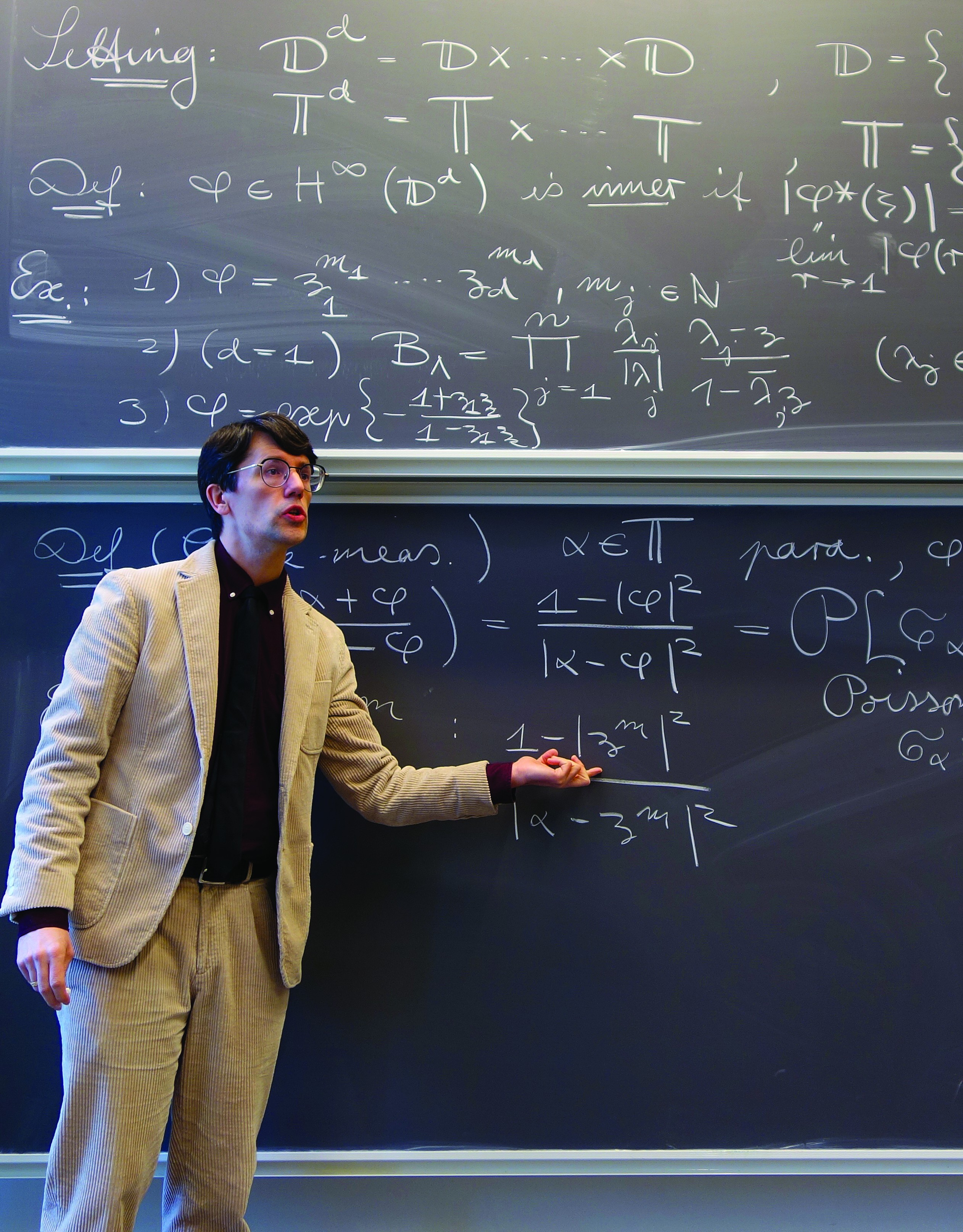
Alan Sola is a Lecturer in the Department of Mathematics at Stockholm University's Faculty of Science, where he serves as Head of the Division of Mathematics. His office is located in Room G1359 at Building 1, Albano campus, and he can be reached at sola@math.su.se or by phone at +46 8 16 45 23. Dr. Sola's research program centers on mathematical analysis with particular emphasis on complex analysis, harmonic analysis, operator theory, probability theory, and dynamical systems. His work examines rational inner functions from multiple perspectives including Clark measures, singularities, level curve portraits, and connections to stable polynomials. He has established significant collaborations with researchers like K. Bickel, J.E. Pascoe, and G. Knese, resulting in numerous publications in top mathematical journals. His recent publications (2021-2025) reveal a cohesive research trajectory focused on multivariable complex analysis, particularly examining rational inner functions and their properties across different mathematical contexts. This work bridges pure analysis with applications in operator theory and dynamical systems, demonstrating both theoretical depth and interdisciplinary relevance. Dr. Sola actively supervises graduate students at multiple levels. His current PhD student is Hampus Nyberg (expected graduation 2028). Former PhD students include Eleftherios Theodosiadis (2024) who researched "Geometry of multi-slit Loewner chains and semigroups of finite shift" and Linus Lidman Bergqvist (2023) who investigated "Holomorphic functions in polydiscs and measures on the distinguished boundary." He has also guided Master's students including David Appelgren (2025), Nell P. Jacobsson (2023), and Linus Lidman Bergqvist (2017), several of whom have co-authored publications with him. As an educator, Dr. Sola has taught advanced graduate courses including Quasiconformal maps (fall 2023), Complex Dynamics (fall 2021), and Geometric Function Theory (fall 2020 and spring 2018). His teaching materials and lecture notes demonstrate his commitment to making sophisticated mathematical concepts accessible to students. He has also participated in significant conferences such as the upcoming Operators on analytic function spaces meeting at CIRM (France) in December 2024.
Matthew Peter Anderson is an Associate Professor and Principal Investigator at Beth Israel Deaconess Medical Center , with Harvard Medical School affiliations in their Ph.D. Program. His research spans neuropathology , genetic neurological disorders , and molecular mechanisms of epilepsy/autism . Director of Neuropathology, Beth Israel Deaconess Medical Center Faculty, Harvard Medical School Ph.D. Program Research Interests His work focuses on: Cell Biology of Neurons & Glia Gene Expression in Neurological Diseases Synapse Function & Plasticity Systems Neuroscience of Autism and Epilepsy Key Discoveries Dr. Anderson's lab identified: First human genetic epilepsy model with defective synaptic pruning (Nature Medicine 2009) Molecular convergence of UBE3A and seizure-induced effects via Cbln1 repression (Nature 2017) Thalamic-specific sleep disorder mechanisms (PNAS 2005) Scientific Recognition International Distinguished Dissertation Award (HHMI Investigator Michael Welsh collaboration) Experimental Expertise Leverages cutting-edge methods like: Cre-loxP conditional genetics Chemogenetics & optogenetics Brain slice electrophysiology Protein interaction network analysis AAV viral vector gene therapy
Ernest Diez Benavente is an Assistant Professor affiliated with the Utrecht University Medical Center , specializing in the Circulatory Health strategic program. His research focuses on cardiovascular pathology, atherosclerosis, and advanced tissue modeling techniques. Recent publications highlight his work in: Myocardial slice culture and patient-specific cardiac modeling Proteomic and transcriptomic analysis of atherosclerotic lesions Genomic studies of infectious diseases like malaria Sex-based differences in heart failure progression His articles demonstrate interdisciplinary approaches combining molecular biology, bioinformatics, and clinical cardiology. No specific awards, students, or laboratory affiliations are mentioned in the provided texts.
Linda van Laake (MD, PhD) is a Full Professor in Cardiology at Utrecht University and the University Medical Center Utrecht, Netherlands. She leads research in cardiac regeneration using stem and progenitor cells while maintaining a clinical role as a specialized cardiologist in heart failure. Her work bridges fundamental cardiac development studies with translational applications. Educational Background: Medical Degree: Maastricht University PhD: Utrecht University (Cardiac Recovery by Stem and Progenitor Cells) Research Focus: Her lab investigates mechanisms of myocardial repair, inherited cardiomyopathies, and molecular therapies for heart failure. Key themes include stem cell integration, living myocardial slice modeling, and improving outcomes for heart transplant patients. Scientific Contributions: Recent publications emphasize 3D cardiac tissue modeling (2025), clinical applications of endomyocardial biopsies, and mechanical support strategies for cardiogenic shock. Collaborations span Gladstone Institutes (UCSF), Hubrecht Institute, and European Society of Cardiology programs. Honors & Funding: UMCU Clinical Research Talent Fellowship Jacob Jongbloed Talent Society grant for HFpEF/metabolic syndrome research Novartis postgraduate education grant Netherlands Heart Foundation Dekker grant Leadership Roles: She contributes to professional societies as a board member of the Heart Failure Working Group (Netherlands Heart Institute) and connects clinical cardiologists with research initiatives.
Professor Nico van den Berg is a Full Professor at the University Medical Center Utrecht, leading the Computational Imaging group within the Centre of Image Sciences. His research focuses on advancing MRI diagnostics and therapy through interdisciplinary expertise in MR physics, mathematics, computing, and artificial intelligence. Primary Affiliation: Centre of Image Sciences, University Medical Center Utrecht External Role: Scientific Advisor at PrecorDx His research initiatives target high-precision cancer and cardiovascular disease detection, prediction, and treatment. Key projects include: Development of MR-STAT for quantitative MRI in reduced scan times Integration of AI with MRI for personalized radiotherapy planning Hardware engineering for MRI-linac compatibility Respiratory motion compensation in cardiac MRI Publications highlight applications in prostate cancer (PET-MRI fusion), lung cancer (adaptive segmentation), and cardiovascular imaging. Collaborations span multiple strategic programs including Cancer, Brain Developmental disorders, and Image-Guided Therapies.