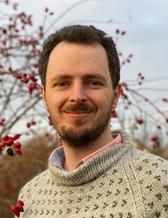
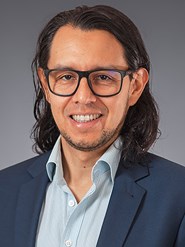
Alexandru Dura is a Doctoral Student and Researcher at the Department of Computer Science, Faculty of Engineering, Lund University. He is affiliated with the ELLIIT initiative (Linköping-Lund) on IT and mobile communication and serves as a Profile Area Member for AI and Digitalization at LTH. His work bridges theoretical program analysis with practical software development needs through declarative approaches. His research focuses on static program analysis, bug pattern detection, and declarative specification languages, with emphasis on incremental evaluation techniques. Key contributions include developing Clog for C static code checkers and JavaDL for Java bug pattern detection, which optimize analysis efficiency through automatic incrementalization. His fingerprint highlights expertise in Syntactics (100%), Pattern Matching (90%), and Specification Languages (50%). Recent publications demonstrate a clear trend toward fully declarative frameworks that simplify static analysis tool development while maintaining performance. His work addresses real-world challenges in program verification, particularly for performance-critical systems where traditional analysis methods become computationally prohibitive. Dura leads the active dissertation project "Performance bug detection through combined static and dynamic program analysis" (funded since October 2018), collaborating with Professor Carl Reichenbach. This research integrates multiple analysis techniques to identify subtle performance issues in software systems.
Graham Leigh is a Professor at the University of Gothenburg's Department of Philosophy and Logic. His primary research focuses on mathematical logic, proof theory, and modal logic, with significant contributions to cyclic proofs, theories of truth, and realisability semantics. He has collaborated extensively with researchers like Bahareh Afshari and Daichi Hayashi on foundational topics in logic and formal systems. Recent work emphasizes advancing proof systems for modal µ-calculus, exploring non-wellfounded proof structures, and analyzing truth theories within intuitionistic frameworks. His publications often bridge theoretical logic with applications in computer science, particularly in automated reasoning and program verification. Leigh's research also investigates the interplay between syntax and semantics in paradoxical contexts, contributing to the understanding of self-referential systems and their foundational limitations. He maintains an active publication record in top-tier journals and conferences such as the Journal of Symbolic Logic and Advances in Modal Logic .
Thierry Coquand is a Professor at the University of Gothenburg, affiliated with the Department of Logic and Types (LT). His research focuses on foundational aspects of mathematics and computer science, particularly in type theory, constructive mathematics, and formal systems. He actively collaborates with international researchers in areas like homotopy type theory, categorical semantics, and algebraic logic. His academic contributions include pioneering work on cubical type theory, univalent foundations, and synthetic approaches to algebraic geometry. Coquand has published extensively in top journals such as Logical Methods in Computer Science and Mathematical Structures in Computer Science . Research interests span foundational questions in proof theory, constructive algebra, and the interplay between type systems and programming language semantics. His work bridges theoretical computer science and mathematical logic, emphasizing computational interpretations of abstract structures.
Andreas Brannstrom is a Postdoctoral Fellow at the Department of Computing Science, Umeå University, Sweden, conducting research on formal and neuro-symbolic methods for trustworthy, human-centered artificial intelligence. His work spans theoretical foundations in knowledge representation to applied verification of interactive systems and intelligent decision support. His research focuses on formal verification of human-agent interaction, neuro-symbolic AI integration, and ethical AI development. Key methodologies include Answer Set Programming (ASP), formal argumentation, and Description Logic (DL), targeting applications in deception detection, computational empathy, and behavior-change systems. Recent work emphasizes security in information-seeking dialogues and socio-technical aspects of AI deployment. Analysis of his 2023-2025 publications reveals a dominant trend in verifying social engineering vulnerabilities through formal methods, with significant contributions to machine ethics ontologies and multicultural affective computing. His research consistently bridges theoretical AI frameworks with real-world applications in healthcare, industrial logistics, and public safety. Brannstrom is affiliated with Umeå University's Agents and Reasoning Group, Formal Methods for Trustworthy Hybrid Intelligence, and Responsible Artificial Intelligence research groups. His active projects include "Strategic Argumentation to deal with interactions between intelligent systems and humans" (2020-2024) and "Collaborative mixed-reality aid for children with autism" (2019-2020), demonstrating commitment to socially impactful AI research.
Esteban Guerrero Rosero is an Associate Professor in Social-Aware Artificial Intelligence at the Department of Computer Science, Umeå University (Sweden). His work bridges multi-agent systems , knowledge representation , and neuro-symbolic methods to develop trustworthy hybrid intelligence systems. He has co-led multidisciplinary projects in Sweden and Finland, focusing on AI applications in health , economics , and sports . Education: Ph.D. in Computer Science, Umeå University M.Sc. in Computer Science, Malmö University B.Eng. in Electronics and Telecommunications, University of Cauca (Colombia) His research emphasizes software agents and non-monotonic reasoning to model human activities in domains like health informatics and ambient intelligence . By integrating argumentation frameworks and neuro-symbolic approaches , he develops systems that adapt to social and behavioral contexts, with applications in digital coaching and behavior change interventions . Recent publications highlight trends in value-based decision-making , financial robo-advisors , and AI regulations , reflecting his focus on trustworthy AI and ethical reasoning . His work often involves cross-disciplinary collaboration , particularly in healthcare and personalized systems. Guerrero Rosero has led the Formal Methods for Trustworthy Hybrid Intelligence research group since 2019. He is involved in projects like STAR-C (2018–2024), Socially Intelligent Autonomous Systems (2017–2019), and NTC - Nordic Telemedicine Center (2015–2018), aiming to create AI systems that support human activities in complex social contexts.
Daniel Gnad is an Assistant Professor at Linköping University's Department of Computer Science (IDA), working within the Artificial Intelligence and Integrated Computing Systems (AIICS) division. He specializes in "Planning and model checking" within artificial intelligence, focusing on theoretical foundations and algorithmic approaches to complex planning problems. Dr. Gnad completed his Computer Science studies at Saarland University, earning his MSc before continuing as a PhD student under Prof. Jörg Hoffmann. In 2022, he joined the RLPLab at Linköping University as a postdoctoral researcher, becoming an assistant professor in 2023. His research primarily centers on AI planning, model checking, and decoupled state-space search methodologies. His recent publications demonstrate significant advancements in planning algorithms, pattern databases, and numeric planning techniques. Gnad's work bridges theoretical computer science with practical applications in artificial intelligence, particularly in developing more efficient search algorithms for complex planning problems. His research often involves transforming planning problems into more tractable forms through abstraction techniques and novel search topologies. Dr. Gnad has received numerous prestigious awards recognizing his contributions to the field: ICAPS 2022 Best Dissertation Award for "Star-Topology Decoupled State-Space Search in AI Planning and Model Checking" SoCS 2022 Best Paper Award for "Additive Pattern Databases for Decoupled Search" SPIN 2018 Best Paper Award for "Star-Topology Decoupling in SPIN" Dr.-Eduard-Martin-Preis for the best dissertation of the Faculty for Mathematics and Computer Science in 2021 Multiple recognitions at the International Planning Competition (IPC) 2018 for the "Saarplan" planning system As a researcher at AIICS, Dr. Gnad contributes to Linköping University's strong position in artificial intelligence research. His work is part of the broader research activities within the Wallenberg Autonomous Systems Program (WASP), one of Sweden's largest research initiatives. While specific details about his advisees aren't provided in the available information, his research group likely contributes to the department's doctoral programs in computer science. Dr. Gnad's laboratory work focuses on developing and analyzing planning algorithms, with applications ranging from theoretical computer science to practical AI systems. His recent integration of techniques like pattern databases with numeric planning represents an important direction in making planning algorithms more versatile for real-world applications.
Victor Lagerkvist is an Associate Professor at the Department of Computer Science (IDA) , Linköping University, Sweden. He is affiliated with the Theoretical Computer Science Laboratory (TCSLAB) and the Artificial Intelligence and Integrated Computing Systems (AIICS) division. His research focuses on the algebraic method for analyzing computational complexity , particularly in constraint satisfaction problems (CSPs), SAT, and graph homomorphism problems. PhD in Computer Science (2016, Linköping University) Habilitation (2020, Linköping University) His recent work investigates fine-grained complexity , twin-width , and universal algebra to improve algorithms for NP-hard problems. Publications span topics like propositional abduction, Allen's interval algebra, and semiring-based dynamic programming. His scientific awards include the Swedish Research Council Starting Grant (2020) and the 2017 Young Researcher Prize from the Ruth and Nils-Erik Stenbäck Foundation. He supervises PhD students such as Leif Eriksson and serves as a secondary supervisor for others at Linköping University and Université de Lorraine.
Daniel Varro is a Professor and Head of Unit at the Department of Computer Science (IDA) of Linköping University, Sweden. He leads the Software and Systems (SAS) department, focusing on AI, software engineering, and cyber-physical systems. His research is supported by major grants like the Vinnova 5.6 million SEK project for AI-generated software quality assurance. Affiliation: Department of Computer Science (IDA), Linköping University Department: Software and Systems (SAS) Research Focus: Model-based systems, large language models for code analysis, reinforcement learning, and cyber-physical safety verification. His recent work includes empirical studies on machine learning notebooks, infrastructure code smells, and data leakage in large language models. He collaborates extensively within the Wallenberg Autonomous Systems Program (WASP) and trains doctoral students in software engineering.
Joel Brynielsson serves as an Associate Professor at KTH Royal Institute of Technology within the Division of Theoretical Computer Science, School of Electrical Engineering and Computer Science, while simultaneously holding the position of Research Director at the Swedish Defence Research Agency (FOI) since 2008. His academic credentials include a Ph.D. in Computer Science (2006) and M.Sc. in Computer Science and Engineering (2000), both from KTH, followed by achieving Docent (Habilitation) status in Computer Science in 2015. Dr. Brynielsson's research spans uncertainty management, information fusion, probabilistic expert systems, command and control systems, operations research, game theory applications, web mining, privacy-preserving data mining, and cyber security. His work bridges theoretical computer science with practical security applications, particularly in national defense contexts. His recent publication record shows consistent scholarly output through 2024, with research focusing on cybersecurity practices in Swedish administrative authorities, cyber-threat perception in the financial sector, and social media applications for crisis management. The interdisciplinary nature of his work is evident in collaborations across security, defense, and emergency management domains. Associate editor for Springer Security Informatics journal Technical program chair for IEEE EISIC conferences (2013-2019) Regular reviewer for security and informatics journals Research funding from EU, Swedish Armed Forces, and public authorities Through his dual appointments, Dr. Brynielsson maintains a vital connection between academic research and practical defense applications, contributing significantly to both scholarly knowledge and real-world security solutions.
Yifei Jin is a WASP Industrial PhD student at KTH Royal Institute of Technology's School of Electrical Engineering and Computer Science, specifically within the Division of Theoretical Computer Science. They are supervised by Professor Aristides Gionis and Associate Professor Sarunas Girdzijauskas at KTH, and also serve as an Experienced Researcher at Ericsson Research and a Visiting Researcher at Yale University under Rex Ying and Leandros Tassiulas. Yifei's research focuses on graph mining , network analysis , and graph representation learning , particularly applied to crowdsourcing data and wireless communication systems. Their work intersects telecommunications network optimization machine learning for graph-structured data AI-driven wireless resource management edge computing and distributed AI as evidenced by their publications spanning 2017–2025. Their academic contributions include 15 recent papers exploring topics such as neural surrogates for voltage drop estimation, wireless ray-tracing models, scalable distributed AI deployment, and vehicle platooning coordination. These publications demonstrate expertise in network traffic reduction KPI conflict analysis graph convolutional networks hyperbolic embeddings for ontologies real-time network diagnostics .
Karl Meinke is a Professor at KTH Royal Institute of Technology, where he serves as Head of the Computer Science Department and Head of the Division of Theoretical Computer Science within the School of Electrical Engineering and Computer Science. His research focuses on applying machine learning techniques to software testing, particularly for safety-critical systems like autonomous vehicles and embedded systems. His research interests span machine learning, software testing, safety critical systems, embedded systems, autonomous driving, digital pathology, and graph neural networks. Meinke has developed innovative approaches like Learning-Based Testing that combine machine learning with formal methods for system validation. His work bridges theoretical computer science with practical applications in automotive systems and medical diagnostics. His recent publications show a strong trend toward applying graph neural networks to diverse domains including program analysis, digital pathology, and autonomous vehicle testing. His research demonstrates a consistent focus on solving the test oracle problem and generating meaningful test cases for complex systems where traditional testing approaches fall short. Meinke actively collaborates with Karolinska Institutet (KI), indicating interdisciplinary work between computer science and medical research. He is responsible for Masters level education in software testing at KTH and serves as examiner for several advanced courses including Degree Projects in Computer Science and Software Reliability. His research group has developed tools like LBTest for learning-based testing of reactive systems, and he has secured funding for projects such as the ITEA3 Testomat Project focused on next-level test automation. His work has significant implications for validating autonomous systems where safety is paramount. Meinke leads research in using machine learning to address fundamental challenges in software testing, particularly for systems where traditional test oracles are unavailable or impractical. His approach of combining active learning with formal specifications has created new pathways for validating complex cyber-physical systems.
Karl Norrman is an Industry doctoral student and Researcher at the Department of Theoretical Computer Science (TCS) at KTH Royal Institute of Technology, concurrently working as a Security Researcher at Ericsson Research since 2001. His academic appointment at KTH is part-time (20% time allocation), while he spends the majority of his time (80%) at Ericsson, where he holds the formal title of Expert Mobile Network Security. He is supervised by Professor Mads Dam for his doctoral studies and receives partial research funding from the Wallenberg AI, Autonomous Systems and Software Program (WASP). His educational background includes: PhD candidate in Computer Science at KTH Royal Institute of Technology, Department of Theoretical Computer Science (ongoing). Research focuses on formal modeling and proofs for cryptographic protocols using pen-and-paper proofs and mechanized proof-support tools such as Tamarin and EasyCrypt. Master's degree in Computer Science from Stockholm University, Department of Mathematics (2001). Thesis: "RTP Security in 3G Networks." During this work, he contributed to the development of the Secure Real-time Transport Protocol (SRTP), standardized in IETF as RFC 3711. Norrman's research centers on formal methods for security protocol verification , with particular expertise in cryptographic protocol analysis, modeling, and mechanized proof techniques. His work bridges theoretical computer science and practical security applications, focusing on making formal verification tools accessible for industrial adoption. Key research areas include 5G/6G security architectures, privacy-preserving mechanisms for mobile networks, authentication and key agreement protocols, and software security. He advocates for "goal oriented and motivated security designs" that balance theoretical rigor with practical implementation constraints while specializing in translating complex security requirements into implementable solutions for telecommunications infrastructure. Analysis of Norrman's publication history reveals a consistent evolution from foundational work on SRTP (2002-2007) through LTE security analysis (2014-2015) to pioneering 5G security research (2016-2020) and now 6G security exploration (2024). His work demonstrates methodological progression from analyzing existing protocols to designing novel security mechanisms and developing verification frameworks like OpenSAW. A distinctive pattern is his focus on industrial applicability —ensuring theoretical security models translate to real-world implementations, particularly evident in his work on USIM-compatible protocols and error-correcting authentication for noisy wireless channels. Recent publications increasingly address cross-domain challenges like secure federated learning in mobile networks, reflecting the expanding scope of telecommunications security. Professional engagement: Reviewer for ACM CCS 2023, EURO S&P 2023, ACM CCS 2022, NordSec 2022, Vietcrypt 2006, IEEE Telecommunications Journal Active contributor to 3GPP security standardization processes Co-author on multiple Ericsson whitepapers shaping industry security practices Norrman maintains a unique dual affiliation that enables direct translation of academic research into industrial security solutions. At KTH, he contributes to the Theoretical Computer Science group's formal methods research, while at Ericsson he applies these techniques to real-world security challenges in mobile network development. His work on OpenSAW exemplifies this bridge between academia and industry, creating practical tools for automated security testing of component-based software systems. This position allows him to identify emerging security challenges in next-generation networks while maintaining theoretical rigor in his approach.
Bengt Lennartson is a Professor of Automation at Chalmers University of Technology and Head of the Department of Systems and Control Engineering. His research focuses on automation engineering, sustainable production, robotics, and energy optimization, with over 280 international publications. Collaborations include industry leaders like Volvo, Daimler, Kuka, and TetraPak. IEEE Fellow for contributions to automation systems Specializes in hybrid/discrete-event systems Develops energy optimization strategies for robotic production lines Recent work explores Plug-and-Produce systems , digital twin calibration , and stochastic energy optimization in robotics. His team integrates AI with formal methods for safety verification and develops open-source educational tools like biomedical exoskeletons. Scientific awards include IEEE Fellowship , with articles addressing energy-efficient robot trajectories, safety-aware multi-agent control, and formal verification of cyber-physical systems.
Robin Adams is a Lecturer at Chalmers University of Technology, affiliated with the Logic and Types research group in Gothenburg, Sweden. Their work focuses on theoretical aspects of computer science, particularly in logic, type theory, and programming language foundations. Their research interests include: Logic in computer science Type systems and theory Programming language semantics Formal methods Theoretical computer science Robin Adams can be contacted via email at robinad@chalmers.se. The visiting address is Rännvägen 6 B, 412 58 Gothenburg, with postal address Box 100, 412 96 Gothenburg. As a member of the Logic and Types research group, Robin Adams contributes to Chalmers' strong tradition in theoretical computer science research, which has been internationally recognized for work in areas such as type theory and formal verification.