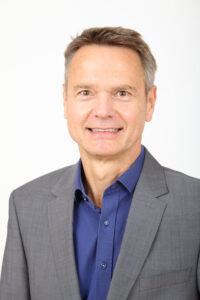
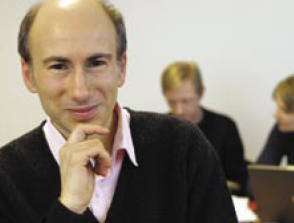
Ao.Univ.Prof. Dipl.-Ing. Dr.techn. Franz Puntigam is an Associate Professor at the Department of Compilers and Languages within the Faculty of Informatics at Technische Universität Wien. His research focuses on programming paradigms, type systems, object-oriented programming, and concurrent programming. He teaches courses such as Programming Paradigms, Type Systems, and Scientific Research and Writing. Dr. Puntigam’s work explores foundational aspects of programming languages, emphasizing concurrency and type system design. His research includes studies on synchronization mechanisms, contextual execution environments, and design methodologies for robotic software systems. His publications span topics like token-based synchronization, dynamic process types, and aliasing effects in object-oriented languages. He supervises numerous diploma and master’s theses on advanced topics such as concurrency in Java, type systems for configuration languages, and actor-based programming. His contributions to education and research are further reflected in his involvement with projects like migrating business software from VB to Java/Unix.
Florian Zuleger is an Associate Professor at TU Wien's Department of Formal Methods in Systems Engineering (E192-04). He has a 100% research focus and serves as Curriculum Coordinator for the Master’s program in Verification and Automated Reasoning. His work emphasizes automated methods for termination analysis, resource-bound estimation, verification of programs with dynamic data structures, parameterized systems, and automated feedback for introductory programming tasks. He has led projects funded by the European Commission (2024–2027), Austrian Science Fund (FWF), Amazon Research Awards, and Vienna Science and Technology Fund. Research Interests: Automated Program Verification Formal Methods for Concurrent Systems Separation Logic and Decision Procedures Resource and Complexity Analysis Parameterized Model Checking Inductive Logic in Verification Grants & Advising: Zuleger’s recent grants explore verification of safety-critical applications and automated cost analysis. He has advised numerous students on topics ranging from verified data structures to fault-tolerant algorithms. His projects include collaboration with Amazon, the European Commission, and FWF. Labs/Teams: Involved with the LogiCS Research Group, focusing on logical methods in computer science, and contributes to tool development (e.g., ATLAS, SpecBMC, SL-COMP competitions).
Stefan Szeider is a full professor and chair of the Algorithms and Complexity Group at the Faculty of Informatics, Technische Universität Wien (TU Wien). He also serves as a visiting scientist at UC Berkeley's Simons Institute for the Theory of Computing. His academic journey includes positions at the University of Durham (UK) and the University of Toronto (Canada), and he earned his Mathematics PhD from the University of Vienna in 2001. Dr. Szeider's research focuses on designing efficient algorithms for problems in Artificial Intelligence, automated reasoning, and combinatorial optimization. He leads several initiatives, including the Vienna Center for Logic and Algorithms (VCLA), and has secured funding from the ERC, EPSRC, FWF, and others. His Erdős number is 2, reflecting his collaborative network in mathematics and computer science. Key achievements include the first ERC Starting Grant awarded to an Austrian computer scientist (2009), and awards such as the Highlighted Paper Award at SAT 2023 and Best Paper at CP 2020. He advises numerous PhD students and postdocs, fostering the next generation of researchers in algorithms and complexity. Notable contributions extend beyond academia to public outreach, including initiatives like the 'Algorithms Think Differently' educational program and the 'Algorithms in 60 Seconds' video competition. His work bridges theoretical foundations and practical applications, influencing both academic and real-world computational challenges.
Leroy Nicholas Chew is a PostDoc Researcher and FWF Projektassistent at the Vienna University of Technology (TU Wien). He is affiliated with the Department of Algorithms and Complexity within the Faculty of Informatics. His roles include contributing to research projects such as QBFPC (2022–2025), Overcoming Intractability in the Knowledge Compilation Map, and REVEAL-AI (2020–2024). These projects reflect his focus on advancing theoretical computer science and automated reasoning methodologies. While specific educational details are not explicitly provided in the text, Leroy Nicholas Chew holds a PhD, as indicated by his role listing. His current position suggests a strong background in computer science and theoretical foundations, consistent with his research activities. His research interests span several key areas in theoretical computer science, including proof complexity, quantified Boolean formulas (QBF), automated reasoning, and knowledge compilation. He explores the hardness of computational problems in logical frameworks, such as analyzing resolution and CDCL proof systems, developing optimal dual proof systems for answer set programming (ASP), and investigating model counting techniques. His work often bridges foundational theory with practical applications in formal verification and algorithm design. Recent publications (2024) highlight advancements in circuits and proofs, model counting, and ASP-QRAT proof systems. Earlier work (2016–2022) addressed QBF resolution calculi, dependency schemes, and certification challenges. These trends underscore his specialization in formal methods and computational logic. No scientific awards are explicitly mentioned in the provided text. In addition to his research, Chew is involved in multiple funded projects. These include the FWF-supported QBFPC (2022–2025), which examines QBF proofs and certificates, and the REVEAL-AI project (2020–2024), focusing on overcoming intractability in knowledge compilation. While specific grant details beyond project funding are not mentioned, his participation underscores his role in collaborative, grant-funded research initiatives. No formal advisees are listed. Chew is part of the Algorithms and Complexity department at TU Wien, collaborating on projects that emphasize proof systems, formal verification, and algorithmic foundations. His work integrates theoretical insights with practical computational methods.
Michele Chiari is a PostDoc Researcher at TU Wien's TrustCPS Group led by Prof. Ezio Bartocci. Previously, he was a PhD candidate and PostDoc at Politecnico di Milano's DEIB in the DeepSE group. His primary affiliations include TU Wien and the TrustCPS group, with a focus on formal verification and cyber-physical systems. Education: PhD candidate and PostDoc at Politecnico di Milano's Department of Electronics, Information, and Bioengineering (DEIB). Research interests include formal methods for safety-critical systems, temporal logic, automata theory, model checking for recursive probabilistic programs, infrastructure-as-code modeling (DOML), floating-point computation verification, and approximate computing. Research highlights: Development of POTL (Probabilistic Operator Temporal Logic), model checkers for operator precedence languages (POMC), and contributions to the PIACERE and CORPORA projects. His work bridges theoretical formal methods with practical applications in software engineering and embedded systems. Key projects include leadership of the EU-funded MSCA PF CORPORA project (2023–present) and contributions to the PIACERE H2020 initiative. Collaborations include tools like TAFFO (floating-point precision tuner) and DOML (Infrastructure-as-Code modeling framework). Labs/Teams: Core member of TU Wien's TrustCPS Group and former contributor to Politecnico di Milano's DeepSE Group. Active in conferences like CAV, RV, and CAiSE, with recent service roles on OOPSLA and RV program committees.
Mark Jonathan Chimes is a Researcher in the Department of Formal Methods in Systems Engineering at Vienna University of Technology (TU Wien). He holds the role of PreDoc Researcher and is affiliated with the E192-04 institute. His work focuses on formal methods, programming semantics, and logic-based systems engineering. Chimes teaches the course 'Semantics of Programming Languages' (2025S) as a VU (lecture with exam). His research includes contributions to graph grammars and their applications in formal verification, as evidenced by his 2024 publication in the Conference on Logic for Programming, Artificial Intelligence, and Reasoning (LPAR). He can be contacted at mark.chimes@tuwien.ac.at and is located at Favoritenstrasse 9, Room HA0309.
Luca Di Stefano is a Post-Doc Researcher at Technische Universität Wien (TU Wien) since March 2024. His research focuses on the specification and verification of complex collective systems like multi-agent systems and robot swarms, using formal methods such as model checking and reactive synthesis. He works on online formal techniques including runtime monitoring. Research Interests: Software verification Model checking Multi-agent systems Formal semantics Process calculi Reactive synthesis Static analysis Recent Article Trends: His work spans formal verification of reconfigurable systems, emergent behavior in collective systems, and synthesis techniques for infinite-state models. Keywords include Agent-Based Modelling, Formal Methods, Temporal Logic, and Runtime Monitoring. Thesis Supervision: He supervises BSc and MSc theses at TU Wien, with Ezio Bartocci as main advisor. Examples include "Type checking a novel language for reconfigurable multi-agent systems" (Benjamin Stolz, 2025) and "Evaluating in-memory caching strategies" (Love Lyckaro, 2023). Teaching: He teaches courses like "Scientific Research and Writing" and "GPU Architectures and Computing" at TU Wien, and has served as teaching assistant for concurrent programming courses at University of Gothenburg and Chalmers. Labs & Projects: He contributes to tools like LAbS (attribute-based stigmergy language), SLiVER (verification tool), R-CHECK (model checking for reconfigurable systems), sweap (symbolic reactive synthesis), and pyxmv (Python interface for nuXmv).
Clemens Eisenhofer is a PreDoc Researcher at TU Wien's Institute of Logic and Computation within the Faculty of Informatics. His role combines doctoral research with active contributions to multiple funded projects, positioning him at the forefront of SMT solver development and formal methods research. His research centers on advancing Satisfiability Modulo Theories through innovations in bit-vector reasoning, non-classical logics, and custom theory integration. Key focus areas include enhancing Z3's capabilities for word-level operations, embedding proof calculi like connection calculus, and developing user-propagator frameworks. These efforts target practical applications in software verification, program analysis, and constraint solving, with direct implications for reliability-critical systems. Eisenhofer actively contributes to four major research initiatives: ARTIST (2021-2026) on automated reasoning foundations; SFB SPyCoDe (2023-2030) for cyber-physical systems verification; TAIGER (2023-2027) in theorem proving; and ForSmart (2023-2027) for smart contract analysis. These projects provide substantial computational resources and foster international collaborations, though he does not currently supervise students given his PreDoc status. His research operates within TU Wien's Institute of Logic and Computation—a leading European hub for formal methods—leveraging institutional expertise in computational logic and strong industry ties. The institute's collaborative environment supports his work on solver extensions while connecting theoretical advances to practical verification challenges across multiple domains.
Markus Fleischmann is a Researcher at the Vienna University of Technology , affiliated with the Faculty of Informatics and the Department of Software Engineering . His work focuses on improving program analyzers through constraint-based testing and formal verification. Role: Researcher (PreDoc) Contact: markus.fleischmann@tuwien.ac.at Project: MirandaTesting (2023–2028): Automated soundness testing of program analyzers Research areas include: Program analysis and testing Constraint-based verification Formal methods in software engineering Markus is based in Room HB0222 at Favoritenstrasse 9, and his recent publications emphasize automated testing frameworks for program analyzers.
Marton Hajdu is a PostDoc Researcher at the Vienna University of Technology , affiliated with the Systems Engineering department under the Formal Methods in Systems Engineering group (E192-04). His research focuses on formal methods , automated reasoning , and inductive logic . He actively contributes to projects such as ARTIST (2021–2026) , ForSmart (2023–2027) , and SFB SPyCoDe (2023–2026) , which explore recursive programming, saturation-based reasoning, and inductive benchmarks. His work intersects superposition calculus , term rewriting , and formal verification . His recent publications highlight advancements in inductive reasoning , recursive program synthesis , and constraint solving using saturation techniques. These contributions align with broader trends in automated deduction and logic programming for computer-aided verification. Marton Hajdu holds a Diploma Thesis from TU Wien (2020) titled Automating inductive reasoning with recursive functions , establishing his expertise in formal methods and recursive logic. He collaborates with researchers like Laura Kovács and Andrei Voronkov , and his work is supported by projects spanning formal reasoning, smart systems, and theoretical computer science.
Christoph Hochrainer is a PreDoc Researcher at Technische Universität Wien, affiliated with the Software Engineering department. His academic role involves research in software systems and formal methods, supported by projects like ForSmart (2023–2027) and MirandaTesting (2023–2028). He completed his Diploma in automated reasoning at TU Wien in 2020. His research spans software engineering, cryptography, and programming languages, with specialized interests in fuzzing techniques, architecture description languages, and smart contract security. Recent work emphasizes zero-knowledge circuits, Solidity benchmarking, and macro systems for domain-specific tooling. Christoph's publications consistently explore automated testing and formal verification, with a trend toward practical applications in blockchain and secure software pipelines. He supervises student theses, including work on inconsistency detection in Solidity smart contracts. He contributes to collaborative projects focused on formal methods and software reliability, operating within TU Wien's research units. No scientific awards are documented.
David Michael Kaindlstorfer is a PreDoc Researcher at the Department of Software Engineering, Faculty of Informatics, Vienna University of Technology (TU Wien). He holds the academic rank of Researcher and teaches courses including Advanced Software Engineering (194.187) and Software Engineering (194.020) for the 2025W semester. His research centers on program analysis and software testing, with specific expertise in developing constraint-based test oracles and interrogation testing methodologies to address soundness and precision issues in static program analyzers. He also investigates symbolic execution enhancements for shape analysis of C programs, particularly focusing on linked data structures and memory safety verification. Current work is anchored in the MirandaTesting project (2023-2028) , which pioneers novel testing frameworks for program analysis tools. Kaindlstorfer’s recent publications at ASE 2024 demonstrate a clear research trajectory toward improving the reliability of automated program analysis through innovative testing strategies. His work bridges theoretical advancements in symbolic execution with practical applications in software verification, particularly for low-level systems programming. As a core contributor to the MirandaTesting initiative, he collaborates on developing infrastructure for large-scale interrogation of program analyzers. His technical role involves designing constraint-based oracle mechanisms and refining abstraction techniques for complex heap structures.
Markus Kirchweger is a PreDoc Researcher at the Department of Algorithms and Complexity, Faculty of Informatics, Technische Universität Wien. His work spans Satisfiability (SAT) solving, graph theory, and combinatorial optimization, with a focus on symmetry breaking and SAT modulo theories. Research Interests: Developing SAT-based frameworks for graph generation and enumeration Dynamic symmetry breaking in combinatorial problem encodings Integrating user propagators into CDCL solvers Applying SAT techniques to conjectures like Erdős-Faber-Lovász and Rota’s Basis Co-certificate learning and shortest common supersequence optimization Projects: INCR (2021–2024), REVEAL-AI (2020–2024), SLIM (2019–2024), ASK-SAT (2024–2027).
Luca Aceto is a Full Professor at Reykjavik University's Department of Computer Science since 2004. He has held leadership roles, including President of the European Association for Theoretical Computer Science (2012–present) and Head of the Department of Computer Science at Reykjavik University (2007). His research focuses on concurrency theory, logic in computer science, and formal verification. Aceto has received notable awards, including the Reykjavik University Research Award (2012) and induction into the Icelandic Academy of Sciences (2012). Research Interests: Concurrency theory, process algebra, structural operational semantics, modal and temporal logics, and computational complexity of verification problems. Awards: Multiple teaching awards at Aalborg University, Distinguished Dissertation Award (1991), and leadership roles in prestigious academic organizations. Professional Activities: Over 60 program committee roles, co-chairing ICALP and CONCUR, and editorial board memberships. Aceto’s work bridges theoretical foundations with practical verification challenges, contributing to formal methods and concurrency theory. His publications span journals, conferences, and textbooks, including a widely adopted textbook on reactive systems.
Nachum Dershowitz is a Full Professor at the School of Computer Science, Tel Aviv University, with a career spanning institutions like the University of Illinois at Urbana-Champaign, Microsoft Research, and the Weizmann Institute. His research bridges theoretical computer science, computational logic, and digital humanities. Fields: Rewrite systems, termination proofs, automated reasoning, program verification, computational linguistics Awards: Herbrand Award (2011), Test-of-Time Award (2006), Chair in Computational Logic (2012) Grants: NSF, ISF, Intel, Google, Israeli Ministry of Science His work on historical manuscript analysis combines computer vision with natural language processing, while his contributions to term rewriting systems have shaped automated deduction. He has edited volumes in logic and AI, and served as program chair for major conferences.