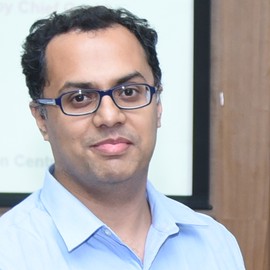
Soumen Chakrabarti is a Professor in the Department of Computer Science and Engineering at Indian Institute of Technology Bombay. His work bridges graph theory, natural language processing, and knowledge representation, focusing on scalable solutions for complex information retrieval problems. He has held visiting positions at Carnegie-Mellon University and Google. Education: B.Tech from IIT Kharagpur, PhD from UC Berkeley Key research areas: Graph Neural Networks, Knowledge Graphs, Code-Switched Text Analysis, Temporal Reasoning His recent publications emphasize neural graph matching , code-switched NLP , and multi-modal QA systems , often integrating symbolic reasoning with deep learning. Awards include the WWW 1999 Best Paper Award and ECML/PKDD 2008 Best Student Paper . He leads projects like CRUSH4SQL for text-to-SQL parsing and CSAW for annotated web search. His lab collaborates with IBM and Google on graph representation learning and temporal knowledge graph completion.
Parag Chaudhuri is a Professor in the Department of Computer Science and Engineering at the Indian Institute of Technology Bombay. His research centers on computer graphics, animation, and virtual reality, developing computational models to replicate real-world phenomena for enriched virtual experiences. His educational background includes: Ph.D. from IIT Delhi under Prem Kalra and Subhashis Banerjee Postdoctoral research at MIRALab, University of Geneva with Nadia Magnenat Thalmann Bachelor's degree in Civil Engineering from Delhi College of Engineering Professor Chaudhuri's research spans Computer Graphics with core focus areas in character/natural phenomena animation, visual data understanding, and 2D/3D content generation. His work integrates computer vision, physics simulation, and machine learning to address challenges in virtual worlds. Specific interests include rendering, modeling, VR/AR systems, and vision-based graphics. Applications extend to medical simulation, entertainment, industrial processes, and digital heritage preservation through physics-driven approaches. Recent publications (2022-2025) reveal strong trends in document analysis for multilingual text recognition (especially Indic scripts), real-time hand/character animation in AR environments, and physics-based fracture/deformation systems. His work bridges graphics with machine learning for practical solutions in visual data processing. At IIT Bombay, he mentors graduate students requiring foundational courses CS675 and CS775. He accepts Ph.D./M.S. candidates through official CSE department procedures but does not offer internships to non-IITB students. He leads a research group advancing computational techniques for virtual world creation, focusing on interactive animation systems and visual data synthesis.
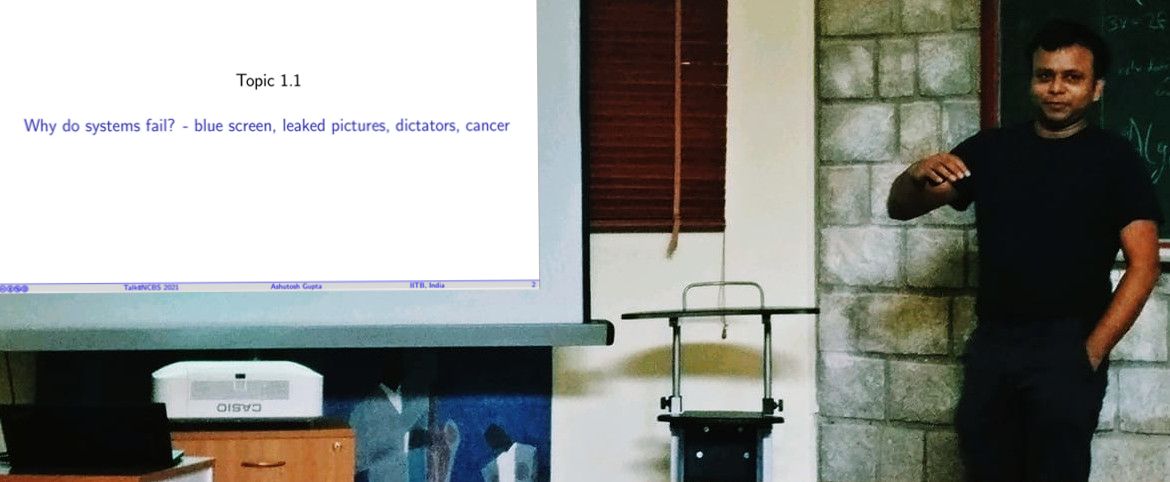
Ashutosh Gupta is an Associate Professor in the Department of Computer Science and Engineering at the Indian Institute of Technology Bombay, where he has been a faculty member since 2018. His research focuses on formal methods for software verification, particularly in the areas of model checking, constraint solving, and automated reasoning for both sequential and concurrent programs. He teaches advanced courses including Automated Reasoning (CS433), Analysis of Concurrent Programs (CS766), and Logic for Computer Science (CS228). Dr. Gupta received his Ph.D. in Computer Science from Technical University of Munich (TUM) in 2011, with affiliations during his doctoral studies at TUM, Max Planck Institute for Software Systems (MPI-SWS), and École Polytechnique Fédérale de Lausanne (EPFL). Prior to joining IIT Bombay, he served as a faculty member at Tata Institute of Fundamental Research (TIFR) in Mumbai and completed post-doctoral research in the Henzinger group at IST Austria. His research interests span formal verification of sequential and concurrent software, modeling of biological systems, and constraint solving including constraint logic programming, decision procedures, and automated theorem proving. He has developed several verification tools including VAJRA, HSF, and InvGen. His work bridges theoretical foundations with practical applications, particularly in verifying safety-critical systems and biological processes. Dr. Gupta's publication record shows a consistent trajectory of high-impact research in top venues like POPL, CAV, TACAS, and AAAI. His recent work has expanded into neural network verification, reinforcement learning verification for medical devices, and applying formal methods to biological systems, demonstrating both depth in core verification techniques and breadth in application domains. Best Paper Award at TACAS 2015 Best Paper Award at TACAS 2009 Dr. Gupta actively mentors numerous students through course projects, research presentations, and specialized workshops like SATfest. He has supervised students working on SAT/SMT solvers, verification of concurrent programs, and applications of formal methods to biological systems. His teaching philosophy emphasizes hands-on experience with verification tools and encourages students to engage with cutting-edge research through reading and presenting recent conference papers. He maintains active research collaborations with institutions including TUM, MPI-SWS, EPFL, IST Austria, and TIFR, reflecting his continued integration into the international formal methods research community.
Professor Sri Sivakumar is a faculty member in the Department of Chemical Engineering at the Indian Institute of Technology Kanpur. His research focuses on advanced nanomaterials with applications spanning from energy to biomedical fields. Dr. Sivakumar earned his PhD from the University of Victoria, Canada in 2006, following an M.Sc. (Tech) from the University of Institute of Chemical Technology, Mumbai in 2001, and a B.Sc. from Manomaniam Sundaranar University in 1993. His educational background also includes a B.Sc. (Tech) from the University of Institute of Chemical Technology, Mumbai in 1997. His research interests center around the synthesis and characterization of nanomaterials, with specific expertise in layer-by-layer assembly techniques, bioimaging applications, drug delivery systems, photoelectrochemical water splitting, and understanding nanomaterial growth mechanisms. His work bridges fundamental materials science with practical applications in healthcare and sustainable energy. Analysis of his recent publications reveals a strong focus on nanomaterials for both energy and biomedical applications. His research shows consistent innovation in nanoparticle synthesis, with particular emphasis on semiconductor heterostructures for catalytic applications and advanced delivery systems for biomedical use. The interdisciplinary nature of his work connects chemistry, materials science, and engineering principles. Class of 1979 Research Fellowship, by IITK Professor Sivakumar maintains an active research program with multiple publications appearing in high-impact journals including ACS Applied Materials & Interfaces, CrystEngComm, RSC Advances, and PLoS ONE. His work demonstrates strong collaboration with researchers across different disciplines and institutions.
Professor Sivakumar is a distinguished faculty member in the Department of Chemical Engineering at the Indian Institute of Technology Kanpur. He holds a PhD from the University of Victoria, Canada (2006), and has established himself as a leading researcher in nanomaterials science and engineering. PhD, University of Victoria, Victoria, BC, Canada, 2006 M.Sc. (Tech), University of Institute of Chemical Technology, Mumbai, 2001 B.Sc., Manomaniam Sundaranar University, Tirunelveli, Tamilnadu, 1993 B.Sc. (Tech), University of Institute of Chemical Technology, Mumbai, 1997 Professor Sivakumar's research spans multiple cutting-edge areas in nanotechnology, with particular emphasis on the synthesis and characterization of advanced nanomaterials. His work bridges fundamental materials science with practical applications in biomedical engineering and energy conversion. He has made significant contributions to the understanding of layer-by-layer assembly techniques, bioimaging methodologies, and drug delivery systems based on nanomaterial platforms. His investigations into photoelectrochemical water splitting represent important work toward sustainable energy solutions. His publication record demonstrates consistent contributions to high-impact journals in materials science and nanotechnology. His research has been recognized with the prestigious Class of 1979 Research Fellowship by IIT Kanpur, highlighting his significant contributions to the academic community. Professor Sivakumar has also contributed to technological development, including a US patent for a lithium-ion battery separator material and generic Monte Carlo software for molecular systems. Class of 1979 Research Fellowship, by IITK Professor Sivakumar maintains an active research program that integrates experimental and computational approaches to address challenges in nanomaterials development. His work has practical implications for healthcare applications through improved drug delivery systems and diagnostic imaging techniques, as well as for sustainable energy technologies through photoelectrochemical water splitting research.
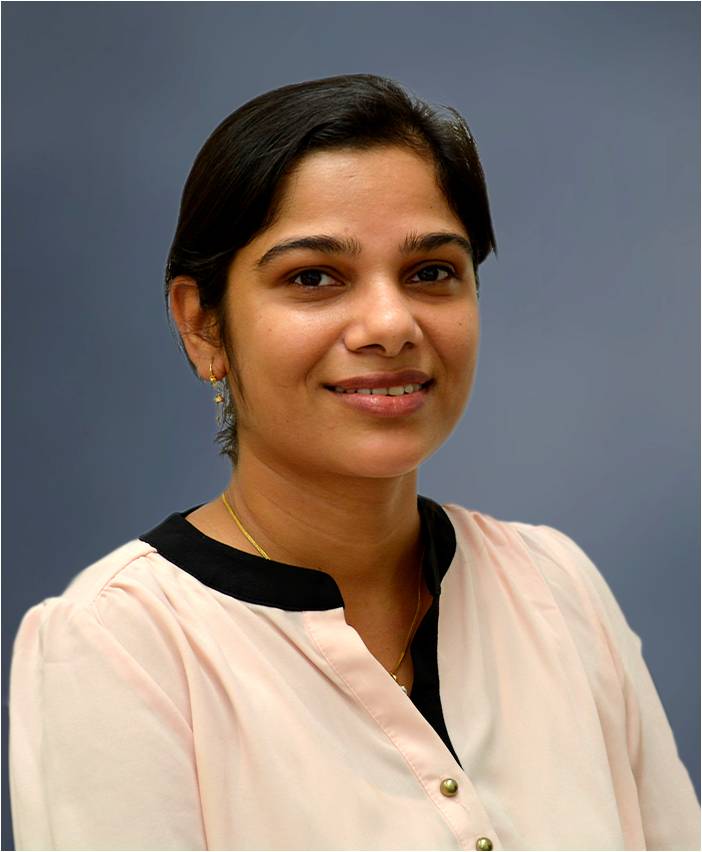
Dipti Gupta is a Professor in the Department of Metallurgical Engineering and Materials Science at the Indian Institute of Technology Bombay (IIT Bombay), where she has been serving since 2011, progressing from Assistant Professor to Associate Professor and then to Professor in 2021. She leads the Plastic Optoelectronics Lab and is actively engaged in research and academic programs at IIT Bombay. Her research centers on flexible and stretchable electronics , organic electronic devices for energy and biomedical applications, and printed electronics . Her work integrates materials science with electronic device engineering to develop innovative solutions for robotics, healthcare, and renewable energy. She explores polymer substrates, thin-film transistors, solar cells, and energy storage systems with a focus on mechanical flexibility and performance stability. The recent publications reflect a strong trend in organic and hybrid electronic devices , particularly in solar cells , thin-film transistors , and flexible memory . Her research emphasizes low-temperature processing , nanomaterial integration , and device stability , contributing significantly to the advancement of printable and wearable electronics. Scientific Awards and Recognitions: No specific awards mentioned in the text. Advising and Grants: She has advised multiple students and researchers involved in her publications. Her research is supported by significant grants from DST-TDB, DST-SERI, INDO-USSTF, Wadhwani Research Center, and IITB Seed Grant, covering projects such as flexible tactile sensors, blood pressure measurement devices, and inkjet-printed solar cells. Labs and Teams: She leads the Plastic Optoelectronics Lab at IIT Bombay, focusing on the development of plastic-based electronic devices using organic, inorganic, and hybrid materials. The lab fosters interdisciplinary collaboration in materials synthesis, device fabrication, and performance characterization.
Pushpak Bhattacharyya is a distinguished Professor in the Department of Computer Science and Engineering at the Indian Institute of Technology (IIT) Bombay. He holds the prestigious title of Abdul Kalam National Fellow and is a Fellow of the National Academy of Engineering (FNAE). His academic leadership extends to roles such as Professor Incharge of the IIT Bombay-Monash Australia Academy and Chairman of the MEITY Committee for Indian Language Standards. Professor Bhattacharyya's research spans multiple domains within computational linguistics and artificial intelligence. His work focuses on Natural Language Processing, Computational Linguistics, Machine Learning, Sarcasm Detection, Sentiment Analysis, Multilingual Processing, and Cognitive NLP. He has made significant contributions to Indian language technology, leading NITI Aayog's initiative on creating an Indian Language NLP stack and Virtual Agents. His recent publications reveal a strong focus on multilingual NLP for Indian languages, bias detection in language models, sarcasm and humblebragging detection, mental health applications of NLP, and code generation. His work bridges theoretical advances with practical applications in education, healthcare, and government services. The research demonstrates increasing integration of cognitive aspects with traditional NLP approaches and a growing emphasis on ethical AI considerations like bias detection and cultural competence. FNAE (Fellow of National Academy of Engineering) Abdul Kalam National Fellow Listed among top 10 Machine Learning Researchers in India Listed among most prolific NLP-ML researchers 2012-17 Professor Bhattacharyya has mentored numerous PhD and Masters students who have gone on to make significant contributions in academia and industry. His research has been supported by various grants from government agencies and industry partners, enabling large-scale projects in Indian language technology and NLP. He has led the development of comprehensive NLP resources for Indian languages and has been instrumental in establishing research collaborations between IIT Bombay and international institutions. He leads a vibrant research group at IIT Bombay focused on Natural Language Processing, with active projects in sarcasm detection, multilingual processing, cognitive NLP, and applications of NLP in healthcare and education. His team has developed several notable systems including those for Indian language translation, sarcasm detection, and mental health analysis through text.
Sandeep K. Shukla is a Professor in the Department of Computer Science and Engineering at the Indian Institute of Technology Kanpur (IIT Kanpur), where he conducts cutting-edge research in formal methods, embedded systems, and cyber security. Previously, he served as Professor at Virginia Tech and held various academic positions including Associate Professor and Assistant Professor at the same institution. Dr. Shukla received his educational foundation from prestigious institutions: PhD in Computer Science from State University of New York at Albany (1997) M.S. in Computer Science from State University of New York at Albany (1995) B.E. in Computer Science and Engineering from Jadavpur University, Kolkata (1991) His research interests span multiple domains within computer science and engineering, with a strong focus on formal verification techniques for system design. Dr. Shukla specializes in applying formal methods to critical infrastructure systems, embedded hardware and software design, and smart grid technologies. His work bridges theoretical computer science with practical engineering applications, particularly in safety-critical domains where reliability is paramount. He has pioneered approaches in model-driven engineering and software synthesis that have influenced industry standards and practices. Dr. Shukla's publication record demonstrates a consistent trajectory of innovation in system-level design methodologies. His work shows a clear progression from foundational research in formal verification to practical applications in critical infrastructure systems. The publications reveal expertise across computer science subfields including embedded systems design, formal methods, hardware-software co-design, and cyber-physical systems. His more recent work focuses on integrating different computational models for complex system design, particularly addressing challenges in smart grid and critical infrastructure security. Dr. Shukla has received numerous prestigious awards recognizing his contributions to the field: IEEE Fellow (2014) for "contributions to applied probabilistic model-checking for system design" ACM Distinguished Scientist (2013) Humboldt Bessel Award (2008) Presidential Early Career Award for Scientists and Engineers (2003) National Science Foundation CAREER Award (2002) Throughout his career, Dr. Shukla has mentored numerous graduate students and secured significant research funding from various sources including the National Science Foundation, US Air Force, and other government agencies. His work on reliability-driven nano-computing led to the development of the NANOPRISM tool, and his contributions to system-level design languages influenced new kernels of the SystemC language. He has collaborated extensively with international research groups, including projects funded by US AFOSR to collaborate with INRIA and the University of Kaiserslautern. Dr. Shukla is actively involved with research centers including the Center for Developing Intelligent Systems (CDIS) at IIT Kanpur. His work integrates multiple research teams focusing on formal methods applications to critical infrastructure systems, with particular emphasis on smart grid security and embedded system reliability. His research group maintains strong industry connections, particularly with technology companies working on embedded systems and security solutions.
Subhajit Roy is an Associate Professor in the Department of Computer Science and Engineering at the Indian Institute of Technology Kanpur. He holds a PhD from the Indian Institute of Science (IISc), which he completed in 2010. His research focuses on Programming Languages, Compilers, Program Analysis, and Code Optimization. Dr. Roy has made significant contributions to compiler design, static analysis, and program optimization techniques. His work bridges theoretical foundations with practical applications in software development and performance enhancement. The research interests span from heap manipulation and program synthesis to path profiling and bug localization. Dr. Roy's research has been published in prestigious conferences including Static Analysis Symposium (SAS), International Symposium on Code Generation and Optimization (CGO), and Compiler Construction (CC). His work demonstrates expertise in both theoretical aspects of programming languages and practical compiler implementation, with particular focus on advanced static analysis techniques, speculative optimizations, and program behavior profiling. As an active researcher, Dr. Roy has contributed to advancing compiler technology through innovations in SSA form extensions, path profiling algorithms, and statistical bug localization methods. His publications reveal a consistent research trajectory focused on improving program analysis and optimization techniques.
Professor Basker Sundararaju is a faculty member in the Department of Chemistry at the Indian Institute of Technology Kanpur (IITK). He specializes in organometallic chemistry and catalysis, with a focus on developing sustainable and environmentally friendly chemical processes. Education: PhD (2011) - Université de Rennes1, France M.S. (2008) - Universite de Rennes, France Research Interests: His research program centers on transition metals to achieve efficient catalytic systems for activating carbon-hydrogen (C-H), carbon-carbon (C-C), and carbon-heteroatom bonds. The goal is to develop regio-, stereo-, and enantioselective reactions for targeted molecular synthesis, emphasizing green and sustainable chemistry. Scientific Awards: Thieme Chemistry Journal Award 2014 DAE-BRNS Young Scientist Award 2014 Alexander Von-Humboldt Fellowship for postdoctoral research (2012-2013) Professional Experience: He has held positions as Assistant Professor at IIT Kanpur since 2013, Alexander von Humboldt Fellow (2012-2013), and Max-Planck Group postdoctoral fellow (2011-2012).