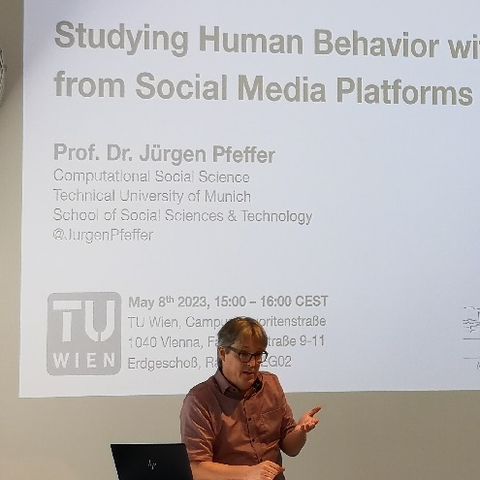
Jürgen Pfeffer is a Professor of Computational Social Science & Big Data at the Technical University of Munich's School of Social Sciences and Technology, with an additional appointment as Adjunct Professor at Carnegie Mellon University's Institute for Software Research. His interdisciplinary work bridges computer science and social science with a focus on analyzing large-scale socio-technical systems. His research expertise spans computational social science, network analysis, and big data methodologies. Pfeffer's work examines methodological, algorithmic, and theoretical challenges in analyzing dynamic social systems, with current projects focusing on modeling and detecting negative dynamics from social media, particularly online firestorms and hate speech against politically active women. His research combines network science approaches with computational methods to understand complex social phenomena. Pfeffer's publication record demonstrates significant contributions to the field since his 2010 doctorate, with high-impact papers in journals like Science and EPJ Data Science. His work on social media analysis, particularly the influential 2014 Science paper 'Social Media for Large Studies of Behavior' co-authored with Derek Ruths, has shaped methodological approaches in the field. His research shows consistent evolution from foundational network analysis to contemporary applications in political discourse, hate speech detection, and multi-layer network analysis. Hennig, M., Brandes, U., Pfeffer, J., & Mergel, I. (2012). Studying Social Networks. A Guide to Empirical Research Ruths, D., & Pfeffer, J. (2014). Social Media for Large Studies of Behavior Pfeffer, J., Morstatter, F., & Mayer, K. (2018). Tampering with Twitter's Sample API As an advisor and collaborator, Pfeffer has worked extensively with researchers including Raji Ghawi, Mirco Schönfeld, Momin Malik, and Kathleen Carley. His work demonstrates strong connections between theoretical network science and practical applications in social media analysis. His current research continues to address pressing issues in online discourse, with recent work focusing on hate speech classification, lexical change in negative word-of-mouth, and polarization dynamics in social media environments. Pfeffer leads the Pfeffer Lab, which focuses on developing methodological approaches for analyzing complex social systems through computational methods. His work has implications for understanding political legitimacy, social influence, and community dynamics in both online and offline contexts.