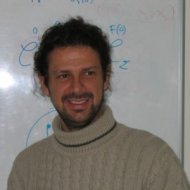
Joe Wells is a Senior Research Fellow at the School of Mathematical & Computer Sciences, Department of Computer Science, Heriot-Watt University. His research focuses on type systems, formal methods, and foundational aspects of computer science and mathematics. He has contributed to areas including calculi, set theories, and formal proof environments. His research interests include the theoretical underpinnings of programming languages, mathematical logic, and the development of tools for semantic markup of mathematical documents. His work often intersects with automated reasoning and formal verification systems. Wells has been recognized with the 2018 Global Learning and Teaching Award (Highly Commended) for contributions to educational excellence. His recent publications explore topics such as generalized set theories and type systems, demonstrating a commitment to advancing foundational computer science research.
Roberto Bruni is a Professor in the Department of Computer Science at the University of Pisa, Italy. He has been actively contributing to theoretical computer science with a focus on formal methods, operational semantics, and reaction systems. His academic service includes serving as PC member for SAS 2025 and CMSB 2025 conferences. Professor Bruni's research interests span Operational Semantic, Petri Nets, Reaction Systems, Graph Transformation, and Monoidal Category. His work bridges theoretical computer science with applications in computational biology and program analysis. He has developed significant tools like BioReSolve, a Prolog interpreter for Reaction Systems analysis, and has contributed to projects such as RemConf (Confusion removal in Petri nets) and The Link Calculus. His recent publications demonstrate a strong focus on reaction systems, program analysis, and formal verification methods. The research trend shows increasing application of theoretical computer science concepts to biological modeling and healthcare applications, particularly through enhanced reaction systems frameworks. Professor Bruni holds several institutional responsibilities including membership in the Commission Didattica del GRIN since 2020, delegation to the University Information System (SIA) for the Department of Computer Science since 2020, and membership in the Doctoral College for Smart Industry since 2018. He has been Vice-president of the Master's Degree in Data Science and Business Informatics at the University of Pisa since 2017. His teaching portfolio is extensive, covering courses in programming, algorithms, quantum computing, business process modeling, and program analysis for both undergraduate and graduate students in multiple languages (Italian and English). He has taught courses such as Programmazione e Algoritimica, Models for Programming Paradigms, Business Processes Modeling, Program Analysis, and Introduction to Quantum Computing. Professor Bruni has been involved in numerous research projects including PRA (FM4HD, DECLWARE, FOG), PRIN (ASPRA, CINA, IPODS), and several EU-funded projects (IST-FP7 ASCENS, IST-FP6 SENSORIA, CoMeta, AGILE, NAPI, GETGRATS). His previous academic positions include PhD Student at University of Pisa, International Fellow at SRI Computer Science Laboratory, and Visiting Scholar at UIUC.
Michele Loreti is Full Professor in Computer Science at the University of Camerino within the School of Science and Technology and serves as Director of the School of Advanced Studies. His career includes roles as Research Associate at University of Firenze (2002-2017) and Visiting Professor at IMT Institute for Advanced Studies (2012-2016). He holds a PhD in Mathematical Logic and Theoretical Computer Science from University of Siena (2001) and a Computer Science degree from University of Rome 'La Sapienza' (1997). Research interests: Formal tools for concurrent/distributed systems Quantitative analysis of collective adaptive systems Spatio-temporal model checking Process calculi and modal logics Programming languages for network-aware applications Runtime verification and dynamic system adaptation Article trends: His work focuses on formal verification of cyber-physical systems, spatio-temporal properties, stochastic process calculi, attribute-based communication, and tools like CARMA and muG for collective system analysis. Editorial roles: Assistant editor for Elsevier Journal on Logical and Algebraic Methods in Programming and member of the Reproducibility Board for ACM Transactions on Modelling and Computer Simulation.
Moreno Falaschi is a Professor at the University of Siena's Department of Information Engineering and Mathematical Sciences. He teaches Programming Fundamentals for Biotech Engineering, Models and Languages for Bioinformatics for Artificial Intelligence Engineering, Programming for Mathematics, and Information Processing Systems, with current responsibilities extending to the 2025/2026 academic year. His research centers on Reaction Systems as formal models for biochemical processes, applying rewriting systems, concurrency theory, and constraint logic programming to analyze biological systems. Key applications include comorbidity treatment strategies, hemostasis pathways, and T cell differentiation, bridging theoretical computer science with medical bioinformatics. Recent publications (2023-2025) demonstrate consistent innovation in dynamic slicing techniques, guarded reaction systems for medical applications, and quantitative extensions using SOS semantics. His work spans formal verification, computational biology, and biomedical AI, with significant contributions to journals like the International Journal on Software Tools for Technology Transfer.
Andrea Esposito serves as a Research Fellow at the Department of Pure and Applied Sciences (DiSPeA) of the University of Urbino Carlo Bo, Italy. His academic role focuses on theoretical research within the university's computer science domain, contributing to the institution's research output through publications in high-impact venues. His research interests include: Reversible Computing Concurrency Theory Process Algebra Bisimulation Relations Noninterference in Security Formal Verification Modal Logic Analysis of his 2023-2025 publications reveals a concentrated research trajectory in reversible concurrent systems. Key contributions include developing expansion laws for bisimilarities, modal logic characterizations of reversible processes, and noninterference frameworks for probabilistic systems. These works demonstrate theoretical rigor with applications in secure system design, published across venues like Logical Methods in Computer Science and Lecture Notes in Computer Science . No scientific awards or honors were documented in available sources. Information regarding student advising, research grants, laboratory affiliations, or collaborative teams was not provided in the source materials.
Giorgio Ghelli is a Full Professor at the Department of Computer Science, University of Pisa. His research focuses on database systems, XML/JSON schema validation, type systems, and formal methods. He has contributed to foundational work on programming languages and query systems, including the development of the Fibonacci database programming language and the TQL query language for semistructured data. His recent work emphasizes JSON schema formalization, validation techniques, and interactive schema inference for large datasets. Teaching includes advanced database courses and foundational database theory. Research interests span data management, formal semantics, and efficient query processing. Over 150 publications including seminal works on XML updates, JSON schema validation, and type systems for mobile ambients.
Pierpaolo Degano is a full Professor at the Dipartimento di Informatica of Università di Pisa since November 1990. He served as Department Head (1993-1996) and currently chairs the Computer Science PhD program within the Galileo Galilei School of Excellence. His roles include Vice-Chair of the 'Galileo Galilei' School (since 2009), Chairman of the Italian Committee for PhD Programs in Computer Science (since 2007), and member of the Scientific Committee of CoSBi (Microsoft Research - University of Trento Centre for Computational and Systems Biology). Education: Extensive academic background inferred from his professorship and leadership roles Research Interests: Focuses on operational methods in concurrency, semantics of programming languages, security, program verification, and computational models for biological systems. His work bridges theoretical foundations with practical applications in distributed systems and formal methods. Publications: Over 200 papers on theoretical computer science, including seminal works on concurrency semantics, mobile processes, and security protocols. Recent contributions emphasize causal semantics, abstract machines for performance evaluation, and formal analysis techniques. Grants & Projects: Led national and EU projects like DEGAS (FET), SENSORIA (FET), and participated in ESPRIT initiatives. Engaged in multiple research collaborations with institutions like Hewlett-Packard and Microsoft Research. Labs/Teams: Co-director of CoSBi, focusing on computational systems biology, and leader of the Operational Methods in Concurrency research group.
Massimo Merro is a Full Professor in the Department of Computer Science at the University of Verona, where he has been serving since October 2018. He previously served as Coordinator of the PhD Program in Computer Science from November 2016 to October 2022. His office is located at Ca' Vignal 2, Floor 1, Room 57, and he can be reached at +39 045 802 7992 or massimo.merro@univr.it. Merro earned his Laurea cum laude (M.Sc.) in Computer Science from the University of Pisa in 1996 and completed his PhD in Computer Science with full marks and honors from the Ecole des Mines de Paris, France, in 2000. Following his PhD, he was a Research Fellow at the School of Cognitive and Computing Science at the University of Sussex, UK (May 2000-April 2002) and at the Laboratoire des Méthodes de Programmation within the Ecole Polytechnique Fédérale de Lausanne, Switzerland (May 2002-October 2002). Professor Merro's research focuses on formal methods applied to concurrent and distributed languages. His work spans process calculi for mobile systems, concurrent and distributed object-oriented languages, formalization of distributed algorithms, and more recently, semantics foundations and security analysis of cyber-physical systems and IoT devices. His research interests are categorized under cybersecurity and software engineering and formal verification, with specific focus on formal methods and theory of security, models of computation, semantics and reasoning, and software organization and properties. Merro regularly teaches courses including "Network security" and "Semantics of programming languages" as part of the Master's degree in Computer Science and Engineering. He has maintained a consistent teaching schedule since 2002, with current courses for 2025/2026 including "Foundations of programming and specification languages" and "Network security". He serves on multiple departmental committees including the Commissione di valutazione affidamento di insegnamenti SSD INF/ING-INF, Faculty Board of PhD in Computer Science, Computer Science Teaching Committee, and Computer Science Department Council. Professor Merro is affiliated with the Laboratorio OPDATE SPY (Formal Methods) Laboratory at the University of Verona, where he conducts research on formal methods and security analysis. He has served as PC-chair and PC-member in international conferences and workshops, and has provided industrial training through tutorials and courses.
Sabina Rossi is a Full Professor in the Department of Environmental Sciences, Informatics and Statistics at Ca' Foscari University of Venice, where she also serves as Rector's Delegate for digital innovation in teaching. Her research develops formal methods for analyzing distributed systems with mobility and concurrency, specializing in process algebraic techniques for performance evaluation, verification, and dependability analysis of complex systems. Recent work extends to Markovian models for wireless networks, blockchain verification, and neural network compression. Her research investigates foundational models of distributed systems, with current emphasis on reversible computation, proportional lumpability in Markov chains, and blockchain security properties. She applies formal methods to analyze information flow security, model checking, and performance evaluation of stochastic systems. Recent publications (2020-2025) address queueing models with job stealing policies, blockchain verifier's dilemma, selfish mining attacks, and neural network compression via formal methods. Teaching responsibilities include 'Formal Methods for System Verification' in the Computer Science graduate program, 'Discrete Structures' for undergraduates, and foundational computer science courses for humanities students. She maintains office Z.B01 at the university's Scientific Campus via Torino in Venice.
Emilio Tuosto is a Full Professor at the Gran Sasso Science Institute (GSSI) in L'Aquila, Italy, where he leads the Computer Science Department. Previously, he held an Associate Professor position at the University of Leicester's School of Informatics (UK). His research focuses on formal methods, distributed systems, and behavioral specifications. He earned his PhD in Computer Science from the University of Pisa in 2003 and holds a degree from the same institution (1998). His research explores theoretical and applied aspects of complex distributed systems, including automata-based models of distributed choreographies and contract-based interaction frameworks. Key projects include BehAPI (Marie Skłodowska-Curie Actions RISE project) and DeLiCE (Decentralised Ledgers in Circular Economy). He actively contributes to conferences like COORDINATION and ECOOP, and organizes GSSI's seminar series. Recent work includes tools like TRAC for data-aware coordination, MoCheQoS for QoS analysis, and CIRC (reversible computing). His publications span formal choreographic languages, static analysis for C programs, and behavioral types for local-first software. Collaborations involve institutions like IMT Lucca, University of Pisa, and international teams. Tuosto's contributions bridge theoretical foundations with practical implementations in distributed systems and formal methods.
Mario Bravetti is a Full Professor at the Department of Computer Science and Engineering, University of Bologna. His academic discipline is Informatics (INFO-01/A). He specializes in formal methods, process calculi, and distributed systems, with a focus on session types, microservices architecture, and formal verification of software systems. His research bridges theoretical foundations with practical applications in cloud computing, edge computing, and industry 4.0. Research interests include: Session types and behavioral contracts Formal semantics of concurrent systems Microservices deployment and orchestration Low-latency anomaly detection in industrial IoT Formal verification tools for programming languages His recent work emphasizes proactive-reactive scaling strategies for microservices and the integration of formal methods into cloud-native architectures. He has contributed to projects like SEAWALL and the BETTY COST Action, advancing software reliability in large-scale systems. His articles highlight advancements in session subtyping algorithms, typestate systems for Java, and edge-cloud continuum optimizations. He has served as a guest editor for journals on service-oriented architectures and formal methods.
Egidio Astesiano is Professor of Computer Science at the Department of Computer Science and Information Science (DISI), University of Genova, where he served as Director since the department's foundation in 1992. He played a pivotal role in establishing Genova's Computer Science program in 1986 and remains actively engaged in European formal methods initiatives including the CoFI Common Specification Framework. His research centers on formal specification techniques with emphasis on algebraic methods for concurrent and reactive systems. Key contributions include foundational work on SMoLCS-driven concurrent calculi, bisimulation in algebraic specifications, and dynamic data type models like D-oids. Current interests focus on integrating formal methods with UML and bridging theoretical frameworks with practical software development processes. Analysis of his 1992-1999 publications reveals consistent innovation in specification methodologies, particularly for concurrency and reactive systems. His work demonstrates strong industry-academia collaboration through ESPRIT, HCM, and Ada FD projects, often translating theoretical constructs into verifiable system specifications for real-world applications like telecommunications and distributed computing. Astesiano founded Genova's Formal Methods research group in the early 1980s, which led major European projects including ESPRIT DRAGON and COMPASS. He coordinates the Reactive Systems Task Group within CoFI and maintains leadership roles in IFIP working groups 2.2 and 14.3, steering AMAST and ETAPS conferences while serving on editorial boards for Science of Computer Programming , Theoretical Computer Science , and Formal Aspects of Computing .
Paola Quaglia is an Associate Professor at the Department of Information Engineering and Computer Science, University of Trento. Her primary teaching activities include courses on Concurrency and Linguaggi formali e compilatori (Formal Languages and Compilers), focusing on shared-memory concurrency and compiler design methodologies applicable to formal/natural language analysis. Quaglia's research expertise spans Algorithms, Concurrency, Process Calculi, Formal Languages, Systems Biology, and Stochastic Processes . Her work bridges computational modeling with biological systems, emphasizing formal verification and concurrent programming paradigms. Notable publication trends include contributions to stochastic process algebra , BlenX/Beta-binders for biological modeling, and model-checking techniques for concurrent systems. She has extensively explored the intersection of programming language theory and computational biology.
Doriana Medić is an Assistant Professor at the University of Turin's Department of Computer Science, affiliated with the Alpha Research Group for Parallel Computing. Her work bridges formal methods, reversible computing, and distributed systems. Projects: Space Center of Excellence (EC HE, Horizon-EuroHPC-JU), European Pilot (EC H2020 RIA), EUPEX (EC H2020 RIA). Her research explores formal models for concurrent and distributed systems, with recent focus on federated learning, workflow modeling, and HPC applications in astrophysics and machine learning. Publications highlight RISC-V architectures, fault tolerance mechanisms, and hybrid workflows. Selected publications span 2019-2025, emphasizing reversible computing, HPC, and workflow modeling. Key tags include semantics , icsc , streamflow , and riscv . She contributes to the Alpha Research Group at the University of Turin, advancing parallel computing solutions.
Paolo Baldan is a Professor of Computer Science at the Department of Mathematics of the University of Padova, where he maintains office 6DA6. Previously, he served as an assistant professor at the University of Venice's Computer Science Department and as a PostDoc Researcher at the University of Pisa's Department of Computer Science. His research focuses on Formal Methods for Software Reliability and Programming Languages , with particular expertise in Concurrency Theory, Petri Nets, and Graph Transformation Systems. Professor Baldan has led multiple research projects including the current MUR Project RAP (2023-2025) and previous initiatives like ASPRA (2019-2022) and ANCORE (2015-2016). His publication record spans journal articles, conference papers, and technical reports in theoretical computer science. His recent work examines resource awareness in programming, program analysis techniques, and verification of concurrent systems. The publications demonstrate consistent contributions to formal methods with applications to software reliability. Professor Baldan actively participates in the academic community through conference organization and committee work, including involvement with CALCO, Petri nets conferences, and ICGT. His upcoming commitments include CSL 2026. He teaches courses including Computability , Languages for Concurrency and Distribution , and Algorithms and Data Structures at the University of Padova. Office hours are held Wednesdays 11:00-13:00, requiring advance contact for meetings.