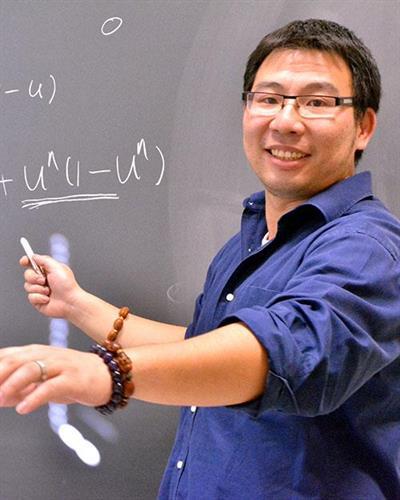
Jesse Perlaمشاهده پروفایل
دانشیار
Jesse Perla is an Associate Professor in the Vancouver School of Economics at the University of British Columbia, Faculty of Arts. He maintains an office in the Iona Building 201B and is actively engaged in research and teaching within the economics department. Dr. Perla received his PhD in Economics from New York University in 2013 and completed his undergraduate studies in Applied Mathematics at Columbia University in 1997. His academic journey has positioned him at the intersection of economics, mathematics, and computational methods. His research focuses on macroeconomics and growth from the firm perspective, with particular emphasis on information diffusion, heterogeneous agents, and computational approaches to economic modeling. He has developed significant expertise in applying machine learning techniques and high-dimensional methods to economic problems, with notable work on technology diffusion, financial frictions, and dynamic programming. His research agenda spans theoretical and computational economics, with increasing integration of artificial intelligence methods in recent years. Perla's publications reveal a strong trend toward computational economics, with growing emphasis on deep learning applications to overcome the curse of dimensionality in economic models. His work frequently explores how information diffusion affects firm behavior and economic growth, often employing sophisticated mathematical and computational techniques to model complex economic phenomena. He is a co-author of the influential open textbook Quantitative Economics with Julia and has made significant contributions to computational economics education. His teaching focuses on preparing students for graduate work in economics, with particular emphasis on mathematical preparation and computational skills. He has published extensive course advice for UBC undergraduates interested in pursuing graduate studies. Perla actively contributes to the development of computational tools for economists, particularly through the Julia programming language ecosystem. His work includes developing educational materials on differential equations for epidemiological modeling in economics and maintaining comprehensive data source references for economic researchers.