Martin Holler is a Professor at the Institute of Mathematics and Scientific Computing at the University of Graz, Austria, where he leads the research group Applied Mathematics and Machine Learning . His work bridges theoretical mathematics with practical applications in imaging and machine learning. Research Focus: His primary research areas include the mathematics of data science, variational methods in imaging, dynamic and multi-modality inverse problems, and biomedical imaging. He has made significant contributions to model-based regularization techniques, particularly with Total Generalized Variation (TGV) approaches for image and video reconstruction. Publication Trends: Over the past decade, Holler's research has evolved from traditional variational methods for image reconstruction toward increasingly sophisticated machine learning approaches. His recent work (2021-2023) focuses on integrating deep learning with variational methods, particularly for motion separation in medical imaging and learning-informed parameter identification in partial differential equations. His publications demonstrate a consistent thread of applying rigorous mathematical frameworks to solve practical problems in medical imaging and computer vision. Mathematics of data science and machine learning Generative models in machine learning Variational methods in imaging Dynamic and multi-modality inverse problems Model-based regularization Biomedical imaging Image and video decompression Technical Leadership: Holler has developed several open-source software packages implementing advanced reconstruction algorithms, particularly for multi-modal imaging problems. His GitHub repositories show active maintenance and development of these tools, which have been cited in the medical imaging community.
Associate Professor at the University of Klagenfurt , affiliated with the Department of Management Control and Strategic Management under the Faculty of Economics and Law . Research focuses on agent-based modeling applied to organizational dynamics , complex systems , and managerial economics . Holds a doctoral degree in Social Sciences and Economics (2012) and venia docendi in Business Economics (2018) . Core faculty member in the Self-Organizing Systems research cluster Academic editor for PLoS ONE and editorial board member for multiple journals Recipient of the 2021 Advancement Award (Humanities/Social Sciences) from Carinthian government Research integrates computational simulation with organizational theory , examining phenomena like decentralized task allocation , incentive mechanisms , and reproducibility in social sciences . Teaching portfolio includes business analytics , management control , and scientific modeling at undergraduate and graduate levels. Recent publications explore organizational resilience , team coordination dynamics , and financial modeling using agent-based simulation techniques. Active participant in international conferences like Social Simulation Conference and European Conference on Operational Research .
Mohamed-Slim Alouini is a Professor of Electrical Engineering and Associate Dean of the Computer, Electrical and Mathematical Science and Engineering (CEMSE) Division at King Abdullah University of Science and Technology (KAUST) in Saudi Arabia. He also serves as the Associate Vice President for Research and holds the UNESCO Chair in Education to Connect the Unconnected. With over 500 journal publications and more than 46,000 citations, he is a world-renowned expert in wireless communications who was elected IEEE Fellow in 2009 at the age of 39. Education: PhD in Electrical Engineering, California Institute of Technology (Caltech), 1998 MS in Electrical Engineering, Georgia Institute of Technology (Georgia Tech), 1995 Diplôme d'Etudes Approfondies (DEA) in Electronics, Université Pierre & Marie Curie (Sorbonne University), 1993 Diplôme d'Ingénieur, École Nationale Supérieure des Télécommunications (Télécom Paris Tech), 1993 Habilitation, Université Pierre & Marie Curie (Sorbonne University), 2003 Dr. Alouini is a world-renowned expert in wireless communication and networking with research interests spanning diversity combining techniques, MIMO systems, multi-hop/cooperative communications, optical wireless systems, cognitive radio, UAV communications, and advanced modulation schemes. His current focus addresses the technical challenges of uneven information and communication technology distribution, particularly targeting rural, low-income, disaster-prone, and hard-to-reach areas through integrated ground-airborne-space networks. His work bridges theoretical foundations with practical implementations to solve real-world connectivity problems. His recent publications (2020-2024) demonstrate a clear research trajectory toward integrated communication networks combining terrestrial, aerial, and space components. There's growing emphasis on UAV communications, satellite systems, optical wireless technologies, and rural connectivity solutions, with increasing integration of machine learning techniques for network optimization. His work shows consistent focus on addressing the digital divide, with several publications specifically targeting 6G challenges for connecting underserved populations and recycling existing infrastructure for enhanced rural connectivity. Scientific Awards: Member of the European Academy of Sciences and Arts (2019) Fellow of the African Academy of Sciences (2018) IEEE Fellow (2009) Abdul Hameed Shoman Award for Arab Researchers (2016) OIC Science & Technology Achievement Award (2017) Multiple recognitions as Highly Cited Researcher NSF CAREER Award (1999) Dr. Alouini has mentored numerous successful students and post-doctoral fellows who have secured positions at top institutions worldwide including Harvard, Caltech, Imperial College, and faculty positions at Korea University, Hanyang University, and universities across the Middle East. His December 2018 PhD graduate Qurrat-Ul-Ain Nadeem received the prestigious Marconi Society Paul Baran Young Scholars award, while post-doctoral fellows have won IEEE ComSoc Young Professionals Best Innovation Award and attended the Lindau Nobel Meeting. His Communication Theory Lab at KAUST drives significant research in wireless communications with funding supporting extensive publication output and innovative projects. Dr. Alouini leads the Communication Theory Lab at KAUST and holds the UNESCO Chair in Education to Connect the Unconnected, focusing specifically on technical solutions for connecting underserved communities. His lab works on integrated ground-airborne-space networks to bridge the digital divide, with particular emphasis on rural, low-income, and hard-to-reach areas. The team develops practical solutions using UAVs, satellite communications, and recycled infrastructure to provide cost-effective connectivity where traditional approaches fail.
Prof. Osamu Terasaki is a leading expert in electron microscopy and structural chemistry, currently serving as Professor and Director of the Centre for High-Resolution Electron Microscopy at ShanghaiTech University, China since 2017. Previously, he held academic roles at Stockholm University (Professor and Head of Structural Chemistry, 2003-2010), KAIST (Invited Guest Professor, 2009-2017), UC Berkeley (Visiting Professor, 2014-2017), and Tohoku University (Assistant to Associate Professor, 1967-2002). Education: B.Sc. in Physics, Tohoku University, Japan (1965) M.Sc. in Physics, Tohoku University, Japan (1967) DSc in Physics, Tohoku University, Japan (1982) Research Interests focus on advanced electron microscopy techniques to solve complex structural problems in nanoporous materials. His work includes groundbreaking contributions to electron dynamical scattering, zeolite characterization, and the development of Gas Adsorption Crystallography for determining adsorbate distributions in nanoporous crystals. He pioneered electron microscopy methodologies for Metal-Organic Frameworks (MOFs) and Covalent-Organic Frameworks (COFs). Scientific Contributions extend to establishing world-leading electron microscopy centers at Stockholm University, KAIST, and ShanghaiTech University. These facilities have advanced the application of state-of-the-art instrumentation to analyze defects, fine structures, and quantum-confined cluster-crystals in microporous materials. Scientific Awards and Honors include: Dual Donald W. Breck Awards (2007, 2019) Humboldt Research Award (2008) Daiwa Adrian Prize (1996) Magnolia Silver Award (2018) Honorary Memberships in the Scandinavian Electron Microscopy Society (2010) and Japan Association of Zeolites (2014) International Collaborations span institutions in Sweden, South Korea, the U.S., and China, reflecting his global impact in structural science and electron microscopy.
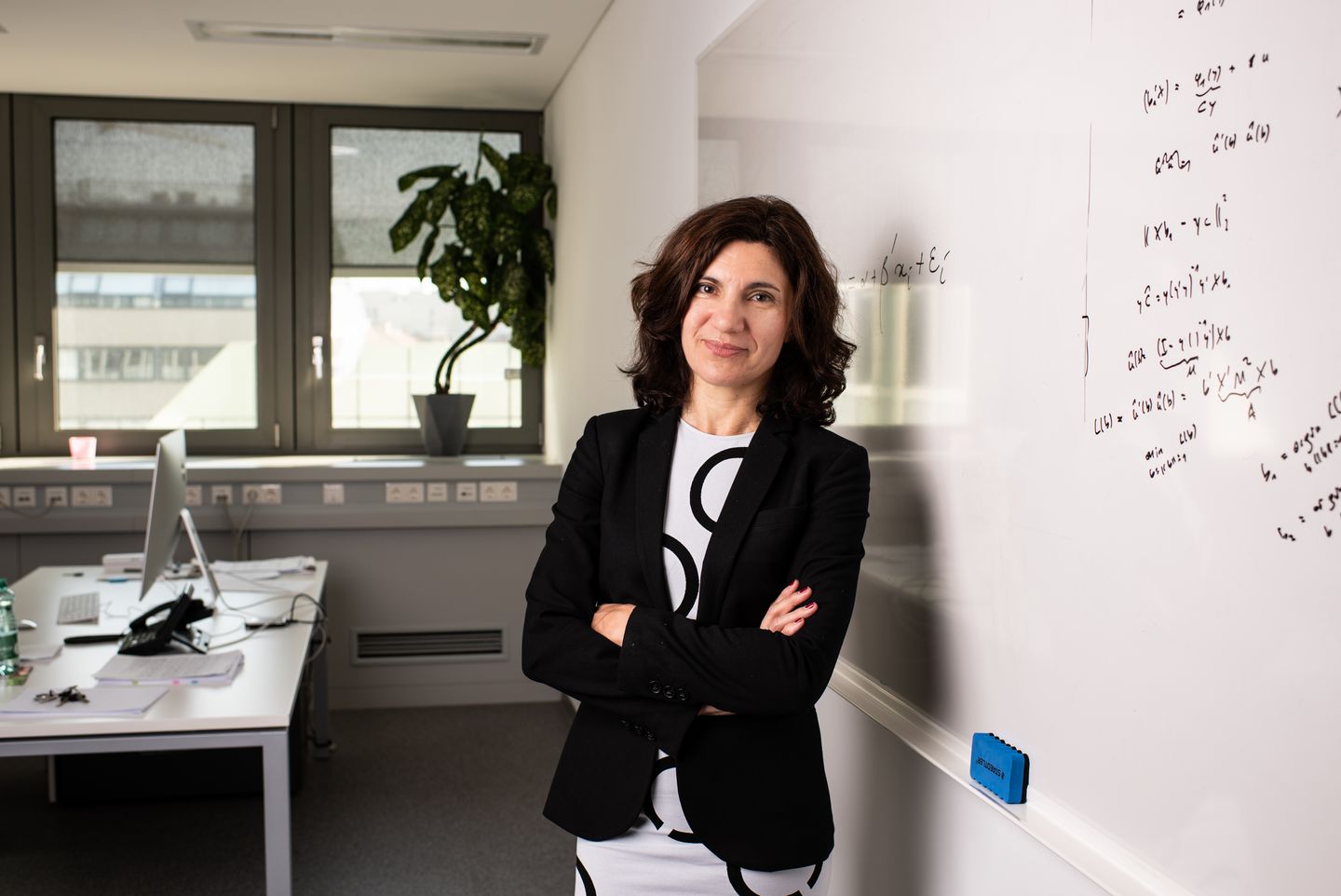
Efstathia Bura is a Professor heading the Applied Statistics Research Unit (ASTAT) within the Institute of Statistics and Mathematical Methods in Economics at TU Wien's Faculty of Mathematics and Geoinformation. Her research focuses on dimension reduction techniques in regression and classification, high-dimensional statistics, and their applications in biostatistics, econometrics, and legal statistics. She leads projects like ProbInG (WWTF-funded) and the SecInt Doctoral College on statistical verification of cyber-physical systems. Her work integrates advanced statistical methodologies with interdisciplinary applications, emphasizing practical solutions for complex data challenges. Current projects explore probabilistic program analysis, security properties in cyber-physical systems, and dynamic econometric modeling. She collaborates internationally, with notable contributions to statistical theory and applications in law, healthcare, and telecommunications. Key research themes include time-varying regression models, sufficient dimension reduction for mixed predictors, and fusion of statistical methods with machine learning. Her publications bridge theoretical advancements and real-world problem-solving, reflecting her role as a leading academic in modern applied statistics. Her team includes postdocs and assistants working on WWTF and SecInt grants, focusing on probabilistic systems and statistical verification. While no formal student advisees are listed, her collaborative projects engage junior researchers in cutting-edge statistical research.
Reinhard Prügl is a Professor and Head of the Institute for Family Business at WU Wien (Vienna University of Economics and Business). He holds a doctorate from WU Wien and conducted postdoctoral research at MIT Sloan School of Management. Previously, he held a chaired professorship at Zeppelin University where he established the Friedrichshafen Institute for Family Entrepreneurship. His research focuses on the intersection of management, entrepreneurship, and strategy with emphasis on: Leadership and generational succession in family firms Family governance structures Innovation and marketing in family business contexts Identity and reputation management His publications demonstrate strong thematic consistency in family business dynamics while methodologically evolving from qualitative case studies (2000s) to experimental designs and cross-cultural comparisons (2020s). Research frequently addresses paradox resolution and crisis management in family enterprises. Awards & Honors: Best Paper Awards from IFERA, EURAM, AMA, and WU Wien Rudolf-Sallinger-Preis for doctoral dissertation Ehrenpreis for leadership in family business research Teaches courses on Family Business Management, Leadership, and Marketing at WU Wien. Leads research projects including comparative studies on family firm reputation across Germany, India, and the United States.
Markus Haltmeier is a Professor in the Department of Mathematics at the University of Innsbruck. His research focuses on inverse problems, image reconstruction, and deep learning with applications in medical imaging, photoacoustics, and computational mathematics. He leads a group dedicated to advancing theoretical and practical solutions for challenges in non-destructive testing and medical diagnostics. His work integrates mathematical analysis with machine learning, addressing issues such as high-resolution imaging in scattering media and automated segmentation of cardiac structures. Key research areas include regularization techniques for inverse problems, self-supervised learning approaches for limited data scenarios, and computational methods for photoacoustic tomography. His contributions span both theoretical developments (e.g., inversion formulas for Radon transforms) and applied solutions (e.g., algorithms for cylinder liner wear assessment and myocardial infarct segmentation). Publications highlight advancements in neural network-based regularization, 3D medical image synthesis, and unsupervised learning frameworks for segmentation and registration. His research emphasizes bridging the gap between mathematical theory and real-world applications in healthcare and engineering.
Nelson Nicolas Higuera Ruiz is a PreDoc Researcher at the Vienna University of Technology, affiliated with the Faculty of Informatics' Knowledge-Based Systems research group. His work bridges logic programming and deep learning for explainable AI. Research Focus: Neurosymbolic AI, Visual Question Answering (VQA), Answer Set Programming (ASP), and hybrid reasoning systems Projects: Leads optimization research in the LCS (2017–2025) project, developing neurosymbolic approaches for intelligent systems Key Contributions: Pioneering adaptive large-neighbourhood search algorithms for ASP optimization, modular neurosymbolic architectures, and contrastive explainability frameworks for VQA Collaborations: Active in international workshops and conferences including IJCAI, AAAI, and CLeaR, frequently collaborating with researchers like Thomas Eiter and Johannes Oetsch Publications: Focus on neurosymbolic integration, optimization algorithms, and explainability across AI, logic programming, and computer vision domains
Yves André is a Research Director 1st Class at CNRS (French National Center for Scientific Research), working at École Normale Supérieure de Paris in the Département de Mathématiques et Applications. He maintains strong affiliations with Université Paris 6 and the Institut de Mathématiques de Jussieu. André's research centers on the deep connections between number theory and algebraic geometry, with particular expertise in p-adic analysis, motivic theory, and arithmetic differential equations. His work has fundamentally advanced our understanding of p-adic differential equations, Galois representations, and the theory of motives through rigorous proofs of major conjectures including Dwork's conjecture and Crew's local monodromy conjecture. His publication record shows a consistent progression from solving specific conjectures to developing comprehensive theoretical frameworks that bridge different mathematical disciplines. The recurring themes across his work include the interplay between geometry and arithmetic, the structure of differential equations in p-adic contexts, and the development of motivic tools for number-theoretic problems. Foreign Member of the Venetian Academy (2007) Doisteau-Blutet Prize of the French Academy of Sciences (2011) Kempf Lectures (Baltimore 2006) Albert Lectures (Chicago 2009) Ordway Lectures (Minneapolis 2012) André has supervised four PhD theses and has been an active contributor to the mathematical community through numerous international mini-courses and conference organization. His leadership roles include serving on the National Committee of the Department of Mathematics at CNRS (2004-08), directing the mathematical monograph series 'Astérisque' for the French Mathematical Society (2005-11), and responsibility for the Paris node of the network ANR 'Galois theories' (2006-09). He is also a member of the 'collectif Histoire-Philosophie-Sciences' at ENS and a trustee of Rendiconti di Padova.
Sophie N. Parragh is Professor and Head of the Institute of Production and Logistics Management at Johannes Kepler University Linz, where she also serves as program director of the master's degree program in Economic and Business Analytics. She received her PhD from the University of Vienna in 2009 and completed her habilitation in 2016, following postdoctoral research at the IBM Center for Advanced Studies in Porto and a visiting professorship at the Vienna University of Economics and Business. Her research focuses on developing exact and heuristic optimization algorithms for complex logistics and transportation problems. Key areas include vehicle routing, green logistics, disaster relief distribution planning, scheduling, and multi-objective optimization. She has particular expertise in branch-and-bound, branch-and-price, column generation, and metaheuristics approaches to solve challenging combinatorial optimization problems. Dr. Parragh's publication record shows a consistent trend toward increasingly complex multi-objective problems, with recent work focusing on electric vehicle routing, multi-echelon production planning under uncertainty, and bi-objective facility location problems with applications in disaster relief. Her research bridges theoretical optimization methods with practical applications in logistics and transportation. Scientific Awards: ÖGOR (Austrian Society for Operations Research) dissertation prize doc.award from the University of Vienna Hertha Firnberg Postdoc fellowship from the Austrian Science Fund (FWF) Dr. Parragh has served as department editor for OR Spectrum and as associate editor for Transportation Science, Transportation Research Part B: Methodological, INFORMS Journal on Computing, and Networks. She has led and participated in numerous third-party funded research projects in operations research, including work in healthcare logistics, field staff routing, production planning, and electric vehicle routing. In 2021-2022, she co-organized the monthly VeRoLog webinar series, demonstrating her active engagement with the international operations research community. She maintains strong research collaborations across Europe, evidenced by her co-authored publications with researchers from institutions in Austria, France, Portugal, Denmark, and beyond. Her work consistently addresses both theoretical challenges in optimization and practical applications in industry and public service contexts.
Winfried Hacker is a distinguished academic serving as Professor at TH Dresden from 1966 to 2001. He holds a PhD (1961) and Habilitation (1965) from the same institution. His research focuses on cognitive psychology, experimental psychology, and problem-solving processes, particularly in design and organizational contexts. He has contributed to understanding reflective practices in problem-solving and innovative work processes. Key honors include membership in the Saxon Academy of Sciences (1991), Academia Europaea (1992), the German Psychology Prize (1996), and an honorary doctorate from the University of Bern (2005). His work bridges theoretical psychology with practical applications in economics and workplace innovation. Publications (2004) explore topics like reflection in design thinking, knowledge exchange in organizations, and cognitive processes in aging populations. His research emphasizes human-centered approaches to work design and decision-making under uncertainty.
Michael Bronstein is a Professor & Chair in Machine Learning and Pattern Recognition at the Department of Computing, Imperial College London (2018–present). He previously held academic roles including Professor at the University of Lugano, Switzerland (2010–present, on leave since 2019), Visiting Associate Professor at Tel Aviv University (2015–2017), and Visiting Lecturer at Stanford University (2008–2009). His research focuses on geometric methods for data analysis, with applications in machine learning, computer vision, and social networks. PhD in Computer Science (2007), Technion – Israel Institute of Technology His expertise spans geometric machine learning , deep learning on graphs, manifolds, and point clouds , 3D shape analysis , and geometry processing . His work bridges theoretical and computational approaches to solving problems in computer vision , pattern recognition , and 3D depth sensors . 2020 Royal Academy of Engineering Silver Medal 2018 Fellow, IEEE and IAPR 2016 ERC Consolidator Grant 2014 Young Scientist, World Economic Forum He has led high-impact industrial projects, including the development of Intel RealSense 3D camera technology, and founded startups like Fabula AI (acquired by Twitter in 2019). His academic and entrepreneurial career includes over 150 publications, 30 patents, and leadership roles in both academia and industry.
Gerhard Hillmer is a Professor and Program Director of the Industrial Engineering & Management Master's program at the Management Center Innsbruck. He holds a Dr.-Ing. in Chemical Engineering from Friedrich-Alexander-University Erlangen-Nuremberg (1993) and an MSc in Management from Management Center Innsbruck (2008). His career spans over 25 years in academia and industry, including leadership roles as Department Head (2009-2023) and Study Coordinator in Process Engineering. Prior to academia, he held strategic roles in ExxonMobil and Esso Italiana focusing on business planning and operations optimization. His research focuses on leadership development in engineering education, interdisciplinary competency models, and organizational change management. He has authored textbooks such as Key Competencies in Leadership and Project Work (2022) and pioneered training concepts for engineering graduates' soft skills and responsible management practices. His work emphasizes integrating non-technical competencies like conflict resolution, project management, and ethical decision-making into engineering curricula. Recent publications address global business strategies in Africa, AI-driven HR practices, and corporate ethics expectations. Hillmer has supervised over 50 theses on topics ranging from cross-cultural leadership to resilient supply chains. His presentations at international conferences highlight trends in engineering education reform and organizational transformation in VUCA environments. Notable contributions include developing the PRiME-based Responsible Management certificate and advancing qualitative research methods for change processes in manufacturing. His work bridges academic research with practical industry challenges, emphasizing sustainable career development for engineers and leadership excellence in multinational contexts.
Prof. Georg Jäggle is a Professor of Vocational Education at the University College of Teacher Education Vienna (PH Wien), specializing in educational robotics, STEM pedagogy, and sustainability education. He leads the Department of Vocational Education within the Institute for Secondary Level Vocational Education (I:SBB). His work integrates technology-enhanced learning environments, focusing on project-based methodologies to bridge gaps between education and industry needs. Key projects include the Recycling Heroes initiative (2022–2024), which employs citizen science to promote circular economy awareness, and the EU-funded ER4STEM project (2017–2018), fostering STEM engagement through robotics. Prof. Jäggle holds a Dipl.-Ing. (FH) and a Dr. in engineering education, with prior industry experience as an engineer and vocational school teacher. His research emphasizes digital competence development, intergenerational learning, and inclusive education strategies. He has coordinated interdisciplinary teams across 10+ EU and national projects, including RoboCoop (2018–2022) and Makers@school (2017–2019), which implemented robotics and maker culture in schools. His teaching spans applied mathematics, engineering, and automation technology at both academic and vocational levels. Research interests include technology integration in vocational training, lifelong learning frameworks, and the impact of educational robotics on student motivation. Recent publications (2022–2024) explore STEM career self-efficacy, sustainability curriculum innovation, and cross-generational robotics collaboration. He currently serves in the Center for Research Management (Zentrum Forschungsmanagement) at PH Wien, advancing applied research in MINT (STEM) education and educational technology.
Ines Zeitlhofer is a PhD student and Research Assistant at the Department of Educational Science, University of Salzburg, affiliated with the School of Education. Her research focuses on metacognition and problem-solving in digital learning environments, with a particular emphasis on pedagogical agents and multimedia learning. Prior to this role, she earned a Master of Educational Sciences from the University of Salzburg and worked as a teacher at Group Scolarie Sophie Barat in Paris and a lecturer for Business German at the Université Paris Cité’s Faculty of Law and Economics. Her work explores cognitive and metacognitive strategies to enhance learning performance, leveraging digital tools and multimedia approaches. Recent publications highlight her contributions to understanding appraisal processes in multimedia learning, the impact of pedagogical agents on motivation, and the application of cognitive prompts in digital platforms. Ines is part of the Digital Learning Research Group (DLRG), collaborating on projects that bridge educational theory and technological innovation. She holds no explicitly stated awards but is actively engaged in advancing evidence-based practices in digital education.