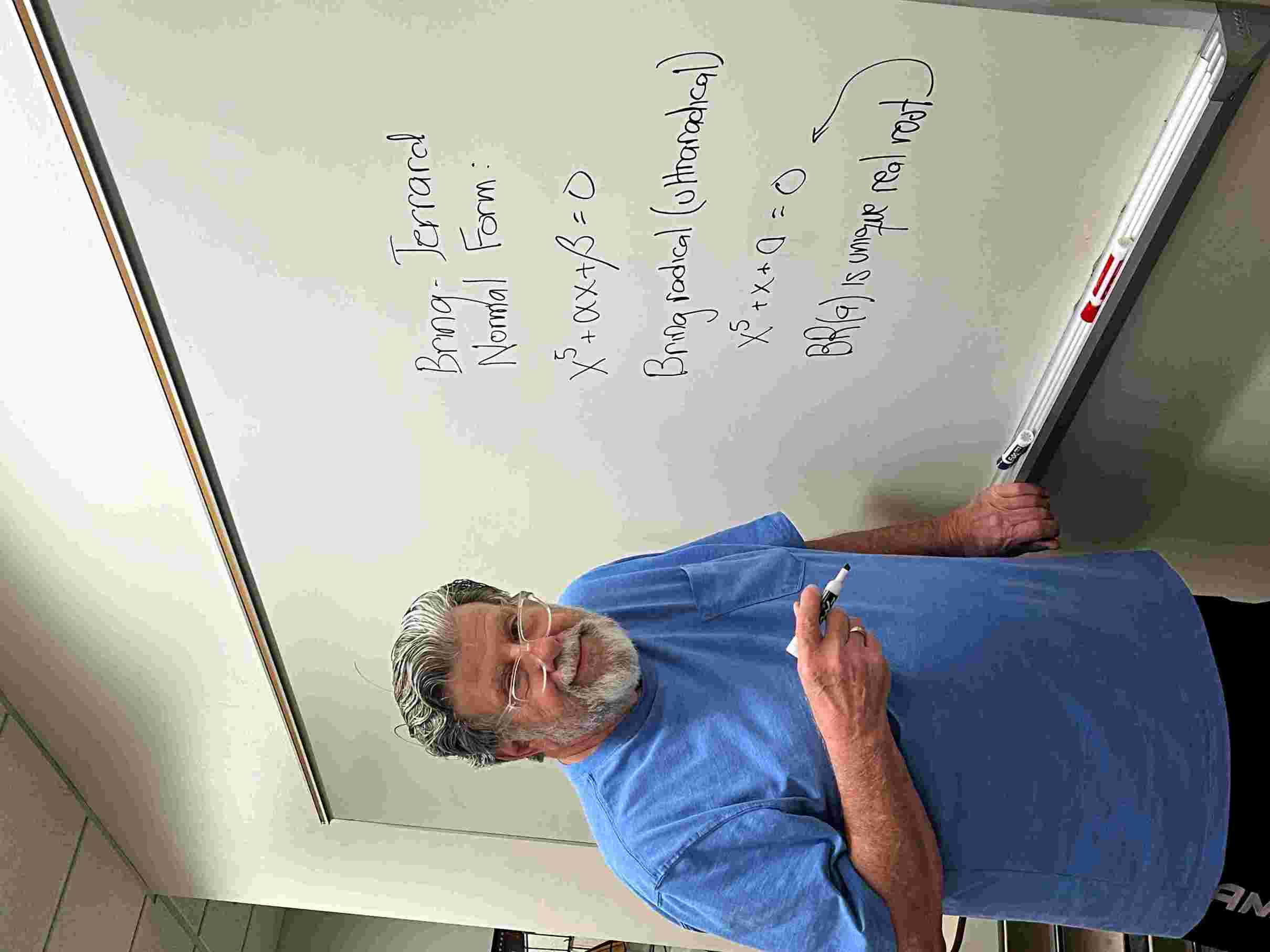
Dr. Tom Beatty is a Professor in the Department of Mathematics at Florida Gulf Coast University , where he has served for 26 years. He teaches undergraduate and graduate courses in real analysis, algebra, and mathematical problem-solving, and was a founding member of FGCU’s Master of Science in Applied Mathematics program. Research Interests: Probabilistic behavior of polynomial reducibility over finite fields Generalized Bernoulli series and summation methods Factorization patterns in finite field polynomials Constructive approaches to modular Fermat equations Academic Contributions: Co-authored a book on LSAT logic puzzles Organized logic workshops for law school-bound students Currently completing a book on mathematical problem-solving for De Gruyter-Brill
Michael Schlosser is an Associate Professor at the Faculty of Mathematics and Department of Mathematics . His research focuses on combinatorics, number theory, and special functions, with a strong emphasis on q-series and hypergeometric series. Research Interests Combinatorics (ascent sequences, lattice paths, rook theory) Number Theory (supercongruences, cyclotomic polynomials, modular forms) Special Functions (theta functions, hypergeometric functions, orthogonal polynomials) Algebra (noncommutative hypergeometric series, matrix inversions) Recent Article Trends (2012-2025) span q-supercongruences, determinant evaluations, asymptotics of Fishburn matrices, lattice path combinatorics, and elliptic hypergeometric series. His work often intersects classical analysis with computational mathematics. Collaborators include prominent researchers like Victor J. W. Guo, Yujun Jin, Ae Ja Yee, Christian Krattenthaler, and Hwang-Fu Zhou.
Dr. Andrzej Krajka is a Professor at the Department of Computer Science Basics within the Faculty of Mathematics, Physics and Computer Science at Maria Curie-Skłodowska University. His research spans probability theory, statistics, and interdisciplinary applications in genetics, epidemiology, and financial mathematics. Faculty: Mathematics, Physics and Computer Science Department: Computer Science Basics Email: andrzej.krajka@mail.umcs.pl Research interests include: Probability theory with focus on random sums and limit theorems Biomarker discovery for lung cancer and multiple myeloma Epidemiological modeling of pandemics (SARS-CoV-2 research) Financial mathematics applications in FOREX markets Data mining techniques in petroleum engineering Stochastic processes with multidimensional indices Recent publications highlight interdisciplinary work bridging: Biostatistics (genetic polymorphisms, DNA methylation) Mathematical modeling (strong laws of large numbers, central limit theorems) Computational epidemiology (social contact networks) Financial time series analysis Industrial process simulation
Dr. Yves J M Tourigny is a Senior Lecturer in Numerical Analysis at the School of Mathematics, University of Bristol, specializing in Applied Mathematics and Mathematical Physics. He holds a B.Sc. from Montreal, M.Sc. from Waterloo, and Ph.D. from Dundee. His primary research focuses on disordered systems , with particular emphasis on developing analytical methods for studying localization phenomena. His work extends into neighboring areas including spectral theory of operators, random matrices, and random walks on Lie groups. The research fingerprint shows strong expertise in Lyapunov Exponent (100%), Continued Fraction (87%), Random Matrix (76%), Matrix theory (47%), Stieltjes methods (38%), Summation techniques (38%), Schrödinger Equation applications (35%), and Diffusion Process analysis (23%). Dr. Tourigny's publication record demonstrates consistent contributions to mathematical physics, particularly in exact solutions for localization phenomena in one-dimensional systems. His most recent work continues to explore analytical methods for disordered quantum systems, building on his long-standing interest in random matrix products and their spectral properties. He has been Principal Investigator on several significant research projects including VIRTUAL INTERFACE CENTRE (2007-2010), COMPUTATIONAL NUMBER THEORY AND NUMERICAL ANALYSIS (2005-2006), and SERIES SUMMATION AND RANDOM CONTINUED FRACTIONS (2004-2008), demonstrating a sustained research program spanning nearly two decades with funding support for his mathematical investigations. Dr. Tourigny actively supervises graduate students and welcomes capable candidates to work on projects related to representation theory and products of random matrices, as well as fluctuations in impurity models, continuing his research trajectory exploring the connections between hypergeometric functions and irreducible unitary representations of SL(2,R).
Dr. Jem Corcoran is an Associate Professor in the Department of Applied Mathematics at the University of Colorado Boulder. His research focuses on applied probability and computational statistics, with an emphasis on developing advanced Monte Carlo methods and Bayesian techniques. He specializes in MCMC (Markov Chain Monte Carlo) algorithms, perfect sampling, and stochastic simulation across disciplines such as image processing, chemical reaction networks, and econometric modeling. His work integrates theoretical rigor with practical applications, addressing challenges in rare event simulation, Bayesian network inference, and high-dimensional data analysis. Notably, he has contributed to advancements in Gibbs sampling, particle filtering, and the application of coupler methods for continuous distributions. His research also explores computational efficiency in stochastic processes and algorithmic design for complex systems. Dr. Corcoran’s scholarly contributions span over two decades, with publications on topics ranging from perfect sampling in Kac equations to Bayesian fusion of particle estimates. His methodologies have been applied in fields such as systems biology, quantum mechanics, and financial time series analysis. Despite his extensive publication record, no academic awards or grants are explicitly mentioned in the provided text.
Xavier Goaoc is a Professor of Computer Science at Université de Lorraine, affiliated with the Department of Computer Science & Engineering at École des Mines de Nancy and the Gamble research team (joint between LORIA and INRIA). His research focuses on algorithms and discrete mathematics, particularly discrete and computational geometry, including convex hulls, intersection patterns, topological generalizations, and geometric transversal theory. University: Université de Lorraine School: School of Engineering Department: Department of Computer Science & Engineering Research Team: Gamble (LORIA/INRIA) Emails: xavier.goaoc@loria.fr , xavier.goaoc@univ-lorraine.fr His research spans computational geometry, combinatorial convexity, geometric transversal theory, and random geometric structures. Key topics include homological minors, order types of point sets, and geometric optimization. His 15 most recent publications highlight advancements in computational geometry algorithms, structural complexity, and topological constraints. Notably, his work has received Best Paper Awards at SoCG 2020, 2018, 2016, and 2012. Administrative roles include heading the computer science & engineering department at Mines Nancy and co-chairing the computer science department of the IAEM doctoral school. He is also a member of the Université de Lorraine's ‘pôle AM2I’ council. Teaching activities encompass courses in algorithms, computer architecture, blockchains, and geometric models for vision, with publications and grants reflecting his interdisciplinary impact in computer science and mathematics.
Alexandru Zaharescu is a Professor of Mathematics at the University of Illinois at Urbana-Champaign (UIUC), affiliated with the Department of Mathematics in the College of Liberal Arts & Sciences. His research focuses on Number Theory, encompassing analytic, algebraic, and geometric aspects with connections to modular forms, L-functions, prime distribution, and partition theory. He holds a Ph.D. from Princeton University (1995). Education: Ph.D. in Mathematics, Princeton University, 1995 Zaharescu's research interests include the Riemann Hypothesis, Farey series, exponential sums, and applications to cryptography and discrete mathematics. Recent work explores geometric interpretations of number-theoretic phenomena, such as angular distributions of lattice points and properties of modular curves. His studies on prime partitions and pseudo-differentiable functions bridge analysis and number theory. His publications reflect a focus on advanced topics like L-functions, divisor functions, and modular forms. Key contributions include proofs of Pollock’s conjectures on icosahedral numbers and statistical analyses of Fermat quotients. Awards: AMS Fellow (2017), LAS Teaching Excellence Award (2010), Center for Advanced Study Associate (2004–05, 2013–14) Zaharescu’s work often intersects with algebraic geometry and combinatorics, addressing problems in both pure and applied mathematics. His research on cyclotomic fields and p-adic valuations contributes to foundational number theory.
Andrew Rosalsky is a Professor in the Department of Statistics at the University of Florida, affiliated with the College of Liberal Arts and Sciences. His research focuses on probability theory and limit theorems. Education: A.B. in Mathematics from Indiana University (1970) A.M. in Mathematics from Indiana University (1972) Ph.D. in Statistics from Rutgers University (1978) Research Interests: Probability Theory Strong and Weak Limit Theorems for Sums of Random Variables Banach Space Valued Random Elements Laws of Large Numbers Publications: His work spans sample correlation matrices, asymptotic distributions, and refinements of classical limit theorems, published in journals like Annals of Applied Probability and Probability Theory and Related Fields .
Ryan W. Matzke is an NSF Mathematical Sciences Postdoctoral Research Fellow at Vanderbilt University's Department of Mathematics, sponsored by Professor Edward B. Saff. His research focuses on Potential Theory, Discrepancy Theory, and Discrete Geometry, with applications in Harmonic Analysis, Frame Theory, and Additive Combinatorics. He has held postdoctoral positions at Technische Universität Graz and completed his Ph.D. at the University of Minnesota-Twin Cities under Professor Dmitriy Bilyk. His research bridges theoretical mathematics with computational methods, including studies on energy optimization, spherical configurations, and deterministic point distributions. Current projects analyze multivariate kernels, Riesz potentials, and geometric discrepancy principles. His work has been published in journals like the Proceedings of the American Mathematical Society, Mathematika, and Probability Theory and Related Fields. In 2025, he will return to the job market for postdoctoral or tenure-track positions. He has received the American Institute of Mathematics' 2025 Alexanderson Award for collaborative research on spherical energy measures. Education Ph.D. in Mathematics, University of Minnesota-Twin Cities (2021) Grants NSF Mathematical Sciences Postdoctoral Research Fellowship (current)
Professor Dorje C. Brody is a Professor in the Department of Mathematics at the University of Surrey, affiliated with the School of Mathematics and Physics. His work bridges quantum theory, mathematical psychology, and financial modelling. Research focuses include quantum foundations, biological systems' information processing, and stochastic models in economics. Key research interests span quantum decoherence, election dynamics, and cognitive psychology using quantum formalisms. Contributions include Lévy models for wave function collapse and information-based asset pricing frameworks. Notable publications address quantum biology, cryptocurrency interest rates, and optimal election strategies. His interdisciplinary approach integrates quantum mechanics with fields like finance and plant biology, emphasizing information flow and stochastic processes. No awards explicitly listed, but extensive collaborative work includes co-authored books and journal articles across disciplines.
Dragana Jankov Maširević is a Full Professor at the School of Applied Mathematics and Informatics, Josip Juraj Strossmayer University of Osijek. She holds a PhD in Mathematical Analysis from the University of Zagreb (2011) and a BSc in Mathematics and Computer Science from the University of Osijek (2007). Her research focuses on special functions, Neumann/Kapteyn/Schlomilch series, integral representations, and applications in probability theory. She has authored/co-authored over 50 journal articles and contributed to books on decision theory and measure theory. Research Highlights: Her work centers on advanced special functions (Nuttall, Marcum, Bessel), series expansions, and probabilistic applications. Notable contributions include new integral/series representations for Nuttall and Marcum functions, bounds for hypergeometric functions, and distribution theory advancements. Her recent projects (2023-2025) address fractional calculus applications in Bessel distributions and non-central chi-square CDFs. Professional Activities: She leads the Erasmus+ MathifyMe project (2024-2027) and previously contributed to GAMMA (2020-2023). She serves as an Associate Editor for the Journal of Classical Analysis and chairs the Quality Assurance Commission at her school. Teaching includes applied mathematics, real analysis, and decision theory courses. Grants & Collaborations: Key projects include the Croatian Science Foundation's 'Inequalities and Applications' (2014) and nonlinear parameter estimation initiatives. She collaborates internationally via EU-funded programs and regularly presents at conferences like the European Congress of Mathematics and OPSFA symposia. Service & Outreach: Organizes winter schools on topics like combinatorial probability and geometric median. Engages in teacher credentialing committees and public math events, promoting accessible education through game-based learning frameworks.
Enrique Trevino is a Professor of Mathematics and Chair of the Mathematics and Computer Science Department at Lake Forest College . His research focuses on Analytic Number Theory and Computational Number Theory , with a strong emphasis on explicit estimates and algorithmic approaches to classical number theory problems. PhD in Mathematics from Dartmouth College (2011) Advisor: Carl Pomerance His work spans topics such as quadratic non-residues, parking functions, Egyptian fractions, and probabilistic methods in number theory. He has published extensively in journals like the American Mathematical Monthly , College Mathematics Journal , and Integers , often collaborating with students on research projects. Travel Grant from American Mathematical Society (2013) Swarthmore College Research Award (2011-2013) GAANN Fellowship (2006-2007) Top 200 in the 66th Putnam Exam (2005) Professor Trevino has supervised undergraduate theses on topics ranging from the probabilistic method to transcendental numbers and directed numerous Richter projects , including studies on Tupper’s Self-Referential Formula and perfect polynomials modulo 2. He also serves as a key organizer for mathematical competitions, leading Mexican teams at international Olympiads since 2017 and co-editing the United States Mathematical Olympiad.
Yuri Matiyasevich is a Russian mathematician and computer scientist affiliated with the Steklov Institute of Mathematics (Leningrad/St.Petersburg Branch) since 1980, where he serves as head of the Laboratory of Mathematical Logic. He also holds part-time professorships at Leningrad/St.Petersburg State University (since 2003) and previously at Polytechnical Institute (1980-1981). His research focuses on Diophantine equations, Computability theory, Algorithms, and Decidability problems. Full member, Russian Academy of Sciences (2008) Corresponding member, Bavarian Academy of Sciences (2007) Docteur Honoris Causa, Université Pierre et Marie Curie (2003) Humboldt Research Award (1997) Markov Prize, Academy of Sciences of the USSR (1980) His recent work involves computational approaches to Riemann's zeta function, probabilistic reformulations of graph theory problems, and algorithmic analysis of Diophantine representations. He has published extensively on connections between number theory and computational models, including studies on exponential Diophantine equations and their applications. Notable contributions include definitive solutions to Hilbert's Tenth Problem through Diophantine representations of recursively enumerable sets, and computational experiments supporting the Riemann Hypothesis. His publications span multiple languages and cover intersections between mathematical logic, number theory, and theoretical computer science.
Dr. Zhong-Hui Duan is a Professor in the Department of Computer Science at the University of Akron's College of Engineering and Polymer Science. He joined the university in 2001 and specializes in interdisciplinary research areas including bioinformatics, data analytics, and machine learning. His work spans computational biology, image processing, and algorithm development with applications in healthcare and molecular science. Dr. Duan holds a Ph.D. from Florida State University. His research focuses on developing computational methods for analyzing biological data, such as cancer gene expression networks and protein sequence-function relationships. He also explores machine learning techniques for dynamic scene deblurring and biomedical diagnostics. His publications span diverse domains from computational chemistry to medical informatics, reflecting a career trajectory bridging computer science with life sciences. Despite no explicitly mentioned awards, his work demonstrates consistent contributions to interdisciplinary research. He teaches courses in algorithms, bioinformatics, graph analytics, and machine learning.
Tanya Khovanova is a Lecturer at the Massachusetts Institute of Technology (MIT) in the Department of Mathematics . Her career spans academia and industry, with extensive experience in recreational mathematics, combinatorics, probability, and algorithm design. She has held positions at MIT since 2008, including Visiting Scholar and Research Affiliate, and has contributed to programs like PRIMES and RSI for mentoring high school students. Ph.D. in Mathematics from Moscow State University (1988), advised by I.M. Gelfand Former roles include Lead Analyst at BAE Systems (2003-2008) and Princeton University (2001-2003, 1996-1998) Her research bridges recreational mathematics with applications in game theory , coding theory , and combinatorial puzzles . She is a prolific blogger and popularizer of mathematics, known for her work in creating innovative puzzles and educational tools like the Math Alive course at Princeton. Recent publications include explorations of EvenQuads games (2025), Chip-Firing algorithms (2022-2025), and SET game generalizations (2025). Her work often intertwines group theory , graph theory , and error-correcting codes . Scientific Awards : 2021 MLK Leadership Award (MIT) 2019 Infinite Mile Award (MIT) 1976 Gold Medal at International Mathematics Olympiad 1975 Silver Medal at International Mathematics Olympiad She mentors students through programs like PRIMES and RSI , emphasizing puzzle-based learning. Her blog and public talks continue to engage global audiences with mathematics.