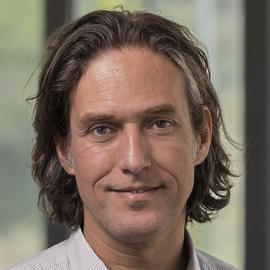
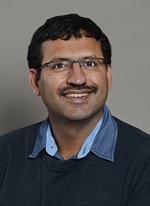
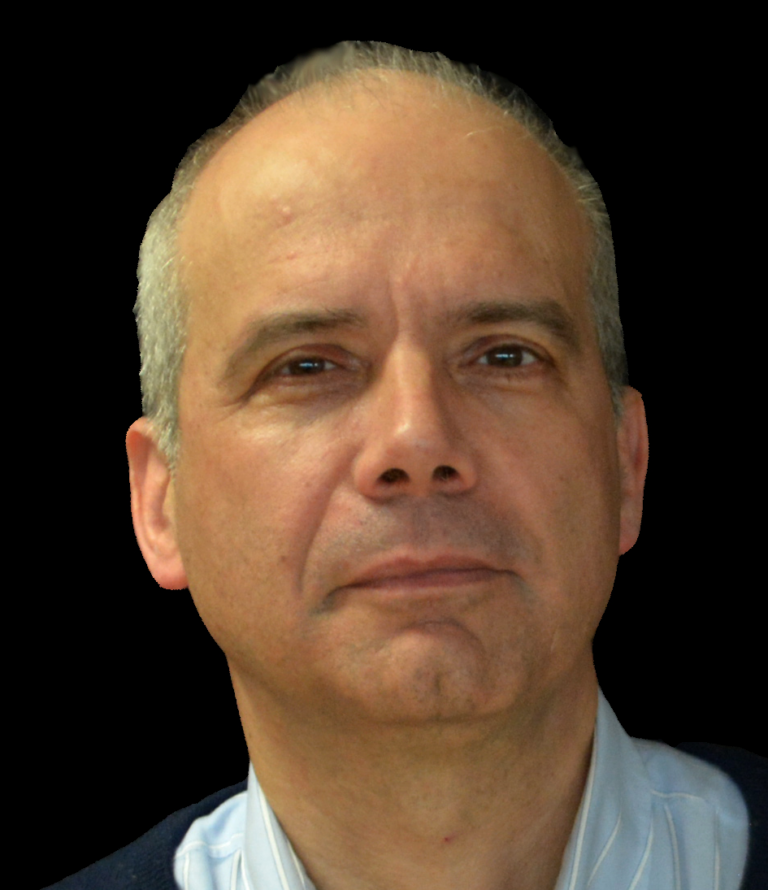
Jeremy Avigad is a Professor in the Department of Philosophy and the Department of Mathematical Sciences at Carnegie Mellon University, where he serves as Director of the Hoskinson Center for Formal Mathematics and holds a Dean's Chair in Logic and Philosophy of Mathematics. His primary research interests include Formal Methods and AI for mathematics, mathematical logic, and the history and philosophy of mathematics. His work bridges deep theoretical inquiry with practical applications, particularly in formal verification and automated reasoning. His recent publications reflect a strong focus on the formalization of mathematics, automated reasoning, and the integration of AI techniques into theorem proving. Key themes include the development and application of the Lean theorem prover, premise selection, proof optimization, and the formal verification of computational claims, especially in the context of blockchain technology. CADE-25 Skolem Award Avigad advises PhD students, such as Chase Norman, and is involved in significant research grants and collaborations, including work with StarkWare. He is an active organizer of major academic events like Big Proof and the Formalization of Mathematics workshops. He leads the Hoskinson Center for Formal Mathematics, a research hub dedicated to advancing the field of formal mathematics.
Prof Dirk Pattinson is a Professor in the School of Computing at Australian National University (ANU). His research focuses on modal logic, coalgebraic systems, automated reasoning, and formal methods. He holds a PhD in Computer Science and has supervised numerous research students. Research interests include coalgebraic logic, non-classical modal logics, automated theorem proving, and applications in computational social choice. His work bridges theoretical foundations with practical tools like the COOL reasoner for modal fixpoint logics. Notable contributions span over 70 peer-reviewed publications since 2008, with recent work on non-iterative modal resolution calculi (2024), Hennessy-Milner properties via topological methods (2022), and formal verification of voting systems (2021). His research often integrates algebraic, categorical, and coalgebraic perspectives.
Dr. Alexandros Evangelidis is a Research Associate at the Department of Computer Science, University of York. He holds a PhD in Computer Science from the University of Birmingham (2020) and is a Fellow of the Higher Education Academy (FHEA). His research focuses on synthesis and verification techniques, probabilistic model checking, performance modeling, state estimation, and the application of machine learning in verification. Prior to his current role, he served as a Postdoctoral Researcher at the Technical University of Munich (2020–2023) and a Teaching Fellow at the University of Birmingham (2018–2020). His work emphasizes interdisciplinary approaches, blending formal methods with practical applications in areas like cloud computing and robotics. Notable contributions include advancements in MDP controller synthesis (MULTIGAIN 2.0), hybrid task planning for human-robot collaboration, and quantitative verification of Kalman filters. His publications reflect a strong focus on algorithmic innovation and rigorous validation of complex systems. No specific scientific awards or grants are explicitly mentioned, but his active research roles indicate sustained engagement in cutting-edge projects. He is affiliated with the Automated Software Engineering research group at York, contributing to topics such as model-driven engineering and distributed systems scalability.
Ioannis Stefanakos is a Research Associate at the Department of Computer Science, University of York, affiliated with the High Integrity Systems research group. His work focuses on formal verification of autonomous systems, safety-critical robotics, and software performance analysis. Current projects include assurance frameworks for drones, adaptive reinforcement learning in healthcare robotics, and probabilistic modeling of software performance. Recent research emphasizes interdisciplinary applications in UAV systems, medical decision support systems, and collaborative manufacturing robots. No academic awards are listed, though his work has been published in top-tier conferences. Advising and grants details are not explicitly stated, but his involvement in doctoral forum papers suggests potential supervision roles in software systems research.
Mark Santolucito is an Assistant Professor of Computer Science at Barnard College, Columbia University. He holds a PhD in Computer Science from Yale University, where his research focused on program synthesis and computer music. His current work explores program synthesis techniques to enhance programmer productivity, particularly in lowering barriers to entry for underrepresented groups and optimizing workflows for advanced developers. He leads the Barnard PL (Programming Languages) Labs, which develops tools like TSL (Temporal Stream Logic) for synthesizing reactive systems and analyzing infrastructure-as-code (IaC). His research intersects formal methods with creative applications in music and live coding, emphasizing accessibility and usability. Education: PhD in Computer Science (Yale University), focusing on program synthesis and computer music. Research interests include program synthesis, temporal logic specifications, infrastructure configuration analysis, and music technology. He emphasizes human-centered design in his work, aiming to make programming more accessible through tools like TSL and interactive synthesis environments. Projects include TSL Move Cube, Block-based Editor for Temporal Logic, and Spiral Analysis for medical software migration. Notable contributions include developing TSL synthesis pipelines, optimizing Arduino configurations, and exploring static analysis for cost prediction in cloud deployments. His work bridges theoretical foundations with practical applications in both software engineering and creative computing. Labs/Teams: Leads Barnard PL Labs, collaborating on projects like TSL Synthesis Engine and Static Analysis for IaC. Active in workshops such as SEConfig and FMCAD.
Abhijit Mazumdar serves as a Research Fellow in the Department of Electronic Systems within Aalborg University's Faculty of IT and Design. He is actively affiliated with the Automation & Control Learning and Decisions Lab, focusing on theoretical and applied aspects of safety-critical decision systems. His research centers on Markov Decision Processes , safety verification , and reinforcement learning with critical applications in control systems. Key interests include stochastic safety analysis of hybrid systems, constrained optimization under uncertainty, and model-free safety verification techniques that prevent safety violations during learning. His work bridges theoretical computer science with practical engineering implementations in autonomous systems. Recent publications demonstrate a strong trend toward formal safety guarantees in learning-based control, with 75% of his 2023-2024 output addressing safety verification for Markovian systems. His fingerprint analysis shows dominant specialization in Computer Science (100%) and Engineering (100%) , particularly in safety-critical domains where theoretical rigor meets real-world implementation constraints. Dr. Mazumdar collaborates extensively within Aalborg University's technical ecosystem, particularly with researchers in control theory and formal methods. His laboratory work in the Automation & Control Learning and Decisions Lab focuses on developing mathematically rigorous frameworks for safe decision-making in uncertain environments.
Pablo Francisco Castro is a Professor and current Chair of the Department of Computer Science at Argentina's National University of Rio Cuarto (UNRC), while simultaneously serving as a Researcher at the Argentinean National Research Council (CONICET). His dual-role positions demonstrate significant academic leadership in both institutional administration and national research infrastructure. His educational foundation includes: Licenciatura in Computer Science from UNRC PhD in Computer Science from McMaster University, Canada Castro's research program centers on the theoretical and practical applications of logic to computing systems, with deep specialization in fault-tolerance mechanisms, computational complexity theory, and functional programming paradigms using Haskell and Python. His work bridges abstract logical frameworks with concrete implementation challenges, particularly in concurrent systems verification and probabilistic reasoning models. His 2023 JELIA conference publication on satisfiability bounds for adaptive knowing-how logic exemplifies his research trajectory toward formalizing complex cognitive processes within computational models, revealing consistent focus on the intersection of epistemic logic, AI reasoning, and computational tractability. While no specific awards are documented in the provided materials, his extensive service as program committee member for premier conferences (FM, CONCUR, CLEI) and reviewer for top-tier journals (Artificial Intelligence, IEEE Transactions) indicates substantial peer recognition within the formal methods community. No information regarding student advisement or research grants appears in the source texts. Similarly, no dedicated laboratory structures or formal research teams are explicitly described, though his GitHub repositories suggest independent tool development aligned with his publication topics.
César Sánchez is a Full Professor at the IMDEA Software Institute , where he has been since 2007. He earned his Ph.D. in Computer Science (2007) and M.S. in Computer Science (2001) from Stanford University , and a M.Eng in Telecommunication Engineering from Universidad Politécnica de Madrid (1998). His academic career includes promotions to Associate Professor in 2012 and Full Professor in 2023. Research Interests Formal Methods Temporal Logics for Hyperproperties Reactive Synthesis Modulo Theories Blockchain and Smart Contract Reasoning Runtime Verification of Real-Time Systems Neurosymbolic Formal Methods His publications span 15 recent works (2023-2025) focusing on formal verification of systems using temporal logics , reactive synthesis , and blockchain applications . Key trends include asynchronous hyperproperty analysis , anticipatory monitoring , and shield synthesis for DRL and blockchain systems. Service & Collaboration Program Committee Member: CAV'25, ATVA'24, TACAS'24, DAPPS'23 Collaborations with institutions like Stanford, IMDEA, and Nature César actively recruits researchers (interns, PhD students, postdocs) for his group at IMDEA, focusing on hyperproperties, reactive synthesis, and blockchain verification.
Rohit Chadha is an Associate Professor in the Department of Electrical Engineering and Computer Science at the University of Missouri and serves as the Director of the Mizzou Cybersecurity Center . His research focuses on formal methods and their application to cybersecurity , particularly in verifying differential privacy mechanisms and randomized security protocols . Education : PhD from the University of Pennsylvania, BTech from the Indian Institute of Technology, Delhi Previous Positions : INRIA Saclay (France), University of Illinois at Urbana-Champaign, Instituto Superior Tecnico (Portugal), University of Sussex (UK) Research Interests include automated verification of security hyperproperties , probabilistic automata , and quantitative information flow . His work addresses privacy risks in aggregate data and AI-driven battlefield communication systems. Publication Trends show a focus on differential privacy verification , zero-trust architectures , and model checking of probabilistic systems. He has contributed to security frameworks for military applications and educational initiatives using collegiate competitions. Scientific Awards : NSF CAREER Award (2016) NSF SHF: Medium Grant (2019) NSF TWC: Medium Grant (2013) Rohit leads the Mizzou Cybersecurity Center , collaborating with industry partners through its Industrial Advisory Board . His research integrates formal verification with practical cyber defense applications.
Christel Baier is a full Professor and head of the Chair for Algebraic and Logic Foundations of Computer Science at the Faculty of Computer Science, Technische Universität Dresden, a position she has held since 2006. She previously served as an associate professor for Theoretical Computer Science at the University of Bonn from 1999 to 2006. She is currently the dean of the Faculty of Computer Science at TU Dresden (2025–2027), having been vice-dean from 2019 to 2024. She holds a Diploma in Mathematics (1990), a Ph.D. in Computer Science (1994), and a Habilitation (1999), all from the University of Mannheim. In 2022, she was awarded an honorary doctorate from RWTH Aachen. Her research centers on formal methods in computer science, with a strong emphasis on modeling, specification, and verification of reactive and stochastic systems. She is a leading expert in probabilistic model checking, temporal and modal logics, automata over infinite structures, game theory, and the verification of infinite-state systems. Her work bridges theoretical foundations with practical applications in system reliability and correctness. The recent publications and edited volumes reflect a consistent focus on formal verification, logic in computer science, and tools for system analysis. Her editorial leadership in major venues such as LICS, TACAS, and FoSSaCS underscores her influence in shaping the research agenda in theoretical computer science and formal methods. Jean-Claude Laprie Award in Dependable Computing (2023) Honorary doctorate from RWTH Aachen (2022) Member of Academia Europaea (since 2011) Editor-in-Chief of Acta Informatica (2015–2022) Steering Committee Member of LICS, FoSSaCS, FORTE, and FSEN Extensive service on program committees of top-tier conferences including CAV, CONCUR, and ICALP Christel Baier has advised numerous PhD and master’s students (though not explicitly listed), and has led major research projects funded by DFG, EU, and DAAD. She has organized pivotal events such as CONCUR'06, TACAS'15, and LICS'22. She is actively involved in academic governance, serving on the senate of TU Dresden (2015–2020), as ombudsperson for the Department of Computer Science, and on the Scientific Advisory Board of Schloss Dagstuhl. Her leadership in the German Excellence Initiative and DFG Research Training Groups highlights her role in shaping national research agendas.
Mahsa Shirmohammadi is a CNRS researcher at Institut de Recherche en Informatique Fondamentale (IRIF) , Université de Paris. Her research focuses on verification, probabilistic models, infinite-state systems, automata theory, and numerical computation. Education : PhD from LSV, ENS de Cachan (France) and ULB (Belgium). Previous Affiliation : Postdoctoral researcher at University of Oxford (UK). Her work addresses stochastic games , timed automata , matrix groups , and algebraic computation . Recent publications analyze strategy complexity, synchronization in decision processes, and parametric algebraic problems. Key collaborators include Stefan Kiefer, Richard Mayr, James Worrell, and Patrick Totzke. Her research has been published in venues like ACM SIGLOG News, ICALP, LICS, and ISSAC. Contact: mahsa@irif.fr , +33 (0)1 57 27 92 29, Office 4017 (Sophie Germain building, Paris).
James Worrell is a Professor of Computer Science at the University of Oxford , with a focus on logic in computer science , linear dynamical systems , and automated verification . He is also a Fellow of Green Templeton College. His research spans theoretical computer science and formal methods , including work on metric temporal logic , probabilistic semantics , and category theory . His publications address decision problems , verification of linear dynamical systems , and automata theory . James has received the EPSRC Established-Career Fellowship for his work in linear dynamical systems verification . His recent papers include polynomial invariants , polyhedral escape problems , and skolem problem solutions . He has advised students such as Mehran Hosseini , Pascale Gourdeau , and Ventsislav Chonev , and teaches courses like Computational Learning Theory and Logic and Proof . His work appears in venues like ICALP , LICS , and SODA .
Marcin Jurdzinski is a Professor at the Department of Computer Science, University of Warwick, with a focus on algorithms, games, automata, and logic. His career spans institutions like the University of Aarhus, University of Paris 7, and UC Berkeley. Research interests include Parity games Stochastic games Timed automata Formal verification Game theory . Recent articles highlight work on parity games, stochastic systems, and timed automata, published in venues like SIAM Journal on Computing, LICS, and CAV. Keywords span Computer Science , Game Theory , and Formal Methods . PhD students mentored include Thejaswini K. S., Michail Fasoulakis, and Ashutosh Trivedi. Funded projects such as Solving Parity Games in Theory and Practice (2017-2021) reflect his research priorities.
Dan Mikulincer is the Brian and Tiffinie Pang Assistant Professor at the University of Washington in the Department of Mathematics, College of Arts and Sciences. He previously held a postdoctoral Instructor position at MIT Mathematics and earned his Ph.D. from the Weizmann Institute of Science under Ronen Eldan. He completed his B.Sc. in Mathematics and Computer Science at Ben-Gurion University, where he also studied Cognitive Neuroscience. B.Sc.: Ben-Gurion University (Mathematics, Computer Science, Cognitive Neuroscience) Ph.D.: Weizmann Institute of Science, Faculty of Mathematics Postdoc: MIT Mathematics Current: Assistant Professor, University of Washington, Department of Mathematics His research lies at the intersection of high-dimensional geometry, probability, statistics, information theory, and data science. He is particularly focused on normal approximations, Stein's method, stochastic analysis, and dimension-free phenomena. His work explores foundational aspects of learning theory, random matrices, transportation inequalities, and neural networks, often using probabilistic and analytic tools to derive sharp, robust results in high dimensions. The recent publications reflect a consistent focus on probabilistic methods in high-dimensional settings. Key themes include normal approximation via Stein's method, optimal transport, concentration and anti-concentration inequalities, random graph models, and theoretical aspects of machine learning such as learnability and neural network expressivity. The work spans both pure mathematics (e.g., GAFA, PTRF) and top-tier computer science venues (e.g., COLT, STOC, NeurIPS), highlighting interdisciplinary impact. Although no formal scientific awards are listed in the provided text, his publications in premier journals and conferences (Annals of Probability, STOC, NeurIPS, COLT) indicate significant recognition in the theoretical community. Dan Mikulincer has advised or collaborated with several researchers including Yair Shenfeld, Max Fathi, Ronen Eldan, and Sébastien Bubeck. He has served as a TA for 18.650: Statistics for Applications at MIT and taught programming courses (Java, Python, JavaScript) at the Interdisciplinary Center Herzliya. He is also a senior lecturer at WeCode, a nonprofit providing free programming education to underrepresented youth in Israel, indicating a strong commitment to education and outreach. He has been affiliated with research groups at MIT Mathematics, Weizmann Institute, and Microsoft Research AI, where he spent the summer of 2019 hosted by Sébastien Bubeck. These collaborations span theoretical machine learning, stochastic processes, and algorithmic foundations.
Roles and Affiliations: José Nuno Oliveira is a Full Professor at the University of Minho's School of Engineering, Department of Computer Science. He is a member of the HASLab (High-Assurance Software Laboratory) and the Formal Methods Europe (FME) Association. He has held roles such as General Chair of the 3rd World Congress on Formal Methods (FM'19) and served on numerous international conference committees. Education: Habilitation in Computing Foundations (2010), University of Minho Ph.D. in Computer Science (1984), University of Manchester, UK M.Sc. in Computer Science (1981), University of Manchester, UK Lic. Eng. Elect. (Digital Systems & Computers) (1978), University of Porto, Portugal Research Interests: Oliveira focuses on formal methods, program calculation, and algebraic programming. His work emphasizes improving software design through mathematical rigor, including applications of relational algebra, functional programming, and program transformation. He has contributed to frameworks like Alloy and QAlloy for software verification. Publications: His recent work spans topics like quantum programming (e.g., quantamorphisms), typed linear algebra for data analysis, and formal methods in education. Over 80 publications include influential papers on Galois connections, metaphorisms, and coalgebraic systems. Awards and Grants: Not explicitly listed, but his leadership roles and extensive conference involvement highlight his recognition in formal methods. Active in projects like IBEX (cyber-physical systems) and TRUST (Alloy-based design). Teaching and Service: Teaches courses on program calculation and formal methods. Serves on editorial boards (e.g., Formal Aspects of Computing ) and chairs international conferences. Active in promoting formal methods education through workshops and training initiatives. Labs and Teams: Co-leads the HASLab (INESC TEC & University of Minho), focusing on high-assurance software systems. Collaborates on projects like EVEREST (railway network verification) and LeanBigData (big data analytics).