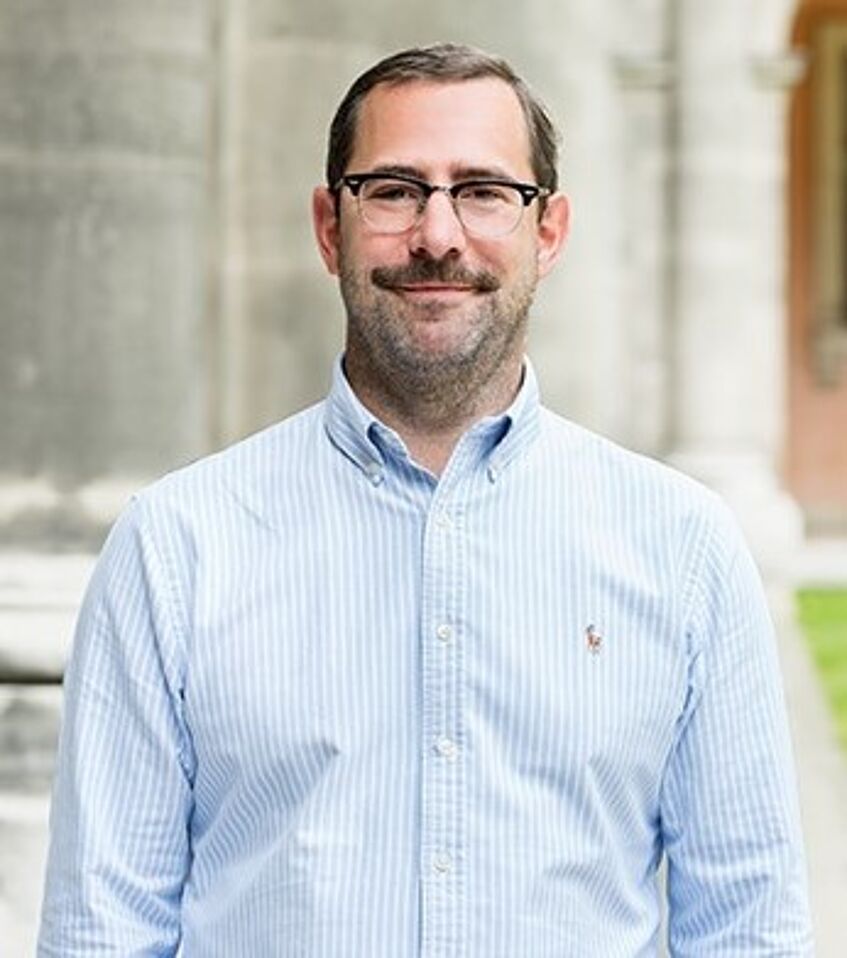
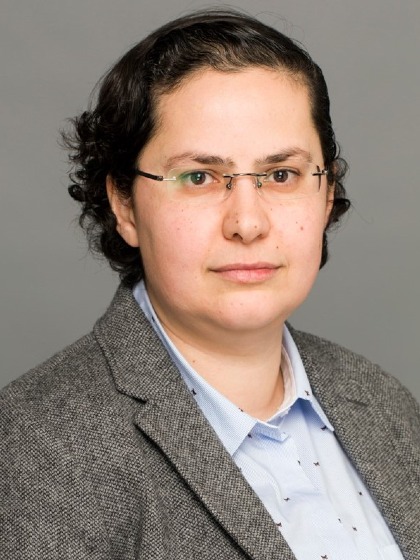
Brenda López Cabrera is a Professor of Statistics at the School of Business and Economics , Humboldt University of Berlin. She holds the Ladislaus von Bortkiewicz Chair of Statistics and contributes to research in climate, weather, and energy finance. Research Focus: Climate risk, nonstationary time series, machine learning, and financial risk modeling. Collaborations: Collective Cognition & Cooperation Network (Humboldt-Princeton), IRTG 1792 (DFG-funded), SFB 649 Project C11 (Weather Risk Management). Scientific Contributions include publications on wind power forecasting, temperature derivatives, CO2 futures volatility, and functional data approaches to electricity demand. Her work bridges statistical theory with practical applications in energy and environmental economics. Teaching: Involves digital economy, blockchain, and financial market statistics. She mentors research projects and co-develops Quantlet-based educational resources.
Chang-Tien Lu is a Professor of Computer Science at Virginia Tech, serving as Curriculum Lead at the Virginia Tech Innovation Campus and Associate Director of the Sanghani Center for AI and Data Analytics. He holds a Ph.D. in Computer Science from the University of Minnesota (2001) and an M.S. from Georgia Institute of Technology (1996). His research focuses on spatial databases, data mining, urban computing, AI, and transportation systems, supported by grants from NSF, NIH, DoD, and others. He is an ACM Distinguished Scientist and Virginia Tech College of Engineering Faculty Fellow. Research interests include AI applications in healthcare (e.g., virtual healthcare bots), spatiotemporal data analytics, cybersecurity, and ethical AI frameworks. His work bridges social and cyber dimensions in vulnerability assessment, with contributions to urban digital twins and environmental modeling. He serves on editorial boards for journals like ACM Transactions on Spatial Algorithms and Systems, and has organized major conferences including ACM SIGSPATIAL. Awards: ACM Distinguished Scientist, Virginia Tech College of Engineering Faculty Fellow Grants: NSF, NIH, DoD, DoE, IARPA, and DOT funding Advisory Roles: Secretary and Vice Chair of ACM SIGSPATIAL (2008–2014) Recent publications highlight advancements in LLM vulnerability detection, urban computing systems, and healthcare analytics. His work often integrates machine learning with domain-specific challenges, such as transportation optimization and environmental data analysis.
Dr. Abbas Mamudu is an Assistant Professor in the Department of Petroleum Engineering at Memorial University of Newfoundland. He holds a B.Eng. and M.Eng. from the University of Benin (2007, 2014) and a PhD from Memorial University (2022, GPA 4.0). His expertise spans Safety and Risk Engineering, Green Energy, and Enhanced Oil Recovery. Prior to joining Memorial, he worked as Quality Control Manager at Schneider & Schroeder Services Limited, addressing process safety and risk challenges, and served as a Postdoctoral Fellow in Process Engineering at Memorial. His research focuses on CO2 sequestration, reservoir simulation, and AI-driven risk mitigation. Key areas include offshore hydrocarbon reservoir utilization, dynamic risk modeling, and sustainable energy practices. His work integrates advanced technologies like AI and 4IR frameworks to enhance operational safety and efficiency. Education: B.Eng. in Petroleum Engineering, University of Benin (2007) M.Eng. in Petroleum Engineering, University of Benin (2014) PhD in Petroleum Engineering, Memorial University (2022) Dr. Mamudu has published extensively in top-tier journals, with a focus on CO2 storage, reservoir dynamics, and safety engineering. His awards include the Best Regional Research Paper (Society of Petroleum Engineer) and the School of Graduate Studies’ Fellowship from Memorial University. Awards: Best Regional Research Paper (M.Sc Division), Society of Petroleum Engineer Fellow of the School of Graduate Studies’ Award, Memorial University His advisory experience includes leading research projects at the University of Benin and mentoring students in reservoir simulation and EOR techniques. His work bridges academic research and industrial applications, emphasizing practical solutions for energy sector challenges.
Dr. Jen Henderson is an Assistant Professor in the Department of Geosciences at Texas Tech University. She directs the Risk and Equity in Disasters (RED) Lab , which focuses on vulnerability, risk communication, and decision-making in weather and climate disasters. Her research addresses compound hazards (e.g., tornadoes, floods, droughts) through interdisciplinary collaborations with the National Weather Service and affected communities. Education B.A. in Psychology and English, Weber State University (2000) M.A. in Cultural Studies, Kansas State University (2002) M.F.A. in Creative Nonfiction, Goucher College (2004) Ph.D. in Science and Technology Studies, Virginia Tech (2016) Research Focus Henderson's work examines how risk and uncertainty manifest during disasters, with emphasis on marginalized populations. She employs qualitative methods (interviews, ethnography, social media analysis) to study warning systems, political ecology, and disaster equity. Her RED Lab bridges expert knowledge (e.g., forecasters) and community experiences to co-produce policy-relevant science. Publications Her recent articles (2022-2024) explore disaster communication, compound hazards, and qualitative methodologies. Themes include social media analysis of public behavior during hurricanes, ethical frameworks for disaster research, and improving forecast usability for emergency managers. The work consistently integrates social science with operational meteorology. Professional Activities Associate Editor for Weather, Climate and Society Member of TTU STEM-CORE
Peter Knippertz is a Professor at the Karlsruhe Institute of Technology (KIT), leading research at the Institute of Meteorology and Climate Research. He serves as the representative for the collaborative research center 'Waves to Weather'. His work focuses on atmospheric dynamics, dust storms, monsoons, and machine learning applications in weather prediction. Recent publications emphasize West African climate systems, tropical waves, dust particle analysis, and forecast optimization. He coordinates field campaigns (e.g., CADDIWA) and develops educational tools like the TEEMLEAP testbed for atmospheric prediction training.
Daniel Wright is an Associate Professor in the Department of Civil and Environmental Engineering at the University of Wisconsin–Madison, part of the College of Engineering. His research focuses on flood hazards, urban drainage systems, and climate change impacts. He specializes in developing innovative methods to assess flood risks in urban areas and large watersheds. His work integrates hydrological modeling, satellite data analysis, and AI-driven techniques to improve flood prediction accuracy. Key themes include rainfall projection under climate change, urban infrastructure resilience, and the application of stochastic storm transposition for flood risk assessment. He collaborates on global datasets like STREAM-Sat to enhance real-time precipitation monitoring. Recent research highlights include advancing ensemble-based stochastic downscaling, validating satellite precipitation products, and evaluating urban drainage system performance under extreme rainfall scenarios. His contributions address both technical challenges and policy implications of climate adaptation in water resources management. Dr. Wright has no listed awards but is actively engaged in peer-reviewed publications and conference discussions on climate-linked economics and infrastructure innovation. His advising and grant activities are not detailed in the provided texts. His research also explores interdisciplinary topics such as urban ecohydrology and wildfire-driven flood dynamics.
Valentina M. Khan is a Senior Research Scientist at the Hydrometeorological Research Centre of the Russian Federation, working in the Department of Long-Range Forecasting. Her career includes roles as Visiting Researcher/Lecturer at the University of Rio Grande (Brazil, 1995-1999) and Research Scientist positions since 1999. Khan specializes in climate variability analysis, statistical forecast methodologies, and ocean-atmosphere teleconnections. She has led major projects funded by the Russian Foundation for Basic Research (RFBR), focusing on climate predictability assessment and synoptic process diagnostics. Her research integrates observational data with physics-based models to understand meteorological anomaly patterns. Current projects emphasize statistical heterogeneity in climate time series and probabilistic seasonal forecasting using multimodel ensembles. Khan's publications span meteorological journals and edited volumes, addressing topics like snow cover dynamics in Russian river basins and upper-air temperature trends. She collaborates internationally, evidenced by co-authored works with researchers from Ukraine, Germany, and other countries. Her technical expertise combines advanced statistical methods with climatic system analysis, contributing to operational long-range forecasting systems. Despite no listed awards, her sustained RFBR project leadership underscores recognition within the scientific community. Khan's work bridges theoretical climate modeling with practical forecasting applications, addressing critical needs in environmental monitoring and climate service development.
Dr. Joseph Trujillo-Falcón is an incoming Assistant Professor (August 2025) at the University of Illinois Urbana-Champaign, jointly affiliated with the Department of Climate, Meteorology, and Atmospheric Sciences and the Department of Communication. He leads the ALERTAS lab, focusing on multilingual weather and climate communication equity. His interdisciplinary research bridges meteorology and social sciences, driving policy changes in NOAA and the National Weather Service. Previously, he was an Illinois Distinguished Postdoctoral Research Associate and conducted research at NOAA’s National Severe Storms Laboratory and NWS Storm Prediction Center. Education: Ph.D. in Risk Communication (University of Oklahoma, 2024); M.A. in Organizational Communication (2021); B.S. in Meteorology and B.A. in Spanish (Texas A&M University, 2019). Research interests include multilingual risk communication strategies for extreme weather, policy advocacy for language equity, and broadcast meteorology practices. He has pioneered frameworks for inclusive watch/warning translations and enhanced wireless emergency alerts for Spanish speakers. His work has influenced NOAA’s operational protocols, emphasizing accessibility for diverse communities. Teaching: Planning to teach ATMS 491/CMN 496: Extreme Weather Communication Fieldwork (Fall 2025) and courses on environmental hazard communication. Guest lectures across universities on multilingual disaster communication and policy. Awards: 2024 Premio Orgullo Peruano; 2023 Outstanding Achievement in Research (CIWRO); 2023 Telly Awards (2x); 2022 AMS Early Career Achievement Award. Labs/Teams: ALERTAS Lab collaborates with practitioners and public stakeholders, advancing equitable communication through surveys, fieldwork, and policy engagement. Collaborators include institutions like NOAA, NWS, and academic departments in communication and meteorology.
Niklas Erdmann is a Research Fellow and PhD candidate at the University of Oslo, affiliated with the Section for Autonomous Systems and Sensor Technologies. He holds a Master's in Artificial Intelligence and a Bachelor's in Psychology from the University of Groningen (NL). His research focuses on applying machine learning to energy systems, particularly solar irradiance forecasting using weather data. Education: Master's in Artificial Intelligence, University of Groningen (NL) Bachelor's in Psychology, University of Groningen (NL) Research interests include time series forecasting, explainable AI, and probabilistic machine learning. His work emphasizes uncertainty quantification and applications in energy systems. Recent publications include a conference paper on solar irradiance forecasting at the Arctic Circle using deep learning methods. Labs/Teams: Active in the Section for Autonomous Systems and Sensor Technologies.
Martin Weißmann is a Professor for Theoretical Meteorology at the University of Vienna's Faculty of Earth Sciences, Geography and Astronomy, where he has served since 2020. Previously, he headed the Department of Meteorology and Geophysics (2020-2022) and the Data Assimilation Branch at the Hans-Ertel Centre for Weather Research. His research focuses on numerical weather prediction, atmospheric data assimilation, ensemble forecasting, error modeling, and applications of wind lidar and satellite data. Education includes an MSc in Meteorology from the University of Innsbruck (1996-2003) and a PhD from DLR Oberpfaffenhofen in cooperation with University of Innsbruck (2003-2006). His scientific commitments include membership in the ESA Aeolus Science and data quality Advisory Group and coordination of the project Experimental Validation and Assimilation of Aeolus Observations. Research interests center on: Advanced data assimilation techniques for numerical weather prediction Ensemble methods for probabilistic forecasting and error quantification Integration of novel observation systems like Doppler wind lidars Validation and application of Aeolus satellite wind data Convective-scale modeling and high-resolution forecasting His publication record demonstrates consistent focus on improving weather prediction systems through innovative assimilation methods, with recent work emphasizing machine learning applications, convective-scale data assimilation, and satellite data validation. Teaching responsibilities include courses in dynamic meteorology, numerical weather prediction, and scientific communication.
Dr. Wided Medjroubi is an Assistant Professor at the Energy and Sustainability Research Institute Groningen, Faculty of Science and Engineering, University of Groningen. Her research examines energy system modeling with a focus on computational approaches to climate change adaptation, renewable integration, and sustainable urban energy systems. Her work investigates: How collaborative models can address complex future energy systems; How energy models enhance resilience against geopolitical conflicts and extreme weather; How GIS and Open Science accelerate energy transitions; and Climate change impacts on energy production/consumption. Her methodological expertise includes computational fluid dynamics, spatial analysis, and uncertainty quantification. Recent publications demonstrate strong focus on energy transition technologies (hydrogen systems, geothermal integration) and climate resilience planning. Over 75% of her last 15 articles address renewable integration challenges using advanced modeling techniques, particularly through GIS applications and machine learning approaches.
Dr. Yiming Sun is a Researcher in the School of Electrical and Electronic Engineering at the University of Sheffield, focusing on Complex Dynamic Weather Processes Modelling. His work integrates machine learning with environmental systems, including seasonal weather forecasting and energy management optimization. He holds a Research Associate position, contributing to interdisciplinary projects at the intersection of engineering and environmental science. Research interests span environmental modeling, climate prediction, soil chemistry, plant biology, and biotechnology. Key projects include developing hybrid machine learning models for weather systems and studying plant-microbe interactions in contaminated environments. His work bridges theoretical models with practical applications in sustainable energy and ecological remediation. Publications highlight contributions to weather forecasting algorithms, energy management systems, and plant-based bioremediation strategies. Recent work emphasizes interpretability in machine learning models for climate science and optimizing building energy systems through probabilistic modeling. No scientific awards or funded grants are explicitly listed. Collaborations with industry and academic partners are evident in his research on food science education and corporate partnerships in biotechnology. Laboratory and team affiliations are not detailed, but his research involves interdisciplinary teams addressing environmental challenges and technological innovations.
Phil Taylor is the Professor, Vice-Chancellor and President at the University of Bath. His research focuses on energy systems, power distribution engineering, and climate change mitigation. He leads the Supergen Energy Networks Hub Renewal project funded by the Engineering and Physical Sciences Research Council (EPSRC), exploring energy storage systems and grid resilience. Key research interests include smart grids, renewable integration, and weather impacts on power infrastructure. Recent work addresses extreme weather effects on UK distribution grids, electric vehicle charging strategies, and lightning strike mitigation in power systems. He has published extensively on energy storage optimization, multi-energy systems, and grid resilience under climate change scenarios. Notable contributions include developing preemptive EV charging frameworks and probabilistic models for outage prediction. His projects often involve interdisciplinary collaboration, combining engineering, data science, and policy analysis. Current initiatives emphasize net-zero transitions and cross-border energy interconnector stress analysis. He holds a leadership role in advancing UK energy infrastructure through strategic research and innovation programs. Collaborations span academic, industrial, and government sectors to address systemic challenges in decarbonization and grid reliability.
Tom Frame is a researcher at the University of Reading's Department of Meteorology, School of Mathematical, Physical and Computational Sciences. His work focuses on atmospheric dynamics, climate variability, and advanced weather forecasting techniques, particularly in jet stream behavior, convection-permitting ensemble modeling, and tropical-extratropical interactions. He has contributed to understanding North Pacific and Atlantic jet stream trends, extreme precipitation forecasting, and sub-seasonal prediction in Southeast Asia. Frame's research emphasizes improving forecast accuracy through ensemble methods and analyzing climate dynamics using observational and model data. Key research interests include jet stream dynamics, ensemble forecasting systems, tropical variability impacts, and the predictability of high-impact weather events. His studies often bridge observational analysis with numerical modeling, addressing gaps in understanding weather patterns and their long-term climate context. Frame collaborates on interdisciplinary projects like the DIAMET initiative, exploring cyclone dynamics and cloud processes.
Dr. Jochen Broecker serves as Associate Professor in Environmental Data Analysis at the University of Reading, UK, within the School of Mathematical and Physical Sciences and Department of Mathematics and Statistics. Since September 2015, he has held this position, following a Lecturer role from September 2012 to September 2015. He currently serves as Co-director of the Mathematics of Planet Earth Centre for Doctoral Training (MPECDT) and has organized significant academic events including the June 2024 Ver-AI workshop on Verification of AI-Based Meteorological Forecasts. Dr. Broecker's research spans the critical intersection of mathematical theory and practical meteorological applications. His work bridges Analysis, Dynamical Systems, Probability Theory, and Statistics with real-world applications in Weather, Climate, and Ocean systems. He develops both rigorous mathematical methods and practical software tools for implementation. His current research focuses include Nonlinear and Infinite Dimensional Stochastic Systems, Data Assimilation, Applied Nonlinear Filtering, Statistical Learning, and the Evaluation of Weather- and Climate Forecasts, with particular emphasis on Calibration, Skill Scores and Reliability metrics. Analysis of Dr. Broecker's recent publications reveals a consistent trajectory at the forefront of climate mathematics and forecast verification. His work demonstrates increasing focus on the signal-to-noise paradox in climate forecasting, mathematical foundations of data assimilation techniques, and rigorous verification methodologies for both traditional and AI-based forecasting systems. His research shows strong interdisciplinary connections between pure mathematics, statistics, and practical meteorological applications, with particular relevance to improving the reliability and accuracy of weather and climate predictions. Dr. Broecker actively supervises postdoctoral researchers and graduate students, including Noeleene Mallia-Parfitt (working on validation of data assimilation algorithms), Lea Oljača (researching filtering in dissipative and hyperbolic dynamics), and Giulia Carigi (investigating ergodic properties of stochastic two-layer geophysical fluid dynamics models). His teaching responsibilities include advanced courses such as MA3PAM Probability and Measure and MA3TPA Topics in Pure and Applied Mathematics. Beyond his academic work, Dr. Broecker maintains diverse personal interests including calligraphy, history, model airplanes, woodworking, and dinghy sailing, with his personal website featuring extensive information about OK dinghy sailing, indicating a dedicated involvement in this sailing discipline.

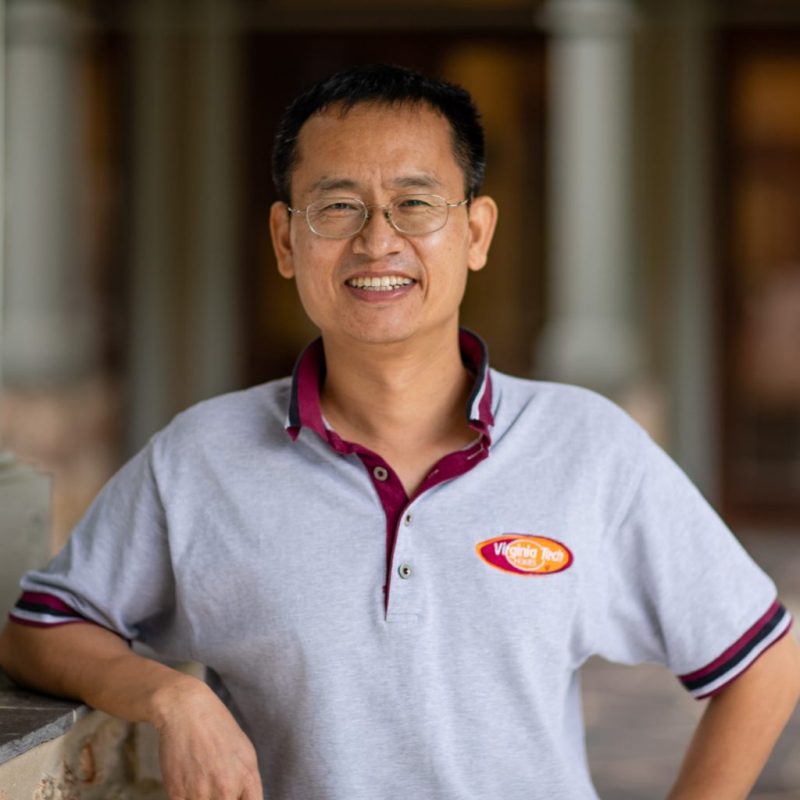


/niklase/erdma.png)