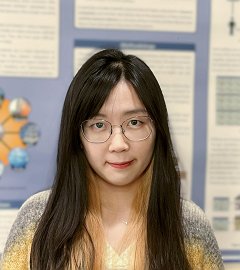
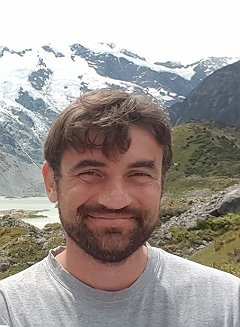
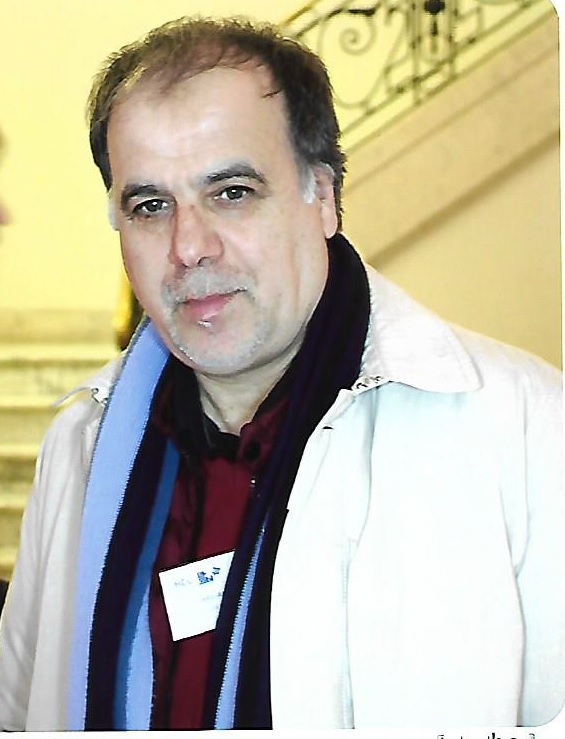
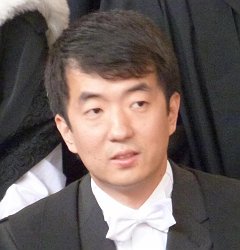
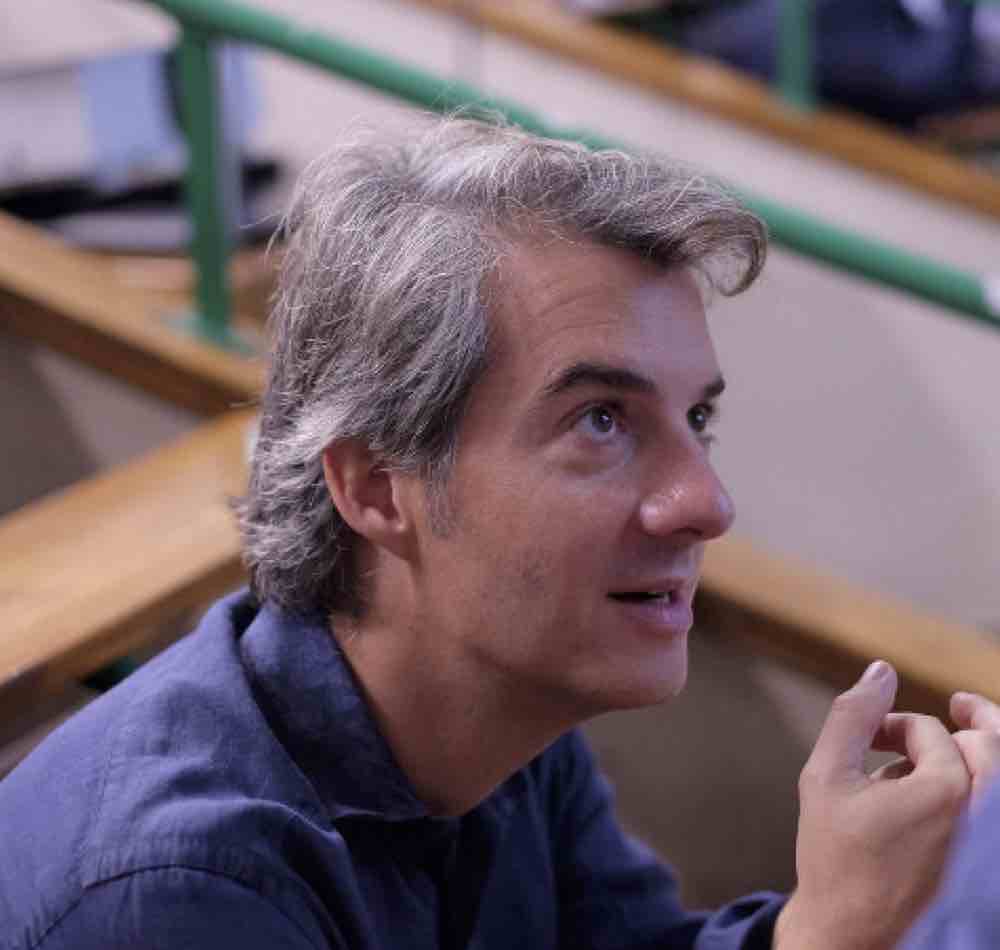
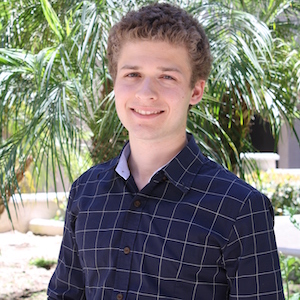
Ningning Xie is a researcher affiliated with the University of Toronto, specializing in functional programming, type systems, and logics. Their work spans applications in compilers, code generation, and machine learning, with a focus on compositional programming and effect handling. Research interests include: Functional programming Type systems Logics Compiler design Multi-stage programming Effect handlers Recent publications demonstrate expertise in type-level programming, staged compilation, and effect systems. Key areas include distributive disjoint polymorphism, parallel algebraic effect handlers, and macro systems for OCaml and Haskell. Their work bridges theoretical formalisms with practical language implementations. Contributions to academic service include organizing and reviewing for conferences like POPL, PLDI, ICFP, and Haskell workshops. Notable roles include Publicity Chair for POPL 2026 and Co-chair for PLMW and Artifact Evaluation committees.
Dr. Giulio Guerrieri is a lecturer (= associate professor) in computer science at the University of Sussex, UK, and a Maître de Conférences (= associate professor) at Aix-Marseille University, France (currently in voluntary layoff status). His research spans logic, proof-theory, lambda-calculus, type theory, linear logic, abstract machines, and denotational semantics. Education : PhD in Computer Science and Philosophy from Università Roma Tre (Italy) and Université Paris Diderot-Paris 7 (France), supervised by Lorenzo Tortora de Falco and Thomas Ehrhard. Current Roles : Lecturer at University of Sussex; Maître de Conférences at Aix-Marseille University. Past Roles : Senior researcher at Huawei Edinburgh Research Centre; postdoctoral fellow at University of Bath, Università di Bologna, University of Oxford, and others. His research focuses on theoretical computer science, particularly computational calculi and their logical foundations. Recent publications include work on lambda-calculus normalization, quantitative inhabitation, and proof-net confluence. He has taught courses at multiple universities, including Functional Programming (University of Bath), Logic for Computer Science (Università di Bologna), and Programming for Mathematics (Università di Bologna). He has served on program committees for workshops like CSL, FSCD, and FoSSaCS. His lab affiliations include the Laboratoire d'Informatique et Systèmes (LIS) at Aix-Marseille University and the Programming Language team at Huawei Edinburgh Research Centre.
Julien Perret is a senior researcher at the National Institute of Geographic and Forest Information (IGN) in France, affiliated with the LASTIG laboratory and STRUDEL research team. His work spans geographical information science, urban dynamics, and historical cartography. Current Affiliation: National Institute of Geographic and Forest Information (IGN) Research Team: LASTIG, STRUDEL Academic Rank: Senior Researcher (Directeur de Recherche) Education Habilitation (HDR) in Geographical Information Science, Université Paris-Est (2016) PhD in Computer Science, Université Rennes 1 (2006) Engineering Degree in Computer Science, INSA Rennes (2002) Research Interests Perret's research focuses on urban dynamics through computational approaches, including agent-based modeling and 3D urban simulation . He investigates historical cartographic data like the Napoleonic land registry and Cassini Carte de France to understand long-term urban evolution. His work integrates geospatial data with epidemiological modeling using digital twins, particularly for pandemic simulations. Scientific Contributions Key publications include: 2025: Building change models for urban densification studies 2024: Historical map vectorization benchmarks 2017: Scalable point cloud management systems 2015: 3D analysis of urban regulation impact 2005: Procedural geometry modeling with FL-systems Advising and Collaborations Perret has supervised multiple PhD students and collaborated on projects like SoDUCo (1789-1950 Paris urban dynamics) and iSpace&Time (4D GIS for city modeling). He contributes to open-source GIS tools like GeOxygene .
Allel Hadjali is a Full Professor in Computer Science specializing in Data Engineering at ISAE-ENSMA (École Nationale Supérieure de Mécanique et d'Aérotechnique) in Poitiers, France. He is affiliated with the Laboratory LIAS (Laboratoire d'Ingénierie des Applications de la Connaissance et des Systèmes) at ISAE-ENSMA. His academic career includes progression from Associate Professor to his current Full Professor position, with extensive teaching experience across multiple computer science domains. Professor Hadjali's research falls within the data science domain, with particular focus on Exploitation, Extraction, and Recommendation (E2R). His work applies Computational Intelligence and Soft Computing techniques to massive data exploitation and analysis, including flexible querying approaches (Skyline, Gradual, and Bipolar queries), modeling and querying uncertain/incomplete data, cooperative answering techniques, and data reduction through linguistic summaries. He also conducts research in recommendation systems (learning-based and group recommendation) and extraction techniques (mining gradual patterns), along with related interests in data quality, intelligent systems, and crowdsourced data management. His publication record demonstrates consistent contributions to top-tier journals and conferences, with recent work focusing on skyline query processing, uncertain data management, RDF knowledge bases, and explainable AI. His research shows a clear trajectory from foundational work in fuzzy logic and uncertain databases toward more applied research in semantic web technologies and machine learning explainability. Professor Hadjali serves on the editorial boards of several prestigious journals including the Journal of Smart Environments and Green Computing, Sensors Journal, and the Universal Journal of Aeronautics and Aerospace Research. He has also organized special issues on topics such as uncertainty in cloud computing and managing uncertain data. At ISAE-ENSMA, Professor Hadjali teaches courses including Formal aspects of software engineering, Language interpretations and compilation, Programming languages, and Data management and exploitation. Previously as an Associate Professor, he taught courses on object modeling, distributed algorithms, operating systems, and advanced databases focusing on preferences and uncertainty. He leads the Data Engineering team within the Laboratory LIAS, which focuses on developing computational intelligence approaches for modern data challenges. His current projects include work on data quality (QDoSSI project funded by CNRS Mastodons 2016-2018) and research actions in GDR MADICS 2018 related to scientific data quality.
Dr. Meng Wang is a Professor at the School of Computer Science, University of Bristol, where he leads the Programming Languages Research Group. His career includes prior roles as a Lecturer at University of Kent and Assistant Professor at Chalmers University of Technology. Current Affiliation: University of Bristol Past Affiliation: University of Kent Past Affiliation: Chalmers University of Technology Research interests center on applying theoretical rigor to practical programming, with a focus on designing languages and tools for software development and testing. Key areas include: Bidirectional Programming Functional Programming Software Testing Type Systems Embedded Languages Publication trends show a strong emphasis on bidirectional programming, functional language design, and compiler techniques. His recent work explores large language model applications in code translation and formal verification of refinement types in object-oriented systems. Supervision and team leadership include mentoring 12 current PhD students and 1 Research Associate, while past mentees include notable researchers who have transitioned to industry and academic roles. He has organized workshops like VeTSS summer school and co-chaired PEPM 2024, demonstrating active community engagement.
Giulio Biroli is a Full Professor of Theoretical Physics at the École Normale Supérieure (ENS) in Paris, affiliated with the Laboratoire de physique de l’Ecole normale supérieure (LPENS). His research spans statistical physics of classical and quantum systems, with a focus on disordered systems and glassy dynamics, alongside interdisciplinary applications in Machine Learning and Theoretical Ecology. Director of the Master ICFP program Teacher of the M2 course "Advanced Statistical Physics and New Applications" Director of the Beg Rohu Summer School of Physics His work explores common themes across diverse fields, including dynamics in high-dimensional spaces, probabilistic methods, and emergent behaviors in complex systems. He leads the Simons Collaboration "Cracking The Glass Problem" and holds leadership roles in the Paris Artificial Intelligence Research Institute and the CFM-ENS Data Science Chair. Contact: Office GH215, giulio.biroli@ens.fr
Aurélien Garivier is a Professor at Ecole Normale Supérieure de Lyon , affiliated with the UMPA and LIP laboratories. He serves as Deputy Director of UMPA and leads the Master 2 Fundamental Computer Science program at ENS Lyon. His research and academic activities span multiple domains within Machine Learning , Statistics , and Sequential Decision Problems . Local chair of COLT 2025 in Lyon Co-organizer of workshops on Graph Representation Learning and Reinforcement Learning Former director of the Department of Mathematics at the Faculty of Science and Engineering (2016-2018) He has contributed to comparative studies of programming languages for statistical tasks, such as the Baum-Welch algorithm speed analysis in R/Python/Matlab, and co-authored the Perfect Simulation of Processes with Long Memory (2015), which introduced CIAFTP algorithms for stationary processes with transition kernels. His leadership extends to organizing educational initiatives like the UT3-INSA-UT1 Big Data Challenges and Enter the World of AI exhibition. He is also co-host of the SciDoLySE group (Data Science in Lyon and Saint-Etienne).
Kaniav Kamary is a researcher specializing in Bayesian inference and mixture distribution modeling, affiliated with the Laboratory of Mathematics and Computer Science for Complexity and Systems. Their work bridges computational statistics, probabilistic modeling, and applied mathematics. Research Interests Kamary's research focuses on Bayesian model choice Non-informative prior development Reparameterization techniques for mixture models Statistical validation of computational methods Scientific Contributions Recent publications address methodological challenges in Bayesian inference and applications in health informatics and environmental modeling.
Vadim Malvone is an Associate Professor in the Computer Science and Networks (Infres) department at Télécom Paris, affiliated with the Autonomous and Critical Embedded Systems (ACES) team within the Information Processing and Communication Laboratory (LTCI). His research focuses on strategic reasoning, multi-agent systems, formal verification, and temporal logics in theoretical computer science. Education: Ph.D. in Computer Science (2018), University of Naples "Federico II" Master's in Computer Science (2014), University of Naples "Federico II" Bachelor's in Computer Science (2010), University of Naples "Federico II" Research Trends: His recent work spans attack graphs , stochastic temporal logics , compositional verification frameworks , and cost-aware strategic modeling . He explores formal methods for cybersecurity, smart contracts, and dynamic game reasoning. Scientific Awards: BEST PAPER AWARD at Formal Methods - 25th International Symposium, FM 2023 Advising and Grants: Vadim supervises research projects on topics like dynamic cybersecurity strategies for automotive cyber-physical systems and verification of smart contracts . He has collaborated with institutions including University of Evry, Polish Academy of Sciences, and Sorbonne University. Labs & Teams: He works with the ACES team at LTCI (Télécom Paris) and has engaged in international collaborations with researchers such as Francesco Belardinelli, Aniello Murano, and Jean Leneutre.
Alexander Terenin is an Assistant Research Professor at Cornell University , specializing in machine learning and artificial intelligence. His work focuses on decision-making under uncertainty, Bayesian optimization, and Gaussian processes, particularly in non-Euclidean spaces. He has contributed to geometric learning, scalable Gaussian process methods, and applications in robotics, plasma science, and legal AI. His research integrates theoretical foundations with practical algorithms, emphasizing principles like the Gittins Index for optimal decision-making. Notable projects include the GeometricKernels software package for manifold learning and the Cambridge Law Corpus for legal AI. His work bridges statistics, geometry, and computer science to address challenges in autonomous systems, energy optimization, and data-driven decision-making. Recent Talks and Contributions: An Adversarial Analysis of Thompson Sampling (INFORMS Applied Probability Society 2025) Cost-aware Bayesian Optimization (NeurIPS 2024) Stochastic Poisson Surface Reconstruction (ICML 2025) Key Research Themes: Bayesian Optimization for multi-objective problems (e.g., plasma-driven energy systems) Geometric Gaussian Processes for robotics and 3D modeling Statistical guarantees for Gaussian processes on manifolds Grants and Collaborations: His work involves interdisciplinary projects with institutions like Carnegie Mellon University, ETH Zürich, and the University of Cambridge, reflecting a global network in AI and statistical learning.
Hasnaa Zidani is a Professor in applied mathematics at INSA Rouen Normandie, affiliated with the Laboratoire de Mathématiques de l'INSA (LMI), CNRS EA-3226. She holds the Chaire d'excellence 'COPTI' (2021–2025), funded by ANR, Région Normandie, and the EU, focusing on optimal control applications in environmental modeling, transportation, and image processing. Her research emphasizes optimal control theory, Hamilton-Jacobi equations, numerical methods, and stochastic systems. Recent activities include organizing conferences like the “On the Road to New Horizons” event (June 2024) celebrating Witold Respondek and serving as a speaker at the 3rd International Conference on Variational Analysis (2024). She co-leads the Workshop on Optimal Control Theory (2023) and has contributed to the ROC-HJ solver for optimal control problems. Key research interests include multi-objective optimization, stochastic control, and applications in aerospace engineering. Her work bridges theoretical advancements with practical tools like the ROC-HJ software. Awards include the COPTI excellence chair, recognizing her contributions to applied mathematics and control theory. Grants: COPTI Project (ANR, 2021–2025) Labs/Teams: Laboratoire de Mathématiques de l'INSA (LMI), collaboration with CMM (Chile) and Thales Alenia Space
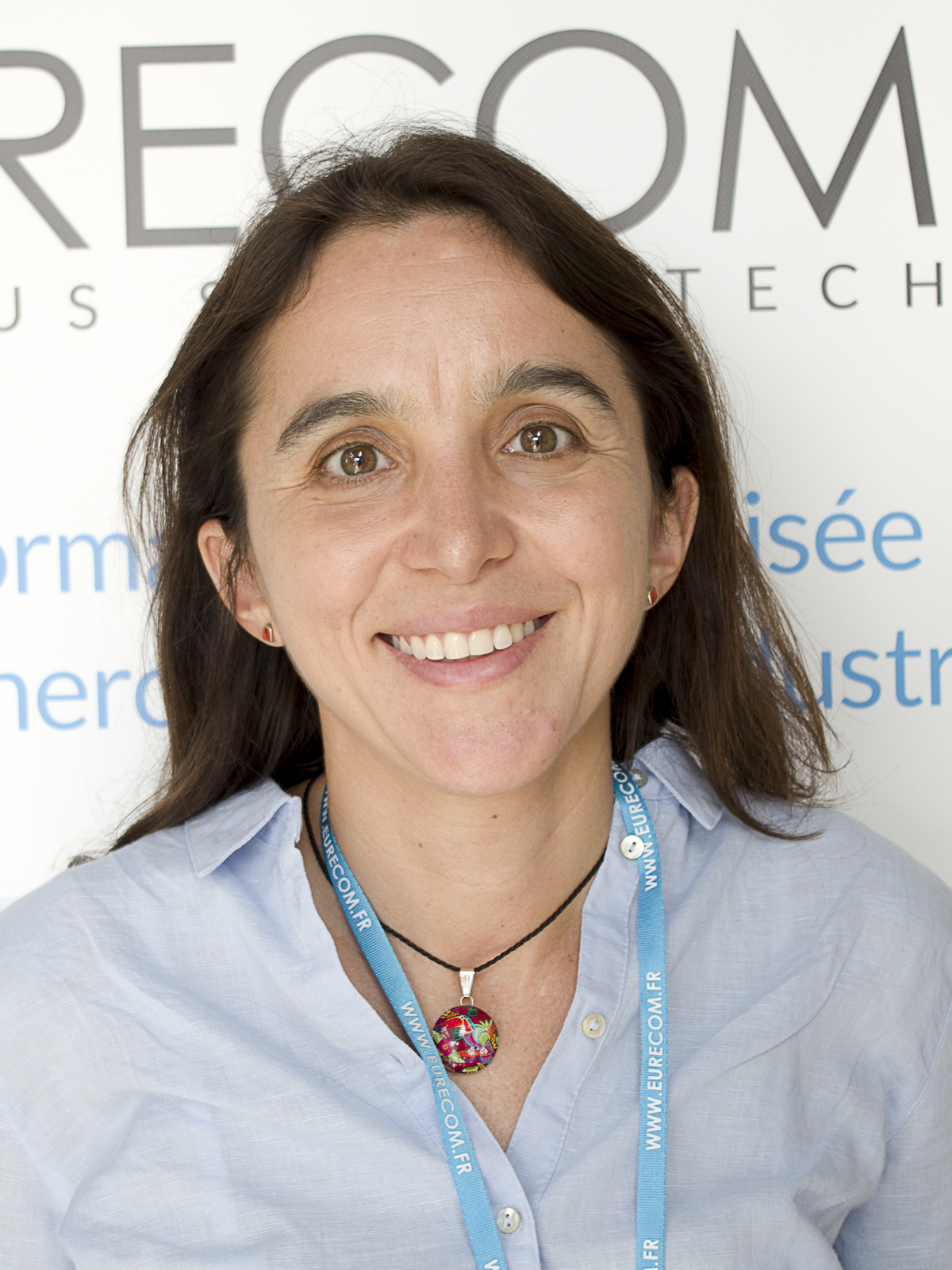
Maria A. Zuluaga is a full-time Professor at EURECOM (Department of Data Science) and holds an affiliate faculty position as Senior Lecturer at King's College London's School of Biomedical Engineering & Imaging Sciences. She previously served as a Senior Research Associate at University College London. Her academic background includes a BSc in Electronics Engineering from Universidad del Valle, an MSc in Computer Science from Universidad de los Andes, and a PhD in Signal and Image Processing from Université de Lyon. Her research develops novel machine learning methods for healthcare applications, focusing on neurovascular imaging, cardiovascular analysis, and cancer research. Key areas include medical image segmentation, trustworthy AI deployment, multimodal learning, and time-series analysis. Her work bridges technical innovation with clinical needs to advance medical diagnostics and treatment planning. Publications demonstrate strong focus on medical imaging (85% of recent papers), particularly segmentation techniques (40%), with emerging themes in trustworthy AI (25%) and multimodal learning (20%). Vascular analysis dominates application domains (50%), followed by cancer research (30%) and neuroimaging (20%). Awards & Honors: ERC Consolidator Grant (2024) She leads research in medical AI through publications and major grants, though specific student advisees, labs, or additional grants aren't detailed in available sources.
Soufia Benhida is a researcher specializing in optimization, operations research, and data approximation methods, with affiliations to both INSA Rouen Normandie and ENSA Agadir . Her doctoral work focused on decision support systems for logistics chains under uncertainty, combining theoretical and applied approaches to problems like the Probabilistic Traveling Salesman Problem (PTSP). She collaborated on the M2NUM project (Normandy and Europe region) and received joint supervision from Ahmed Mir (ENSA Agadir), Christian Gout, and Arnaud Knippel (INSA Rouen). Ph.D. Defense: December 12, 2018 Supervisors: Christian Gout, Ahmed Mir, Arnaud Knippel Projects: M2NUM, Logistics Optimization under Uncertainty Her research integrates optimization techniques for solving complex problems in logistics and industrial engineering, with a focus on exact methods for the Traveling Salesman Problem and data approximation using finite elements and splines. Current work involves probabilistic modeling for market uncertainty applications and wind field approximation considering topographic factors. Key publication trends include combinatorial optimization , subtour elimination constraints , and vector field approximation , reflecting interdisciplinary applications in logistics, environmental modeling, and industrial systems. Collaborations span institutions in Morocco and France. She has presented her work at major conferences including the International Symposium on Combinatorial Optimization (Marrakech) , CESCA Agadir , and LOGISTIQUA 2018 , showcasing methodological comparisons and novel formulations for the TSP.
Hasnaa ZIDANI is a Professor in applied mathematics at INSA Rouen Normandie , holding the COPTI Chair . Her research focuses on optimal control , mathematical modeling , and numerical simulation , with applications to transportation systems (e.g., autonomous vehicles, traffic management) and environmental modeling (e.g., resource management, marine ecology). She leads the COPTI project, funded by the ANR , Région Normandie , and EU’s ERDF , aiming to advance international-level research in optimal control methods. Research priorities include Optimal control of large-scale and stratified systems, Trajectory planning and crowd movement optimization, Image segmentation and optimal transport, Applications in aerospace (e.g., launcher trajectory optimization) and energy (e.g., demand response systems). ZIDANI actively contributes to academic events, such as the 2024 conference on Control Theory (co-chair) and the 2023 workshop on Optimal Control in Italy . She collaborates with institutions like Thales Alenia Space and develops tools like the ROC-HJ solver for reachability analysis and optimal control. Affiliations : Laboratoire de Mathématiques de l’INSA Rouen (LMI), CNRS EA-3226. Contact via Hasnaa.Zidani@insa-rouen.fr .
Ronald Fagin is a Research Fellow at IBM Research - Almaden, renowned for his groundbreaking contributions to database theory, finite model theory, and reasoning about knowledge. His work bridges logic with practical applications in computer science, including entity resolution, query answering, and uncertainty modeling. Ph.D. in Mathematics, UC Berkeley B.A. in Mathematics, Dartmouth College His research focuses on applying logic to computer science, particularly in database theory, finite model theory, and knowledge representation. His recent work explores quantifier complexity, multi-structural games, and ontology-driven data integration. His publications span database theory, logic, and information extraction, with a strong emphasis on formal frameworks and complexity analysis. Key themes include entity linking, uncertainty reasoning, and algorithmic voting theory. Member of National Academy of Sciences Member of National Academy of Engineering Recipient of Gödel Prize and IEEE Technical Achievement Award Laurea Honoris Causa (Italy) and Docteur Honoris Causa (France) Senior Fellow of ACM, IEEE, and AAAS Ronald Fagin has mentored prominent collaborators in database theory and information extraction. His research includes leading projects on imprecise probabilistic logic and developing frameworks for knowledge representation under uncertainty.