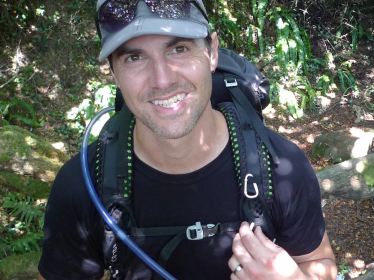
Dr. Brian C. Ancell is a Professor in the Department of Geosciences at Texas Tech University, where he leads the Atmospheric Science Group. He specializes in numerical weather prediction, data assimilation, and the predictability of high-impact weather events. Dr. Ancell directs both a deterministic and ensemble real-time weather prediction system at Texas Tech University, providing forecast guidance at convection-allowing scales for operational and research purposes. B.S., Civil Engineering, University of Illinois, Urbana-Champaign, 1998 Ph.D. Atmospheric Science, University of Washington, Seattle, 2006 Dr. Ancell's research focuses on the predictability of high-impact weather events across various scales. His current work emphasizes severe convection, winter precipitation events, and wind power forecasting. He investigates how irrigation, wind farms, and urban heat islands contribute to non-local inadvertent weather modification. Using ensemble and adjoint sensitivity analysis, he develops tools to improve forecast accuracy for severe weather events and collaborates with the National Weather Service to transition these techniques into operational use. His work includes maintaining real-time deterministic and ensemble prediction systems at Texas Tech's High Performance Computing Center. Analysis of Dr. Ancell's recent publications reveals a strong focus on ensemble sensitivity techniques for improving high-impact weather prediction. His research demonstrates how ensemble-based methods can identify critical forecast sensitivities and improve probabilistic forecasting through ensemble subsetting. Much of his work bridges theoretical atmospheric science with practical applications in wind energy forecasting, severe storm prediction, and operational meteorology. His publications show increasing collaboration across disciplines, particularly in renewable energy applications and hydrological modeling. Dr. Ancell has secured significant research funding from multiple federal agencies including the National Science Foundation, National Oceanic and Atmospheric Administration, and Department of Energy, as well as industry partners like Shell Wind Energy. His $721,883 NSF CAREER award supports research on inadvertent weather modification and educational outreach through the Museum of Texas Tech University. He actively mentors graduate students, with multiple PhD and Master's students completing or working on research related to ensemble forecasting, severe weather prediction, and wind energy applications. Dr. Ancell serves as Associate Editor for three major meteorological journals and contributes to professional societies including the American Meteorological Society and American Geophysical Union. Dr. Ancell leads the Texas Tech real-time ensemble and deterministic weather prediction systems, which run on approximately 1,000 computing cores. These systems support operational forecasting applications, commercialization efforts, and research into advanced ensemble techniques. His work on the NSF-funded Big Weather Web project aims to establish computing infrastructure for university big data research in weather prediction. Through the Museum of Texas Tech University exhibit "How Weather Works: Our Place between the Sun and a Storm," he engages the public in understanding weather principles and human impacts on atmospheric processes.