Maciej Zięba is an academic researcher affiliated with the Faculty of Information and Communication Technology at Wrocław University of Science and Technology, specifically within the Department of Artificial Intelligence . His work spans machine learning, deep learning, and computer vision, with a focus on hyperspectral imaging, autonomous systems, and 3D modeling. Recent research includes uncertainty-aware sensor deployment for autonomous vehicles, low-light image enhancement algorithms, and probabilistic regression frameworks for tabular data. He has co-authored publications on flow-based models, hypernetworks, and neural radiance fields (NeRF) applied to 3D face rendering. Contact: maciej.zieba@pwr.edu.pl
Prof. Tadeusz Tyszka is a Full Professor and Director of the Center for Economic Psychology and Decision Research (Centrum Psychologii Ekonomicznej i Badań Decyzji ALK) at Kozminski University. His primary research interests include decision-making psychology, economic psychology, and behavioral economics. He has authored numerous books and articles, including Psychologiczne Pułapki Oceniania i Podejmowania Decyzji and Psychologia Zachowań Konsumenckich . He has held leadership roles in international scientific associations, such as the International Association for Research in Economic Psychology and the Division 9 (Economic Psychology) of the International Association of Applied Psychology. His research focuses on cognitive and emotional factors influencing risk perception, decision-making under uncertainty, and consumer behavior. Recent work examines how psychological biases affect choices related to insurance, disaster preparedness, and entrepreneurial risk-taking. Prof. Tyszka’s interdisciplinary approach bridges psychology, economics, and behavioral science to understand human decision processes in complex scenarios. He has contributed to debates on moral judgment, probabilistic reasoning, and the application of psychological principles to policy design. His publications span experimental studies, theoretical analyses, and critiques of literary and historical works through a psychological lens.
Caglar Oskay is an Associate Professor in the Department of Civil and Environmental Engineering at Vanderbilt University, where he has held academic positions since 2006. He specializes in multiscale computational mechanics, materials modeling, and failure analysis of heterogeneous materials. His research integrates advanced numerical methods such as the Extended Finite Element Method (XFEM), reduced-order homogenization, and variational multiscale enrichment to study composite materials, viscoelastic systems, and polycrystalline structures under extreme conditions. Dr. Oskay has been recognized with awards including the Chancellor Faculty Fellow (2016–2018) and ASCE ExCEEd Fellow (2011). Education: PhD (Civil Engineering, Rensselaer Polytechnic Institute, 2003), M.S. (Civil Engineering, Rensselaer Polytechnic Institute, 2000), M.S. (Applied Mathematics, Rensselaer Polytechnic Institute, 2000), B.S. (Civil Engineering, Middle East Technical University, 1998). Research focuses on predictive computational models for material behavior under mechanical, thermal, and chemical loading. Key areas include fatigue life prediction, damage accumulation in composites, and coupled transport-deformation phenomena. Recent work addresses multiscale modeling of nickel-based superalloys, polyurea-coated composites, and energetic materials under dynamic loading. His contributions span 100+ peer-reviewed publications, including seminal studies in International Journal for Multiscale Computational Engineering and Acta Materialia . His articles emphasize multiscale frameworks for heterogeneous materials, with trends in reduced-order methods, uncertainty quantification, and interdisciplinary applications (e.g., biology, energy systems). Awards highlight his educational and technical leadership. Advising and grants include collaborative projects on composite durability and energetic material simulation. Dr. Oskay leads the Multiscale Computational Mechanics Lab (MCML), advancing computational tools for engineering materials research.
Tomasz Placek is a Professor at the Jagiellonian University within the Institute of Philosophy , specifically the Department of Epistemology . His work bridges philosophy of physics , ontology , and theories of agency , with a focus on quantum mechanics, relativity, and epistemological frameworks. Research Interests : Philosophy of physics (quantum theory, relativity), causal set theory, determinism vs. indeterminism, and modal interpretations of spacetime. Key Contributions : Analysis of Wigner’s Friend paradoxes, causal structures in quantum correlations, and topological issues in indeterministic models. Email : tomasz.placek@uj.edu.pl
Prof. Jan Magott holds a research position at the Faculty of Information and Communication Technology of Wrocław University of Science and Technology , specifically within the Department of Computer Engineering . His work bridges formal methods in computer science with safety engineering applications. Focus on safety-critical systems across railway and aviation domains Expertise in computational intelligence and dependability analysis Research interests span: Formal verification of time-dependent systems Fault tree modeling with temporal constraints Functional Resonance Analysis Method (FRAM) applications Hospital safety and medical diagnostics optimization Urban transport reliability analysis Human factors in safety systems Recent publications show increasing focus on: Railway safety protocols and traffic management (2023) Medical error prevention in primary care (2021-2020) Formal timing analysis in software engineering (2016) Aviation incident modeling with fuzzy logic (2016) Key methodological contributions include: Time-dependent fault tree analysis Execution time modeling for real-time systems Fuzzy probability applications in safety engineering FRAM framework for complex system analysis
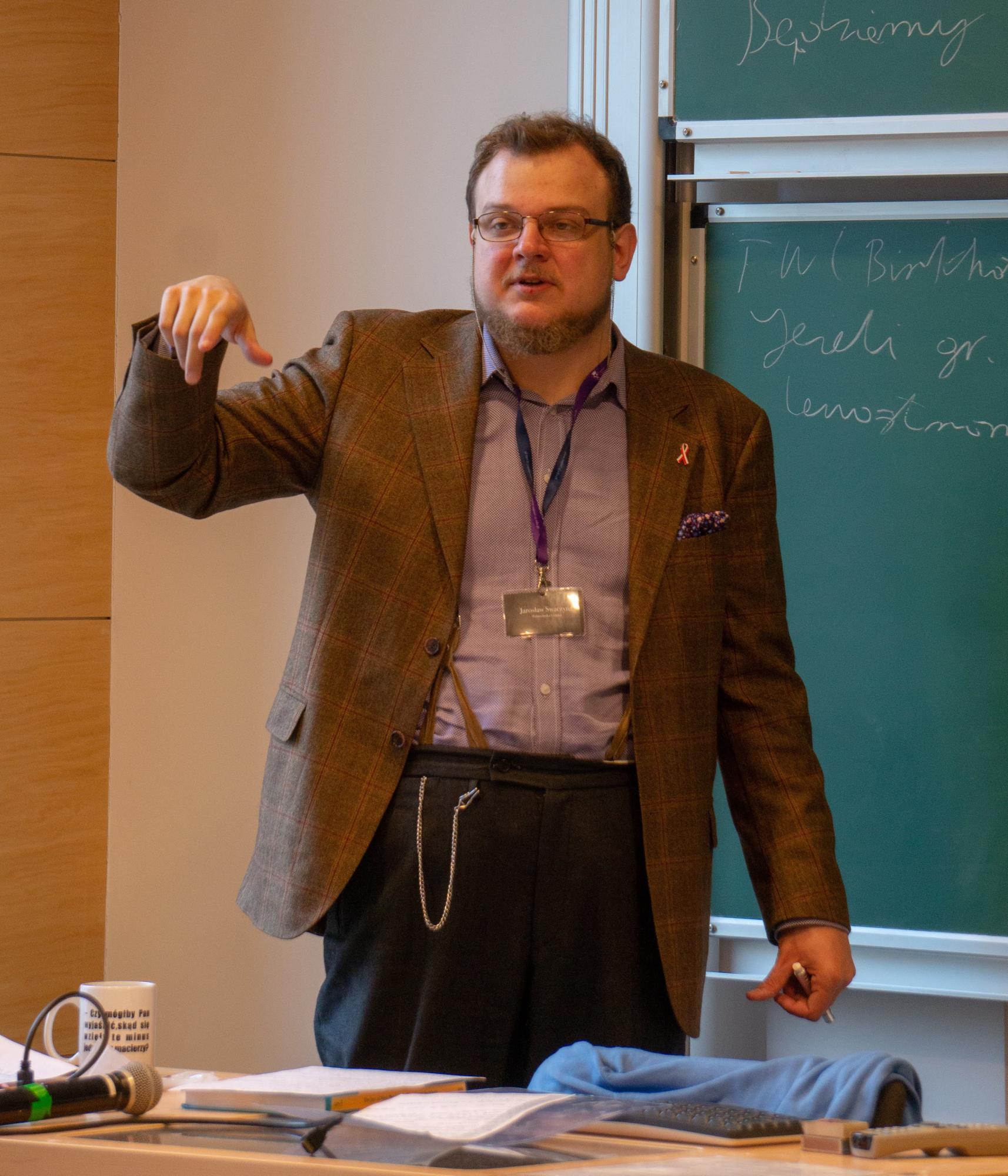
Jarosław Swaczyna is an Assistant Professor at the Division of Applications of Contemporary Mathematical Analysis , Lodz University of Technology. His research spans functional analysis, set theory, fractal geometry, and mathematical logic. Research Interests: His work focuses on the intersection of infinite-dimensional spaces, probabilistic combinatorics, and topological properties of Polish groups. He investigates generalized iterated function systems, density ideals, and continuity of functionals in Banach spaces. Publications Trends: Recent contributions include probabilistic models for random graphs, structural properties of Hamel bases, and topological dynamics of fractal attractors. Earlier works explore density ideals, Cantor sets, and generalized IFSs. Contact: Email: jaroslaw.swaczyna@p.lodz.pl Phone: (+48) 42 631-38-51 Room: 154
Wojciech Matysiak is an Assistant Professor in the Faculty of Mathematics and Information Science at Warsaw University of Technology. His research lies at the intersection of probability theory, quantum stochastic processes, and algebraic structures in mathematics. Institution: Warsaw University of Technology School: Faculty of Mathematics and Information Science Position: Assistant Professor of Mathematics Email: matysiak@mini.pw.edu.pl Office: 439, Mathematics Building, ul. Koszykowa 75, Warsaw, Poland His primary research interests include Probability Theory , Quantum Stochastic Processes , Orthogonal Polynomials , and Noncommutative Probability . He investigates structures such as quadratic harnesses, quantum Bessel processes, and random fields with linear regressions, often using operator-theoretic and algebraic methods. The analysis of his recent publications reveals a strong focus on the interplay between algebra and probability, particularly through q-commutation relations, martingale polynomials, and generalized stochastic processes. His work spans pure mathematics with applications in mathematical physics and has extended into interdisciplinary domains such as soil science and oncology. Wojciech Matysiak has published in prestigious journals including Transactions of the American Mathematical Society , Stochastic Processes and their Applications , and Journal of Theoretical Probability . His recent work continues to explore deep connections between algebraic identities and probabilistic models. He collaborates with researchers such as Włodzimierz Bryc, Jacek Wesołowski, and Marcin Świeca. He is involved in the Probability Seminar at his institution and contributes to teaching materials for mathematics and engineering students. No scientific awards or grants are mentioned in the provided texts. He maintains a research webpage and is actively publishing, indicating ongoing scholarly activity in mathematical probability and its applications.
Dr. Piotr Darnowski is a researcher at the Institute of Heat Engineering (IHE), Warsaw University of Technology. His work focuses on nuclear reactor safety analysis, computational modeling, and probabilistic risk assessment. His research spans: Advanced reactor safety analysis methodologies Gen-III/IV reactor thermal-hydraulics Artificial intelligence applications in nuclear systems Fast reactor technology and fuel cycle analysis Uncertainty quantification in severe accident codes Recent publications demonstrate expertise in: AP1000/MELCOR coupled simulations Cobalt-60 activation studies PWR pressurized thermal shock analysis Gen-III+ reactor safety improvements Artificial neural network reactor modeling
Leszek Rutkowski is a Professor and Director of the Institute of Computational Intelligence at the Technical University of Czestochowa, Poland. He is also affiliated with the Systems Research Institute of the Polish Academy of Sciences and the AGH University of Science and Technology. His research focuses on machine learning, data mining, neural networks, fuzzy systems, and computational intelligence. He has authored over 200 publications, including influential books on neuro-fuzzy systems and computational intelligence. Rutkowski is an IEEE Fellow, a member of the Polish Academy of Sciences, and a recipient of the Doctor Honoris Causa from AGH University. Education: MSc in Technical Cybernetics (1977), Wrocław University of Science and Technology PhD in Technical Sciences (1980), Wrocław University of Science and Technology Habilitation (1986), Wrocław University of Science and Technology Research Interests: Rutkowski’s work spans data stream mining, neuro-fuzzy systems, adaptive neural networks, and pattern recognition. He has pioneered methods like probabilistic neural networks and contributed to IEEE Transactions publications. His research emphasizes real-time systems and ensemble learning techniques. Professional Activities: He founded the Polish Neural Network Society and organized international conferences on artificial intelligence. Rutkowski has served as editor-in-chief of the Journal of Artificial Intelligence and Soft Computing Research and is on the editorial boards of multiple journals. Awards: IEEE Fellow (2005) Member of the Polish Academy of Sciences (2004–2016) Doctor Honoris Causa, AGH University (2014) IEEE Transactions on Neural Networks 2005 Outstanding Paper Award Grants & Labs: His projects include foundational work on non-stationary environment modeling and collaborations with institutions like the Swiss Government and the National Science Centre. Rutkowski leads the Institute of Computational Intelligence, focusing on cutting-edge AI and soft computing techniques.
Paweł Trajdos is a researcher at the Department of Systems and Computer Networks within the Faculty of Information and Communication Technology at Wrocław University of Science and Technology. His work focuses on machine learning, multi-label classification, and ensemble systems, with applications in biomedical engineering and pattern recognition. Over the years 2015–2018, he co-authored significant publications on classifier chains, fuzzy confusion matrices, and hybrid learning models. Research Interests: Multi-label learning frameworks Fuzzy logic in classifier evaluation Ensemble system design Bioprosthetic control algorithms Dynamic data processing Decision-theoretic optimization
Dr. hab. Paweł Rokita, professor at the Wrocław University of Economics, specializes in financial investments and risk management. He holds a position in the Department of Financial Investments and Risk Management. His research focuses on household financial planning, longevity risk analysis, stochastic modeling, and applications of copula functions in financial risk assessment. Notable areas include optimization of multi-goal financial plans, risk tolerance verification, and analysis of extreme market dependencies. Key contributions include development of cumulated surplus approaches for retirement planning, methodologies for determining longevity risk aversion, and studies on dependence structures between extreme losses in stock markets. His work spans both theoretical frameworks (e.g., adaptive market hypothesis applications) and practical modeling techniques for household financial stability. Publications analyze Polish financial markets extensively, with comparative studies to German and global markets. Research emphasizes dynamic financial planning methodologies under uncertainty, stochastic goal optimization, and international portfolio diversification strategies.
Katarzyna Rycerz is a Lecturer at the Institute of Computer Science within the Faculty of Computer Science at AGH University of Science and Technology in Kraków, Poland. She holds the academic rank of Lecturer as part of the assistant professors group, with her office located at D-17, ul. Kawiory 21, room II, 3.54. Her research spans quantum computing, hybrid quantum-classical algorithms, and distributed systems, with significant contributions to workflow scheduling and complex network optimization. Dr. Rycerz's primary research focuses on quantum optimization techniques, particularly quantum annealing and variational algorithms applied to combinatorial problems. Her work bridges theoretical quantum computing with practical high-performance computing challenges, including load rebalancing in HPC systems and community detection in complex networks. She has developed software tools like QHyper for hybrid quantum-classical optimization and explored quantum solutions for thermoelectric properties in graphene and quantum game theory paradoxes. Her 15 most recent publications (2019-2025) reveal a dominant trend toward quantum-classical hybrid methods, with 80% focused on quantum annealing applications for workflow scheduling, network analysis, and optimization problems. Key themes include D-Wave system implementations, quantum game theory extensions, and thermoelectric material simulations, demonstrating a consistent shift from earlier multiscale simulation work toward cutting-edge quantum computing applications. No scientific awards are documented in the available information. Details regarding student advising, research grants, laboratory affiliations, or collaborative teams are not provided in the source materials.
Prof. Wojciech Bożejko is a Professor at the Department of Control Systems and Mechatronics within the Faculty of Information and Communication Technology at Wrocław University of Science and Technology. His research focuses on optimization algorithms, scheduling theory, and quantum computing applications in discrete optimization problems. He has contributed extensively to the development of metaheuristics for solving complex scheduling challenges, including cyclic job shop, flow shop, and single-machine scheduling under probabilistic or uncertain conditions. Notably, his recent work explores quantum annealing techniques on D-Wave systems for tackling knapsack problems and flow shop scheduling. Prof. Bożejko has also co-edited special issues on discrete systems and authored over 50 peer-reviewed articles in journals like *Computers & Industrial Engineering* and *Archives of Control Sciences*. His methodologies emphasize parallel computing approaches to enhance solution efficiency. Research Interests: - Quantum Computing Applications in Optimization - Metaheuristic Algorithms (Tabu Search, Simulated Annealing) - Cyclic and Flow Shop Scheduling - Stochastic and Robust Scheduling - Parallel Computing for Discrete Optimization Advising & Grants: While no specific grants or advisees are listed, his research outputs indicate significant contributions to collaborative projects in scheduling optimization and quantum computing applications. His work often involves interdisciplinary collaborations, such as with the Wrocław Centre for Networking and Supercomputing. Labs/Teams: Affiliated with the Department of Control Systems and Mechatronics, contributing to research groups focused on automation, discrete systems, and advanced optimization techniques.
Marcin Chwała is a researcher at the Faculty of Civil Engineering, Wrocław University of Science and Technology, affiliated with the Department of Geotechnology, Hydro Technology, and Underground and Hydro Engineering. He holds a DSc, PhD, and Eng, and is actively engaged in teaching and research in geotechnical engineering and planetary civil engineering. His research interests include probabilistic methods in geotechnical engineering, soil spatial variability, foundation bearing capacity, slope stability, and the structural stability of lunar lava tubes. He bridges traditional civil engineering with cutting-edge planetary science, focusing on the potential of lunar caves as shelters for future missions. The recent articles (2023–2024) reflect a strong trend toward geotechnical risk, stochastic modeling, and planetary infrastructure, with publications in high-impact journals such as Icarus , Earth and Planetary Science Letters , and Reliability Engineering & System Safety . The work emphasizes numerical analysis, probabilistic assessment, and optimization in both terrestrial and extraterrestrial contexts. Teaching Excellence Award at Wrocław University of Science and Technology Member of Academia Iuvenum (2023–2025) Recipient of National Science Center, Poland funding (SONATA 19 program) Editorial Board Member, ASCE-ASME Journal of Risk and Uncertainty in Engineering Systems, Part A: Civil Engineering Member of ISSMGE’s TC304 (Engineering Practice of Risk Assessment and Management) Marcin Chwała has co-supervised PhD student Daniel Teshager to successful defense. He leads the PROMISE project (funded by NCN) and collaborates with international researchers from the University of Padua and University of Ferrara. He also leads a university-funded research team analyzing rock samples from lava tubes. His work has received significant media attention and public engagement, including radio interviews and public lectures on civil engineering on the Moon. He is actively involved in laboratory analysis, fieldwork planning, and international conferences such as LPSC 2024 and LPSC 2025, and promotes student involvement through scholarship opportunities in planetary geotechnics.
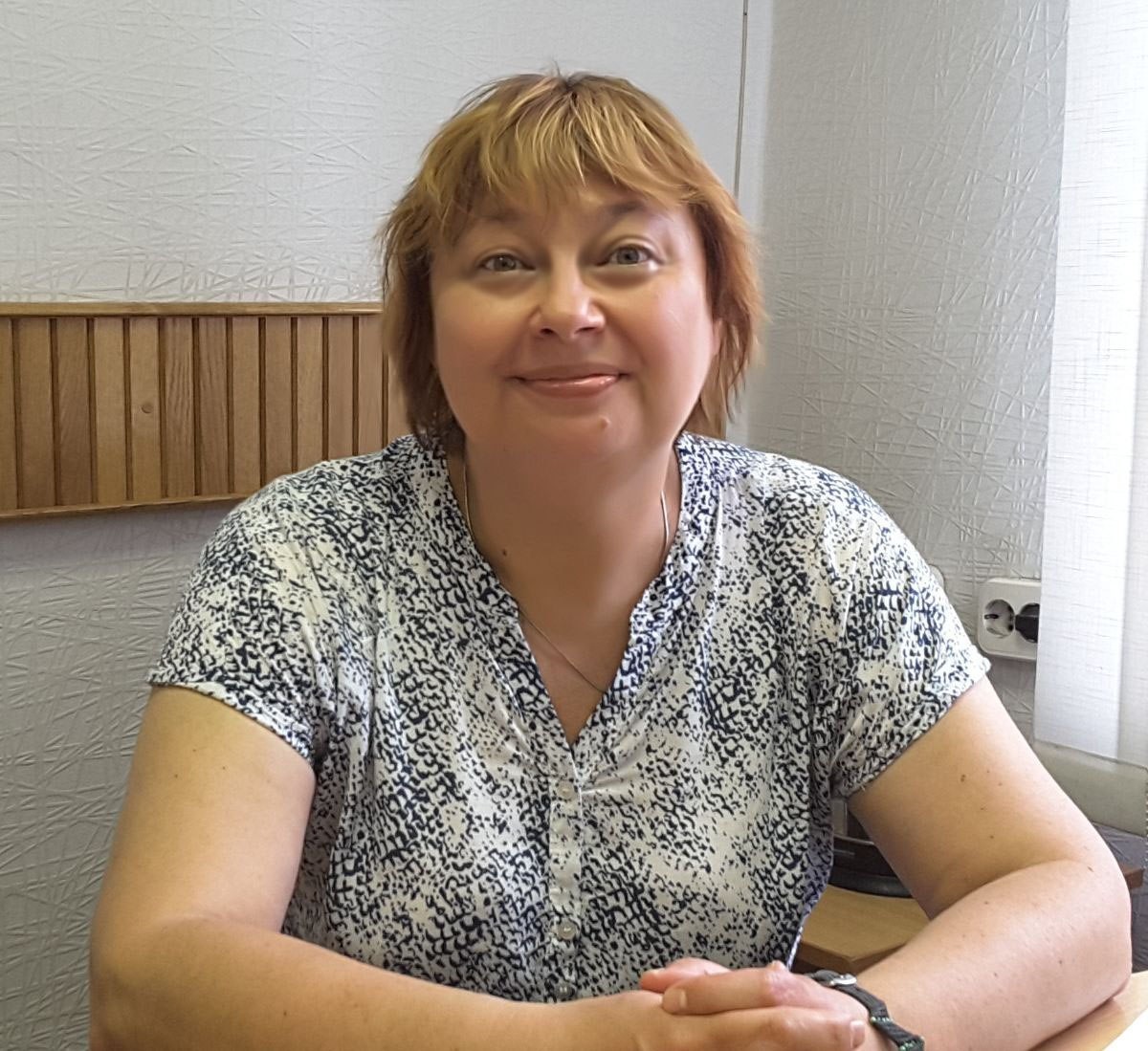
Dr. Lyudmyla Kirichenko serves as a Research and Teaching Assistant Professor in the Insurance and Capital Markets Department at Lodz University of Technology, Poland. Her academic profile includes active research publication through 2025, with contact details listing room 167 and email lyudmyla.kirichenko@p.lodz.pl. She maintains collaborative research ties with institutions in Ukraine and international conferences. Her research spans Machine Learning, Time Series Analysis, and Cybersecurity with specialized focus on fractal dynamics and computational finance applications. She develops advanced methodologies including wavelet transforms, recurrence plots, and LSTM autoencoders for classifying complex time series data. Her work bridges theoretical computer science with practical implementations in intrusion detection systems, financial market analysis, and computer vision security applications. The departmental affiliation with Insurance and Capital Markets indicates applied research directions in e-commerce forecasting and risk modeling. Analysis of her 15 most recent publications (2022-2025) reveals dominant trends in machine learning classification of fractal time series, with increasing interdisciplinary applications. Her 2023-2025 work shows expansion into public health modeling (respiratory infections in conflict zones) and crisis response optimization, while maintaining core expertise in wavelet-based feature extraction and neural network approaches for time series problems. The publications demonstrate consistent methodological innovation across computer science, physics, and operations research domains. Scientific Awards No scientific awards were documented in the provided materials Advising and grant activities cannot be confirmed from the available information. The publication record indicates extensive collaboration with Ukrainian researchers including Tamara Radivilova and Sergiy Yakovlev, but no student supervision or funding details are specified. Her research appears supported through institutional affiliations and conference participations. Laboratory resources or dedicated research teams are not explicitly described, though her methodology-focused publications suggest computational laboratory work involving machine learning frameworks and signal processing tools. The departmental context implies integration with financial data analysis infrastructure.