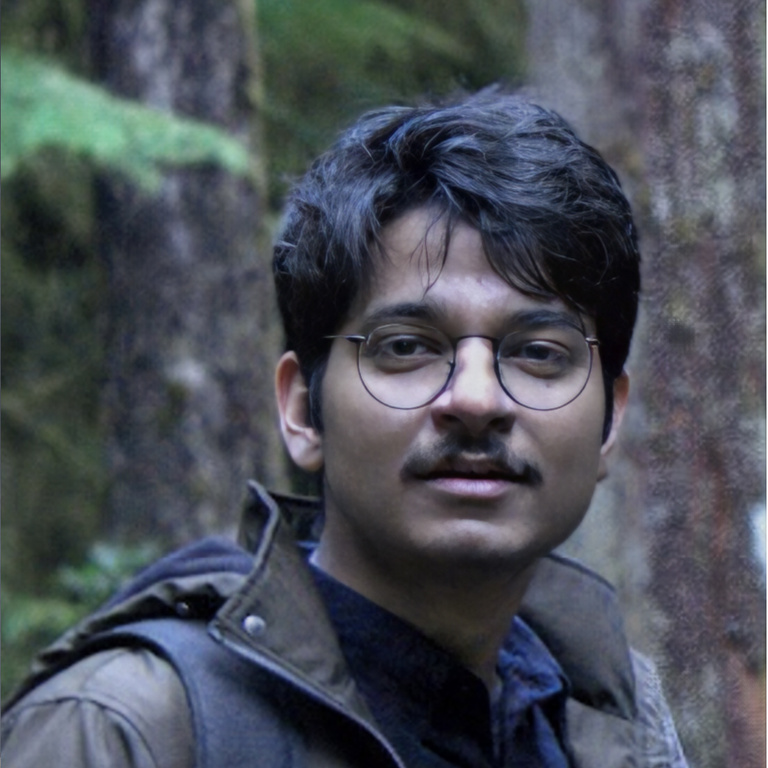
Amey Bhangale is an Assistant Professor in the Department of Computer Science and Engineering at the University of California, Riverside. Prior to this, he held positions as a post-doctoral fellow at the Weizmann Institute of Science under Irit Dinur and a research fellowship at the Simons Institute. His research focuses on Approximation Algorithms , Probabilistically Checkable Proofs , Hardness of Approximation , and Analysis of Boolean Functions . Research Trends His recent work explores inapproximability bounds for constraint satisfaction problems, parallel repetition theorems, and additive combinatorics in finite fields. Notable collaborations include Subhash Khot, Dor Minzer, and Yang P. Liu. Teaching CS219: Advanced Algorithms (2025) CS141: Intermediate Data Structures and Algorithms (2024) CS218: Design and Analysis of Algorithms (2023) CS215: Theory of Computations (2021-2023)
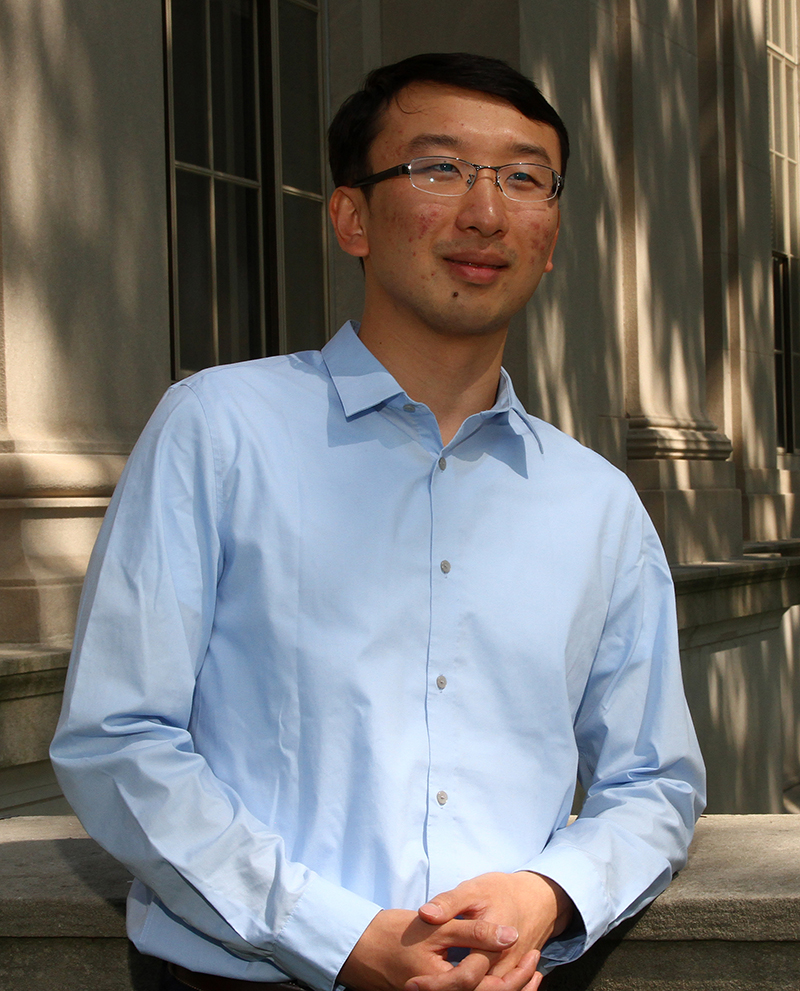
Sourya Roy is an Assistant Professor in the Department of Computer Science at the University of Iowa. Prior to his academic career, he worked as a Data Scientist at Foursquare. He earned his PhD in Computer Science from the University of California, Riverside in 2022, advised by Silas Richelson and Amey Bhangale. Education: PhD in Computer Science (University of California, Riverside, 2022) His research spans theoretical and applied domains, focusing on pseudorandomness, coding theory, and cryptography in theoretical computer science, while also contributing to computer vision and machine learning applications. Recent publications emphasize expander graph theory, coding algorithms, and spatio-temporal modeling. Dr. Roy is actively seeking PhD students to collaborate on theoretical computer science projects. His publications highlight expertise in pseudorandomness, expander graphs, and scalable unsupervised learning techniques. Key conferences include FOCS, ECCV, and IEEE Transactions on Information Theory.
Natan Rubin is a faculty member in the Computer Science Department at Ben-Gurion University of the Negev, Beer-Sheba, Israel, where he has been conducting research in combinatorial and computational geometry since 2014. He is the principal investigator of a 5-year ERC Starting Grant project titled 'Combinatorial Aspects of Computational Geometry' (CombiCompGeom), which supports graduate students and postdocs in geometric algorithms and structures. Ph.D., Tel Aviv University, 2012 Advisor: Prof. Haim Kaplan and Prof. Micha Sharir His research focuses on fundamental problems in computational geometry, including geometric transversals , epsilon-nets , Voronoi diagrams , Delaunay triangulations , and intersection patterns of geometric objects . He has made significant contributions to the understanding of combinatorial bounds in geometric settings, such as resolving the Richter-Thomassen conjecture for pairwise intersecting Jordan curves and improving long-standing bounds on weak epsilon-nets. The recent publications reveal a consistent trend toward improving asymptotic bounds in high-dimensional and planar geometric configurations, with a strong emphasis on combinatorial methods and topological reasoning. His work often intersects with extremal combinatorics and discrete geometry, particularly in analyzing crossing and touching structures in planar graphs and families of convex sets. His scientific recognition includes: Best Paper Award at FOCS 2013 Best Paper Award at SoCG 2012 Rubin actively contributes to the academic community through service, having organized major workshops such as SODA 2018 and SoCG 2022, and hosting international researchers. He collaborates widely with leading figures in the field, including Pankaj Agarwal, János Pach, Micha Sharir, and Haim Kaplan. Though no formal list of students is provided, his ERC-funded project explicitly advertises multiple graduate and postdoctoral positions, indicating active mentorship. He is also involved in organizing international workshops and fostering collaboration within Israel’s strong computational geometry community, including researchers at BGU, Tel Aviv, and Jerusalem. His research is supported by competitive grants and involves the development of robust kinetic data structures and stable geometric graphs, with applications in dynamic environments and algorithmic stability.
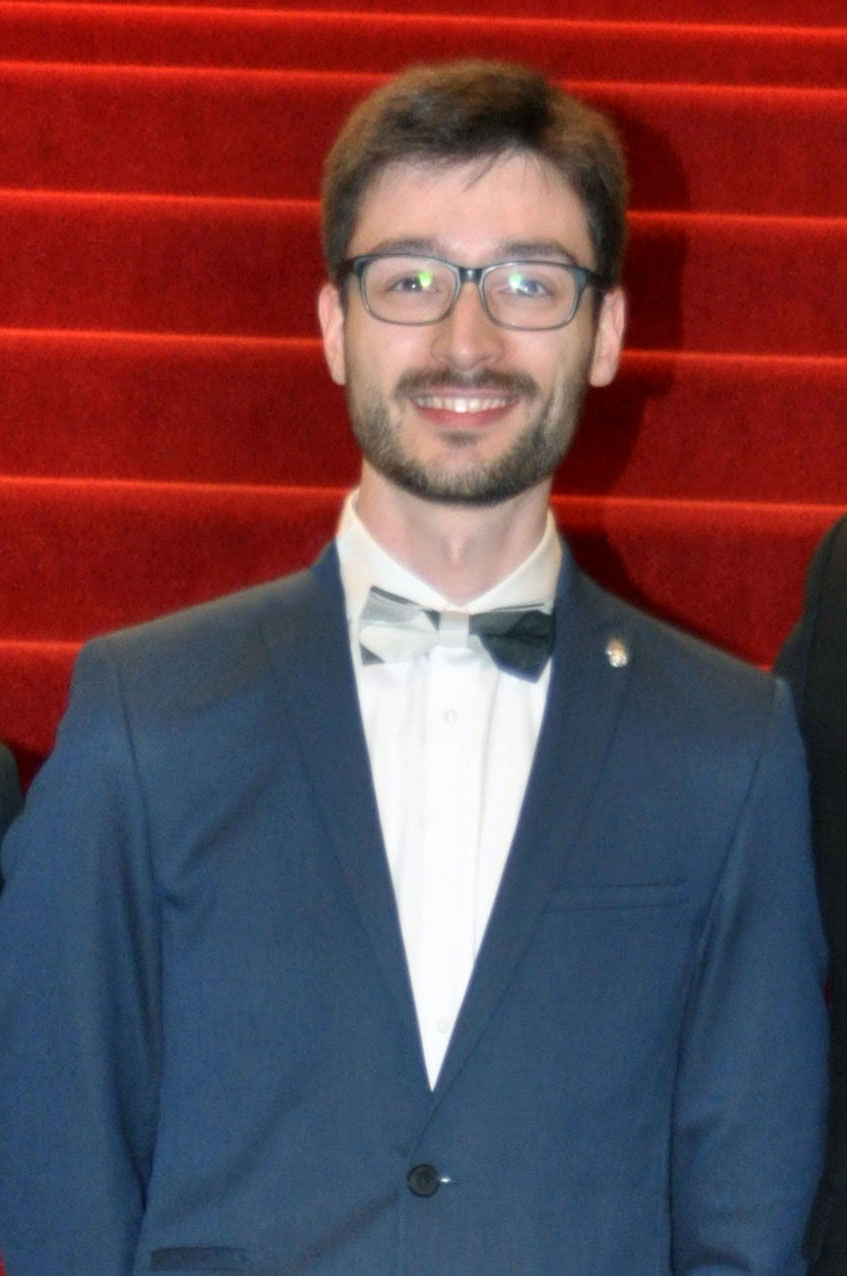
Dan Mikulincer is the Brian and Tiffinie Pang Assistant Professor at the University of Washington in the Department of Mathematics, College of Arts and Sciences. He previously held a postdoctoral Instructor position at MIT Mathematics and earned his Ph.D. from the Weizmann Institute of Science under Ronen Eldan. He completed his B.Sc. in Mathematics and Computer Science at Ben-Gurion University, where he also studied Cognitive Neuroscience. B.Sc.: Ben-Gurion University (Mathematics, Computer Science, Cognitive Neuroscience) Ph.D.: Weizmann Institute of Science, Faculty of Mathematics Postdoc: MIT Mathematics Current: Assistant Professor, University of Washington, Department of Mathematics His research lies at the intersection of high-dimensional geometry, probability, statistics, information theory, and data science. He is particularly focused on normal approximations, Stein's method, stochastic analysis, and dimension-free phenomena. His work explores foundational aspects of learning theory, random matrices, transportation inequalities, and neural networks, often using probabilistic and analytic tools to derive sharp, robust results in high dimensions. The recent publications reflect a consistent focus on probabilistic methods in high-dimensional settings. Key themes include normal approximation via Stein's method, optimal transport, concentration and anti-concentration inequalities, random graph models, and theoretical aspects of machine learning such as learnability and neural network expressivity. The work spans both pure mathematics (e.g., GAFA, PTRF) and top-tier computer science venues (e.g., COLT, STOC, NeurIPS), highlighting interdisciplinary impact. Although no formal scientific awards are listed in the provided text, his publications in premier journals and conferences (Annals of Probability, STOC, NeurIPS, COLT) indicate significant recognition in the theoretical community. Dan Mikulincer has advised or collaborated with several researchers including Yair Shenfeld, Max Fathi, Ronen Eldan, and Sébastien Bubeck. He has served as a TA for 18.650: Statistics for Applications at MIT and taught programming courses (Java, Python, JavaScript) at the Interdisciplinary Center Herzliya. He is also a senior lecturer at WeCode, a nonprofit providing free programming education to underrepresented youth in Israel, indicating a strong commitment to education and outreach. He has been affiliated with research groups at MIT Mathematics, Weizmann Institute, and Microsoft Research AI, where he spent the summer of 2019 hosted by Sébastien Bubeck. These collaborations span theoretical machine learning, stochastic processes, and algorithmic foundations.
Yufei Zhao is an Associate Professor of Mathematics at the Massachusetts Institute of Technology (MIT). His research focuses on extremal, probabilistic, and additive combinatorics, with applications to graph theory, discrete geometry, and computer science. Dr. Zhao received his S.B. in Mathematics and Computer Science and Engineering from MIT in 2010, followed by an M.A.St. in Mathematics with Distinction from Cambridge University in 2011. He completed his Ph.D. in Mathematics at MIT in 2015 under the supervision of Jacob Fox. His research interests span a broad range of combinatorial mathematics, with particular emphasis on the interplay between structure and randomness. Dr. Zhao has made significant contributions to extremal graph theory, additive combinatorics, and the theory of pseudorandom graphs. His work often connects different areas of mathematics through innovative applications of combinatorial methods. Dr. Zhao's publications demonstrate a consistent focus on fundamental problems in combinatorics, with recent work exploring equiangular lines, spherical codes, extremal set theory, and the connections between graph theory and additive combinatorics. His research has been recognized with prestigious awards including the Fulkerson Prize (2024), NSF CAREER award (2021), Sloan Research Fellowship (2019), and Dénes König Prize (2018). Fulkerson Prize (2024) NSF CAREER award (2021) Sloan Research Fellowship (2019) Dénes König Prize (2018) Dr. Zhao actively mentors students, currently advising Travis Dillon, Dingding Dong, and Nitya Mani. His former PhD students include Benjamin Gunby, Jonathan Tidor, Aaron Berger, Ashwin Sah, and Mehtaab Sawhney. He has also authored the influential textbook "Graph Theory and Additive Combinatorics: Exploring Structure and Randomness" (Cambridge University Press, 2023), which has received high praise from leading mathematicians including Terry Tao and Ben Green.
Conrado Martinez Parra is a Professor in the Department of Computer Science at the Faculty of Computer Science, Universitat Politècnica de Catalunya (UPC). He is a core member of the ALBCOM research group, which focuses on Algorithmics, Bioinformatics, Complexity, and Formal Methods. Affiliation : Department of Computer Science, Faculty of Computer Science (FIB), UPC Research Group : ALBCOM - Algorísmia, Bioinformàtica, Complexitat i Mètodes Formals Email : conrado@cs.upc.edu ORCID : 0000-0003-1302-9067 Researcher ID : G-4629-2015 His research spans theoretical computer science with a strong emphasis on the design and analysis of algorithms and data structures. His work includes average-case analysis of algorithms, combinatorial generation, probabilistic methods in algorithmics, and applications in information retrieval and data stream processing. He has extensively studied multidimensional data structures such as quadtrees, K-d trees, and skip lists, analyzing their performance under various query models including partial match and orthogonal range searches. His recent publications reveal a sustained focus on algorithmic efficiency, sampling techniques, and probabilistic modeling in data structures. Trends indicate a deep engagement with randomized algorithms, unbiased estimation, and cache-efficient selection methods, reflecting both theoretical rigor and practical applicability in modern computing environments. Scientific Contributions Extensive publication record spanning over three decades, from 1989 to 2024. Active in major algorithmic conferences such as ANALCO, AofA, and AAAI. Contributions to foundational algorithm analysis including Hoare’s FIND, Quickselect variants, and deletion in binary search trees. Collaborative research with prominent figures in theoretical computer science across Europe. Professor Martinez Parra has advised or collaborated with several doctoral students, including Gustavo Lau, whose thesis on partial match queries he supervised. He has participated in numerous competitive R&D projects funded by national and regional programs, focusing on large-scale information processing and graph-based computing models. His work is supported by long-standing grants from Spanish and Catalan research councils. He is affiliated with the ALBCOM research group, a leading team in algorithmic research at UPC, contributing to both theoretical advances and practical implementations in combinatorics and data structure optimization.
Pierre Bienvenu is a Research Scientist at the Johann Radon Institute for Computational and Applied Mathematics (RICAM), part of the Austrian Academy of Sciences, since June 2025. Previously, he held postdoctoral positions at the Technische Universität Graz (2021-2022), the Max Planck Institute for Mathematics in Bonn (2020-2021), and the Institut Camille Jordan in Lyon/St-Etienne (2018-2020). He also served as a Teaching Fellow at Trinity College Dublin (2022-2023) and as a Lecturer at the American University in Paris in Spring 2018. His educational background includes a PhD in Mathematics from the University of Bristol (2014-2018), supervised by Julia Wolf, with a thesis titled "Linear, bilinear and polynomial configurations in function fields and the primes." Bienvenu's research lies at the intersection of arithmetic combinatorics, number theory, and harmonic analysis. He employs analytic, combinatorial, probabilistic, and algebraic methods to study problems in additive combinatorics, such as configurations in prime numbers, sum-product estimates, and density of sumsets. His work has strong connections to ergodic theory and theoretical computer science, particularly in pseudorandomness and error-correcting codes. His recent publications, spanning from 2017 to 2025, focus on density constraints, intersective sets, power monoids, and transference principles in additive combinatorics. These works often involve deep applications of higher-order Fourier analysis and the Green-Tao method, addressing fundamental questions about the structure of sets of integers and primes. As a member of RICAM, Bienvenu contributes to the institute's research groups in computational mathematics and number theory, collaborating with an international network of mathematicians on cutting-edge problems in arithmetic combinatorics.
Dr. Vadim Zverovich is an Associate Professor of Mathematics at the University of the West of England (UWE) in Bristol, UK, and Head of the Mathematics and Statistics Research Group within the Faculty of Environment and Technology. With over 35 years of research experience and 70+ peer-reviewed publications, his work bridges theoretical and applied mathematical sciences. Education: PhD in Mathematics (1993) Zverovich’s research focuses on graph theory, combinatorial optimization, and their applications in transport networks, probabilistic methods, and decision-making systems. His work has been published in high-impact journals such as Computer-Aided Civil and Infrastructure Engineering and Automation in Construction . Key Publication Trends: 2024: Systematic approaches to graph decomposition 2021: Practical implementations of graph theory in infrastructure 2019: Interdisciplinary applications of network analysis Scientific Awards: Alexander von Humboldt Foundation Fellowship Higher Education Academy Fellowship (2016) UWE Faculty of Environment and Technology Researcher of the Year (2017) Zverovich has supervised numerous final-year research students and PhD/post-doctoral researchers, serving as internal/external examiner for multiple theses. He actively participates in academic governance as a member of the EPSRC Mathematical Sciences Strategic Advisory Team, EPSRC Peer Review College, and advisory bodies for the UK Operational Research Society and London Mathematical Society.
Karen Gunderson is an Associate Professor in the Department of Mathematics at the University of Manitoba's Faculty of Science. Her research spans graph theory, combinatorics, random graphs, percolation, hypergraphs, and extremal combinatorics. Research Focus : Graph theory, combinatorics, random graphs, percolation, hypergraphs, extremal combinatorics Academic Role : Associate Professor, Acting Associate Head Graduate Contact : Karen.Gunderson@umanitoba.ca , karen.gunderson@umanitoba.ca Her work includes bootstrap percolation , random geometric graphs , and extremal hypergraph problems , with applications in network modeling and probabilistic combinatorics. Recent publications focus on adversarial burning densities, Erdos-Ko-Rado robustness, and Turán numbers in switching contexts. Academic Leadership : Co-organizer of the University of Manitoba Combinatorics Seminar and key organizer for the 2023 CanaDAM conference and Movement & Symmetry in Graphs retreat.
Tamara Grava is an Associate Professor at the International School for Advanced Studies (SISSA) in Trieste, Italy, and a Professor at the University of Bristol, UK. Her research focuses on mathematical physics, particularly integrable systems, nonlinear waves, and random matrix theory. She maintains active collaborations between these two prestigious institutions, contributing significantly to both theoretical developments and interdisciplinary applications. Her educational background includes a PhD in Mathematical Physics from SISSA, completed on October 5, 1998, with a thesis titled "On the Cauchy problem for the Whitham equations" under the supervision of Boris Dubrovin. Professor Grava's research spans several interconnected areas in mathematical physics. She investigates integrable systems with random initial data, developing probabilistic Riemann-Hilbert methods to analyze soliton gases and their connections to statistical mechanics. Her work on dispersive nonlinear partial differential equations examines long-time and small-dispersion asymptotics, with particular attention to dispersive shock waves and rogue waves. She also makes significant contributions to random matrix theory, studying special functions, orthogonal polynomials, and their connections to Painlevé equations. Her research often bridges pure mathematics with applications in physics, revealing deep connections between seemingly disparate fields. Analysis of Professor Grava's recent publications (2021-2024) reveals a strong focus on the intersection of integrable systems, random matrix theory, and nonlinear wave phenomena. Her work increasingly explores soliton gases and their statistical properties, connecting microscopic soliton dynamics to macroscopic hydrodynamic descriptions. There's a clear progression toward more complex systems involving random initial conditions and the development of rigorous mathematical frameworks to handle these problems. Her research shows strong interdisciplinary connections between mathematical physics, statistical mechanics, and quantum field theory. Professor Grava actively supervises PhD students including Sacha Grover (Bristol), Dmitrii Rachenkov (SISSA), Xiao-Fan Zhang, Xiaodong Zhu, and Zechuan Zhang. Her editorial work includes service on the boards of Nonlinearity (since 2012), SIAM Journal of Mathematical Analysis (since 2022), Constructive Approximation (since 2023), and the Bulletin and Journal of the London Mathematical Society (starting 2025). She participates in numerous international conferences and workshops, with upcoming engagements in 2025 including events on enumerative combinatorics, integrable systems, and statistical physics at institutions including CIRM, Harvard University, and the MATRIX Institute.
Noga Alon is the Baumritter Professor Emeritus of Mathematics and Computer Science at Tel Aviv University and currently a Professor of Mathematics at Princeton University. He received his Ph.D. from the Hebrew University of Jerusalem in 1983 and has held visiting positions at MIT, Harvard, Institute for Advanced Study, IBM Almaden, Bell Labs, and Microsoft Research. Research Focus His work centers on combinatorics and graph theory applied to theoretical computer science. Key contributions include: Expander graphs and applications Derandomization techniques Streaming algorithms foundation Algebraic/probabilistic methods in discrete mathematics Information theory and combinatorial geometry Honors and Leadership Member: Israel Academy of Sciences, Academia Europaea Fellow: ACM, AMS Editorial board member for 12+ technical journals Plenary speaker at International Congress of Mathematicians (2002) Supervised 25+ PhD students. Authored 600+ research papers and the book The Probabilistic Method (4th ed., 2016).
Alistair Sinclair is the Kikuo Ogawa and Kaoru Ogawa Professor of Computer Science in the Department of Electrical Engineering and Computer Sciences at UC Berkeley. He received his BA in Mathematics from the University of Cambridge (1982) and PhD in Computer Science from the University of Edinburgh (1988). After briefly serving on faculty at Edinburgh, he joined UC Berkeley in 1994. Sinclair has held visiting positions at DIMACS, Princeton University, Rutgers University, Microsoft Research, École Polytechnique, University of Paris-Orsay, and University of Rome III. His research explores: Randomized algorithms and Markov chain Monte Carlo methods Phase transitions in statistical physics Algorithmic applications of stochastic processes Nonlinear dynamical systems Combinatorial optimization Analysis of Sinclair's recent publications (2017-2025) reveals strong emphasis on statistical physics models (especially Ising and random-cluster systems), Markov chain dynamics, phase transitions, and algorithmic solutions for combinatorial problems. Key methodologies include spatial mixing analysis, entropy decay measurements, and deterministic approximation techniques. Scientific Awards: 1996 ACM-EATCS Gödel Prize 2006 Fulkerson Prize 2017 SIGACT Distinguished Service Prize Sinclair has advised 17+ PhD students including notable researchers in theoretical computer science and mathematics. He served as Founding Associate Director (2012-2017) of the Simons Institute for the Theory of Computing, receiving recognition for developing its research programs on probability, geometry, and computational complexity.
François Pirot is an Associate Professor (Maître de Conférences) at Université Paris-Saclay since September 1, 2021. He conducts research at the LISN laboratory within the GALaC team and teaches at the Faculty of Science of Orsay. PhD in Mathematics (Radboud University) and Computer Sciences (Université de Lorraine), 2019 Postdoctoral experience: ULB (2019), G-SCOP (2019-2020), Inria Sophia Antipolis (2020-2021) His research focuses on graph coloring problems in diverse contexts such as graph powers, locally sparse graphs, and distributed algorithms, utilizing probabilistic methods and connections to bio-informatics through circular codes. He has advanced bounds for h -conflict-free coloring, acyclic coloring, and dichromatic numbers in oriented graphs, with applications to minor-closed families and geometric group theory. Scientific contributions include: Asymptotically tight bounds for chromatic numbers in sparse graphs Efficient fractional coloring algorithms for K_t-minor-free graphs Structural analysis of comma-free and mixed circular codes in genetic alphabets Charles Delorme Prize for outstanding thesis in Graph Theory (2019) Collaborations span institutions like ULB, G-SCOP, Inria, and cross-disciplinary fields from computer science to mathematical biology.
Sundar Vishwanathan is a Professor in the Department of Computer Science and Engineering at Indian Institute of Technology Bombay (IIT Bombay), where he has established himself as a leading researcher in theoretical computer science. His academic career spans over three decades with consistent contributions to algorithms, combinatorics, and complexity theory. His research interests form a cohesive body of work focused on theoretical foundations of computing: Algorithms (particularly approximation algorithms, online algorithms, and randomized algorithms) Combinatorics and extremal set theory Complexity theory and circuit lower bounds Graph theory and graph algorithms Combinatorial optimization problems Vishwanathan's publication record demonstrates remarkable consistency and depth, with publications spanning from 1990 to 2024. His recent work focuses on graph algorithms (particularly maximum matching problems), approximation algorithms for combinatorial optimization, and circuit complexity. He has developed innovative techniques using linear algebra, combinatorial methods, and probabilistic analysis to solve challenging theoretical problems. His approach often bridges theoretical insights with practical algorithmic considerations. His collaborative work spans multiple research groups, with frequent co-authorships with researchers such as Ashish Chiplunkar, Sumedh Tirodkar, and Sreyash Kenkre. His research has evolved from foundational work in online graph coloring in the 1990s to more specialized topics in combinatorics and recently to circuit lower bounds, showing both depth in core areas and adaptability to evolving research landscapes.
Terence Tao is an Australian-American mathematician and professor of mathematics at the University of California, Los Angeles (UCLA), where he holds the James and Carol Collins Chair in the College of Letters and Sciences. Widely regarded as one of the greatest living mathematicians, Tao has received numerous prestigious awards including the Fields Medal, the Breakthrough Prize in Mathematics, and the MacArthur Fellowship. Dr. Tao's educational background includes: Bachelor's and Master's degrees from Flinders University (1991) Ph.D. from Princeton University (1996) under Elias M. Stein Tao's research spans an extraordinary breadth of mathematical fields. He is particularly known for his work in harmonic analysis, partial differential equations, combinatorics, and analytic number theory. His research has included groundbreaking contributions to compressed sensing, the Green-Tao theorem on arithmetic progressions in prime numbers, and progress on the Navier-Stokes equations. Tao is renowned for his collaborative approach, having worked with over 60 co-authors throughout his career. Tao's publications demonstrate remarkable diversity across mathematical disciplines. His work shows strong trends in connecting seemingly disparate areas of mathematics, often bringing techniques from one field to solve problems in another. He has made significant contributions to both theoretical and applied mathematics, with applications ranging from signal processing to number theory. Among his numerous scientific achievements, Tao has received: Fields Medal (2006) Breakthrough Prize in Mathematics (2014) Royal Medal (2014) MacArthur Fellowship (2006) Crafoord Prize (2012) Princess of Asturias Award (2020) Tao has mentored numerous students throughout his career, with Monica Vișan among his doctoral students. He has secured significant research funding through prestigious awards including the Packard Fellowship, Sloan Fellowship, and Simons Investigator award. His collaborative research has been supported by multiple National Science Foundation grants. Tao maintains an active research group at UCLA and frequently collaborates with mathematicians worldwide. His blog and public lectures have made advanced mathematical concepts accessible to broader audiences, demonstrating his commitment to mathematical education and outreach.