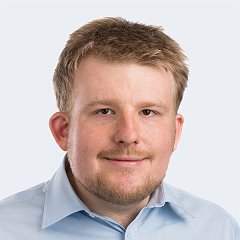
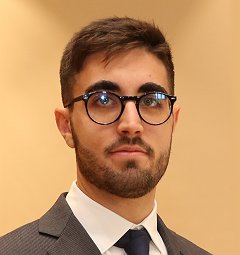
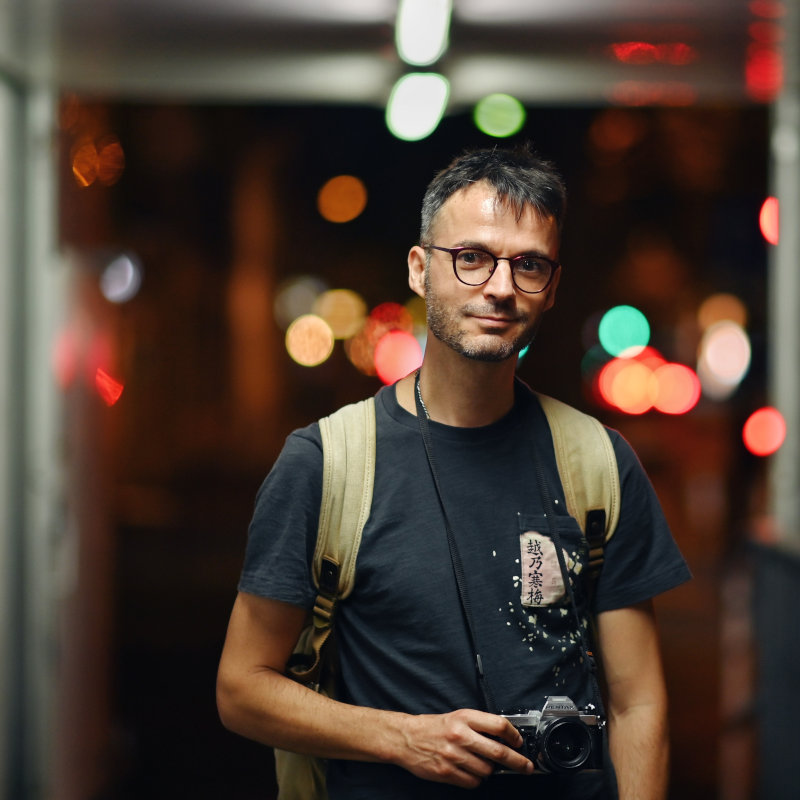
Clemens Dubslaff is an Assistant Professor in the Formal System Analysis group at TU Eindhoven (The Netherlands). His research focuses on improving the reliability and explainability of computing systems through formal methods, particularly probabilistic model checking and symbolic techniques. He holds a Ph.D. from TU Dresden (Germany) and has affiliations with TU Dresden's Cluster of Excellence CeTI and Collaborative Research Center CPEC. His work addresses challenges in analyzing complex configurable systems and enhancing system transparency through explainable AI approaches. Education: B.Sc. in Mathematics and Computer Science (TU Dresden) M.Sc. in Computational Logic (NOVA University Lisbon) Ph.D. in Formal Methods (TU Dresden) Research Interests: Formal methods and model checking Symbolic analysis techniques Configurable and reconfigurable systems Explainability in AI and verification Probabilistic systems analysis Recent Achievements: NWO VENI Grant (2023) Launched OxiDD decision diagram framework (2024) Key contributions to feature-based software analysis Labs/Teams: Formal System Analysis group at TU/e, collaborating with Dresden's CeTI and CPEC initiatives.
Dr. Abraham Westerbaan is a Lecturer at Radboud University's ICIS (Digital Security Department) and a Scientific Programmer at Radboud's iHub. He earned his Ph.D. in 2019 under the supervision of Bart Jacobs, defending a thesis titled *The Category of Von Neumann Algebras*, which explores foundational aspects of operator algebras and category theory. His research spans quantum computing, mathematical logic, and cryptographic systems, with notable contributions to quantum programming languages and mathematical structures in theoretical physics. Westerbaan's work integrates advanced algebraic concepts with computational security, reflecting his dual role in academic research and applied scientific programming. His publications emphasize categorical frameworks for quantum mechanics, operational quantum logic, and cryptographic protocols for network privacy. He maintains an active GitHub repository documenting his thesis and related projects, showcasing collaborations in operator algebra theory and computational mathematics. While no specific grants or awards are explicitly listed, his extensive publication record and academic roles indicate sustained engagement with cutting-edge research in theoretical computer science and mathematical physics. His affiliations with ICIS and the iHub highlight a commitment to both foundational inquiry and applied technological development.
Klaus Ostermann is a Professor of Programming Languages and Software Technology at the Department of Computer Science, Faculty of Science, University of Tübingen, Germany. He leads a research group focused on programming language design, functional programming, and software modularity. Research Interests: His work spans functional programming, type systems, effect handlers, software architecture, and domain-specific languages. He investigates the duality between data and codata, the safe integration of effects in typed languages, and the modularity of software systems. His research often bridges theoretical foundations with practical implementations in languages like Scala and Haskell. The recent publications highlight a strong trend in effect systems, continuation-passing, and the symmetry between data and codata. His group develops the Effekt language and explores advanced compilation techniques for effect handlers, contributing to both theoretical understanding and practical language design. Scientific Awards: Most Influential Paper Award at GPCE 2018 for 'Polymorphic Embedding of DSLs' (2008 paper) He actively supervises PhD and master’s students, including Philipp Schuster, Marius Müller, and Jonathan Brachthäuser. His group has received funding for research in programming language foundations, effect systems, and software modularity, though specific grants are not listed. He serves on the program committees of top conferences such as POPL, ICFP, PLDI, and OOPSLA, reflecting his active role in the programming languages community. The research is conducted within the Uroboro project, which explores duality in programming language constructs, and involves collaboration with both national and international researchers. The team also engages in educational projects, including thesis supervision on topics ranging from probabilistic programming to music notation visualization.
Nilufer Onder is an Associate Professor in the Department of Computer Science at Michigan Technological University, where she also serves as Associate Chair and Undergraduate Program Director. She is actively involved in research, teaching, and academic leadership. Education: PhD in Computer Science, University of Pittsburgh, 1999 MS in Computer Engineering, Middle East Technical University, 1988 BSc in Computer Engineering, Middle East Technical University, 1985 Her research focuses on Artificial Intelligence , particularly planning under uncertainty, probabilistic planning, and temporal/concurrent planning , and Computer Science Education , with an emphasis on student persistence in STEM, peer mentoring, and broadening participation in computing . She also explores applications in construction management and intelligent assistance systems. Her recent publications span AI planning, memory systems optimization, and educational technology, reflecting a strong interdisciplinary trajectory integrating systems, AI, and pedagogy. Scientific Awards: No specific awards listed in the provided text. She has advised numerous graduate and undergraduate students in research and thesis work, and has secured funding from the NSF and other agencies for projects related to computing education and faculty-student interaction. She is actively involved in service, including advising student groups such as Women in Computing Sciences (WiCS) and Upsilon Pi Epsilon (UPE), and participating in university committees and outreach programs like the Science Olympiad. Labs and Teams: She leads the Interactions Unlimited project, a Faculty-Student Interaction (FSI) initiative funded by the NSF through the Engage Engineering program, aimed at enhancing student engagement and retention through structured faculty-student connections.
Tom Holvoet is a Full Professor at the Department of Computer Science , KU Leuven , affiliated with the Faculty of Engineering Science and the research groups Distributed and Secure Software (DistriNet) and Leuven.AI . Research focuses on decentralized systems , multi-agent systems , and autonomic computing . Currently supervising PhD and master's projects on blockchain vulnerabilities , autonomous decision-making , and embedded systems resilience . Teaching courses: Software Design , Programming Principles , and Distributed Systems . His work involves collaborations with international institutions and grants from the FWO (Fonds Wetenschappelijk Onderzoek) .
Siegfried Nijssen is a Professor at the Department of Computer Science within the Faculty of Engineering Science at KU Leuven. He is a core member of the Declarative Languages and Artificial Intelligence (DTAI) research group at the Arenberg campus and affiliated with Leuven.AI, the university-wide Institute for Artificial Intelligence. His academic position is designated as 'professor BOF', reflecting a specialized research-focused appointment. Nijssen's research centers on the integration of declarative programming paradigms with machine learning, particularly through constraint programming frameworks. Key focus areas include interpretable rule learning, neural-symbolic integration, and constraint-based optimization for combinatorial problems. His work bridges theoretical computer science with practical applications in bioacoustics, pandemic response modeling, and network analysis, emphasizing transparency and reliability in AI systems. Analysis of his 2021-2024 publications reveals a strong trajectory toward interpretable AI, with significant contributions like RL-Net (combining neural networks with rule-based reasoning) and novel approaches to NP-hard optimization using structured perceptrons. His research consistently targets the intersection of symbolic reasoning and statistical learning, addressing critical challenges in constraint imposition, model explainability, and stochastic optimization. Nijssen currently leads two major research initiatives: 'Declarative Languages for Imposing Constraints on Machine Learning Models' (2025-2027) and the long-term 'Declarative Programming for Machine Learning (DeclaLearn)' project (2025-2035), demonstrating sustained leadership and funding in his specialized domain. These projects extend his foundational work on constraint-based machine learning frameworks. Based at the DTAI research group, Nijssen contributes to KU Leuven's AI ecosystem through collaborative research in logic programming, constraint solving, and data mining. His work with Leuven.AI positions him at the forefront of institutional efforts to advance trustworthy and constraint-aware artificial intelligence systems.
Lars Birkedal is a Professor in the Department of Computer Science at Aarhus University, Denmark. He is a leading researcher in programming languages and formal methods with extensive contributions to the field over the past decade. His work appears consistently in top-tier programming languages conferences including POPL, ICFP, and PLDI, where he has served in leadership roles such as Program Chair and committee member. Birkedal's research primarily focuses on the theoretical foundations of program verification, with significant contributions to separation logic, type theory, and formal methods for concurrent and probabilistic systems. His work bridges theoretical computer science with practical verification challenges, particularly through the development and application of the Iris framework for higher-order concurrent separation logic. He has pioneered approaches for reasoning about probabilistic programs, capability-based security, and memory models for modern architectures. Analysis of Birkedal's recent publications (2023-2025) reveals a continued focus on advancing separation logic for increasingly complex systems. His work shows a clear trajectory from foundational theoretical work toward practical verification of real-world systems like WebAssembly while maintaining rigorous formal guarantees. There's a notable emphasis on probabilistic programming, error bounds analysis, and distributed systems verification in his most recent contributions. As a faculty member at Aarhus University, Birkedal has built a strong research group focused on programming language theory and formal verification. His leadership in the programming languages community is evident through his repeated service on program committees for major conferences and his mentorship of numerous graduate students and junior researchers, though specific student names aren't listed in the available information. His research has likely been supported by significant grants from Danish and European funding agencies, given the sustained output and international collaborations evident in his publication record.
Michael Hicks is a Professor in the Department of Computer and Information Science at the University of Pennsylvania and an Amazon Scholar. Previously, he was a Professor at the University of Maryland (2002-2021) and Senior Principal Scientist at Amazon Web Services (2022-2025). He co-founded the Programming Languages research lab (PLUM) at Maryland and was its director, as well as Director of the Maryland Cybersecurity Center (MC2). He is a Fellow of the Association of Computing Machinery (ACM), former Chair of ACM SIGPLAN, and Editor-in-Chief of Proceedings of the ACM on Programming Languages (PACMPL). His research focuses on programming languages and their application to software security , quantum programming , and formal verification . He has pioneered dynamic software updating techniques, developed tools like Checked C for memory safety, and co-designed the Cedar authorization policy language at AWS. In quantum computing, he works on verified compilers like VOQC and Qunity to ensure reliability and correctness. His recent work trends include quantum programming languages , secure multi-party computation (e.g., Wysteria , Symphony ), and fuzz testing methodologies . He has contributed to formal verification for quantum programs and language-based security frameworks. Scientific Awards include: ACM Fellow He has advised numerous PhD and Master’s students , including James Parker, Andrew Ruef, Kesha Hietala, and Aseem Rastogi, who now hold academic and industry positions. His lab, PLUM , has been instrumental in advancing programming languages research.
Alexandra Silva is a Professor of Computer Science at Cornell University, with a research group partially based at University College London (UCL) where she previously held a Royal Society Wolfson Fellowship. She is deeply involved in academic leadership, serving on program committees for conferences like ECOOP and POPL, and organizing workshops at venues such as VMCAI and PLDI. Her research spans formal methods, probabilistic programming, and coalgebraic modeling, with applications in network verification and concurrent systems. Key Research Themes: Kleene Algebra with Tests (KAT), coalgebraic semantics, probabilistic program verification, network control plane analysis, and categorical approaches to formal methods. Collaborations: Active collaborations with institutions including Cornell, UCL, University of Leicester, and INRIA Rhone-Alpes. Scientific Awards: Distinguished Paper Award at POPL 2020 Advising: Currently advising eight PhD students, including Tiago Ferreira and Noam Zilberstein, with a broader team of postdocs, alumni, and collaborators.
Kristóf Marussy is an Assistant Professor at the Department of Artificial Intelligence and Systems Engineering , Budapest University of Technology and Economics , Hungary. His work bridges model-driven engineering with dependability analysis and logic solvers , focusing on critical cyber-physical systems in railway, automotive, and aerospace domains. Assistant Professor (2025–) Research Fellow (2023–2024), Assistant Research Fellow (2020–2023) Contributor to Refinery (graph solver for model generation) and Ferdium (open-source messaging suite) Research Interests center on: Formal Verification of critical system designs Automated Reasoning via logic/numerical solvers Graph Generation for testing data-driven systems AI Integration in system modeling Recent Publications demonstrate expertise in: Graph solver infrastructure (Refinery framework) Cyber-physical system architecture synthesis Formal methods for API key security (PKCE workflow) Constraint optimization in model generation Probabilistic analysis for system reliability Awards & Scholarships : 2024 EKÖP Postdoc Fellowship 2023 ÚNKP Researcher Prize 2023 Josef Heim Award for innovation 2021 OOPSLA Artifact Reviewer Recognition Academic Service includes committee roles at OOPSLA 2025, LLM4MDE 2024, ECOOP 2023, and FASE 2025. He actively mentors 7 BSc and 5 MSc students while contributing to European Space Agency's VAMPIR project on AI-enhanced positioning systems.
Michele Chiari is a researcher at TU Wien (Vienna University of Technology) specializing in formal methods, software verification, and approximate computing. With active contributions to academic conferences like SPLASH, ICFP, and ECOOP, they combine theoretical rigor with practical applications in programming language design and analysis. Research Focus Temporal logic and model checking Probabilistic program inference Floating-point verification techniques Parallel parsing algorithms Conference Involvement 2025: Member of OOPSLA Review Committee (SPLASH conference) 2025: Program Committee member for VORTEX-track 2024: Committee Member in VORTEX conference 2023: External Reviewer for ECOOP Research Papers-track Publications 2025: Boosting Parallel Parsing through Cyclic Operator Precedence Grammars (SLE track) 2025: Exact Inference for Nested Discrete Probabilistic Programs (LAFI track) 2021: Verification of Floating-Point C/C++ Programs with math.h/cmath Functions (ICSE Journal-First Papers)
Étienne André is a Full Professor at Université Sorbonne Paris Nord , affiliated with the Institut Galilée and the Laboratoire d’Informatique de Paris Nord (LIPN) . He leads the SAFER research team and has previously held professorial positions at Université de Lorraine . His work bridges formal verification and real-world applications in cyber-physical and distributed systems. PhD from ENS Cachan (2010) Postdoc at National University of Singapore (2010–2011) Associate Professor at Université Sorbonne Paris Nord (2011–2019) Full Professor at Université de Lorraine (2019–2022) Full Professor at Université Sorbonne Paris Nord (2022–present) His research centers on formal verification of concurrent and real-time systems, with a focus on parametric timed model-checking . He investigates how systems behave under timing uncertainty and develops methods to synthesize safe timing parameters. His work extends to monitoring cyber-physical systems and detecting side-channel attacks using quantitative formal methods. He is a strong advocate for sustainable research , minimizing carbon footprint through reduced air travel. The recent publications reflect a consistent trajectory in parametric verification , real-time systems , and model checking , with increasing emphasis on distributed and probabilistic approaches. His tools like IMITATOR and InSPEQTor enable practical application in industrial and academic settings. PhD Award, Académie Lorraine des Sciences (2024) Étienne André has supervised several PhD students and postdoctoral researchers. He leads major research projects such as ProMiS , MoCcA , and PACS , funded by ANR, PHC, and other international agencies. His collaborative work spans France, Singapore, Poland, and Japan. He is deeply involved in the formal methods community, serving on steering committees for SynCoP and Petri Nets , and organizing conferences such as ETAPS and ICFEM . He has participated in over 30 program committees, including FORTE , TACAS , and HSCC .
Jan Friso Groote is a Full Professor and Chair of the Formal System Analysis group in the Department of Mathematics and Computer Science at Eindhoven University of Technology (TU/e). He also holds professorial roles in the EAISI Foundational and EAISI High Tech Systems institutes. Since 2016, he has been working part-time at ASML, contributing his expertise in formal verification to industrial applications. Education: Born in 1965, studied Computer Science at Twente University of Technology (now University of Twente), 1983–1988. PhD in 1991 from the University of Amsterdam with thesis 'Process algebra and structured operational semantics', based on research at CWI (Centrum Wiskunde en Informatica). Jan Friso Groote is a leading researcher in formal methods and software verification. His work focuses on enabling the development of flawless software through rigorous formal analysis. Key research areas include structural operational semantics, model checking, branching bisimulation, protocol verification, and the development of the mCRL2 toolset. His current goal is to integrate formal techniques into complete software system design, improving both development speed and quality. His research has demonstrated that formal methods can reduce development time by a factor of three and increase quality tenfold, with potential for zero-defect software. His recent publications demonstrate sustained contributions in formal verification, including work on mutual exclusion algorithms, industrial control system modeling, probabilistic systems, and efficient bisimulation algorithms. The articles span topics such as tunnel control systems, simulation lower bounds, and formal methods for critical systems, reflecting both theoretical depth and practical application. Scientific Awards: Best Paper Award FACS 2018 FMICS-AVoCS Best Paper Award (2017) Jan Friso Groote has held significant leadership roles in education, including Director of Education for Computer Science (2000–2010) and for multiple bachelor’s and master’s programs. He has advised numerous researchers and supervised a large body of research output (over 320 publications). He leads the Formal System Analysis group and has been involved in projects such as 'Composable Embedded Systems for Healthcare'. His work bridges academia and industry, particularly through collaborations with ASML and Rijkswaterstaat, and he has been a visiting researcher at institutions across Europe and China. He is a key contributor to the mCRL2 toolset, which supports modeling and verification of software behavior with data, time, and probabilities. His research fingerprints highlight strong expertise in model checking, transition systems, software design, and process algebra. He teaches courses such as System Validation, Embedded Software, and Capita Selecta in Formal System Analysis.
Dr. Simon Wells is a Lecturer at the School of Computing Engineering and the Built Environment, Edinburgh Napier University. His research bridges Artificial Intelligence, Argumentative Dialogue, and Human-Computer Interaction, focusing on formal models of reasoning and communication. He has developed computational systems enabling argumentation between humans and machines, applied across scientific, educational, and policy domains. University of Dundee (2011) University of Aberdeen (2012) Edinburgh Napier University (2014–present) His work integrates Behaviour Change and Interaction Design through gamification and persuasive technology, particularly in sustainable transport systems. Projects like SUPERHUB and West of Scotland Herring Hunt highlight his interdisciplinary approach, combining AI with environmental and cultural studies. Recent publications analyze the synergy between formal dialogue models and Large Language Models, offering insights into argument visualization, socio-technical trust, and segmentation-based behavior interventions. Key research areas include argumentation theory, evolutionary robotics, and digital ethnography. PhD Supervisor: Yagmur Yigit, Dana Khartabil Co-Supervisor: Thomas Farrenkopf Funded by the William Grant Foundation and Natural Environment Research Council, his projects span from citizen-science tools in Brazil to historical socio-economic studies in Scotland. Collaborations include institutions like the Open Microscopy Environment and SICSA.
Yong Gao is a Professor of Computer Science, Data Science, and Mathematics at the University of British Columbia (UBC) Okanagan, affiliated with the Irving K. Barber Faculty of Science. He holds a PhD from the University of Alberta and leads research in algorithmic and computational problems in artificial intelligence, network science, and computational biology. His work emphasizes graph theory, probabilistic methods, and applications in social media and biological systems. Educational Background : PhD in Computer Science, University of Alberta Research Interests : Algorithmic foundations of AI and network science Graph-based methods for computational biology and social media analysis Probabilistic modeling of complex systems Awards & Grants : Recipient of multiple NSERC Discovery Grants (2006–2019) UBC Okanagan Startup Grant (2005–2008) Senior Member, Association for the Advancement of AI (AAAI) Professional Roles : Member, Centre for Optimization, Convex Analysis and Nonsmooth Analysis Graduate student supervisor Teaching : Courses in algorithm design, artificial intelligence, discrete mathematics, and network science.