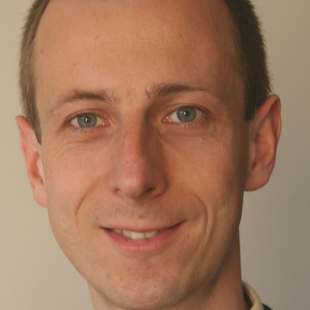
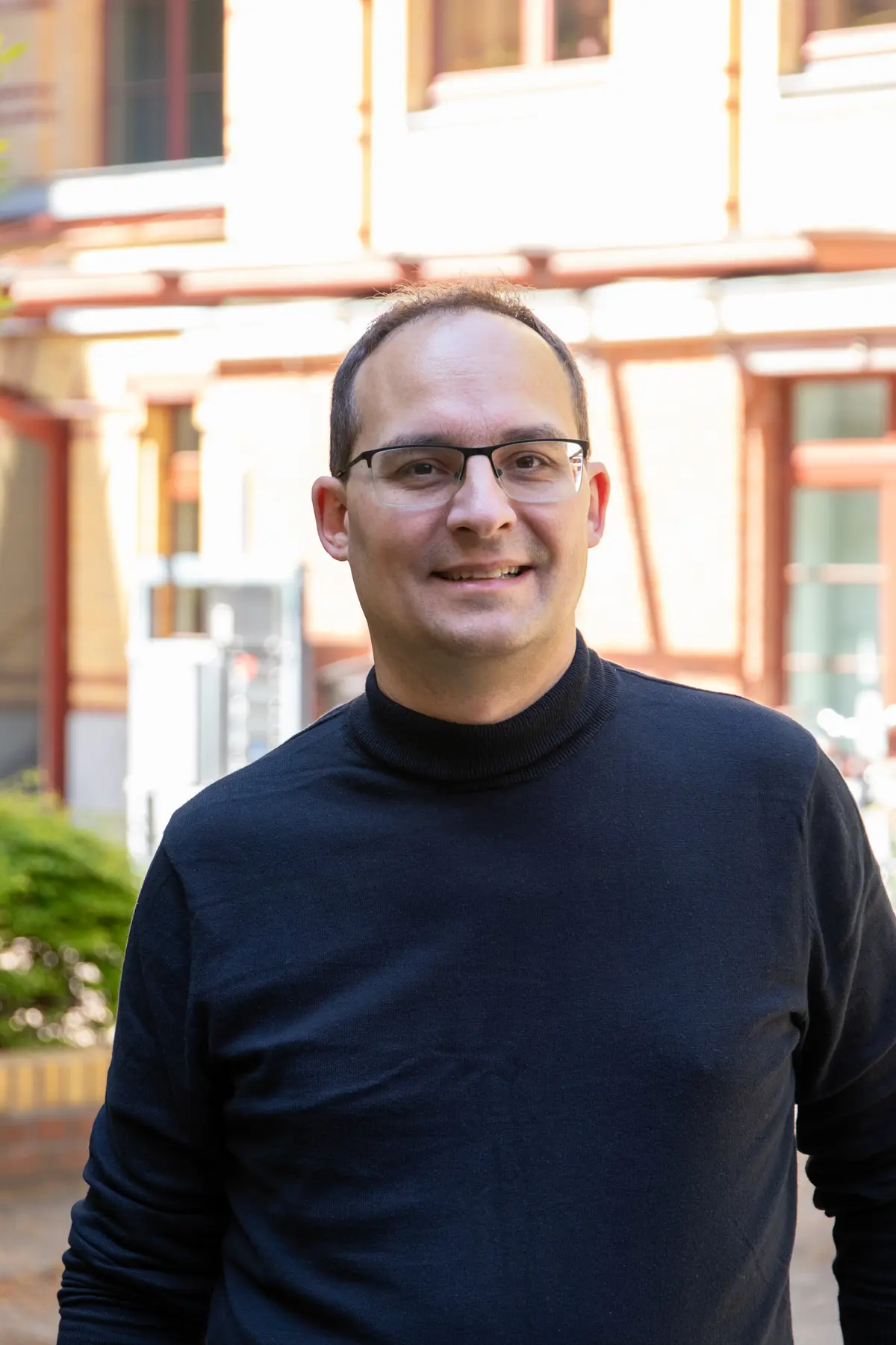
Thomas Richthammer is a Professor at the University of Paderborn , affiliated with the College of Electrical Engineering, Computer Science and Mathematics and specifically the Institute for Mathematics within the department of Applied Mathematics and Stochastics . His research focuses on stochastic models and mathematical physics. Current research interests include stochastic processes, equilibrium and non-equilibrium statistical mechanics, and probabilistic models in mathematical physics. His work often involves rigorous analysis of particle systems and Gibbsian frameworks. Recent publications examine displacement bounds in 2D Gibbsian systems, thermal motion in hard disk models, and permutation-based Gibbs measures. These studies span probability theory, statistical mechanics, and spatial stochastic modeling. Contact: thomas.richthammer@uni-paderborn.de | Office: Room J2.204, Warburger Str. 100, 33098 Paderborn.
Professor Alexander E Holroyd is a faculty member at the School of Mathematics, University of Bristol. His research spans probability theory, combinatorics, and lattice dynamics, with a focus on spatial processes, symmetrization, and stochastic modeling. Current affiliations: School of Mathematics, University of Bristol Academic ranks: Professor His research explores probabilistic phenomena in lattice structures, including stable matchings, shift-invariant models, and finite-type processes. Recent work investigates bootstrap percolation, equivariant colorings, and cyclic birth-and-death systems. Key trends in his publications include spatial probability models, combinatorial optimization, and dynamic lattice systems. Notable contributions address percolation thresholds, symmetrization techniques, and cyclic process dynamics. Scientific awards: Paul R. Halmos-Lester R. Ford Award (2018), Reza Sarhangi Outstanding Paper Prize (2022)
Professor Nina C Snaith is affiliated with the University of Bristol as a Professor of Mathematical Physics in the School of Mathematics . Her work bridges Random Matrix Theory with Number Theory , focusing on eigenvalue statistics and connections between characteristic polynomials and functions like the Riemann zeta function and L-functions. Research Interests : Snaith investigates how Random Matrix Theory techniques can analyze zeros of number-theoretical functions, particularly elliptic curve L-functions. Her research spans eigenvalue distributions, asymptotics, and combinatorial methods in matrix determinant analysis. Scientific Awards : LMS Whitehead Prize (2008) Supervision & Grants : She has supervised 7 PhD students and led projects such as RANDOM MATRIX THEORY AND NUMBER THEORY: DISTRIBUTION OF PRIMES AND HIGHER ORDER VANISHING OF L-FUNCTIONS (2005-2009) and a fellowship (2004-2010), supported by grants focused on L-functions, elliptic curves, and random matrix ensembles.
Joseph S.B. Mitchell is a SUNY Distinguished Professor at the Department of Applied Mathematics and Statistics, State University of New York at Stony Brook. His office is located in Math Tower, Room P-138A. His research spans computational geometry, algorithms, optimization, and related fields. Research Interests: Prof. Mitchell's work focuses on fundamental and applied problems in geometric computing, including: Algorithm design for spatial optimization (e.g., art gallery problems, dispersion) Robotics applications (multi-agent path planning, sensor deployment) Efficient solutions for geometric data structures and visibility constraints Recent Publications: His 15 most recent articles (2024-2025) demonstrate a consistent focus on geometric optimization, visibility problems, and algorithm design for polygons and networks. Common themes include approximation algorithms, multi-robot coordination, and combinatorial solutions for spatial challenges. Awards: SUNY Distinguished Professor (recognizing exceptional academic contributions)
Mikhail Georgievich Chebunin is a Senior Lecturer in the Department of Higher Mathematics at the Faculty of Physics, Novosibirsk State University (NSU), Russia. Since 2012 he has held continuous academic appointments at NSU, progressing from Assistant to Senior Lecturer following completion of his PhD in 2016. Education: 2012 – Graduated with honors, Novosibirsk State University. 2016 – PhD (specialty 01.01.05) with thesis "Limit theorems in the problem of servicing with multiple access and in the problem of an infinite urn scheme" . Research Focus: Dr. Chebunin concentrates on theoretical probability and its engineering applications. His core interests span limit theorems , order statistics , Markov chains , and the probabilistic analysis of data transmission systems . A recurring theme in his work is the infinite urn scheme , which serves as a versatile model for studying occupancy problems, heavy-tailed phenomena, and decentralized network protocols. Across his publications he has advanced functional central limit theorems for statistics arising in urn schemes, devised asymptotically normal estimators for power-law distributions (Zipf’s law), and analyzed ergodic algorithms governing random multiple-access communication systems with partial feedback. Scientific Communications: He has presented his findings internationally, notably as a poster presenter at the 40th Conference on Stochastic Processes and their Applications (SPA 2018) in Gothenburg, Sweden. Teaching & Service: Since 2012 he has taught within the Higher Mathematics department of NSU’s Faculty of Physics, guiding undergraduate and graduate students in advanced probability and stochastic modeling.
Stephan Wagner is a Professor at the Institute of Discrete Mathematics at Graz University of Technology. His research focuses on discrete mathematics and stochastics, with expertise spanning combinatorics, graph theory, and probability theory. Research Interests : Wagner's work centers on theoretical and applied aspects of discrete mathematics, including structural analysis of graphs, probabilistic models, and combinatorial optimization. His research bridges foundational mathematical concepts with practical applications. Contact & Affiliation : Office: Steyrergasse 30/III, Room ST03198, Graz Website: https://www.math.tugraz.at/idm/
Emil Petkov Kamenov serves as an Assistant Professor in the Department of Probability, Operations Research and Statistics at the Faculty of Mathematics and Informatics, Sofia University 'St. Kliment Ohridski', where he maintains an office in room FMI-510 and can be contacted via phone at +359 2 8161-543. His research program centers on combinatorial probability and number-theoretic structures, with deep specialization in integer partition theory, plane partitions, and asymptotic enumeration methods. Dr. Kamenov investigates probabilistic behaviors of partition components, structural properties of random partitions, and asymptotic distributions in discrete combinatorial systems, bridging theoretical probability with analytic number theory. Analysis of his publications reveals a consistent focus on asymptotic methodologies applied to partition combinatorics, particularly examining large distinct parts in random integer partitions (2001) and enumeration of plane partitions through asymptotic formulas (2006). These works demonstrate rigorous application of analytic combinatorics to solve complex enumeration problems in discrete mathematics. While no scientific awards or student advisement records appear in the source material, his scholarly contributions reflect sustained engagement with fundamental problems in combinatorial mathematics through collaborative research, as evidenced by his co-authored publication with L. Mutafchiev.
T. Kyle Petersen is Professor and Chair of the Department of Mathematical Sciences at DePaul University's College of Science and Health, where he serves as a full-time faculty member specializing in combinatorics research and education. Education history: AB, Washington University in St. Louis PhD, Brandeis University (2006), supervised by Ira Gessel Research focuses on core and specialized areas of combinatorics: Enumerative Combinatorics : Counting methods and sequence analysis Algebraic Combinatorics : Algebraic structures in discrete mathematics Topological Combinatorics : Geometric and topological approaches Recent publications (2019-2021) demonstrate broad engagement with combinatorial theory and applications—including permutation studies (Sós Permutations), probabilistic card shuffling models, geometric puzzle theory, Coxeter group analysis, and inquiry-based learning frameworks. This work consistently bridges theoretical foundations with educational innovation. Beyond research, Dr. Petersen actively contributes to pedagogical advancement through the Academy of Inquiry-Based Learning, promoting student-centered mathematics education.
Professor Jérémie Bourdon is a Full Professor of Computer Science at the University of Nantes, Faculty of Science and Technology, where he serves as Vice-Dean in charge of Research, Innovation and International Relations since 2018. He is affiliated with LS2N (Laboratory of Digital Sciences of Nantes, UMR 6004) and heads the ComBi research group (Combinatorics and Bioinformatics) since January 2014. His research focuses on the application of probabilistic methods in bioinformatics, particularly in systems biology. Professor Bourdon's work spans from Number Theory to Systems Biology with a common thread of developing and using probabilistic tools. His main research activities include dynamical analysis of algorithms and systems biology modeling, where he has developed the transition event graph model to integrate quantitative and qualitative biological data. Professor Bourdon's recent publications demonstrate consistent output in high-impact journals including Nature Communications, PLOS Computational Biology, and BMC Systems Biology, with research trends showing increasing focus on metabolic network analysis, multi-omics data integration, and constraint-based modeling approaches. Academic Editor for PLOS One Co-chair of CMSB 2015 international conference Member of Biogenouest scientific council (2004-2017) Co-scientific responsible for BiRD bioinformatics platform Professor Bourdon has secured significant research funding including the 1.4M€ GRIOTE project and participation in multiple ANR/CNRS projects. He has supervised 9 PhD students, typically through co-direction arrangements, reflecting his collaborative research approach. His ComBi group consists of 12 members including professors, assistant professors, PhD students, post-docs, and engineers, working on diverse topics in bioinformatics and computational biology. The ComBi research group, led by Professor Bourdon since 2014, focuses on combinatorics and bioinformatics with activities centered around comparative genomics and systems biology. The group provides a collaborative environment for interdisciplinary research at the intersection of computer science and biology, with strong connections to biological research teams and access to computational resources through the BiRD platform.
Carles Noguera Clofent serves as Associate Professor in the Department of Information Engineering and Mathematics at the University of Siena since 2022. His academic trajectory includes lecturing at the University of Lleida (2006-2007), postdoctoral research at the University of Siena (2007-2009), junior research at the Artificial Intelligence Research Institute (2009-2012), and scientist positions at the Czech Academy of Sciences (2013-2022) where he led funded projects and taught at Charles University. His educational foundation comprises: Mathematics degree from University of Barcelona (2001) Ph.D. in Logic and Foundations of Mathematics from University of Barcelona (2006) Philosophy degree from University of Barcelona (2007) A logician bridging mathematics, philosophy, and computer science, his research pioneers algebraic structures in many-valued logics with applications in AI. Key contributions include fuzzy logic semantics, temporal reasoning systems, and probabilistic truth-value frameworks, establishing him as a leading theorist in non-classical logics. Analysis of his 2024-2025 publications reveals sustained innovation in many-valued logic foundations, with growing emphasis on computational applications. Work spans pure theory (e.g., asymptotic truth-value laws) to implementable systems (e.g., tableau methods for interval temporal logic), demonstrating seamless integration of abstract mathematics with AI/CS challenges. He has directed multiple research projects at the Czech Academy of Sciences while maintaining teaching commitments in Prague institutions. Current advising activities and grant details beyond the Czech period remain unspecified in available materials. His institutional affiliations highlight enduring ties to the Artificial Intelligence Research Institute (IIIA-CSIC) and Czech Academy of Sciences, where he developed core methodologies later refined at Siena for logic-based AI systems.
Daniel Kráľ is an Alexander von Humboldt Professor for Discrete Mathematics at Leipzig University and an affiliated member of the Max Planck Institute for Mathematics in the Sciences (MPI MiS). Previously, he held the Donald Ervin Knuth Professorship at Masaryk University in Brno and is also an honorary professor at the University of Warwick, where he was a professor of mathematics and computer science and a member of the Centre for Discrete Mathematics and its Applications (DIMAP). His research addresses various topics at the interface of mathematics and computer science, with primary focus on structural and extremal graph theory, discrete algorithms, and combinatorial limits. The theory of combinatorial limits is an emerging area that provides analytic methods to study large graphs such as social networks, establishing new links between analysis, combinatorics, ergodic theory, group theory and probability theory. His work has been supported by prestigious ERC grants including the CCOSA Starting grant and LADIST Consolidator grant. Dr. Kráľ's scholarly output includes over 150 journal research papers and numerous conference contributions. His recent publications demonstrate continued leadership in extremal combinatorics, graph limits, and structural graph theory, with significant contributions to understanding quasirandomness, Turán densities, and the coloring of complex graph structures. Scientific Recognition: SIAM Fellow (2024) Fellow of the American Mathematical Society (2020) Philip Leverhulme Prize in Mathematics and Statistics (2014) European Prize in Combinatorics (2011) ERC Consolidator grant LADIST (2015-21) ERC Starting grant CCOSA (2010-15) Professor Kráľ has supervised numerous PhD students and postdoctoral fellows throughout his career. His editorial service includes Editor-in-Chief of SIAM Journal on Discrete Mathematics (2017-2022), Co-Editor-in-Chief of Journal of Combinatorial Theory (since 2025), and Managing editor of Advances in Combinatorics (since 2018). He has organized multiple international workshops and conferences including Oberwolfach workshops on Graph Theory and the European Conference on Combinatorics, Graph Theory and Applications (EUROCOMB'23).
Matija Bucic serves as an Assistant Professor in the Department of Mathematics at the University of Vienna, based at Oskar-Morgenstern-Platz 1, 1090 Wien (Room 11.143). His contact details include email matija.bucic@univie.ac.at and phone +43-1-4277-55756, with his profile last updated on 2025-09-11. His research spans core mathematical disciplines, with primary emphasis on Discrete Mathematics and Combinatorics , extending to specialized areas including Graph Theory , Extremal Combinatorics , and Probabilistic Methods . These interests align with foundational theoretical research in discrete structures and algorithmic applications.
Ariane Carrance is a postdoctoral researcher at the Department of Mathematics, Faculty of Mathematics, University of Vienna, where she works with Professor Nathanaël Berestycki. Her research program bridges combinatorics, probability theory, and theoretical physics with applications to quantum gravity. PhD in Mathematics, Institut Camille Jordan, supervised by Grégory Miermont and Fabien Vignes-Tourneret Postdoctoral position at Laboratoire de Mathématiques d'Orsay with Nicolas Curien and Jean-François Le Gall Hadamard lecturer at Centre de Mathématiques Appliquées de l'École polytechnique Dr. Carrance specializes in the combinatorial and probabilistic aspects of discrete metric spaces. Her work in dimension 2 focuses on specific families of maps, while in higher dimensions she investigates "colored trisps" and associated tensor models. She has made significant contributions to the understanding of random discrete structures and their continuum limits, with implications for quantum gravity theories. Her research combines deep theoretical insights with computational approaches, including development of mathematical software. Dr. Carrance's publication record demonstrates a consistent progression from foundational work on planar maps and triangulations toward more complex higher-dimensional structures. Her recent work shows increasing sophistication in handling the interplay between combinatorial structures and probabilistic phenomena, with particular attention to asymptotic behaviors and scaling limits. The mathematical tools she employs span from classical combinatorics to advanced probability theory and computational mathematics. Dr. Carrance has collaborated with leading researchers in probability theory including Nicolas Curien, Jean-François Le Gall, and Nathanaël Berestycki. She co-developed the SageMath package dynpuiseux for Puiseux series expansions, demonstrating her commitment to computational approaches in pure mathematics. Her research is supported through postdoctoral fellowships and academic positions at prestigious institutions across Europe. As a member of the probability research group at the University of Vienna, Dr. Carrance contributes to a vibrant mathematical community focused on stochastic processes, random geometry, and their applications. Her work connects with broader efforts to understand the mathematical foundations of quantum gravity through discrete approaches.