Livingston McPherson is a Teaching Assistant Professor at the University of Illinois, affiliated with the Siebel School of Computing and Data Science and the Department of Computer Science. Their research focuses on robotics, human-robot interaction, and safety-critical systems. Key areas include assistive robotics, anomaly detection in autonomous systems, and proactive safety mechanisms for industrial and automotive applications. Research interests span robotics, computer vision, and machine learning, with an emphasis on practical applications such as voice-controlled robots, crowd navigation algorithms, and human-in-the-loop systems. Their work often bridges theoretical advancements with real-world usability, addressing challenges in manufacturing, transportation, and emergency response scenarios. Recent publications highlight contributions to dialogue-based assistive robots, driver distraction mitigation in ADAS, and safety frameworks for collaborative robots (cobots). Articles also explore visual-audio fusion for embodied AI and structural anomaly detection in traffic systems. No scientific awards or grants are explicitly listed in the provided materials. Advising information is unavailable, though their research team likely engages in robotics and AI projects. No lab or team affiliations are detailed in the text.
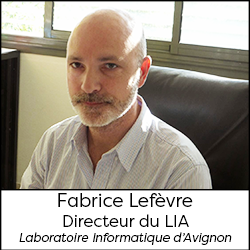
Fabrice Lefèvre is a Professor and Director of the Avignon Computer Science Laboratory (LIA) at Avignon Université, serving as Scientific Integrity Officer and Head of the AI Master's program. He leads research in artificial intelligence, focusing on human-machine interaction and robotics. His work integrates reinforcement learning, large language models, and multimodal systems. Education: DEA (Master's equivalent) in Artificial Intelligence, UPMC PhD in Speech Recognition (LIP6), followed by research at LIMSI (CNRS-LISN) Research Interests: Explores proactive dialogue systems, human-robot interaction, and AI applications in healthcare (e.g., hospital patient assistance via robots). Current projects include autonomous decision-making in robots for real-world tasks. Key Activities: Co-organizing SIGDIAL 2025 in Avignon. Active in Open Science initiatives via HAL Avignon and the Metaboscope Platform. Labs/Teams: LIA (UPR 4128) integrates researchers, engineers, and students in computer science research, nested within CERI.
Sonia Chernova is an Associate Professor in the School of Interactive Computing at Georgia Tech's College of Computing. She leads the Robot Autonomy and Interactive Learning (RAIL) lab, focusing on developing intelligent and interactive autonomous systems. Her research spans robotics and AI, emphasizing semantic reasoning, human-robot interaction, and explainable AI. She directs the NSF AI Institute for Collaborative Assistance and Responsive Interaction for Networked Groups (AI-CARING), which develops AI systems to support aging adults in home environments. Research Interests: Chernova’s work integrates human-centric approaches to robotics, including adaptive autonomy, explainable AI, and AI for health. She explores how robots can learn from human feedback, navigate ambiguous tasks, and provide proactive assistance in daily environments. Her lab’s projects emphasize real-world applications in healthcare, smart homes, and collaborative human-robot teams. Key Contributions: Developed frameworks for preference adaptation in object rearrangement and human-robot collaboration Pioneered explainable AI techniques for robot failures and decision-making transparency Advanced semantic reasoning methods for robots operating in everyday environments Led initiatives in proactive assistive robotics and aging-in-place technologies Awards & Recognition: 2021 IEEE/ACM HRI Best Paper Award 2018 NAE Frontiers of Engineering Top 100 Researcher 2014 ONR Young Investigator Award 2012 NSF CAREER Award Teaching & Outreach: Teaches courses on robotics, human-robot interaction, and robotics research. Co-chaired the Conference on Robot Learning (CoRL 2023) and developed outreach programs to bridge pre-college computer science education gaps. Affiliations: GVU Center, Institute for Robotics and Intelligent Machines (IRIM), and the NSF AI-CARING Institute.
Dr. Mark Mayfield is an Assistant Professor of Clinical Mental Health Counseling at Colorado Christian University, affiliated with the College of Adult and Graduate Studies - School of Counseling. He is a Licensed Professional Counselor, author, speaker, and leadership coach with extensive experience in executive leadership, having founded and led a non-profit counseling center serving over 25,000 annual appointments. He also serves as the Director of Practice and Ministry Development and Editor of Marriage & Family: A Christian Journal at the American Association of Christian Counselors (AACC). Ph.D., Counselor Education and Supervision with an emphasis in Non-Profit Leadership and Management, Walden University M.A., Community Counseling, Denver Seminary B.A., Youth Ministry, Colorado Christian University Dr. Mayfield's research and clinical work focus on trauma-affected families, adolescent self-injury, loneliness, emotional healing, and the integration of faith and mental health. He is an expert in suicide prevention, particularly among teens, and addresses the psychological impact of social media and isolation. His work extends into leadership coaching for churches and organizations navigating emotional health challenges. His recent publications and articles explore themes such as teen suicide, emotional abuse, holiday stress, and trauma-informed parenting. Collectively, these works reflect a strong trend toward practical, accessible mental health guidance rooted in both clinical expertise and Christian values, targeting parents, counselors, and faith communities. Invited to the White House (December 2019) to discuss mental health in America Featured in NBC, Woman's Day, Reader's Digest, Hello Giggles, Byrdie, and other national media outlets Dr. Mayfield has advised and spoken nationally on trauma, loneliness, and mental health in faith contexts. While no formal grant funding is mentioned, his leadership of a large non-profit counseling center and editorial role at a national journal indicate significant professional influence and organizational support. He has delivered keynote addresses and presentations at major conferences including the AACC Mega-National Conference and Colorado Counseling Association events. Dr. Mayfield founded and led Mayfield Counseling Centers, a 501c3 non-profit in Colorado Springs, demonstrating deep involvement in clinical operations, team leadership, and community mental health delivery. His current research initiatives include Equine Facilitated Psychotherapy with Veterans and Social Justice within the church, indicating ongoing engagement with innovative and socially relevant mental health practices.
Jorjeta Jetcheva is an Assistant Professor in the Computer Engineering Department at San José State University, part of the Charles W. Davidson College of Engineering. She brings extensive industry experience from leadership roles at Accenture, Fujitsu Laboratories of America, Itron, and Firetide, where she led innovations in AI, smart grids, and wireless networking. Her research focuses on Artificial Intelligence-based Personal Assistants, Natural Language Processing, and Knowledge Management . Her work bridges human-centered AI and enterprise applications, with emphasis on intelligent agents, knowledge platforms, and ethical AI systems. She explores how AI can enhance user productivity, decision-making, and system security across domains such as healthcare, energy, and customer service. The recent publications highlight a strong trend in Natural Language Processing applied to real-world problems like fake health news detection, agent assist systems, and knowledge graph integration. Her research also spans Smart Grid analytics, cybersecurity, and AI ethics , reflecting a multidisciplinary approach grounded in both theoretical rigor and practical deployment. Scientific Awards: Best Application Paper Award at IEEE Big Data Service 2022 Best Paper Award at SmartGridComm 2014 Top 10 Finalist, Fujitsu Next Generation Product Idea Contest 2016 ('Robo Butler') CSU STEM-NET Faculty Fellow (2023) Advising and Grants: Professor Jetcheva is the Principal Investigator of a $2.5 million NSF S-STEM grant titled 'Empowering Students to Succeed in Engineering and Computer Science'. She actively mentors graduate students, including Master’s student Garima Chaphekar, with whom she co-authored an award-winning paper on fake health news detection. She serves on the SJSU AI Advisory Committee and leads the AI Research Cluster, fostering interdisciplinary collaboration and student success. Labs and Teams: She leads the AI Research Cluster at SJSU, promoting innovation in artificial intelligence across departments. Her work involves close collaboration with students, industry partners, and interdisciplinary teams focused on deploying scalable, ethical AI solutions.
Dr. J. Kenneth Young serves as Associate Professor in the Center for Doctoral Studies in Educational Leadership within Lamar University's College of Education and Human Development. Appointed in January 2009, he maintains an adjunct professorship at Baylor University's School of Social Work since 2010 and previously held positions at University of Mary-Hardin Baylor. Dr. Young earned his Ph.D. in Educational Psychology from Baylor University, complemented by a Master of Divinity and Bachelor of Science degree. His academic journey includes roles as evaluation project coordinator and media center assistant at Baylor University prior to his Lamar appointment. His research program centers on cognitive epidemiology and individual differences in educational contexts, with significant contributions to hiring practices in education, educational leadership, and organizational change. Recent work explores online learning environments, superintendent personality factors, and cultural dialogue in leadership education. Dr. Young employs both quantitative and qualitative methodologies across his investigations, often focusing on practical applications for educational practitioners. With 18 peer-reviewed publications and 22 conference presentations, his scholarly output demonstrates consistent productivity since joining Lamar. His 2017 REG Grant for Creative Works supported pilot research on educational hiring practices, reflecting his focus on evidence-based personnel decisions. Chaired/co-chaired 30+ dissertations Served on 50+ dissertation committees Active reviewer for Frontiers in Psychology and NCPEA publications Co-editor for Education Leadership Review Dr. Young's professional engagement extends to SERA leadership roles and NCPEA award committees, demonstrating his commitment to advancing educational leadership scholarship nationally. His community service includes elementary school volunteering and science fair judging, reflecting his dedication to local educational improvement.
Elisabeth André is a Professor at the University of Augsburg specializing in Human-Computer Interaction and Affective Computing. Her research develops cutting-edge AI systems for socially intelligent interactions, with projects spanning healthcare, environmental sensing, and conversational agents. Key research domains include: Multimodal Affect Recognition : Designing self-supervised architectures for real-world emotion analysis Human-AI Collaboration : Establishing best practices for proactive AI agents (BEHAVE AI initiative) Generative Social Agents : Creating dialogue systems for embodied AI (MeLaX project) Trust in Robotics : Investigating nonverbal cues during human-robot interactions She maintains international collaborations across Europe and Australia, contributing to large-scale challenges like REACT for facial reaction synthesis. Her work emphasizes ethical frameworks and real-world validation.