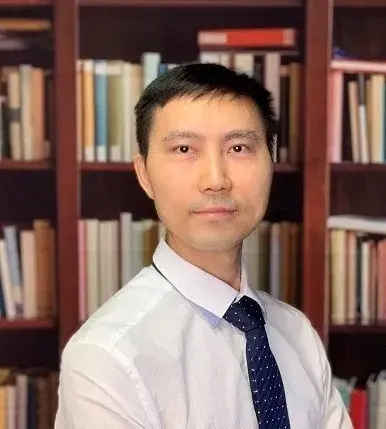
Kaiyi Ji is an Assistant Professor in the Department of Computer Science and Engineering at the University at Buffalo, SUNY. He earned his PhD in Electrical and Computer Engineering from Ohio State University in 2021 and completed a postdoctoral fellowship at the University of Michigan. His research focuses on large-scale optimization, machine learning, and foundation models. PhD: Electrical and Computer Engineering, Ohio State University (2021) Postdoc: University of Michigan (2022) BSc: University of Science and Technology of China (2016) Research interests include bilevel optimization, multi-task learning, continual learning, and AI4Science, with applications in robotics and crystal property prediction. Recent work explores efficient algorithms for LLM training and optimization. His publications span top venues like ICLR, ICML, NeurIPS, and IEEE Transactions on Information Theory. He received the CSE Junior Faculty Research Award (2023) and NSF CAREER Award (2025). He advises PhD students and actively participates in departmental service as Associate Chair for Graduate Student Admissions and organizer of academic workshops.
Volker Markl is a Professor at Technische Universität Berlin in the Institute of Software Engineering and Theoretical Computer Science, with additional affiliations at the Berlin Institute for the Foundations of Learning and Data (BIFOLD) and the German Research Center for Artificial Intelligence (DFKI). His research spans database systems, stream processing, and distributed data management with significant contributions to both theoretical foundations and practical implementations. Markl's research interests focus on next-generation data management systems, particularly for streaming and IoT environments. His work addresses critical challenges in distributed query processing, system integration, and performance optimization. He has pioneered approaches for stream processing in volatile infrastructures and developed innovative techniques for GPU-accelerated database operations. His NebulaStream project represents a major contribution to distributed stream processing systems. His publication record demonstrates consistent impact across top database venues including VLDB, SIGMOD, and ICDE. Recent work shows increasing focus on machine learning integration with database systems, privacy-preserving query processing, and educational approaches for teaching large-scale data management. Markl has mentored numerous researchers who have become prominent in the database community, with frequent collaborators including Steffen Zeuch, Tilmann Rabl, and Philipp Grulich. His leadership extends to major research initiatives and collaborations across European institutions.
Martin Aumüller is a Lecturer in Theoretical Computer Science Algorithms at the IT University of Copenhagen . He serves as Head of Education and Master of Software Design , focusing on algorithm engineering, differential privacy, and similarity search. Research interests include: Algorithm engineering for high-dimensional data Locality-sensitive hashing and nearest neighbor search Privacy-preserving machine learning Fairness in approximate search algorithms Benchmarking and evaluation of similarity search tools Publications trends highlight his work on approximate nearest neighbor search , privacy-preserving techniques , clustering algorithms , and scalable outlier detection in high-dimensional spaces. His recent projects (2024-2025) focus on fairness, differential privacy, and efficient indexing. Grants and projects : DIREC (2020-2025): Digital Research Centre Denmark (Innovation Fund Denmark) DIREC: Bias and Benefit of Approximate Nearest Neighbor Search (2022-2025): Principal Investigator (Innovation Fund Denmark) BARC (2017-2024): Basic Algorithms Research Copenhagen (Villum Fonden) SSS (2014-2019): Scalable Similarity Search (European Commission)
Dr Raja Akrom is a Senior Lecturer in the Department of Computer Science , School of Natural and Computing Sciences , University of Aberdeen since July 2020. Previously, he held research positions at Royal Holloway, University of London (Post Doctoral Research Assistant), University of Waikato (Research Fellow), and Edinburgh Napier University (Senior Research Fellow). PhD in Information Security from Royal Holloway, University of London MSc in Information Security and Computer Science from Royal Holloway and University of Agriculture, Faisalabad BSc in Mathematics and Physics from University of the Punjab His research focuses on user-centric applied security and privacy architectures , data ownership in heterogeneous computing , security for machine learning , and security in emerging technologies such as blockchain, UAVs/drones, and autonomous vehicles. Key technical interests include smart card security, cryptographic protocols, IoT security, and Trusted Execution Environments. The article list reveals expertise in: edge computing security (DECML 2025), medical AI applications (2024), embedded device ownership (CO-TSM 2024), NFC transaction security (2024), and malware detection with ML (2024). Earlier work explored UAV security , blockchain governance , and smart card protocols . Currently teaching courses in Operating Systems , Secure Software Design , and Enterprise Security Architecture . Supervises postgraduate MSc Cybersecurity program.
Stefan Decker is a full University Professor (Universitätsprofessor) at RWTH Aachen University, Germany, where he heads the Chair of Information Systems and Databases (Informatik 5) within the Faculty of Mathematics, Computer Science and Natural Sciences. He is actively involved in teaching, research, and the supervision of numerous ongoing and completed doctoral, master’s, and bachelor theses. Education & Academic Background Doctorate (Dr. rer. pol.) – field of Information Systems or related (exact institution/year not stated in text). Appointed as University Professor and Chair of Information Systems and Databases at RWTH Aachen University. Research Interests Prof. Decker’s work lies at the intersection of databases, knowledge graphs, semantic web technologies, data science, and cybersecurity . He investigates architectures and algorithms for large-scale, privacy-preserving, decentralized data analytics , develops ontology-driven information systems , and explores the use of large language models (LLMs) for educational technology, anomaly detection, and incident-response playbooks. Additional focal areas include smart energy systems, mixed-reality learning environments, FAIR data principles, and federated machine learning . Scientific Contributions & Trends His recent publications (2022-2025) demonstrate a clear trend toward explainable AI, LLM-enhanced systems, secure data spaces, and semantic interoperability . Key contributions include novel anomaly-detection frameworks for encrypted power-grid communications, knowledge-graph-driven chatbots for higher-education support, and methodological advances in decentralized analytics and FAIR data sharing. These works are disseminated in top-tier venues such as AAAI, IEEE ISGT Europe, ESWC, IDEAL, and various Springer LNCS and IEEE Transactions. Supervision & Grants Doctoral Theses Advised: A. T. Neumann – “Chatbots as professional companions in large-scale community information systems” (2024) S. M. Welten – “Methods for practical data sharing and decentralized analytics” (2025) Master’s Theses Co-Advised: A. R. Küsters – “Object-centric process constraints using variable bindings” (2025) Additionally supervising more than 30 ongoing bachelor, master, and doctoral projects covering topics such as LLM-driven cybersecurity playbooks, knowledge-graph construction for German law, privacy-preserving analytics in smart grids, and mixed-reality learning agents. Principal investigator or senior researcher in large collaborative projects including NFDI4DS, WestAI, champI4.0ns and several EU/national initiatives on sovereign data spaces and AI services. Labs & Teams Prof. Decker leads the Information Systems & Databases (DBIS) Research Group . The group operates well-equipped laboratories for knowledge-graph engineering, mixed-reality applications, privacy-enhancing technologies, and secure distributed analytics . Current team size exceeds 30 researchers including PhD candidates, postdocs, and scientific programmers, supported by national and EU funding streams.
Jianfeng Gu is a Ph.D. Candidate and researcher at the Technical University of Munich (TUM), affiliated with the Department of Computer Science and specifically the Chair of Computer Architecture and Parallel Systems led by Prof. Martin Schulz. He maintains an active research profile with numerous publications and contributes to the academic community through teaching seminars on Cloud Computing. His academic path began with a Bachelor of Software Engineering from Sun Yat-sen University in China (2014-2018), followed by a Master of Engineering from the same institution (2018-2020). Since April 2021, he has been pursuing his Ph.D. at TUM, advancing research in computing systems and architectures. Gu's research focuses on Heterogeneous Serverless Computing for Deep Learning applications, specializing in GPU, FPGA, and NPU technologies within serverless environments. His work addresses critical challenges in resource allocation, auto-scaling, and performance optimization for serverless inference systems. Additionally, he investigates Real-time Autonomous Driving Systems , developing advanced perception techniques through sensor fusion (particularly stereo-LiDAR fusion) for high-precision depth sensing and object detection in autonomous vehicles. His interdisciplinary approach bridges hardware acceleration, cloud infrastructure, and AI applications. His publication trajectory shows a progression from foundational computer vision and autonomous driving research (2018-2020) toward increasingly sophisticated work on serverless computing and federated learning (2021-2025). Recent publications focus on efficient resource sharing in heterogeneous serverless environments, with particular attention to GPU and FPGA allocation strategies that maintain service level objectives while optimizing costs. His work demonstrates strong technical depth across multiple computing domains. Best Paper Award at IEEE/ACM DATE 2021 15+ publications with 185+ citations Research featured in top venues for computer architecture and cloud computing As a Ph.D. researcher, Gu teaches seminars on Cloud Computing (IN2107) and contributes to multiple research projects at TUM's Chair of Computer Architecture and Parallel Systems. His work is supported by the department's research infrastructure and collaborations with faculty including Prof. Martin Schulz and Prof. Michael Gerndt. Gu works within TUM's advanced computing research environment, contributing to projects related to high-performance computing, serverless architectures, and autonomous systems. His research group maintains specialized hardware and software infrastructure for evaluating modern HPC architectures and accelerators, including FPGA clusters and GPU resources for deep learning research.
Amirhosein Taherkordi is a Professor in the Networks and Distributed Systems group at the Department of Informatics, University of Oslo, Norway. His research focuses on resource-efficiency, scalability, adaptability, dependability, mobility and data-intensiveness of distributed systems for emerging computing technologies including Internet of Things (IoT), Fog/Edge/Cloud Computing, and Cyber-Physical Systems (CPS). Dr. Taherkordi received his Ph.D. from the Informatics Department at the University of Oslo under the supervision of Prof. Frank Eliassen, with his thesis titled "Programming Wireless Sensor Networks: From Static to Adaptive Models." He holds an M.Sc. in Information Technology Engineering (Software Engineering) from University of Science and Technology and a B.Sc. in Computer Engineering from Sharif University of Technology. His research spans multiple domains of distributed systems with emphasis on practical applications. He investigates energy efficiency in wireless sensor networks, communication optimization in IoT systems, and adaptive resource allocation in edge computing environments. His work addresses critical challenges in network traffic classification, federated learning for vehicular networks, and data processing across heterogeneous platforms. Analysis of his recent publications reveals a strong trajectory toward communication-efficient federated learning techniques for vehicular networks, energy-aware protocols for IoT data collection, and advanced machine learning approaches for network traffic analysis. His research consistently focuses on optimizing resource usage while maintaining system performance and privacy in distributed architectures. Dr. Taherkordi actively contributes to several research initiatives including the CPS Lab at UiO for Cyber Physical Systems, DILUTE: Fluid Service Abstraction for Large-Scale Cloud IoT Systems, and the Gemini Centre on IoT at UiO. His work bridges theoretical advances with practical implementations in transportation systems, environmental monitoring, and industrial automation.
Nick Antipa is an Assistant Professor at the University of California, San Diego, affiliated with the Jacobs School of Engineering and the Department of Electrical and Computer Engineering. His work focuses on computational imaging systems that integrate optics, sensors, and algorithms to enable novel imaging modalities. PhD in Electrical Engineering from UC Berkeley Former optical metrology engineer at Lawrence Livermore National Lab Research interests span computational imaging , lensless camera design , and single-shot high-dimensional optical signal capture . His lab develops systems like DiffuserCam for compressive 3D imaging and Miniscope3D for miniature fluorescence microscopy. Recent publications address differentiable wave optics, high-speed video reconstruction, and marine imaging applications. Awards include Best Paper at ICCP 2016/2019 and Best Demo at ICCP 2017. His lab explores machine learning-driven optical design and differentiable rendering frameworks for end-to-end optimization of imaging systems. Current projects include oceanographic imaging, computational photography, and infrared spectroscopy acceleration.
Elena Grigorescu is an Adjunct Associate Professor in the Department of Computer Science at Purdue University, where she has been a faculty member since Fall 2012. Her research program spans theoretical computer science with a focus on foundational algorithmic challenges in large-scale data processing and computational limits, maintaining strong connections to cryptography, communications, and optimization applications. Her educational background includes a PhD from the Massachusetts Institute of Technology (MIT), establishing her expertise in rigorous theoretical frameworks. Professor Grigorescu's research emphasizes designing algorithms that operate in sublinear time or space for massive datasets, analyzing complexity of error-correcting codes and lattices, and exploring information-theoretical computation limits. Current investigations integrate differential privacy with learning-augmented techniques to solve online optimization problems, network design challenges, and data stream processing bottlenecks. Her work bridges abstract theory with practical implementations in cryptographic systems and quantum computing paradigms, demonstrating consistent innovation in algorithmic foundations. Analysis of her recent publications (2022-2025) reveals a dominant focus on sublinear-time algorithms, particularly at the intersection with differential privacy and machine learning augmentation. Key contributions include novel spanner constructions for network design, privacy-preserving clustering frameworks, and breakthroughs in trace reconstruction and coding theory. A pronounced trend shows increasing integration of learning-based predictions to enhance classical online algorithms for packing/covering problems while maintaining theoretical guarantees, alongside sustained contributions to error-correcting code analysis and graph-theoretic foundations. No specific scientific awards or major fellowships were documented in the provided materials, though her publication record in premier venues like STOC, FOCS, and APPROX/RANDOM indicates significant peer recognition. Professor Grigorescu actively mentors graduate students in theoretical computer science research, guiding investigations in sublinear algorithms, complexity theory, and coding theory. Her collaborative projects involve interdisciplinary teams across institutions, focusing on cryptographic applications and quantum information theory, though specific grant details were not included in the source texts. Ongoing work suggests expansion into quantum algorithm design and privacy-preserving machine learning frameworks. While dedicated laboratory facilities were not specified, her research operates within Purdue's theoretical computer science group, leveraging university-wide computational resources and fostering collaborations through conference participation and workshop organization.
Guandong Xu is a Professor in the School of Computer Science at the University of Technology Sydney (UTS), where he has been employed since 2012. He also serves as the Director of the UTS-Providence Smart Future Research Centre, which focuses on disruptive technology for sustainability, and leads the Data Science and Machine Intelligence Lab dedicated to research excellence and industry innovation in data science and artificial intelligence. Dr. Xu holds a PhD in Computer Science from Victoria University, Australia, along with MSc and BSc degrees in Computer Science and Engineering. After holding various research positions at European and Australian universities, he joined UTS in 2012 and was promoted to Associate Professor in January 2017, then to Professor in January 2019. His research spans data mining, machine learning, social computing, recommender systems, text mining, predictive analytics, and user behavior modeling. He has published over 240 papers in these areas with increasing citations from academia. His recent work demonstrates a strong focus on integrating large language models with recommendation systems, causal inference in recommendation, multimodal learning, and fairness in AI systems. His publications reveal sophisticated graph-based approaches and addressing challenges in dynamic recommendation scenarios, particularly through temporal modeling and hypergraph structures. Dr. Xu has received numerous prestigious awards including the Digital Disruptors Winner for ICT Research Project of the Year (2021), eBay's Leaders' Choice Award (2021), and was elected Fellow of Institution of Engineering and Technology (IET), UK (2021) and Fellow of Australian Computer Society (ACS) (2022). He has shown strong academic leadership as founding Editor-in-Chief of Human-centric Intelligent Systems Journal, Assistant Editor-in-Chief of World Wide Web Journal, and founding Steering Committee Chair of the International Conference of Behavioural and Social Computing Conference. He has supervised over 25 high degree research students and secured over $8 million in research funding from ARC, government, and industry sources, including projects like 'Smart Personalized Privacy Preserved Information Sharing in Social Networks' and 'A Secured Smart Sensing and Industry Analytics Facility for Industry 4.0.' Dr. Xu directs the Data Science and Machine Intelligence Lab at UTS, which aligns with UTS research priority areas in data science and artificial intelligence. The lab focuses on research excellence and industry innovation across academia and industry, with particular emphasis on developing advanced techniques for recommendation systems, knowledge graphs, and multimodal learning applications.
Danushka Bollegala is a Professor in the Department of Computer Science at the University of Liverpool, where he leads both the Machine Learning and Natural Language Processing research groups. He previously held a lectureship at the University of Tokyo (2010-2013) and currently serves as an Amazon Scholar for Amazon Search. His research bridges fundamental AI with applications in healthcare, law, and social sciences. Research Focus: Professor Bollegala specializes in developing core NLP methodologies including word embedding techniques, semantic similarity measurement, and domain adaptation. His machine learning research explores privacy-preserving AI, unsupervised parsing, and bias mitigation. Recent applications include clinical decision support for polypharmacy management and legal document analysis. His publications demonstrate strong emphasis on: 1) Advancing evaluation methodologies for generative NLP systems, 2) Developing privacy-aware embedding techniques, and 3) Creating cross-domain NLP applications for healthcare and social good. Research consistently addresses real-world implementation challenges. Research Leadership: Principal Investigator for £6M+ grants including DynAIRx (NIHR: £4.2M) for AI in multi-morbidity management KTP grant with Fletchers Solicitors for legal AI systems EU-funded WEB-RADR project for pharmacovigilance Leads 30+ member research group spanning NLP, machine learning, and healthcare AI. Teaches graduate course COMP 527: Data Mining and Visualisation.
Maarten van Steen is a Professor active in the fields of Distributed Systems , Artificial Intelligence , and Cybersecurity . With an h-index of 35 and over 5,400 citations, his work focuses on Edge AI , Privacy Preservation , and WiFi-Based Sensing . His research emphasizes non-intrusive authentication, anonymization techniques, and crowd monitoring without compromising individual privacy. Key research areas: Distributed Systems, Privacy Preservation, WiFi Security Recent projects: RoomKey, LocKey, FlowPrint Crowd-monitoring applications: Subway travelers, pedestrian dynamics Van Steen's work combines Machine Learning with Homomorphic Encryption to develop privacy-first solutions. He has contributed to mobile app fingerprinting , WiFi authentication , and blockchain scalability challenges. His 2024–2025 publications reveal trends in contextual security , crowd behavior analysis , and automated threat intelligence . Notable methods include Bloom Filters, automata learning, and WiFi beacon frame analysis. Dutch Cyber Security Best Research Paper Award 2024 Runner-up (shared prize) Van Steen supervises research teams and collaborates on datasets like Code for Threat Intelligence Processing and DeepCASE . His work spans 20+ years , with 208 total research outputs and significant contributions to decentralized systems, network traffic analysis, and urban mobility.
Brandon Lucia is a Full Professor in the Department of Electrical and Computer Engineering at Carnegie Mellon University's College of Engineering. He leads the abstract research group focusing on the intersection of computer architecture, systems, and programming languages. His work bridges theoretical foundations with practical implementations in energy-constrained environments. Lucia's research centers on intermittent computing systems and edge computing in extreme environments. His work on energy-harvesting systems has established fundamental principles for batteryless computing, while his orbital edge computing research pioneers computational intelligence for nanosatellite constellations. These research thrusts address critical challenges in reliability, efficiency, and programmability for systems operating under severe power constraints. His publication record shows a clear evolution from foundational work on intermittent computing models to sophisticated applications in space computing and edge intelligence. Recent publications demonstrate increasing integration of dataflow architectures with energy-harvesting constraints, particularly in satellite constellations where computational resources must be managed across distributed, power-constrained platforms operating in extreme environments. NSF CAREER Award (2017) IEEE TCCA Young Computer Architect Award (2019) Sloan Foundation Fellowship (2021) ASPLOS Best Paper Awards (2018, 2020) OOPSLA Distinguished Paper and Artifact Awards (2015) Lucia actively mentors numerous PhD students including Brad Denby, Zhuo Cheng, and Emily Ruppel, many of whom contribute significantly to his research program. His abstract research group maintains strong industry connections while pursuing fundamental advances in computing systems. The group has developed multiple open-source tools including Legerdemain for program analysis and MultiCacheSim for cache coherence simulation. His laboratory work spans from theoretical foundations of intermittent computing to practical implementations in space systems. Current projects include computational nanosatellite constellations, energy-minimal dataflow architectures, and secure edge computing systems that operate reliably despite frequent power failures.
Dr. Saidi Siuhi serves as an Associate Professor of Civil Engineering at South Carolina State University, where he teaches undergraduate and graduate courses while conducting research and providing institutional service across departmental and university levels. His academic credentials include: Ph.D. in Civil Engineering from the University of Nevada, Las Vegas (2009) M.Sc. in Civil Engineering from Florida State University (2006) B.Sc. in Civil Engineering from the University of Dar-es-Salaam (2003) Specializing in transportation engineering, Dr. Siuhi's research focuses on traffic safety, transportation planning, and microscopic traffic simulation. His work addresses critical transportation challenges including distracted driving/walking behaviors, traffic management during special events (notably the 2017 solar eclipse), and the application of advanced computational methods to transportation networks. He integrates emerging technologies like virtual reality, machine learning, and deep learning to develop innovative safety solutions for complex transportation systems. Analysis of his recent publications (2021-2025) reveals a strong trajectory toward computational transportation safety, with increasing emphasis on AI-driven solutions for pedestrian safety, driver behavior analysis, and infrastructure monitoring. His work consistently bridges theoretical transportation models with practical safety applications, particularly in distracted behavior analysis and event-based traffic management. Dr. Siuhi actively mentors students through senior design projects (CE 459/460) and graduate coursework, though specific advisee names aren't documented. His service contributions span departmental, college, and university committees, supporting academic operations and strategic initiatives within the engineering program.
Thomas Tie Luo is a tenured Associate Professor in the Department of Electrical and Computer Engineering and holds a courtesy joint appointment in the Department of Computer Science at the University of Kentucky, affiliated with the Stanley and Karen Pigman College of Engineering. He previously served as Associate Professor at Missouri University of Science and Technology and earned his PhD in Electrical and Computer Engineering from the National University of Singapore (ranked #8 globally by QS). His research focuses on Trustworthy Artificial Intelligence with applications in medicine, healthcare, and IoT, emphasizing Explainable AI (XAI) , Robust Machine Learning , and Privacy-Preserving Federated Learning . Education: PhD, Electrical and Computer Engineering, National University of Singapore (2009) His recent work explores Time Series Anomaly Detection , Secure Federated Learning for LEO Satellite Networks , and Medical Imaging Analysis through advanced deep learning architectures and adversarial attack mitigation. His research has been recognized with Best Paper Awards at ECAI'25, PAKDD'24, and PerCom'24, as well as a Best Student Paper Award at AAIM'18. Dr. Luo actively contributes to academic service as a Senior Member of IEEE, serving on editorial boards for journals like IEEE Transactions on Services Computing and Elsevier Ad Hoc Networks . He has advised PhD students in Computer Science, Electrical Engineering, and Computer Engineering, with graduates placed at institutions such as Washington State University and ByteDance.