Halil Ali is a Lecturer in Data Science (Education Focused) at the School of Computing Technologies, RMIT University. His research spans privacy-preserving machine learning, blockchain technologies, and cybersecurity. Key research areas include federated learning , quantum-enhanced AI , secure biometrics , edge unlearning , and privacy in healthcare data . His recent publications focus on resilient AI systems , blockchain applications , and ethical data handling in emerging technologies. His work demonstrates expertise in integrating machine learning with blockchain security across domains like IoT, smart grids, and metaverse healthcare. He contributes to practical frameworks for zero-trust architectures , lightweight consensus protocols , and quantum-classical hybrid models .
Rui Zhang is an Associate Professor in the Department of Computer and Information Sciences at the University of Delaware. He holds a PhD in Electrical Engineering from Arizona State University (2013) and has held academic positions at the University of Hawaii and industry roles at UTStarcom. His research focuses on cybersecurity, wireless networks, and privacy-preserving technologies, with notable work on secure edge computing and mobile authentication systems. Education: PhD, Electrical Engineering, Arizona State University, 2013 M.E., Communication and Information Systems, Huazhong University of Science & Technology, 2005 B.E., Communication Engineering, Huazhong University of Science & Technology, 2001 Research Interests: Rui’s work spans secure wireless systems, mobile crowdsourcing, accessibility technologies for visually impaired users, edge computing, and social network privacy. He has led NSF-funded projects on trustworthy hierarchical edge computing and secure mobile cloud sensing. Grants & Awards: Recipient of the NSF CAREER Award (2017) and multiple NSF grants totaling over $1M. Current focus includes NSF-funded research on edge computing security and privacy-preserving data aggregation. Teaching: Has taught courses in algorithms, network security, and computer networks at both University of Delaware and University of Hawaii. Labs & Teams: Leads research projects in secure edge computing and collaborates with Arizona State University on federally funded initiatives. Active in organizing academic conferences like ISC 2016 and serving on editorial boards of IEEE journals.
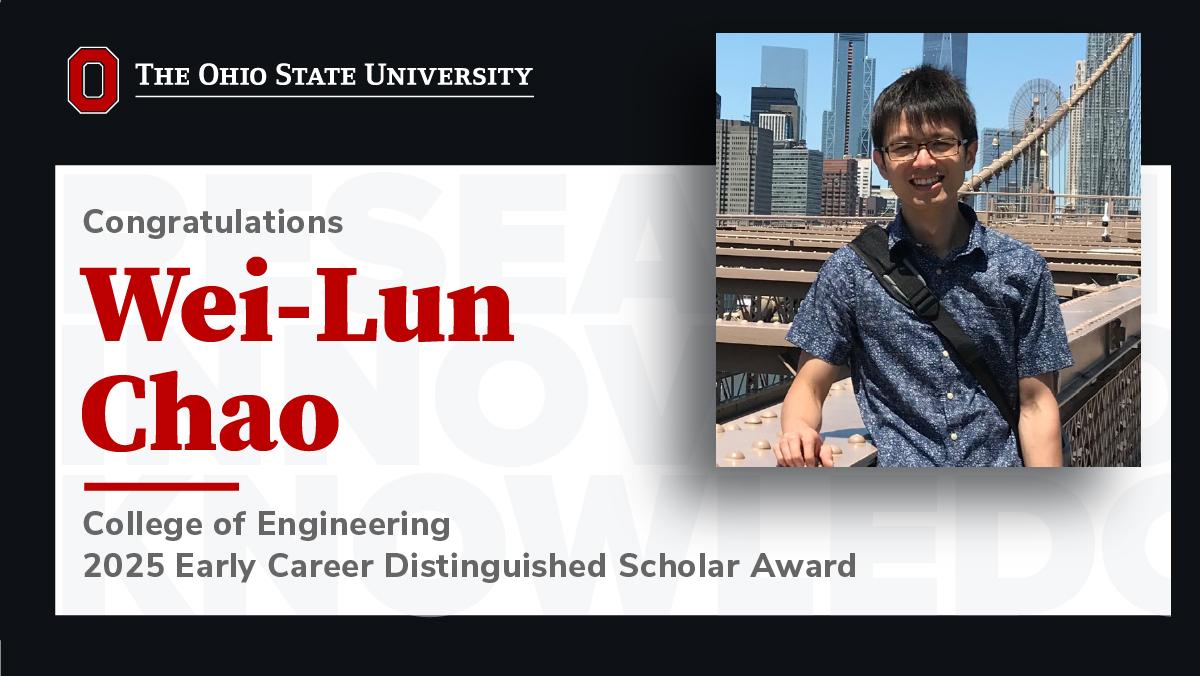
Wei-Lun (Harry) Chao is an Associate Professor in the Department of Computer Science and Engineering at the Ohio State University (OSU), College of Engineering. Promoted to this role in May 2025, he is also an Innovation Scholar and Distinguished Assistant Professor of Engineering Inclusive Excellence. His work spans machine learning, computer vision, and their applications in autonomous driving, healthcare, biology, and natural language processing. Research Focus: Machine learning with imperfect data, interpretable and personalized learning, robust perception for autonomous systems, and visual recognition in real-world scenarios. Awards: 2025 OSU Early Career Distinguished Scholar Award, CVPR Best Student Paper Award (2024), CSE Faculty Teaching Award (2024), Lumley Research Award (2023). Grants: Funded by NSF, NIH, ONR, Cisco, AWS, and Google. Notable Research Trends: The 15 most recent articles highlight his work on vision foundation models, federated learning, diffusion models for biological species generation, interpretable vision transformers, and robust perception systems for autonomous driving. Key subfields include sparse autoencoders, 3D object detection, semi-supervised learning, and anomaly detection in scientific domains. Scientific Awards: 2025 Early Career Distinguished Scholar Award (OSU) CVPR Best Student Paper Award (2024) CSE Faculty Teaching Award (2024) Lumley Research Award (2023) Mentoring & Grants: As an advisor for the OSU Buckeye AutoDrive Team and AI Club, he mentors graduate and undergraduate students. His research is supported by major grants from NSF, NIH, ONR, and industry partners like Cisco and Google.
Asaf Cidon is an Associate Professor at Columbia University, jointly affiliated with the Department of Electrical Engineering and Computer Science, and a member of the Data Science Institute. His research focuses on software systems , storage , large-scale machine learning , and cybersecurity . Stanford University - PhD in Electrical Engineering Stanford University - MS in Electrical Engineering Technion - BS in Computer and Software Engineering His work in distributed storage systems has been commercialized by companies such as Facebook, Tibco, and Rubrik. He has led projects like Sentinel and Forensics during his industry career. Recent publications highlight advancements in software-based radiation protection (ASPLOS'26), PCIe pooling with CXL (HotOS'25), and AI phishing detection (IMC'25). These reflect his expertise in system architecture , security , and networking . Scientific recognitions include best paper awards at OSDI, Usenix Security, CIDR, and ATC, along with NSF CAREER and ARO Young Investigator Awards . His papers Cookie Monster (SOSP'24) and Chablis (CIDR'24) received notable accolades. He has mentored numerous PhD and Master's students , including Edward Guo, Harry Wang, and Teng Jiang, many of whom now hold roles at Google, Meta, Amazon, and academic institutions. His lab at Columbia is actively recruiting CS and EE PhD students. Prior to Columbia, he founded and led the startup Sookasa to acquisition and served as Senior Vice President of Email Protection at Barracuda Networks , managing a $200M business with 100 engineers.
Christos Faloutsos is the Fredkin Professor of Computer Science at Carnegie Mellon University, with a courtesy appointment in Electrical and Computer Engineering. He holds a B.Sc. from the National Technical University of Athens and M.Sc./Ph.D. from the University of Toronto. His research focuses on data mining, graph analysis, fractals, and database systems. Notable contributions include foundational work on R-trees, graph mining laws (e.g., Kronecker graphs), and applications in medical imaging, network security, and fraud detection. Key projects include PEGASUS (petascale graph mining), fraud detection in online auctions (NetProbe), and tools for human trafficking analysis (TrafficVis). He has led NSF-funded projects on tensor mining, network anomaly detection, and bioinformatics. Over 300 refereed publications highlight his contributions across databases, data mining, and networks. Awards include the KDD Best Paper (2005, 2016), SIGMOD Test-of-Time Award, and recognition as a top nurturer in IT. His lab collaborations span the Parallel Data Lab (PDL), Machine Learning Department, and Computational Biology.
Jonas Fischer is the head of the Explainable Machine Learning group at the Max Planck Institute for Informatics, Department of Computer Vision and Machine Learning. His research focuses on interpreting complex machine learning models, particularly in genomics and healthcare, aiming to enhance robustness and alignment with human decision-making. Prior to his role at MPI, he was a postdoctoral fellow at Harvard University's Department of Biostatistics, where he worked on interpretable models for gene regulatory systems in cancer. Education: PhD in Computer Science from Saarland University (2022), with a thesis titled More than the sum of its parts , exploring the intersection of pattern mining and deep learning. He has contributed to advancing methods in neural network pruning, federated learning, and low-dimensional embeddings (e.g., dtSNE, Mercat). His work bridges computational biology, data mining, and machine learning, with applications in DNA methylation analysis, graph-based differential networks, and biomedical informatics. Key research areas include: (1) Explainable AI and neural network interpretability, (2) Biomedical applications of machine learning (e.g., gene regulatory networks, cancer genomics), (3) Low-dimensional embeddings and visualization techniques, (4) Federated learning for privacy-preserving collaborative models, and (5) Pattern mining for error analysis in NLP and classification tasks. Publications span top venues like NeurIPS, ICLR, Bioinformatics, and Genome Biology. His group develops tools such as BONOBO for omics data integration and node2vec2rank for scalable graph analysis. He actively collaborates with biomedical researchers to address challenges in data-driven healthcare and precision medicine.
Dr. Jimeng Sun is a Health Innovation Professor at the Siebel School of Computing and Data Science and Carle Illinois College of Medicine at the University of Illinois Urbana-Champaign. Co-founder of Keiji AI , he leads groundbreaking research at the intersection of artificial intelligence and healthcare, actively deploying clinical AI systems and developing frameworks like PyHealth and Therapeutics Data Commons . His research spans four major areas: Clinical AI Systems : Developing interpretable models (e.g., RETAIN) for patient similarity, temporal event prediction, medication recommendation, and clinical outcome forecasting Drug Discovery : Creating molecular optimization frameworks, drug-target interaction models, and AI-driven platforms Clinical Trials : Pioneering patient-trial matching, outcome prediction, and optimization frameworks using deep learning and graph neural networks Biosignal Analysis : Advancing sleep staging, seizure classification, and automated EEG/Cardiac monitoring systems With over 500 top-tier publications (including in Nature , NEJM AI , and leading AI conferences) and an h-index of 99, his work has been recognized with the Top 100 AI Leaders in Drug Discovery and Advanced Healthcare award. He maintains active collaborations with institutions like Massachusetts General Hospital , Medidata Solutions , and OSF Healthcare . His recent publications reveal a strong focus on: Reinforcement learning applications in medical data analysis Large language model adaptation for clinical tasks Knowledge graph integration with AI systems Synthetic data generation for healthcare Multi-modal learning in clinical contexts Explainable AI for medical applications Dr. Sun's lab ( Sunlab ) emphasizes practical impact over theoretical work, actively collaborating with hospitals and healthtech companies. He welcomes contributions from clinicians, researchers, and industry partners through initiatives like his AI for Health webinar series .
Minseok Ryu is an Assistant Professor at the School of Computing and Augmented Intelligence, Arizona State University (ASU). He holds a Ph.D. in Industrial & Operations Engineering from the University of Michigan (2020). Prior to ASU, he was a postdoctoral appointee at Argonne National Laboratory’s Mathematics and Computer Science Division. His research focuses on optimization methodologies for decentralized and stochastic decision-making distributed algorithms for machine learning and operations research applications in healthcare systems and energy grids Teaching responsibilities include courses on applied deterministic operations research (IEE 574), optimization (IEE 622), and research practicums (IEE 792). His work emphasizes computational challenges in decision-making under uncertainty, with recent projects addressing nurse staffing optimization, federated learning frameworks (e.g., APPFL/APPFLX), and resilient power grid systems. He has no recorded academic awards but actively contributes to open-source software and cross-disciplinary research collaborations. Research interests bridge theory and practice, targeting social goods through optimization techniques like distributionally robust optimization, federated learning, and heuristic algorithms for energy and healthcare systems.
Philip S. Yu is a Distinguished Professor in the Department of Computer Science at the University of Illinois at Chicago and holds the Wexler Chair in Information Technology. Previously, he led the Software Tools and Techniques department at IBM Thomas J. Watson Research Center. Education: B.S. in Electrical Engineering, National Taiwan University M.S. and Ph.D. in Electrical Engineering, Stanford University M.B.A., New York University His research spans data mining , big data , social networks , privacy-preserving data publishing , graph/network mining , recommender systems , and deep learning . He has authored over 970 papers with 74,500+ citations and an H-index of 127. Recent work focuses on heterogeneous graph representation, quantum walks in network analysis, and federated unlearning. Scientific Honors: ACM SIGKDD 2016 Innovation Award IEEE Computer Society 2013 Technical Achievement Award IEEE ICDM 2003 Research Contributions Award IEEE Region 1 Award (1999) UIC Research of the Year (2013) IBM Master Inventor with 300+ patents AI 2000 Most Influential Scholar Honorable Mentions (2024-2025) He served as Editor-in-Chief for ACM Transactions on Knowledge Discovery from Data and IEEE Transactions on Knowledge and Data Engineering , and on steering committees for ACM KDD and IEEE Data Mining. His work bridges theoretical advances in graph neural networks , deep learning , and privacy-preserving systems with applications in healthcare, social media, and enterprise analytics.
Wendy Ju is an Associate Professor of Information Science at Cornell Tech, with appointments in the Cornell Ann S. Bowers College of Computing and Information Science, the Jacobs Technion-Cornell Institute, and the Technion-Israel Institute of Technology. Previously, she served as executive director of interaction design research at Stanford University's Center for Design Research and as an associate professor of interaction design at the California College of the Arts. Her work bridges human-computer interaction, design, and robotics with a focus on how interactive devices can communicate with people without interrupting them. PhD in Mechanical Engineering from Stanford University Master's degree in Media Arts and Sciences from MIT Professor Ju's research centers on implicit interactions, human-robot collaboration, and automotive interfaces. She investigates how people interact with automated systems in natural contexts, develops methods for early-stage prototyping of autonomous technologies, and examines the social implications of robotics in urban environments. Her work spans from theoretical frameworks to practical applications, with particular emphasis on designing systems that integrate seamlessly into human activities without demanding constant attention. Her recent publications reveal a strong trajectory toward understanding human-robot interaction in public urban spaces, with increasing focus on robot navigation in city streets, the social implications of autonomous vehicles, and the integration of generative AI in design processes. Her work consistently bridges theoretical HCI frameworks with practical applications in transportation, urban design, and everyday robotics. Inducted into the ACM SIGCHI Academy (2025) Multiple Honorable Mention Awards at ACM CHI and DIS conferences Best Paper Award at Multimodal Technologies and Interaction (2023) Best Student Paper Award at IEEE Intelligent Vehicles Symposium (2017) Best Demonstration Award at HRI (2017) Professor Ju actively mentors numerous PhD and master's students, many of whom have become leading researchers in HCI and robotics. Her research has been supported by significant grants from NSF and industry partners, enabling extensive field studies of human-robot interaction in real-world settings. She has pioneered methodologies for studying autonomous vehicle interactions through both simulated and naturalistic driving environments. Her work with the Jacobs Technion-Cornell Institute supports interdisciplinary research at the intersection of computing, design, and urban technology. She has established research partnerships with transportation authorities, automotive companies, and urban planning organizations to study how emerging technologies can enhance urban mobility while respecting human needs and social contexts.
Sarah Billington is the UPS Foundation Professor of Civil and Environmental Engineering at Stanford University and a Senior Fellow at the Woods Institute for the Environment. Her research program focuses on sustainable building design, human wellbeing, and ethical supply chain practices. Education: PhD, University of Texas at Austin, Structural Engineering (1997) MSE, University of Texas at Austin, Structural Engineering (1994) BSE, Princeton University, Civil Engineering & Operations Research (1990) Her lab employs interdisciplinary methods to study how built environments impact human physical, psychological, and social wellbeing. Current projects include developing tools to quantify nature exposure in buildings, exploring affordable housing's role in wellbeing, and using AI to assess forced labor risks in material supply chains. While no longer active in this area, her group previously pioneered research on sustainable construction materials like bio-based composites and ductile cement-based composites. Her recent publications address topics such as nature integration in architecture, workplace design optimization, and health impacts of building materials. The Billington Lab at Stanford fosters collaborative team science, welcoming partnerships to advance occupant-centric engineering solutions.
Brian Y. Lim is an Associate Professor in the Department of Computer Science at the National University of Singapore (NUS), leading the NUS Ubicomp Lab. His research integrates Explainable AI (XAI) , Human-Computer Interaction (HCI) , and Ubiquitous Computing to address societal challenges in healthcare , wellness , and urban sustainability . He holds a Ph.D. and M.S. in Human-Computer Interaction from Carnegie Mellon University and a B.S. in Engineering Physics from Cornell University. Education: B.S., Engineering Physics, Cornell University M.S., Human-Computer Interaction, Carnegie Mellon University Ph.D., Human-Computer Interaction, Carnegie Mellon University His research focuses on designing human-centric AI systems that prioritize transparency and user trust. Key areas include explainable AI algorithms , context-aware computing , data visualization , and trustworthy machine learning . Projects like RexNet and Directed Diversity demonstrate his work in creating relatable AI explanations and enhancing crowd creativity through algorithmic prompting. Recent publications (2022–2025) highlight advancements in faithful visual explanations , user-centric XAI frameworks , and healthcare analytics . Notable awards include the CHI'22 Best Paper Award , IMWUT Distinguished Paper Award , and MOE Outstanding Mentor Award . He has advised numerous PhD and Masters students and leads the NUS Ubicomp Lab, which explores applications like TasteHealthy (food recommendation app) and Food Loves Fellowship (narrative data visualization).
Prof. Srdjan Capkun is a Full Professor in the Department of Computer Science at ETH Zurich and Director of the Zurich Information Security and Privacy Center (ZISC). He holds a Dipl.Ing. from the University of Split (1998) and a Ph.D. from EPFL (2004). His research focuses on system and network security, including wireless security (e.g., secure positioning), trusted computing, blockchain technologies, and privacy-preserving systems. He co-founded 3db Access (acquired by Infineon) and Sound-Proof, addressing secure distance measurement and authentication. Notable achievements include an ERC Consolidator Grant (2016), ACM Fellowship, and IEEE Fellowship. Education: Dipl.Ing., Electrical Engineering / Computer Science, University of Split, 1998 Ph.D., Communication Systems, EPFL, 2004 Research Interests: Wireless security (e.g., UWB, GNSS, cellular) Trusted execution environments (TEEs) Blockchain and cryptocurrency systems Privacy-preserving technologies Awards & Grants: ERC Consolidator Grant (2016) ACM Fellow and IEEE Fellow Leadership of ZISC Advising & Labs: Leads the System Security Group at ETH Zurich Guided postdoctoral researchers and graduate students in security and privacy Companies: 3db Access (secure distance measurement) Futurae (online authentication)
Osman Yağan is a Research Professor in the Department of Electrical and Computer Engineering at Carnegie Mellon University (CMU), with affiliate faculty status in the School of Computer Science. He is also a core member of CyLab Security and Privacy Institute. Prior to joining CMU in 2013, he was a Postdoctoral Research Fellow at CyLab. He holds a Ph.D. in Electrical and Computer Engineering from the University of Maryland (2011) and a B.S. from Middle East Technical University (2007). His research focuses on modeling, analysis, and optimization of computing systems, leveraging applied probability, network science, data science, and machine learning. Key areas include multi-armed bandits, resilient machine learning, contagion processes in networks, and cybersecurity. Research Interests include Machine Learning, Data Science, Network Science, Cybersecurity, and Robustness in Cyber-Physical Systems. He has advised numerous students, including current PhD candidates Yurun Tian, Orkun İrsoy, and Ishank Juneja, as well as notable alumni such as Mansi Sood (now at MIT) and Jun Zhao (Assistant Professor at Nanyang Technological University). Key Awards include the CIT Dean's Early Career Fellowship, IBM Academic Award, and Best Paper Awards at ICC 2021, IPSN 2022, and ASONAM 2023. His work spans theoretical contributions (e.g., contagion models in multi-layer networks) and applied research (e.g., mitigating cascading failures in power systems). He leads or co-leads grants from ONR, NSF, and ARO, focusing on resilient machine learning, network robustness, and pandemic modeling.
Raman Arora is an Associate Professor in the Department of Computer Science at Johns Hopkins University, with affiliations to the Mathematical Institute for Data Science (MINDS), the Center for Language and Speech Processing (CLSP), and the Institute for Data-Intensive Engineering and Science (IDIES). His research spans theoretical and practical aspects of machine learning, focusing on robustness, privacy, representation learning, and optimization. Research Interests: Machine Learning Theory Representation Learning (e.g., Deep CCA, Multi-view Learning) Privacy-Preserving Machine Learning (Differential Privacy) Robustness in Deep Learning Online and Reinforcement Learning Stochastic Optimization Algorithms His recent publications, primarily in top-tier venues like NeurIPS, ICML, and ICLR, demonstrate a strong focus on the theoretical foundations of adversarial robustness, multi-task learning, offline reinforcement learning, and differentially private optimization. His work often bridges theory and practice, with applications in speech, language, and data-intensive systems. Scientific Awards and Honors: NSF CAREER Award (2020) ICML Test-of-Time Award Finalist (2023) for Deep CCA Member, Institute for Advanced Study (2019–2020) Visiting Scientist, Simons Institute (2019, 2020, 2022) Advising and Grants: Raman Arora has advised numerous PhD and master’s students, many of whom are now researchers at leading tech companies like Google, Meta, and Microsoft. His research is supported by significant grants from the NSF (including CAREER, BIGDATA, TRIPODS, and CRCNS awards), DARPA, and other agencies, focusing on foundational aspects of machine learning such as inductive biases, privacy, robustness, and computational neuroscience. Laboratory and Research Group: He leads a dynamic research group at Johns Hopkins, comprising current PhD students and postdoctoral researchers working on the intersection of theory and applications in machine learning. The group is actively involved in projects related to adversarial robustness, meta-learning, offline reinforcement learning, and private optimization.