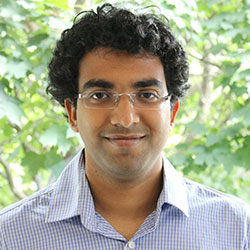
Ashish Khisti is an Associate Professor at the University of Toronto's Department of Electrical and Computer Engineering (ECE), where he directs the Signals, Multimedia and Algorithms Laboratory (SMA Lab). He holds the Canada Research Chair (Tier II) and maintains affiliations with the Vector Institute for Artificial Intelligence. His research bridges communication systems, information-theoretic security, and machine learning, with a focus on real-time streaming and privacy-preserving algorithms. Research Trends: Recent publications emphasize streaming codes for latency-sensitive networks , machine learning-driven compression , and privacy mechanisms in federated learning . Scientific Recognition: Canada Research Chair (Tier II), 2012 and 2017 renewal Cisco Research Center Award, 2017 Ontario Early Researcher Award, 2012 Best Paper at NeurIPS 2021 Deep Generative Models Workshop Academic Contributions: Supervised PhD students Ahmed Badr, Farrokh Etezadi, and Si-Hyeon Lee. Served as Associate Editor for IEEE Transactions on Communications (2012-2015) and IEEE Transactions on Information Theory (2015-2018). Labs & Collaborations: Leads the Signals, Multimedia and Algorithms Laboratory, collaborating with institutions like KAUST, Texas A&M University (Qatar), and the Vector Institute. Organized workshops at BIRS and IEEE conferences.
Shamik Sengupta is the Ralph E. and Rose A. Hoeper Professor at the University of Nevada, Reno (UNR) , where he serves as Professor in the Department of Computer Science & Engineering and Executive Director of the Cybersecurity Center . He holds a PhD in Computer Science from the University of Central Florida (2007) and a BE in Computer Science from Jadavpur University (2002). IEEE Senior Member Director, UNR Cybersecurity Center NSF CAREER Award Recipient
David Atienza is a Professor in the Department of Electrical Engineering at the School of Engineering, Swiss Federal Institute of Technology in Lausanne (EPFL), renowned for pioneering embedded systems education and research in ultra-low power computing. His innovative teaching methods, including using Nintendo DS consoles and smartphones to teach embedded systems, earned him the 2015 EPFL Teaching Award in Electrical Engineering. His research focuses on Embedded Systems , Edge AI , and Wearable Healthcare , with breakthroughs in energy-efficient hardware-software co-design for biomedical applications. Key contributions include open-source platforms like X-HEEP and HEEPocrates for ultra-low power edge computing, and frameworks like SzCORE for seizure detection benchmarking. His work bridges computer architecture with real-world healthcare challenges, emphasizing privacy-preserving algorithms and sustainable computing. Recent publications (2023-2025) reveal a dominant trend toward biomedical edge AI and sustainable computing , with 70% of articles targeting healthcare wearables (seizure detection, cough monitoring) and 30% addressing energy efficiency in data centers and edge devices. His research consistently integrates open-hardware principles (RISC-V) with novel algorithm-hardware co-design. Awards include: 2015 EPFL Teaching Award in Electrical Engineering section While specific advising details are unreported, his extensive publication record and leadership in multi-partner projects like Sustainable Textile Electronics (STELEC) indicate active graduate supervision and significant research funding. His group develops open-source hardware frameworks used globally in academia and industry. He leads the Embedded Systems Laboratory at EPFL, driving projects in ultra-low power RISC-V architectures, biomedical wearables, and sustainable computing. Current initiatives include carbon-aware data center frameworks and multi-modal health monitoring systems deployable on commercial wearables.
Tamara Heidi Roth is a tenure-track Assistant Professor in the Information Systems Department at the Sam M. Walton College of Business, University of Arkansas. She previously served as a Post Doctoral Researcher at the Interdisciplinary Centre for Security, Reliability and Trust (SnT) at the University of Luxembourg and has an interdisciplinary background spanning information systems and educational psychology. Dr. Roth holds two PhDs: one in Information Systems from the University of Luxembourg (2021-2024) and another in Educational Psychology from the University of Bayreuth, Germany (2020-2022). Her educational background reflects her interdisciplinary approach to research that bridges technology adoption with human and organizational factors. Dr. Roth's research focuses on the adoption and integration of emerging technologies, particularly blockchain and digital identity systems, within structured organizational environments such as government agencies and utilities. Her work explores how these technologies can drive innovation while addressing cultural and structural barriers to implementation. Through an interdisciplinary lens, she examines the intersection of technology, organizational behavior, and human-centric innovation. Her research spans multiple domains including public sector technology implementation, responsible innovation, digital identity systems, and the social implications of emerging technologies. Dr. Roth has published extensively in top-tier journals including the Journal of Information Technology, Government Information Quarterly, Journal of the Association for Information Systems, Nature Machine Intelligence, and MIT Sloan Management Review. Her recent work shows a strong focus on blockchain applications in government, digital identity systems, and the social implications of emerging technologies. She has developed a distinctive research trajectory examining how structured organizations adopt and implement blockchain and digital identity technologies, with particular attention to institutional barriers and cultural factors. Excellent Thesis Award, University of Luxembourg, 2024 (awarded to only the top 10% of Science, Technology, and Medicine PhD graduates) Dr. Roth serves as an Associate Editor for major conferences including the International Conference on Information Systems (ICIS) and has provided editorial reviews for numerous prestigious journals such as Journal of Information Technology, Management Information Systems Quarterly, and Journal of the Association for Information Systems. She teaches undergraduate courses at the University of Arkansas on Information Systems, Artificial Intelligence and Technology Ethics, and Introduction to Business Information Systems. Her research activity spans Innovation Management, Behavioral Research, Responsible Innovation, Organizing Visions, Digital Identities, and both Qualitative and Computationally Intensive Research approaches.
Dr. Volkan Dedeoglu is an active researcher at Queensland University of Technology (QUT), specializing in blockchain technology and IoT systems within the School of Computer Science. His work focuses on developing privacy-preserving frameworks and trust architectures for distributed systems. Research Focus: Blockchain applications in IoT and cyber-physical systems Privacy-preserving data sharing and threat intelligence Decentralized trust and reputation management Secure data aggregation and marketplace frameworks His recent work explores cutting-edge applications like CypherChain for privacy-preserving data aggregation in blockchain-based demand response programs and Priv-Share for differential privacy in cyber threat intelligence sharing. These publications demonstrate a consistent focus on bridging theoretical blockchain innovations with practical cybersecurity challenges in IoT ecosystems. Collaborative Research: Dr. Dedeoglu frequently collaborates with QUT colleagues including Raja Jurdak, Salil Kanhere, and Sidra Malik, indicating active participation in QUT's distributed systems and cybersecurity research groups.
Simone Silvestri is a Professor and Director of Graduate Studies in the Department of Computer Science at the University of Kentucky, within the Stanley and Karen Pigman College of Engineering. He has held this position since 2025, having previously served as Associate Professor from 2021-2025 and Assistant Professor from 2017-2021. Prior to his appointment at UK, he was an Assistant Professor at Missouri University of Science and Technology (2014-2017) and held postdoctoral positions at Pennsylvania State University (2012-2014) and Sapienza University of Rome (2010-2012). Dr. Silvestri earned his Ph.D. in Computer Science from Sapienza University of Rome, Italy in 2010, following a Laurea cum Laude in Computer Science from the same institution in 2006. His research focuses on Cyber-Physical-Human Systems, Internet of Things, Smart Grid Security, Terrestrial and Aerial Mobile Networks, and Network Management. His work bridges computer science with practical applications in agriculture, energy management, and disaster response scenarios. His research program has been supported by over $5 million in federal funding, including an NSF CAREER award in 2020. He has published more than 100 papers in top-tier journals and conferences including IEEE Transactions on Mobile Computing, IEEE Transactions on Smart Grids, and ACM Transactions on Sensor Networks. His recent work shows a strong trend toward applying cyber-physical systems to agricultural technology, energy management, and precision livestock farming, with increasing integration of machine learning techniques. NSF CAREER Award (2020) Best Demo Runner-Up Paper - IEEE PerCom (2025) Excellent Editor Award - IEEE Transactions on Network Science and Engineering (2024) Best Editor Award - Elsevier Pervasive and Mobile Computing (2024) Best paper award - IEEE International Conference on Network Protocols (2009) Dr. Silvestri has advised numerous graduate students to completion, including Ph.D. candidates Xu Tao and Ashtuoth Timilsina, and Master's students Josh Guess and Seifalla Moustafa. His research group has secured significant funding from NSF, NIFA, NATO, and other agencies for projects totaling over $6 million. He also created the CSMentor resource, providing guidance for computer science graduate students on academic writing, PhD success, and career development. Dr. Silvestri actively collaborates with researchers across multiple disciplines, particularly in agricultural technology and precision farming applications.
Professor Dingxuan Zhou is a distinguished academic serving as Professor and Head of School of Mathematics and Statistics at The University of Sydney, joining the institution on August 29, 2022. He is also a member of The Net Zero Institute and has held significant editorial positions, including editor-in-chief of the journal "Analysis and Application" of "Mathematical Foundations of Computing" and serving on the editorial boards of over ten international journals. Educational Background: BSc in Mathematics from Zhejiang University, China (1988) PhD in Mathematics from Zhejiang University, China (1991) Professor Zhou's research spans learning theory, neural networks, wavelet analysis, and approximation theory, with his current focus on the theory of deep learning. His work aligns with the Faculty of Science Research Strengths in Complex Systems, Precision and Digital Health, Data and Decisions, and National Security. His research demonstrates a consistent progression from foundational mathematical theory to cutting-edge applications in machine learning and artificial intelligence, with particular emphasis on understanding the theoretical underpinnings of neural networks and deep learning systems. His extensive publication record reveals a strong trend toward distributed learning frameworks, approximation theory for neural networks, and the mathematical foundations of deep learning. Recent work focuses on federated learning, transformers, physics-informed neural networks, and the theoretical analysis of over-parameterized networks, reflecting the evolving landscape of machine learning research with increasing emphasis on theoretical guarantees and practical applications. Scientific Awards: Humboldt Research Fellowship (1993) Fund for Distinguished Young Scholars from the National Science Foundation of China (2005) Highly-cited Researcher by Thomson Reuters/Clarivate Analytics (2014-17) World's Top 2% Scientist by Stanford University (2021, 2022, 2023) Professor Zhou has demonstrated exceptional leadership in research and mentorship, having conducted over 40 research grants as Principal Investigator, supervised more than 20 PhD students, and co-organized over 20 international conferences. His collaborative approach is evident in his extensive co-authorship network across multiple institutions globally. He has also served in significant administrative roles including Head of Department of Mathematics (2006-12), Associate Dean of School of Data Science (2018-22), and Director of the Liu Bie Ju Centre for Mathematical Sciences (2019-22) at City University of Hong Kong.
Sabine Roeser is a Full Professor of Ethics at Delft University of Technology, working within the Ethics and Philosophy of Technology Section at the Faculty of Technology, Policy and Management. She has been with TU Delft since 2001 and has held several leadership positions including Head of the Ethics and Philosophy of Technology Section (2015-2020), Head of Department of Values, Technology and Innovation (2021-2024), and Acting Dean of the Faculty of TPM (November 2024-April 2025). As one of six Principal Investigators in the NWO Gravitation project on 'Ethics of Socially Disruptive Technologies' (ESDiT), she co-leads the emotions and art lines of this major research initiative. Her educational background spans multiple disciplines, with degrees in painting (BA, Maastricht Academy of Fine Arts, 1994), philosophy (MA, University of Amsterdam, cum laude 1997), political science (MA, University of Amsterdam 1998), and a PhD in metaethics from Vrije Universiteit Amsterdam (2002). During her PhD studies, she conducted research at the University of Notre Dame and University of Reading. Roeser's research focuses on the intersection of ethics, emotions, and technology, particularly in the context of risk assessment and decision-making. She has developed 'affectual intuitionism,' a metaethical theory combining ethical intuitionism with cognitive theories of emotions. Her work argues that emotions serve as forms of moral cognition that can alert us to ethically relevant aspects of risky technologies. She has published two monographs ( Moral Emotions and Intuitions , 2011; Risk, Technology and Moral Emotions , 2018) and co-edited eight books with major academic publishers. Her research spans multiple technological domains including nuclear energy, climate change, transportation, and public health. Analysis of her recent publications reveals a consistent focus on the role of emotions in ethical decision-making, particularly in technological contexts. Her work increasingly explores how art can scaffold moral-emotional deliberation about risky technologies. She has made significant contributions to engineering ethics education, developing the 'Delft approach' that emphasizes problem-based learning and integration of ethical reflection throughout engineering curricula. More than 200 academic talks, mostly invited Over 100 interviews for popular media Member of various national and international policy advisory committees Former integrity officer of TU Delft (2018-2021) Chair of TU Delft's Human Research Ethics Committee (2014-2019) Roeser has secured competitive funding from organizations including NWO and the EU, leading multiple research projects and supervising numerous PhD candidates and postdoctoral researchers. She has played a key role in developing TU Delft's integrity policy and Code of Conduct. Her leadership has significantly grown both the Ethics and Philosophy of Technology Section and the Department of Values, Technology and Innovation.
Lars Dittmann is a Professor at the Department of Electrical and Photonics Engineering at the Technical University of Denmark (DTU), leading the Networks Technology and Service Platforms section. His work bridges advanced networking technologies with real-world applications in healthcare and transportation. Academic Role: Professor, Head of Section University: Technical University of Denmark (DTU) Department: Networks Technology and Service Platforms Research Interests: Professor Dittmann specializes in Software-Defined Networking (SDN) , 5G and IoT technologies , and energy-efficient network design , with a focus on applications in telemedicine and transportation systems . His work integrates machine learning for privacy-preserving traffic analysis and explores optical networks for high-bandwidth scenarios. Scientific Contributions: His recent publications emphasize green cellular networks using SDN/NFV/C-RAN, IoT benchmarking for coverage and mobility, and secure edge architectures for railways. Collaborative projects like the Future Patient telerehabilitation program highlight his interdisciplinary impact. Supervision: He supervises PhD candidates such as Radheshyam Singh, focusing on SDN-based IoT security and 5G network optimization. Labs & Projects: Leads initiatives like EXplorative network PLAnnINg and Broadband Trial Integration , addressing challenges in network reliability , emergency communication , and optical data center scaling .
Julian Fierrez is a Full Professor at the School of Engineering, Universidad Autonoma de Madrid. With an h-index of 74 and over 20,000 citations, his work spans biometrics, signal/image processing, artificial intelligence, and human-computer interaction. Key research areas include: Biometric anti-spoofing and DeepFakes detection Mobile and behavioral biometrics Bias/fairness in AI systems Biometric applications in e-health and education Security in multimodal biometric systems His recent publications show strong focus on deep learning applications for biometric security, with specific subfields including fake detection, keystroke authentication, facial analysis for Parkinson detection, and privacy-preserving AI. He serves as Associate Editor for multiple IEEE and Elsevier journals. Scientific distinctions include: IAPR Young Biometrics Investigator Award (2017) Miguel Catalan Award to Best Researcher under 40 (2017) EURASIP Best PhD Award (2012) EBF European Biometric Industry Award (2006) Prof. Fierrez leads the BiDA Lab and supervises students like Ruben Tolosana and Aythami Morales. Current projects include BBforTAI (Biometrics and Behavior for Unbiased & Trustworthy AI) and PRIMA (Privacy Matters). He also contributes to standardization efforts in biometric evaluation.
Michael Benedikt is a Professor of Computer Science at the University of Oxford and a Governing Body Fellow of University College. He holds the role of Director of the Advanced MSc in Computer Science program. His research focuses on databases, Web data management, logical methods in computer science, and theoretical computer science. Benedikt's work intersects with artificial intelligence, machine learning, and algorithms, with contributions to query languages, data integration, and formal methods. Education: Ph.D. in Mathematics, University of Wisconsin, 1993 Prior roles: Distinguished Member of Technical Staff at Bell Laboratories (1994–2006), visiting researcher at Yahoo! Labs Research Interests: Databases and information exchange Web and Web 2.0 data management Logical methods in computer science Formal verification and query optimization Applications in AI and machine learning Key Projects: FOX : Query-driven data acquisition from web-based sources PDQ : Proof-driven query answering over web-based data TRANCE : Transforming nested collections efficiently Awards: Best Paper Award at ICALP 2017 (Track B) EPSRC Established Career Fellowship (2015–2020) Advising & Grants: Directed the MSc in Advanced Computer Science program Supervised PhD students including Chia-Hsuan Lu and past advisees such as Luying Chen and Ben Spencer Received funding for projects like the ERC DIADEM initiative Labs & Teams: Active in the Department of Computer Science’s research groups, including the Algorithms At Large and Databases teams.
Dr. Vijayaraghavan Aravindan is an Associate Professor in the Department of Computer Science at Northwestern University, with a courtesy appointment in Industrial Engineering & Management Sciences. He is a core member of the Theory CS Group and serves as the Site Director for the NSF-funded Institute for Data, Economics, Algorithms, and Learning (IDEAL). His research focuses on theoretical computer science, particularly algorithmic foundations of machine learning, quantum information, and beyond worst-case analysis. Education: Ph.D. and M.A. in Computer Science, Princeton University B.Tech. in Computer Science and Engineering, Indian Institute of Technology Madras Research Interests: His work bridges theoretical computer science and machine learning, emphasizing efficient algorithms for high-dimensional data, quantum entanglement certification, and adversarial robustness. He explores paradigms such as smoothed analysis and stability-based approaches to provide practical algorithmic guarantees. Awards & Grants: NSF CAREER Award Google Research Scholar NSF AITF Grants (CCF-1637585, CCF-2154100) Advising & Teaching: He advises PhD students on topics like quantum computing, robust machine learning, and optimization. Courses taught include graduate algorithms, theoretical foundations of data science, and quantum computation. His lab collaborates on projects at IDEAL and with institutions like Carnegie Mellon University and TTI Chicago. Professional Leadership: Served as FOCS 2024 General Chair and organizes the McCormick Theory Workshops. Active on program committees for ICML, COLT, and NeurIPS.
Jun Shen is a Professor at the School of Computing and Information Technology, University of Wollongong. He specializes in computational intelligence, cloud computing, and big data applications, with a focus on AI-driven solutions for real-world challenges in transport systems, healthcare, education, and environmental management. He has secured over 40 research grants totaling AU$4.5 million and supervised 26 completed PhD projects. His work spans interdisciplinary areas including bioinformatics, smart manufacturing, and digital health. Research interests include bio-inspired algorithmic optimization, AI in arts/media, and edge computing for IoT systems. He has pioneered research centers in applied computing since 2014 and holds editorial roles in top journals like IEEE Transactions. As an IEEE Distinguished Lecturer, he actively promotes AI ethics and interdisciplinary collaboration. Recent publications emphasize adversarial machine learning defenses, UAV systems, and multimodal data fusion. His supervision includes projects in intelligent transport systems, cloud computing, and e-learning. Grants include projects on resilient energy systems and UAV geolocation verification. Leadership roles include leading over 20 researchers and chairing conferences. He advocates for digital transformation in public services and has conducted fieldwork at MIT, UCI, and Georgia Tech.
Kasper Welbers is an Associate Professor at the Department of Communication Science, Faculty of Social Sciences, Vrije Universiteit Amsterdam. He holds additional appointments at the Network Institute and the Communication Choices, Content and Consequences (CCCC) research group. He is co-Director of The Societal Analytics Lab, Vice Chair of the Computational Methods Division at the International Communication Association (ICA), and a scientific representative of the OPINION COST Action network. His research focuses on computational communication science, journalism, and political communication, particularly exploring how news spreads and the role of gatekeepers in media systems. He develops open-source tools for research and advocates for reproducible computational methods. Education and Academic Background: While formal education details are not explicitly provided, his academic trajectory is evident through his faculty role and publications. Research Interests: Welbers combines methodological innovations with substantive research on news diffusion, media gatekeeping, and computational text analysis. His work addresses topics like dark platforms' agenda-setting roles, automated content analysis techniques, and the impact of platform policies on data donation studies. He emphasizes ethical research practices and open-source infrastructure development. Grants and Awards: He received the Faculty of Social Sciences Dissertation Award (2017) and Teacher Talent Award (2019), highlighting both research and pedagogical excellence. Labs and Collaborations: His work is anchored in The Societal Analytics Lab, fostering interdisciplinary research on societal challenges through computational methods. Collaborations span global networks like the OPINION COST Action, addressing cross-cultural media dynamics. Teaching: He teaches courses such as Computational Analysis of Digital Communication and contributes to curriculum development in AI ethics and data science for societal issues.
Meng Xu is an Assistant Professor in the Cheriton School of Computer Science at the University of Waterloo, Canada. He is affiliated with the Cryptography, Security, and Privacy (CrySP) group and the Cybersecurity and Privacy Institute (CPI). His research focuses on system and software security, emphasizing secure-by-design languages (e.g., Rust, Move), automated program analysis, and runtime defense techniques. Education : Ph.D., Computer Science (2020), Georgia Institute of Technology B.Eng. and B.Business (First Class Honors), Nanyang Technological University (2014) Research Interests : Secure-by-design languages Automated security analysis (fuzzing, symbolic execution) Runtime defense mechanisms (moving target defense, secure hardware) Key Awards : EAPLS Best Paper Award (2022) USENIX Security Distinguished Paper Award (2018) Grants & Funding : BlackBerry Research Grant (CAD $200,000) Amazon Research Award (USD $60,000) NSERC Discovery Grant (CAD $170,000) Labs & Collaborations : CrySP (Cryptography, Security, and Privacy Group) Cybersecurity and Privacy Institute (CPI)