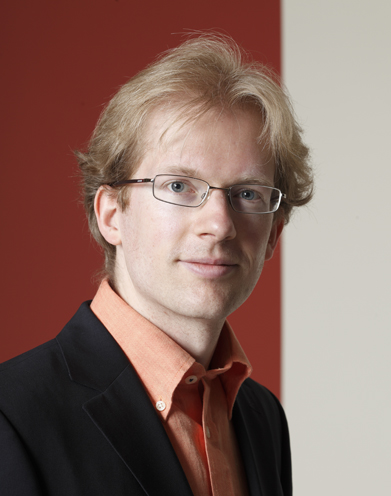
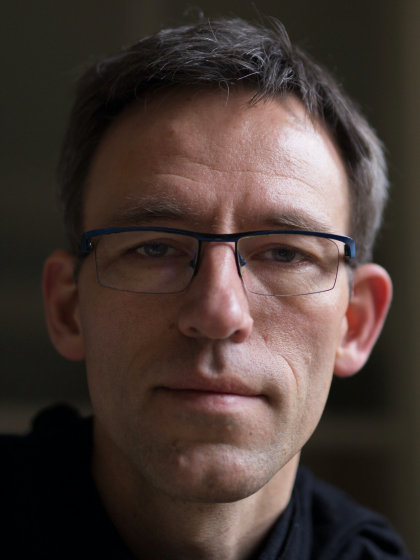
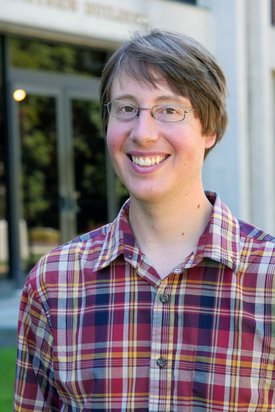
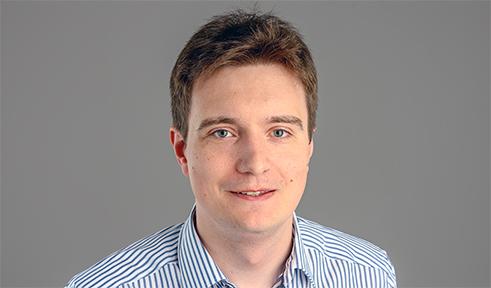
Harvey B. Meyer is a Professor of Theoretical Physics at Johannes Gutenberg University Mainz since 2014. Previously, he held positions including Junior Professor at Mainz (2010), Fellow at CERN's Theoretical Physics Division (2009), Research Scientist at MIT (2008), and postdoctoral roles at MIT (2006-2008) and DESY (2004-2006). He earned his D.Phil. in Theoretical Physics from the University of Oxford (2001-2004) and a Diplome de Physique from the University of Lausanne (1996-2001). His research focuses on lattice field theory, QCD phase diagrams, thermal field theory, and hadron structure. He leads the NEPhEuQCD collaboration and has received the ERC Consolidator Grant (2018) for the SIMDAMA project. Meyer teaches courses in theoretical physics and mathematical methods at Mainz, including 'Theoretische Physik 4' and 'Mathematische Rechenmethoden'. His work integrates advanced computational techniques to address fundamental questions in particle and nuclear physics. Key achievements include pioneering studies on the muon's anomalous magnetic moment, hadronic light-by-light scattering, and quark-gluon plasma dynamics. Collaborations include MIT, CERN, and institutions globally through lattice QCD projects. His lab and team contributions are central to the PRISMA+ Cluster of Excellence at Mainz.
Takuya Ooura is an Assistant Professor at the Research Institute for Mathematical Sciences (RIMS) at Kyoto University, specializing in numerical analysis and mathematical software development. His work bridges theoretical mathematics with practical applications in scientific computing and software development. Dr. Ooura earned his educational credentials through a rigorous academic path: he graduated from Hokuriku High School in 1987; completed his undergraduate studies at Nagoya University's School of Science in 1992; earned his Master of Engineering from the Department of Applied Physics at the University of Tokyo in 1994; and completed his PhD (Engineering) from the same department in 1997. His academic journey continued with a Research Fellowship from the Japan Society for the Promotion of Science (1997) followed by a position as Research Associate at RIMS, Kyoto University (2000). Dr. Ooura's research focuses on numerical integration algorithms, particularly his groundbreaking double exponential formula for Fourier-type integrals, which has been incorporated into Mathematica's NIntegrate function. He has also developed a high-speed FFT library that's utilized in Google Chrome browser (visible in chrome://credits). His work on continuous Euler transformation for accelerating convergence of slowly decaying integrals represents significant innovation in numerical analysis. His research spans both theoretical development and practical implementation of mathematical algorithms with real-world applications. His publication record demonstrates consistent contributions to numerical analysis, with particular emphasis on quadrature methods, integral transforms, and high-precision computation. His work shows a clear progression from theoretical foundations to practical implementations, with several algorithms achieving widespread adoption in commercial and open-source software. Paper prize awarded by JSIAM (2000) for 'A continuous Euler transformation and its application to Fourier transforms of slowly decaying functions' Paper prize awarded by JSIAM (2001) for 'Improvement of the PI Calculation Algorithm and Implementation of Fast Multiple-Precision Computation' Paper prize awarded by JSIAM (2005) for 'An Improved Convergence Test for the Double Exponential Formula' Japan Society for Industrial and Applied Mathematics 4th Achievement Award (2014) for 'Pioneering and practical development of the double exponential numerical integration method' Dr. Ooura has developed several widely used mathematical software packages including the double exponential integral formula, Clenshaw-Curtis numerical integration rule, and a general-purpose FFT library. His FFT package is particularly notable for its speed and accuracy, with benchmark tests showing superior performance compared to other implementations. His software has been incorporated into major projects including Google Chrome and SETI@home, demonstrating the practical impact of his theoretical work. His future research directions include further development of numerical computation libraries and applying his methods to various computational problems.
Prof. dr. Steven Hoekstra is an Associate Professor of Atomic and Molecular Physics at the University of Groningen's Faculty of Science and Engineering, within the Van Swinderen Institute. His research focuses on precision measurements using cold molecules to explore fundamental physics, including Stark deceleration, laser cooling, and searches for physics beyond the Standard Model. He leads the NL-eEDM program at Nikhef, investigating the electron's electric dipole moment. Hoekstra is also involved in educational innovation, having received the Teacher of the Year award (2020) and a Senior Teacher Qualification (2023). He has supervised over 11 PhD theses and currently mentors 5 students. His work combines experimental techniques with theoretical insights, addressing questions like symmetry violations and quantum dynamics. Key projects include manipulating BaF molecules with electrostatic fields and exploring levitated nanoparticles as sensors. Hoekstra has secured major grants, including NWO VICI (2022) and VIDI (2013), and collaborates internationally on projects like the European Strategy for particle physics. Recent articles highlight advancements in molecular beam control, spin-precession methods for EDM searches, and opportunities in radioactive molecules. He actively participates in the Physics Olympiad Netherlands as chair, contributing to science outreach and education.
Thomas M. Antonsen Jr. is a Distinguished University Professor at the University of Maryland, holding joint appointments in the Department of Electrical and Computer Engineering and the Department of Physics. He is affiliated with the Institute for Research in Electronics & Applied Physics (IREAP), Maryland Energy Innovation Institute, and the Institute of Physical Science and Technology. His research focuses on plasma physics, nonlinear dynamics, and high-power coherent radiation sources. Antonsen earned his B.S., M.S., and Ph.D. in electrical engineering from Cornell University (1973–1977) and has held visiting positions at institutions such as the University of California, Santa Barbara, and the École Polytechnique in France. **Education:** B.S., Electrical Engineering, Cornell University, 1973 M.S., Electrical Engineering, Cornell University, 1976 Ph.D., Electrical Engineering, Cornell University, 1977 **Research Interests:** Antonsen’s work spans magnetically confined plasmas, laser-plasma interactions, and advanced vacuum electronics. He has pioneered adjoint methods for optimizing beam-wave interaction systems and contributed to the development of high-power microwave amplifiers. His recent projects include wave chaos in complex systems and machine learning applications in nonlinear dynamics. **Awards & Honors:** James Clerk Maxwell Award (American Physical Society, 2023) IEEE Marie Sklodowska-Curie Award (2022) University of Maryland Distinguished University Professor (2017) IEEE Fellow (2012) **Teaching & Mentorship:** Antonsen teaches courses such as Physics 132 (Biophysics), Electrodynamics, and Plasma Physics. He mentors graduate students in plasma physics and vacuum electronics through his research groups at IREAP and the Bright Beams Collective. **Labs & Collaborations:** His research is supported by grants from the Department of Energy, NASA, and the Office of Naval Research. Key collaborations include the National Institute of Standards and Technology (NIST) and the European XFEL facility.
Prof. Dr. Michael Klasen is a leading theoretical physicist at the Institute of Theoretical Physics at the University of Münster, where he heads his eponymous research group. His work bridges nuclear and particle physics, with significant contributions to quantum chromodynamics and physics beyond the Standard Model. His research focuses on Particle Physics , Quantum Chromodynamics , and Physics beyond the Standard Model , with particular emphasis on understanding the quark-gluon structure of atomic nuclei and dark matter phenomena. His innovative approach connects microscopic quark-gluon dynamics with nuclear binding phenomena, creating a crucial bridge between nuclear and particle physics. Prof. Klasen's recent work analyzing nucleon binding at the quark-gluon level was recognized as a "Breakthrough of the Year 2024" by Physics World. His research group's publication in Physical Review Letters demonstrated how quarks and gluons behave differently in nucleon pairs than in free nucleons, fundamentally advancing our understanding of nuclear binding. Breakthrough of the Year 2024 from Physics World Leadership of Research Training Group 2149 "Strong and weak interactions - from hadrons to dark matter" Supervision of award-winning doctoral research including the Infineon Dissertation Prize 2025 Prof. Klasen has successfully mentored numerous PhD students, with 20 of his group's graduates continuing their academic careers at prestigious institutions including CERN and Stanford University. His research has been supported by major funding bodies including the German Research Foundation (DFG), the Helmholtz Alliance for Astroparticle Physics, and BMBF collaborative research programs. The Klasen working group maintains active collaborations with international research networks including CTEQ, DM@NLO, and RESUMMINO.
Tim Cohen is an Associate Professor of Physics at the University of Oregon, with affiliations at CERN and EPFL's Lausanne Theory Physics Laboratory. He is based at the Institute for Fundamental Science within the Department of Physics at the University of Oregon's College of Arts and Sciences. His research focuses on theoretical particle physics, particularly exploring phenomena beyond the Standard Model. Dr. Cohen's research interests center on particle physics beyond the Standard Model, with specific expertise in Large Hadron Collider phenomenology, effective field theory, electroweak naturalness, and dark matter. His work bridges theoretical frameworks with experimental possibilities at major particle physics facilities. His research program encompasses both theoretical developments in quantum field theory and practical applications to collider physics and cosmology. Analysis of his recent publications reveals a strong focus on effective field theory applications, de Sitter space physics, and dark sector phenomenology. His work demonstrates sophisticated mathematical approaches to problems in quantum field theory while maintaining connections to observable phenomena at particle colliders and in cosmological settings. He frequently collaborates with researchers across institutions including CERN, EPFL, and various US universities. Dr. Cohen serves as a senior researcher with active roles at multiple institutions, contributing to major collaborative efforts such as the Snowmass community planning process for particle physics. His work appears in leading journals including Journal of High Energy Physics, Physical Review D, and Physics Letters B, demonstrating consistent productivity and impact in the field. His research group operates within the Institute for Fundamental Science at the University of Oregon, with additional connections to theoretical physics groups at CERN and EPFL. This international collaboration network enables him to work at the intersection of theoretical developments and experimental frontiers in particle physics.
John Laiho is an Associate Professor in the Department of Physics at Syracuse University, part of the College of Arts & Sciences. His research focuses on high energy particle physics and lattice field theory, particularly lattice quantum chromodynamics and quantum gravity applications. He holds a PhD from Princeton University (2004) and has held academic positions at Fermilab, Washington University in St. Louis, and the University of Glasgow before joining Syracuse in 2013. Education: PhD in Physics, Princeton University (2004) BA in Physics and Mathematics, Rhode Island College (1998, summa cum laude) Research Interests: Specializes in lattice field theory techniques for studying quark-flavor physics, beyond the Standard Model physics, and quantum gravity. Recent work includes dynamical dark energy models and improved lattice quantum gravity simulations. Grants & Collaborations: DOE-funded project on theoretical particle physics and cosmology (2013–2025) CUSE grant exploring quantum information and fundamental physics (2018–2023) Teaching Highlights: Teaches advanced mechanics, relativity, and computational physics courses. Supervises independent studies and has taught a range of undergraduate/graduate physics topics.
Dag Hanstorp is a Professor at the Department of Physics, University of Gothenburg. His office is located at Fysikgränd 3, Göteborg (Room F8032), and he can be contacted via email or telephone. His research focuses on experimental atomic/molecular physics and laser applications, including: Quantum phenomena in levitated droplets Ultraprecise spectroscopy of radioactive molecules (e.g., radium monofluoride) Laser-induced dynamics in fuels and aerosols Electron affinity measurements of alkali metals Vacuum laser particle acceleration techniques Spin Hall nano-oscillator characterization Recent publications (2023-2025) demonstrate interdisciplinary work combining atomic physics, fluid dynamics, quantum optics, and nanotechnology. Common themes include advanced laser spectroscopy, quantum system control, and novel imaging techniques applied to fundamental physical processes.
David Simmons-Duffin is a Professor of Theoretical Physics at the California Institute of Technology (Caltech), where he has held positions since 2016. He is part of the Division of Physics, Mathematics and Astronomy, contributing to the Physics Department. His career progression includes roles as Visiting Associate (2016–17), Assistant Professor (2017–20), and Associate Professor (2020–21) before becoming full Professor in 2021. Education: A.B. and A.M. from Harvard University (2006), CASM from the University of Cambridge (2007), and Ph.D. from Harvard University (2012). His research focuses on conformal field theory (CFT), bootstrap methods, quantum field theory, and AdS/CFT correspondence. Key areas include precision computations in strongly coupled systems, critical phenomena, and applications to holography and quantum gravity. Research highlights include advancing the conformal bootstrap program, analyzing CFT data in 3D Ising models, and exploring connections between CFTs and gravitational theories. His work often bridges theoretical frameworks with numerical methods, yielding insights into operator product expansions (OPE), spectral gaps, and causality constraints. Affiliations include the Institute for Quantum Information and Matter (IQIM) and other Caltech research centers. His contributions have shaped modern approaches to understanding universality in critical systems and the geometric aspects of quantum field theories. Notable collaborations involve high-precision calculations, bootstrap island techniques, and studies of thermal QFT and light-ray operators. His work emphasizes interdisciplinary methods, combining analytic tools with computational advancements to tackle complex theoretical problems.
Antonio Vairo is a full Professor at the Department of Physics, TUM School of Natural Sciences, Technical University of Munich, where he holds the Chair of Theoretical Physics - Applied Quantum Field Theory (T39) at the James-Franck-Str. 1/I campus in Garching bei München. His research focuses on the theoretical foundations of quantum chromodynamics with emphasis on heavy quark systems and non-perturbative phenomena. Professor Vairo's primary research interests include Quantum Chromodynamics (QCD), Heavy Quark Physics, Lattice Gauge Theory, Effective Field Theories, and Exotic Hadron Spectroscopy. His work bridges computational approaches with analytical frameworks to investigate quarkonium dynamics in extreme environments like the quark-gluon plasma, while developing novel applications of Born-Oppenheimer effective theory to multi-quark systems. Recent investigations extend into dark matter bound state formation in the early universe, demonstrating interdisciplinary reach across particle physics and cosmology. Analysis of his 2024-2025 publications reveals three dominant research thrusts: (1) quarkonium suppression mechanisms in heavy-ion collisions using open quantum systems approaches, (2) high-precision lattice QCD computations of static forces and chromoelectric correlators, and (3) systematic development of effective field theories for exotic hadrons and dark matter pairs. His work on pNRQCD (potential non-relativistic QCD) provides critical connections between lattice results and experimental observables in heavy-ion physics. Professor Vairo maintains active research leadership through collaborations with international groups including the Belle II experiment, as evidenced by his contributions to 'The Belle II Physics Book'. His methodological innovations in applying quantum trajectory methods to quarkonium evolution and developing FeynOnium computational tools for effective field theories demonstrate significant technical contributions to the field. Current research directions emphasize next-to-leading order corrections in heavy quark dynamics and Debye mass effects in dark matter bound state formation.
Martha Constantinou is an Associate Professor of Physics at Temple University, specializing in Theoretical/Computational Nuclear Physics with a focus on Lattice Quantum Chromodynamics (QCD). Her research addresses fundamental questions in hadron structure, including nucleon spin content and proton radius puzzles, leveraging supercomputing resources. She leads a group conducting advanced numerical simulations at major computational facilities. Constantinou holds a Ph.D. in Theoretical Computational Physics (University of Cyprus, 2008) and a BS in Physics (University of Cyprus, 2003). Her work aligns with the upcoming Electron-Ion Collider (EIC) at Brookhaven National Lab, aiming to explore nucleon structure and dark matter connections. Key research areas include generalized parton distributions (GPDs), axial form factors, and high-performance computing applications. Notable awards include the US Department of Energy Early Career Award (2019) and the Selma Lee Bloch Brown Professorship (2020). Her publications (15 most recent listed) emphasize Lattice QCD advancements, with contributions to GPDs, quark-gluon momentum partitioning, and EIC theory. She actively promotes STEM outreach and public engagement through collaborative initiatives.
Phiala E. Shanahan is the Class of 1957 Career Development Associate Professor of Physics at the Massachusetts Institute of Technology (MIT). Her research focuses on theoretical nuclear and particle physics, particularly the structure of hadrons and nuclei from QCD. She integrates machine learning to overcome computational challenges in QCD studies, pioneering techniques for lattice gauge theory simulations. Affiliated with MIT's Center for Theoretical Physics, Laboratory for Nuclear Science, and the NSF AI Institute for Fundamental Interactions (IAIFI), she also collaborates with Jefferson Lab and the Electron-Ion Collider project. Education: BSc (2012) and PhD (2015) from the University of Adelaide. Career: Postdoctoral Associate at MIT (2015–2017), then joint position as Assistant Professor at College of William & Mary and Senior Staff Scientist at Jefferson Lab (2017–2018) before joining MIT in 2018. Research Interests: Gluon structure in nuclei, strange quarks in protons/nuclei, and machine learning applications. Her work predicts gluon distributions testable at Jefferson Lab and the Electron-Ion Collider, with implications for dark matter detection via precision calculations. She also explores nuclear forces and symmetry-breaking effects in QCD. Awards: 2023 South Australian Woman of the Year, 2022 Ruby Payne-Scott Medal, 2021 Maria Goeppert Mayer Award (APS), 2020 Kenneth G. Wilson Award, 2018 NSF CAREER Award, 2016 Bragg Gold Medal. Grants & Labs: DOE Early Career Award (2020), IAIFI affiliate, MIT Center for Theoretical Physics. Active in public engagement, including a Perimeter Institute lecture on 'The Building Blocks of the Universe.'
Peter Matthias Stoffer is an SNSF Eccellenza Professor at the University of Zurich and a Tenure-track scientist at the Paul Scherrer Institute (PSI). His research is currently funded by a SNSF project grant at PSI and an SNSF professorial fellowship, jointly hosted by the University of Zurich and PSI. Previously, he held positions as a University assistant at the University of Vienna (2020-2021), Postdoctoral researcher at UC San Diego (2019-2020), SNSF postdoctoral research fellow at UC San Diego (2017-2018), and Postdoctoral researcher at the University of Bonn (2014-2016). Stoffer's research focuses on effective field theories for physics beyond the Standard Model (SMEFT, LEFT), non-perturbative methods for low-energy hadron physics including dispersion relations and chiral perturbation theory, matching to lattice-QCD schemes, and applications to precision observables such as dipole moments, CP violation, and lepton-flavor violation. His work is particularly relevant to understanding the muon anomalous magnetic moment (g-2) and other precision tests of the Standard Model. The analysis of his recent publications reveals a strong emphasis on renormalization group equations for effective field theories, hadronic light-by-light scattering, and precision calculations related to the muon g-2 anomaly. His work spans both theoretical developments in effective field theory and practical applications to current experimental puzzles in particle physics. Stoffer has received the prestigious SNSF Eccellenza Professorship, which supports outstanding early-career researchers in establishing their own independent research groups. His research group maintains close connections between the University of Zurich and PSI, leveraging the complementary strengths of both institutions.
Prof. Dr. Matthias Steinhauser is a faculty member at the Karlsruhe Institute of Technology (KIT), affiliated with the Institute for Theoretical Particle Physics (TTP) since October 2004. His research focuses on precision calculations in particle physics, particularly in Higgs boson production, rare B meson decays, non-relativistic QCD, and multi-loop corrections. Research Interests: Higgs boson production at the LHC Rare B meson decays as probes for physics beyond the Standard Model Non-relativistic QCD and QED Massive and massless form factors Automation of multi-loop calculations Prof. Steinhauser’s recent publications (2025–2024) emphasize next-to-leading and next-to-next-to-leading order QCD corrections for Higgs boson production, B meson mixing, and decay rates. His work includes advanced computational techniques and high-order quantum corrections. Contact Information: Room: 11/11 Phone: +49 (0)721 608 - 47149 Email: Matthias.Steinhauser@kit.edu Office hours: Tuesday 13:30–14:30 and by request
Christian Drischler is an Assistant Professor in the Department of Physics and Astronomy at Ohio University, affiliated with the Institute of Nuclear and Particle Physics (INPP) and serving as a FRIB Theory Alliance Bridge Faculty. He is also an Adjunct Assistant Professor at the Facility for Rare Isotope Beams (FRIB) at Michigan State University and an elected member of the FRIB Theory Alliance Executive Board. Education: Ph.D. in Physics, Technical University Darmstadt, Germany, 2017 M.Sc. in Physics, Technical University Darmstadt, Germany, 2014 B.Sc. in Physics, Technical University Darmstadt, Germany, 2012 Dr. Drischler's research lies at the intersection of theoretical nuclear physics and nuclear astrophysics, focusing on strongly interacting dense matter in the universe. His primary interests include neutron stars, the equation of state of neutron-rich matter, chiral effective field theory, many-body perturbation theory, Bayesian uncertainty quantification, and computational physics. He develops and applies advanced computational methods to model nuclear systems with high precision and quantified uncertainties. The recent publications reflect a strong trend in applying Bayesian methods and emulator techniques to nuclear physics, particularly in constraining the equation of state of neutron-rich matter and emulating nuclear reactions. His work integrates machine learning and statistical inference into ab initio nuclear theory, contributing to multimessenger astrophysics and rare isotope beam science. Scientific Awards: NSF CAREER Award (2024) Inaugural FRIB Early Achievement Award (2021) FRIB Theory Alliance Fellowship (2020–2022) Feodor Lynen Fellowship (Humboldt Foundation, 2019–2020) Research Award of the Gerhard Herzberg Foundation (2018) Dr. Drischler advises several graduate and undergraduate students, including Joshua Maldonado (M.S. thesis, 2024) and Grace Eichler (undergraduate HTC thesis). He is the principal investigator on active grants from the National Science Foundation (CAREER Award 2339043) and the Department of Energy (STREAMLINE Collaboration, DE-SC0024233). He plays a key role in major scientific collaborations including N3AS, BUQEYE, BAND, and STREAMLINE, which are dedicated to advancing nuclear theory through interdisciplinary methods. He leads a research group at Ohio University with postdoctoral researcher Jane Kim and graduate students Yoon Gyu Lee and Abhinav Giri. He also organizes the Public Telescope Nights at the Ohio University Observatory and serves as Faculty Advisor for the Physics and Astronomy Graduate Students (PandA GradS) organization.