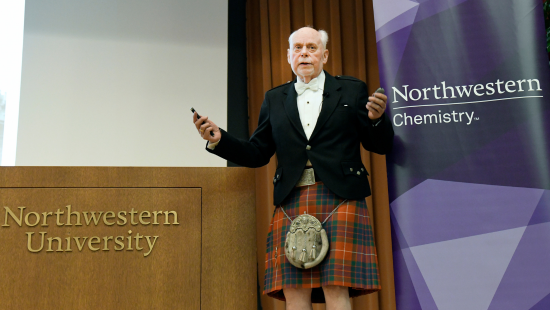
Sir Fraser Stoddart (1942-2024) was the Board of Trustees Professor of Chemistry and Director of the Center for the Chemistry of Integrated Systems at Northwestern University. A pioneer in supramolecular chemistry, he pioneered mechanical bonds and molecular machines, co-winning the 2016 Nobel Prize in Chemistry. Education: B.S. and Ph.D. from University of Edinburgh (1964/1966), followed by honorary doctorates from multiple institutions globally. Research focused on molecular recognition, self-assembly, and mechanically interlocked molecules, leading to innovations in molecular switches, rotaxanes, and nano-electronic devices. His work enabled molecular lifts, muscles, and advanced computer chip technologies. Major awards include the Nobel Prize, Royal Medal, Davy Medal, and knighthood from Queen Elizabeth II. He established a laboratory at Hong Kong University and led Northwestern's chemistry department to international prominence. Known for mentorship, he inspired generations of researchers through his energy and vision. His legacy includes over 1,400 publications and foundational contributions to nanotechnology and molecular engineering.
Professor Karl Bernhard Friedrich serves as Universitätsprofessor and Chair of Metallurgical Process Engineering and Metal Recycling at RWTH Aachen University's Faculty of Georesources and Materials Engineering. He leads the Institute for Metallurgical Science and Electrometallurgy (IME), with his office located in Building 1401, Room 108 at Intzestraße 3 in Aachen. His leadership extends to numerous EU-funded research initiatives focused on sustainable metallurgy and circular economy principles. Professor Friedrich's research interests span metallurgical process engineering, metal recycling, extractive metallurgy (pyrometallurgy and hydrometallurgy), battery recycling technologies, lithium recovery processes, and vacuum metallurgy. His work emphasizes resource efficiency and sustainable practices in metal production and recycling, with particular focus on developing environmentally sound processes for electronic waste and battery recycling. The institute under his leadership has pioneered several innovative recycling concepts for lithium-ion batteries and electronic scrap. Analysis of his recent publications reveals a strong focus on battery recycling technologies, particularly lithium recovery from spent batteries through both pyrometallurgical and hydrometallurgical routes. His research group has developed advanced processes for black mass treatment, slag valorization, and metal recovery optimization. The work demonstrates increasing integration of digital technologies and multi-objective modeling in metallurgical process development. Honorary doctorate from Montanuniversität Leoben (2025) recognizing outstanding scientific achievements and commitment to promoting young scientists Long-standing collaboration with Montanuniversität Leoben through the Aachen-Leoben Workshop for non-ferrous metallurgists Professor Friedrich actively supervises numerous doctoral students and has established several collaborative research programs including the DFG priority program 'engineered artificial minerals,' and doctoral programs 'circular electronics' and 'circular e-cars.' His institute maintains strong industry connections, with growing demand for TBRC and VAR trial campaigns. The institute recently commissioned a new large-scale arc furnace and is preparing for leadership transition in early 2027. The IME under Professor Friedrich's leadership operates extensive research facilities focused on vacuum metallurgy, pyrometallurgy, and hydrometallurgy. The institute collaborates with industry partners through the GDMB Zinc & Lead Technical Committee and participates in numerous European research networks. Current research activities focus on developing sustainable processes for battery recycling, electronic waste treatment, and critical metal recovery with emphasis on circular economy principles.
Professor Sandra Wilson holds a personal chair in Ecological Metal Design at the University of Dundee's Duncan of Jordanstone College of Art and Design (DJCAD). Her work bridges art, science, and sustainability, focusing on precious metal recovery from e-waste and traditional silversmithing techniques. She leads major projects like the EPSRC-funded Chemical Recycling of Electronic Waste in India and collaborates with Edinburgh University, National Institute of Design, and IIT (BHU). Her research outputs include 54 publications across exhibitions, articles, and project catalogues, with recent focus on sustainable material innovation and cultural heritage preservation. Notable projects include: Developing gold recovery methods with Edinburgh University's Love Chemistry Group Reviving Ecuadorian 'Dutch raising' silversmithing techniques Organizing international exhibitions like AMBERIF (Poland) and the European Silversmiths Forum (Dundee) Wilson has received awards from the Scottish Arts Council, Audi Foundation, and British European Designers Group. Her work appears in Princess Anne's collection and addresses UN SDGs 9 (Industry), 12 (Sustainability), and 13 (Climate Action). She actively engages the public through exhibitions, media (e.g., BBC interviews), and educational outreach. Current initiatives include the EU-funded OpenDoTT project exploring ethical wearable tech and the Craft Hub Journey documenting sustainable design practices. Her lab-based work emphasizes bridging artisanal craft traditions with modern recycling technologies.
Peter Oakley is a Professor of Material Culture at the Royal College of Art's School of Arts & Humanities, where he also serves as Co-Lead of the Material Engagements Research Cluster. His academic work bridges anthropology, creative practice, science and technology studies, and industrial heritage through ethnographic, experiential, and object-based research methodologies. Education PhD in Anthropology, University College London (2013) Peter Oakley specializes in the anthropology of materials and making, with particular expertise in sustainability across the crafts and applied arts. His research focuses on two main interconnected areas: the social, environmental, and ecological consequences of metal extraction, refining, and assaying throughout history, and the development of sustainable practices within contemporary craft communities. He employs ethnographic, experiential, and object-focused methodologies to examine material culture from multiple perspectives. Analysis of Professor Oakley's recent publications reveals a consistent focus on the intersection of material culture, sustainability, and ethical practices. His work spans historical examinations of mining heritage and contemporary investigations into ethical gold certification programs, with a particular emphasis on the social and environmental impacts of material extraction and use. There is a clear trajectory toward increasingly applied research addressing current sustainability challenges in the creative industries. Research Leadership and Funding UK Principal Investigator for "Toxic Heritage: Socio-natural Landscapes of Extraction and Pollution in the Harz and Cornwall" (AHRC-DFG funded, 2025-2028) Principal Investigator for "Embedding Carbon Literacy in the Applied Arts" (RCA Impact Development Scheme, 2023-2025) Principal Investigator for multiple AHRC-funded projects including "Carbon Measurement Tools in the Creative Industries" (2022-2023) Principal Investigator for international projects in Thailand, Kazakhstan, and other regions focusing on sustainable craft practices Professor Oakley actively supervises PhD candidates, currently advising Enitan Bankole-Race and Yu Lun Eve Lin, with previous successful completion of Wuthigrai Siriphon's doctoral work. His supervision focuses on material culture approaches to creative disciplines and traditional manual skills. Beyond direct supervision, he has led numerous research teams and secured funding from the Arts and Humanities Research Council, Global Challenges Research Fund, and Special Priorities Fund to support sustainability initiatives across the creative industries. As Co-Lead of the Material Engagements Research Cluster at the RCA, Professor Oakley collaborates with researchers across disciplines to advance understanding of material practices and sustainable approaches in the creative sector. His work connects academic research with practical applications through partnerships with craft communities in the UK and internationally, particularly in Thailand, Scotland, and Germany.
Dr. Fatemeh Pourhossein Alamdari is a Research Fellow at Coventry University's Centre for Health and Life Sciences, specializing in bioleaching and circular economy applications. Her work focuses on sustainable recovery of metals from electronic waste, leveraging microbial processes for environmental and industrial solutions. She holds a Ph.D. in Chemical Engineering (Biotechnology) from Tarbiat Modares University (2020), with postdoctoral research in Iran and Italy. Currently, she leads initiatives optimizing bioleaching techniques for critical metals extraction from e-waste. Educational Background: Ph.D., Chemical Engineering (Biotechnology), Tarbiat Modares University, 2015–2020 M.Sc., Chemical Engineering, Babol Noshirvani University of Technology, 2012–2015 B.Sc., Chemical Engineering, Babol Noshirvani University of Technology, 2008–2012 Research Interests: Bioleaching of indium, gold, and precious metals from LCD panels and PCBs Circular economy strategies for e-waste valorization Development of bio-based remediation technologies Design of sustainable bioreactor systems Professional Activities: Guest co-editor for Applied Sciences journal Reviewer for Journal of Environmental Management , Resources, Conservation and Recycling , and others Her research bridges microbiology and engineering to address global challenges in resource recovery and environmental sustainability, contributing to UN Sustainable Development Goals 9 (Industry, Innovation) and 12 (Responsible Consumption).
Mathias Mehofer serves as a Lecturer at the Vienna Institute for Archaeological Science (VIAS), University of Vienna, specializing in archaeometallurgical research and teaching. His institutional affiliation is clearly established through his university email domain and published teaching assignments within the archaeology department. His research focuses on Archaeometallurgy and Bronze Age metal production , with particular emphasis on copper exchange networks across Europe and the Mediterranean. His work integrates experimental archaeology with advanced material analysis techniques including lead isotope studies and metallography. Key regional interests span the Balkans, Anatolia, Cyprus, and Alpine regions, examining metallurgical transitions from the Chalcolithic through Iron Age periods. Analysis of his 15 most recent publications reveals consistent methodological approaches combining fieldwork, laboratory analysis, and experimental replication. His research demonstrates strong specialization in Balkan metallurgical networks , Early Bronze Age Anatolian workshops , and non-destructive analytical techniques for museum artifacts. The publications show increasing focus on supra-regional exchange systems and technological transitions in metal production. Regarding academic supervision and funding, the available materials indicate active teaching responsibilities across multiple graduate-level courses but do not specify student supervision or grant details. His institutional profile suggests integration within VIAS research teams focused on material science applications in archaeology.
Associate Professor James Vaughan is the Chemical Engineering Metallurgy Major Lead and Leader of the Hydrometallurgy Research Group at the School of Chemical Engineering, University of Queensland. He holds a Bachelor's degree in Metallurgical Engineering from McGill University, and Master of Applied Science and PhD degrees in Materials Engineering from the University of British Columbia. Prior to joining UQ, he gained industrial metallurgical R&D experience with Glencore, Barrick, and BHP. His research focuses on fundamental aspects of hydrometallurgical processes including leaching, ion exchange, precipitation reactions, and membrane separations. These projects support base metals, precious metals, alumina refining industries, and value-added materials production. Key research areas include sustainable resource extraction, waste valorization, and critical metal recovery technologies. Current research projects demonstrate a strong focus on sustainable resource recovery: Extracting Queensland's rare earth elements sustainably Copper process innovations Zeolite production from clay/mine tailings Inorganic membrane percrystallisation Pressure oxidation optimization for gold extraction Battery metal recycling and purification Vaughan has led multiple Australian Research Council (ARC) Linkage and Discovery Projects. He teaches undergraduate and graduate courses in Hydrometallurgy and Electrometallurgy (METL6204) and Metal Production and Recycling (METL2201). As leader of the Hydrometallurgy Research Group, he oversees projects developing innovative extraction technologies for primary and secondary resources.
Prof. Fırat Burat is a Professor at Istanbul Technical University's Department of Mineral Processing Engineering, Faculty of Mining Engineering. He specializes in mineral processing, e-waste recycling, and battery recovery technologies. His research focuses on optimizing flotation processes, rare earth element extraction, and sustainable resource management. He holds a PhD in Mining Engineering from ITU (2011) and has been a faculty member since 2004, advancing to Associate Professor in 2018 and full Professor thereafter. Education: PhD in Mining Engineering (ITU, 2011), Master's in ORE COAL Preparation (ITU, 2003), Bachelor's in Mining Engineering (ITU, 2001). Research Interests: E-waste recycling (e.g., lithium-ion batteries, printed circuit boards), coal beneficiation, rare earth element recovery, and industrial raw material processing. His work contributes to UN SDGs like responsible consumption and climate action. Notable projects include recycling spent batteries and recovering metals from electronic waste. He has authored over 45 publications and secured multiple awards, including ITU's 2024 Academic Performance Award. Prof. Burat leads research teams on battery recycling and mineral processing, advising 7+ graduate students. His lab focuses on innovative separation methods and sustainable resource utilization.
Xiao Su is an Associate Professor of Chemical & Biomolecular Engineering at the University of Illinois at Urbana-Champaign, with affiliations in Chemistry, the Lemann Center for Brazilian Studies, and multiple research institutes. Her research focuses on advanced materials for molecularly selective separations, electrochemical systems, and process intensification in energy, environmental, and chemical manufacturing sectors. She holds a BASc from the University of Waterloo (2011), a PhD from MIT (2017), and postdoctoral training at MIT (2017–2018). Her work integrates stimuli-responsive materials and electrochemistry to develop sustainable separation technologies. Notable achievements include PFAS remediation, rare earth element recovery, and electrochemical recycling of precious metals. Key awards include the 2024 ACS Satinder Ahuja Award, 2023 AIChE Kunesh Award, and 2022 Fellowship at the Center for Advanced Study. Recent publications highlight innovations in chiral metallopolymers for enantioselectivity, redox-mediated liquid-liquid extraction, and photoelectrochemical separations. She advises over 10 graduate students and collaborates with industry (e.g., Dow Partnership for platinum catalyst recycling). Her labs are located in Roger Adams Laboratory and affiliated with the Beckman Institute and Prairie Research Institute.
Aleks Nikoloski is a Professor at Murdoch University affiliated with the Centre for Water, Energy and Waste, where he serves as head of the Hydrometallurgy Research Group. With over 25 years of industrial and academic experience, he specializes in extractive metallurgy focusing on hydrometallurgy, electrochemistry, and mineral processing for metal recovery and high-purity compound production. His educational background includes: Doctor of Philosophy in Metallurgical Engineering from Murdoch University (1999-2002), thesis: "The electrochemistry of leaching of pre reduced nickel laterites" (supervised by Professor Mike Nicol) Bachelor of Science in Mineral Science with Honours in Hydrometallurgy from Murdoch University (1997-1998), thesis: "The application of alternative lixiviant for secondary heap leaching of gold" (supervised by Associate Professor Norm Stockton and Professor Mike Nicol) Bachelor of Engineering Technology in Metallurgical Engineering from Saints Cyril and Methodius University of Skopje (1991-1997), thesis: "The recycling of lead from spent lead acid batteries" (supervised by Professor Nikola Nacevski) Nikoloski's research centers on developing sustainable technologies for metal extraction and recovery from primary and secondary resources using aqueous processing methods. His work applies electrochemical techniques to leaching and reduction processes across commodities including lithium, vanadium, copper, cobalt, nickel, manganese, uranium, rare earths, zinc, coal, mineral sands, and precious metals. He advocates for circular economy principles in resource processing as evidenced by his highly cited AusIMM Bulletin article "Future resources: the path to sustainable processing and a circular economy" (2020). His exceptional contributions have been recognized with prestigious awards: The Vice Chancellor's Excellence in Research & Innovation Award for Distinguished and Sustained Achievement (2023) The Vice Chancellor’s Excellence in Research Medal for Outstanding Research Development (2017) The Start Something in Minerals’ Prize (2016) The GB O'Malley Medal from the Australasian Institute of Mining and Metallurgy (2002) As research group leader, Nikoloski directs multiple applied projects addressing industrial-scale metal production challenges while mentoring students and collaborating with industry partners. His work through the Future Battery Industries Cooperative Research Centre directly supports Australia's battery technology development. He actively disseminates knowledge via interviews including Murdoch University's 'Making a Difference' series (2021) and educational resources explaining practical hydrometallurgy applications.
Charity Edwards is a Lecturer in the Department of Architecture at Monash University, specializing in interdisciplinary urban research, architecture, and planetary-scale environmental studies. Her work bridges architecture, astrophysics, and speculative fiction to explore urbanization's multispecies impacts, particularly in remote environments like the Southern Ocean and outer space. Education: Master of Architecture (RMIT), Master of Environment (University of Melbourne) Professional: 15+ years architectural practice, registered architect Research focuses on oceanic urbanization, Antarctic geo-imaginaries, and climate change. She co-founded The Afterlives of Cities collective and contributed to the UN IPCC's 2019 Special Report on oceans and cryosphere. Recent projects include the Warracknabeal Creative Circuit (regional Victoria) and collaborations like 'Future Fossil' at the 2025 Lorne Sculpture Biennale. Teaching emphasizes cross-cultural design pedagogy, winning the 2016 Early Career Teaching Award. Awards: Beazley Design of the Year shortlist (2019), Australian Interior Design Awards (2015) Grants include leadership in projects like Decarbonising Buildings in Asia (2023-2024) and Single Point Incremental Forming of Structural Panels (2022). Active in public discourse through media engagements, curation (AIA Victorian Architecture Awards), and Wikipedia design campaigns. Labs/Teams: Monash Urban Lab, Warracknabeal Creative Circuit initiative.
Rajesh Srivastava is a Professor in the Department of Civil Engineering at the Indian Institute of Technology Kanpur. He serves as the Sir M. Visvesvaraya Chair Professor and previously held the position of Head of the Department of Civil Engineering. His educational background includes: PhD from University of Arizona, USA (1992) ME from University of Roorkee (1982) BE from University of Roorkee (1980) Professor Srivastava specializes in Hydraulics and Water Resources with research interests focused on flow and transport through variably saturated porous media. His work spans multiple areas including groundwater resources management, fluid mechanics, sediment transport, and numerical methods in fluid mechanics. He has made significant contributions to understanding hydrological processes under changing climate conditions and transport phenomena in various media. His publications demonstrate a strong focus on both theoretical and applied aspects of civil and environmental engineering, particularly in the areas of open channel flow, groundwater resources, and transport processes in porous media. His work bridges fundamental research with practical applications in water resources management. His notable awards include: G M Nawathe medal of the Indian Society for Hydraulics for best paper at Hydro-2004, Nagpur G M Nawathe medal of the Indian Society for Hydraulics for best paper at Hydro-2005, Tumkur Best paper award in the 15th Congress of Asia and Pacific Division of International Association of Hydraulic Research (APD-IAHR) in August 2006, Chennai Professor Srivastava advises several research students including Md Ayaz, Chiranjib Chaudhuri, and Pramod Soni. His research group focuses on various aspects of hydraulics and water resources engineering. He has also contributed to professional development through his textbooks on fluid mechanics and numerical methods. He maintains an active research program with connections to both academic and industry partners, including previous work with Water Management Consultants, Inc. (now part of Schlumberger) in Tucson, USA.
Yahui Zhang is an Associate Professor in the Department of Process Engineering at Memorial University of Newfoundland. He holds dual PhDs in mineral processing (Central South University, China) and materials engineering (University of Alberta, Canada). Prior to his current role, he held academic positions at Northeastern University, China, and worked as a senior metallurgist at BGRIMM for nine years. His expertise spans mineral processing, hydrometallurgy, and materials chemistry, with a focus on rare earth elements, precious metals, and nanomaterial synthesis. Education: PhD in Mineral Processing, Central South University, China PhD in Materials Engineering, University of Alberta, Canada Research Interests: Mineral flotation and sulfuride mineral surface analysis Hydrometallurgical recovery of rare earth elements and nonferrous metals Novel reagents and resins for metal extraction Wastewater treatment innovations Nanoparticle/nanopowder preparation for industrial applications Publications & Research: Dr. Zhang has authored over 100 peer-reviewed papers and 13 patents, focusing on topics like fluidized bed reactor optimization, ion exchange separation, and corrosion-resistant coatings. His work bridges theoretical mineralogy with industrial applications, emphasizing sustainable metallurgical processes. Grants & Advising: He has led over 20 research projects and advised numerous students. Notable collaborations include studies on tailings management, electrocatalysts for hydrogen production, and enhanced oil recovery via nanomaterials.
Amit Barnwal is a Research Fellow at Chalmers University of Technology's Department of Chemistry and Chemical Engineering. His work focuses on sustainable management of e-waste, particularly Li-ion battery recycling, circular economy principles, and resource recovery. He developed an indigenous hydrometallurgical recycling technology for Li-ion batteries at India's C-MET, scaled to TRL-6 and transferred to 15 industries. His research integrates environmental science, metallurgy, and engineering to address global e-waste challenges. Previously, he worked as a research scientist at C-MET, Hyderabad, India, where he pioneered methods for extracting lithium, cobalt, manganese, and nickel from discarded batteries. His expertise spans printed circuit board recycling, rare earth recovery from hard disc drives, and thermal/flotation-based metal extraction. Key contributions include advancing solvent-extraction routes for battery materials and optimizing fluidization processes for electronic scrap processing. Research interests emphasize waste-to-wealth initiatives, hydrometallurgical innovation, and sustainable industrial practices. His work bridges academic research and industrial application, aiming to create scalable solutions for critical resource recovery from electronic waste streams.
Dr. Juan Felipe Ortiz-Riomalo is a postdoctoral researcher at the Department of Environmental Economics, Department 9 - Economics, University of Osnabrück, Germany. He works under the supervision of Prof. Dr. Stefanie Engel and is actively involved in research on participatory governance, collective action, and pro-social behavior in natural resource management. His research integrates insights from environmental economics, political economy, institutional analysis, and behavioral science. His research interests include: Participatory governance in environmental policy Collective action and cooperation in social dilemmas Behavioral mechanisms in natural resource management Institutional design for socio-ecological systems Economic experiments (lab and field) to study policy interventions Political economy of environmental conflicts, particularly in Latin America His recent publications reveal a strong trend in using integrative frameworks such as IAD, NAS, and SES to analyze participatory interventions. His work combines theoretical modeling with empirical validation through experiments and case studies, focusing on how communication, perspective-taking, and participatory processes can foster cooperation and sustainable outcomes. Much of his fieldwork is conducted in Colombia and Peru, reflecting a deep engagement with socio-ecological challenges in the Global South. His scientific contributions include multiple peer-reviewed articles in high-impact journals such as Journal of Environmental Economics and Management , Sustainability Science , and World Development , as well as book chapters and policy guidelines. He has been involved in several funded research projects, including a DFG-funded project on participatory vision building and initiatives supported by USAID, GIZ, and Universidad de los Andes. Dr. Ortiz-Riomalo advises on methodological design and has coordinated multi-stakeholder workshops in Peru and Colombia. He has not supervised formal students yet, but has played key roles in collaborative research teams. He is also a contributing author to methodological assessments on the values of nature, demonstrating engagement with interdisciplinary policy-relevant science. He is affiliated with research centers including the Institute for Environmental Systems Research at the University of Osnabrück and has collaborated with the Institute for Nature, Earth, and Energy (INTE) at Pontifical Catholic University of Peru (PUCP). His work often involves transdisciplinary teams and international partnerships, particularly with scholars from Colombia and Germany.