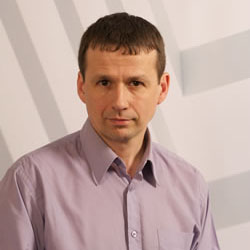
Adam Dyskoمشاهده پروفایل
دانشیار
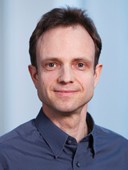
Adam Dysko is a Reader (equivalent to Associate Professor) in the Department of Electronic and Electrical Engineering at the University of Strathclyde, Faculty of Engineering. He has been with the university since 1994, progressing from PhD student to research fellow and then to academic staff. Since 2007, he has served as a lecturer and continues to be an active faculty member. Doctor of Philosophy (PhD), University of Strathclyde, 1998 Master of Science (MSc), Łódź University of Technology, 1990 His research focuses on power system protection, particularly unconventional fault detection methods, stability and control of future power systems with high renewable penetration, power system modelling and simulation (including real-time), and power quality. His expertise includes dynamic and transient simulation, protection system modelling, and performance assessment. The recent publications highlight a strong trend in developing and validating advanced protection schemes for modern power systems, especially those integrating distributed and renewable generation. Key themes include loss-of-mains protection using satellite communication, coordinated PSS design for stability enhancement, and addressing protection challenges in UK distribution networks. The work spans both theoretical development and practical hardware validation, often in collaboration with industry. The IET Best Paper Award 2025 (DPSP APAC 2025) Dr Dysko is actively involved in multiple research projects, often as a co-investigator, collaborating with principal investigators like Dr Qiteng Hong and Prof Campbell Booth. These projects, such as SETTLE-INSIGHT (NIA), Shell-iCase, and SIF BLADE, are funded by industry partners including SSE and Shell, focusing on protection system innovation. He has delivered short courses to industry and contributes to industrial working groups like the Grid Code Review Panel (GCRP), Distribution Code Review Panel (DCRP), and Energy Networks Association (ENA). He also participates in international organizations such as CIGRE, IET, and IEEE, serving on programme committees and as an invited speaker. He is actively engaged in research leadership through participation in international conferences, journal peer review, and advisory roles, such as in the CIGRE Joint Working Group B5-C4.79. His work bridges academia and industry, contributing directly to the evolution of grid codes and engineering standards for safe and reliable power system operation in a renewable-rich future.