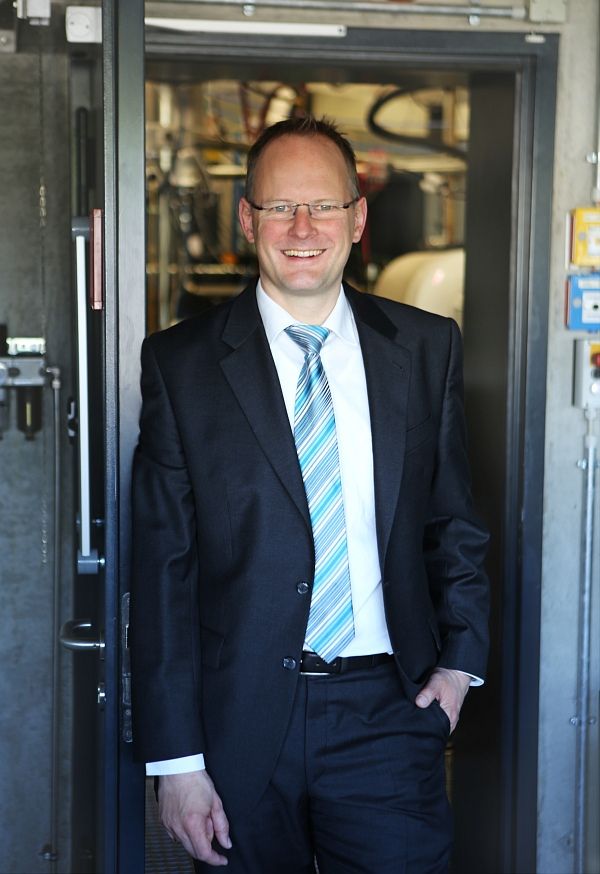
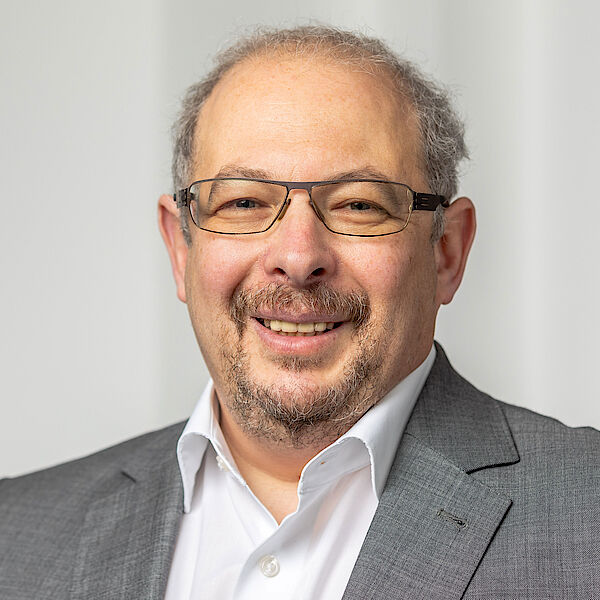
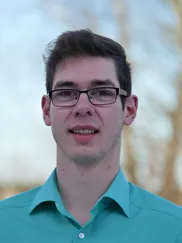
Thomas Koch is a Professor at the Karlsruhe Institute of Technology (KIT) and heads the Institute for Piston Engines (IFKM). His research focuses on improving the CO2 balance of combustion engines, eliminating emissions, and optimizing system efficiency through interdisciplinary approaches. He emphasizes collaboration between electric and combustion engine technologies, advocating for their complementary roles in sustainable mobility and energy supply. Koch’s work centers on non-fossil fuels (reFuels) such as hydrocarbons, hydrogen, and ammonia, aiming to achieve near emission-neutral combustion. His team employs optical measurement techniques, advanced simulations, and industrial partnerships to enhance engine energy conversion, exhaust aftertreatment, and residual heat utilization. He also contributes to scientific advisory boards and international conferences.
Leonid Goubergrits is a Professor of Cardiovascular Modeling and Simulation at the Einstein Center Digital Future and Charité – Universitätsmedizin Berlin . With a background in applied mathematics and physics from the Moscow Institute of Physics and Technology, he has dedicated his career to applying computational fluid dynamics (CFD) to cardiovascular medicine since immigrating to Germany in 1995. His work bridges fundamental research and clinical applications, aiming to integrate numerical models into everyday medical practice to enhance diagnostics and reduce invasiveness. Doctorate at Technische Universität Berlin (2000) Habilitation at Technische Universität Berlin (2016) His research spans blood flow modeling in coronary vessels, cerebral aneurysms, heart valves, and the aorta, alongside artificial organ development and blood damage modeling . He leads a research group at Charité and the German Heart Center Berlin, focusing on patient-specific simulations and their translation to clinical settings. Recent publications highlight his work on deep learning integration for hemodynamic analysis, 4D Flow MRI validation , and medical device optimization using computational models. His team’s research includes virtual therapy planning for aortic valve replacements, hemolysis modeling , and pulmonary artery pressure sensors . Leonid actively contributes to education, redesigning TU Berlin’s Fluid Mechanics in Medicine curriculum and fostering interdisciplinary collaboration between engineers, physicians, and computer scientists. His vision emphasizes the digital transformation of medicine through computational modeling and simulation.
Prof. Dr. Thomas Ludwig is the Director of the German Climate Computing Center (DKRZ) and a Professor at the Universität Hamburg. He holds a doctoral degree and habilitation from the Technische Universität München, with expertise in High-Performance Computing (HPC), energy efficiency, and data storage systems. His research focuses on optimizing parallel systems, storage technologies, and computational efficiency for climate science applications. He leads projects like AIMES and PeCoH, advancing HPC storage and energy-aware computing. Education: Doctoral degree and habilitation from TU München (1988–2001). Chair in Parallel Computing at Universität Heidelberg (2001–2009). Research Interests: HPC, data reduction techniques, energy-efficient systems, parallel I/O optimization, and climate modeling infrastructure. Recent Research Trends: His work emphasizes storage system efficiency, machine learning in HPC, and convergence between HPC and Big Data. Key contributions include frameworks for portability (Vecpar), automated performance tools, and energy-aware storage solutions. Awards: Some publications received recognition, e.g., a Best Paper award in 2014 for work on energy efficiency. However, no personal awards are explicitly listed. Advising & Grants: Supervised numerous theses in HPC, I/O optimization, and energy efficiency. Leads major projects funded by national and international initiatives. Labs/Teams: Heads the DKRZ team providing supercomputing and data management for climate research, collaborating with global institutions like the University of Hamburg and European research networks.
Daniel Kühbacher is a Tutor and researcher at the Chair of Environmental Sensing and Modeling at Technische Universität München (TUM). He specializes in developing high-resolution urban emission inventories for CO2, CH4, and co-emitted species, and leads the setup of a 100-sensor CO2 network in Munich to assess sector-specific emission factors. His work bridges environmental monitoring, sensor technology, and urban climate science. Teaching roles include tutoring the Environmental Sensing and Modeling lecture and advanced seminar, as well as the joint practical course Gemeinschaftspraktikum MST . Research focuses on integrating traffic simulation data, mobile measurement units, and flux footprint modeling to quantify urban greenhouse gas emissions. Education: M.Sc. in Environmental Engineering Affiliations: Member of the ICOS Cities project and contributor to the ICOS Science Network Publications emphasize urban GHG monitoring innovations, including sensor network optimization, flux measurement validation, and inventory intercomparison studies. His work supports policy-relevant insights into emission hotspots and mitigation strategies. Currently develops the SCOUT project for street-level carbon observatories and explores human respiration emissions using mobile network data.
Prof. Dr. rer. nat. Rainer Leupers is a faculty member at RWTH Aachen University, chairing the Department of Software for Systems on Silicon. His research focuses on embedded systems, hardware-software co-design, virtual prototyping, and security in computing-in-memory architectures. He has published extensively on RRAM accelerators, logic locking, and neuromorphic security. Chair of Software for Systems on Silicon Research in hardware security and deep learning accelerators Recent publications on cross-tool virtual frameworks and thermal side-channel attacks His work bridges system-level modeling with practical security implementations, emphasizing reliability and performance in heterogeneous computing environments. Key trends in his 2025-2023 articles include compute-in-memory optimization, neural network inference efficiency, and security vulnerabilities in emerging hardware. Awards and formal recognitions are not explicitly detailed in the provided materials. He has not directly mentioned advising students or research grants in the given text fragments. The chair's contact information includes an office at ICT Cube 1, Electrical Engineering, Aachen, with direct email and website links.
Prof. Miranda Schreurs holds the Chair of Climate and Environmental Policy at the Munich School of Public Policy (TUM), focusing on energy transition, climate governance in Europe/Asia/US, and nuclear waste policy. Previously, she directed the Environmental Policy Research Center (Berlin, 2007–2016) and taught at the University of Maryland. She advises German and EU climate policy, including roles on the Ethics Commission for Energy Supply (2011) and the National Advisory Committee for Nuclear Waste Governance. Her research spans comparative environmental politics, with expertise in federalist systems (e.g., US/EU energy policies), transnational environmental frameworks, and post-Fukushima nuclear governance. Key awards include the Sackler Fellowship (2016–2017) and Fulbright New Century Scholarship (2009–2010). Publications emphasize climate leadership dynamics, urban sustainability (e.g., Berlin’s climate neutrality goals), and geopolitical impacts on energy transitions. Her work bridges academic analysis with policy advising, particularly on multilevel governance challenges in climate action.
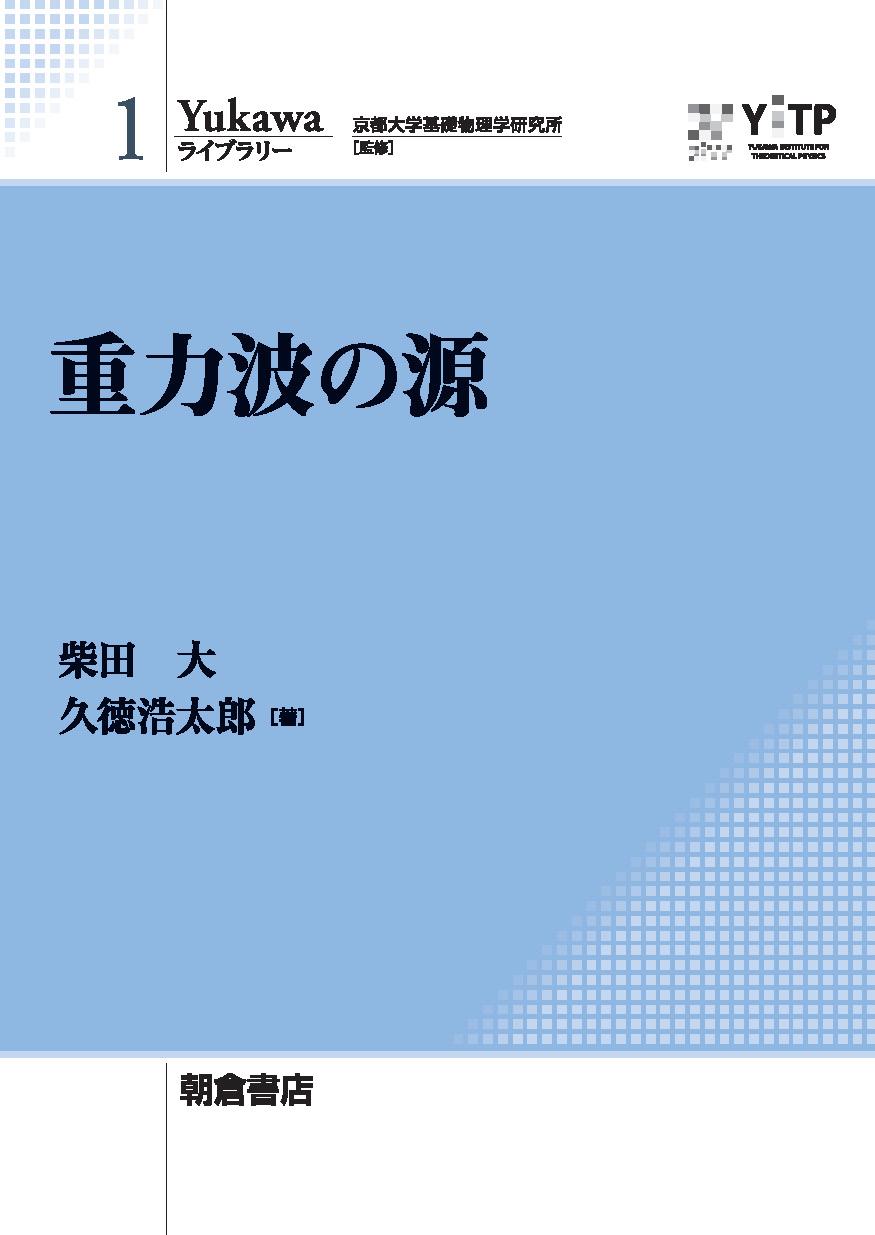
Prof. Masaru Shibata is a leading figure in computational relativistic astrophysics, currently serving as Director at the Max Planck Institute for Gravitational Physics (Albert Einstein Institute) since 2018 and Professor at Kyoto University's Yukawa Institute for Theoretical Physics since 2009. His career spans multiple prestigious institutions including University of Tokyo and Osaka University. PhD in Physics, Kyoto University (1994) Graduate studies in Physics, Kyoto University (1989-1993) Undergraduate in Science, Tokyo Institute of Technology (1985-1989) As a Professor with primary focus on Relativistic Astrophysics , Shibata's research investigates gravitational wave sources , neutron star mergers , black hole formation , and multimessenger astrophysics . His work combines general relativistic simulations , magnetohydrodynamic modeling , and neutrino radiation studies to understand high-energy cosmic phenomena. Recent publications (2024-2025) demonstrate expertise in supermassive star collapse , binary neutron star merger dynamics , and black hole-torus systems . These studies employ advanced numerical relativity techniques with applications to gravitational wave astronomy and gamma-ray burst modeling . 2025 Japan's Medal of Honor (Shiju-houshou) 2018 Nishina Memorial Prize 2013 International Society of General Relativity and Gravitation Fellow 2010 JSAP Excellent Young Researchers Prize 2008 Physical Society of Japan Outstanding Paper Award 2003 Nishinomiya-Yukawa Memorial Prize Shibata contributes to both theoretical frameworks and computational methodology in relativistic astrophysics, maintaining active collaborations with international research teams while leading computational projects at his dual institutions.
Prof. Dr.-Ing. Frank Thielecke is a full Professor and the head of the Institute of Aircraft Systems Engineering (Flugzeug-Systemtechnik) at Technische Universität Hamburg (TUHH), Germany. His research is centered on advanced aircraft systems, avionics, flight control, and the integration of emerging technologies such as hydrogen and hybrid-electric propulsion. Institution: Technische Universität Hamburg Department: Institute of Aircraft Systems Engineering (Flugzeug-Systemtechnik) Email: frank.thielecke@tuhh.de Office: Neßpriel 5, Room 1.012, 21129 Hamburg His research interests include integrated modular avionics (IMA), model-based systems engineering (MBSE), aircraft load estimation, health monitoring, fault diagnosis, and sustainable aviation technologies. He leads a research group actively contributing to next-generation aircraft design, with a strong focus on digitalization, virtual testing, and system safety. The recent publications highlight a consistent trend in developing model-based tools and architectures for avionics and aircraft systems. Key themes include the design of IMA platforms, virtual integration, system validation, hydrogen aircraft systems, and control algorithms for UAVs and flexible aircraft. His work frequently appears in AIAA, DASC, DLRK, and CEAS conferences and journals. Prof. Thielecke has been involved in numerous collaborative research projects focusing on more-electric aircraft, fuel cell systems, and advanced actuation. He has contributed to the development of frameworks such as ASHLEY and SArA for avionics platform design and systems architecting. His team also works on noise reduction in hydraulic systems and condition monitoring for aircraft subsystems. He supervises a group of researchers and PhD students, many of whom co-author his publications. While specific student names are not listed, long-term collaborators like Oliver Luderer, Thimo Bielsky, Nils Külper, and Philipp Chrysalidis are likely doctoral candidates or postdoctoral researchers in his group. He has secured funding for projects related to hydrogen aircraft, hybrid propulsion, and digital avionics engineering. His lab, the Institute of Aircraft Systems Engineering, operates test benches for avionics, hydraulic systems, and flight control validation. The team uses advanced simulation, co-simulation (e.g., FMI), and hardware-in-the-loop techniques for virtual integration and testing. Ongoing work includes the development of tools for early validation of flight control platforms and automated requirement-based testing.
Mikel Sanz is a Ramón y Cajal Researcher and Ikerbasque Fellow at the University of the Basque Country (UPV/EHU) in Bilbao, Spain. His research focuses on quantum computing, quantum algorithms, quantum technologies, and quantum metrology. His research interests include: Quantum Computing and Quantum Algorithms Quantum Metrology and Quantum Sensing Digital-Analog Quantum Computing Quantum Machine Learning Quantum Simulation Quantum Error Correction and Mitigation Dr. Sanz's recent publications demonstrate a strong focus on practical applications of quantum computing across various domains. His work spans quantum hardware design, quantum algorithm development, quantum machine learning applications, and quantum metrology techniques. He has made significant contributions to digital-analog quantum computing approaches, quantum kernel methods, and quantum-enhanced sensing technologies. His scientific awards include being selected as a Ramón y Cajal Researcher, a prestigious research position in Spain for experienced researchers, and an Ikerbasque Fellow, which is awarded by the Basque Foundation for Science to attract top researchers to the Basque Country. Dr. Sanz has collaborated extensively with researchers across multiple institutions, contributing to a wide range of quantum information science projects. His work often bridges theoretical quantum information concepts with practical implementations, particularly in superconducting quantum computing platforms. He is actively involved in advancing quantum technologies through his research group at UPV/EHU, focusing on developing novel quantum algorithms and exploring applications of quantum computing in various scientific and industrial domains.
Willem Leterme is a Professor of High Voltage Technology at RWTH Aachen University, specializing in advanced power systems engineering. His research focuses on high-voltage direct current (HVDC) grids, fault protection mechanisms, and grid integration challenges. His work addresses critical issues such as DC fault mitigation, converter control strategies, and system resilience under fault conditions. He leads projects on HVDC grid protection algorithms, cable aging analysis, and interoperability solutions for multi-vendor systems. Key research themes include: DC grid protection and fault detection Modular multilevel converter (MMC) control High-frequency insulation testing Renewable energy grid integration Recent studies (2023-2025) emphasize: Advanced DC fault response modeling Hybrid AC/DC grid stability Multi-terminal HVDC interoperability Transformer insulation under harmonic stresses Publications highlight contributions to protection system design, DC cable testing methodologies, and grid-forming wind turbine applications. He collaborates on EU-funded initiatives for HVDC infrastructure development and standardization efforts.
Prof. Inga Fischer is a Professor and Head of the Department of Experimental Physics and Functional Materials at BTU Cottbus-Senftenberg since August 2018. Previously, she held roles including private lecturer (2017), habilitation in semiconductor and nanoelectronics (2016), and senior research roles at the University of Stuttgart (2010–2018). Her research focuses on semiconductor materials, optoelectronic devices (e.g., Ge-based photodiodes, tunnel junctions), plasmonics, and nanoelectronics. She has led projects at Siemens (2008–2010) in mathematical engineering and industrial research management. Fischer earned her PhD from the University of Karlsruhe and Cologne, with postdoctoral work at Cologne’s Institute for Theoretical Physics. She oversees a team including Dr. Markus Ratzke, M.Sc. researchers, and collaborators like Dr. Fritz Berkmann. Her work integrates theoretical and experimental approaches, emphasizing functional materials and device engineering. Research Interests Germanium-based optoelectronics and plasmonics Advanced semiconductor materials (SiGeSn, nanohole arrays) Tunneling field-effect transistors and low-power devices Spin injection and magnetism in semiconductors Integrated optical sensors and transceivers Lab & Team Her team at BTU Cottbus-Senftenberg focuses on experimental physics and functional materials, with expertise in molecular beam epitaxy, device fabrication, and characterization. The group collaborates on projects involving nanoelectronics, optoelectronics, and silicon photonics.
Prof. Ingenuin Gasser is a Professor of Modelling and PDEs at the University of Hamburg's Department of Mathematics. He holds roles including UHH Coordinator for the Joint Master's Programme 'MathMods' and former Vice Dean for Internationalization and Young Researcher Support (2012-2022). His research focuses on mathematical modelling with PDEs, renewable energy systems, traffic flow dynamics, and semiconductor equations. He leads interdisciplinary projects on urban systems and energy technologies. Education & Career: Born 1965 in Brixen, Italy Diplom in Technical Physics (1989, TU Wien) Diplom in Technical Mathematics (1992, TU Wien) PhD in Mathematics (1996, TU Berlin) Habilitation in Mathematics (2000, UHH) Junior Professor (2002–2003, UHH) Full Professor (W3) since 2010 at UHH Research Interests: Modelling with PDEs, kinetic/fluid dynamics, renewable energy systems (solar updraft towers, osmosis power), traffic flow models, semiconductor equations, and interdisciplinary urban system modelling. Publications: Over 67 publications, recent works focus on PRO power stations, solar energy systems, and urban modelling. Key themes include energy efficiency optimization, nanofluid applications, and mathematical models for sustainable infrastructure. Grants & Projects: Participated in EU-funded networks (e.g., TMR), DFG projects on quantum transport, and international collaborations in applied mathematics and renewable energy.
Cristiano Porciani is Professor of Astrophysics at the University of Bonn's Argelander Institute for Astronomy, specializing in cosmological structure formation and galaxy evolution. He leads a research group working on numerical simulations of large-scale structure and theoretical cosmology. His research focuses on dark matter distribution, galaxy bias, and cosmological parameter estimation using perturbation theory and high-performance computing. Recent work examines relativistic effects in large-scale structure and intensity mapping techniques. Publications show strong emphasis on Euclid mission science, including instrument characterization, survey simulations, and cosmological tests. Article trends reveal consistent development of statistical methods for analyzing next-generation sky surveys. Supervises 9 graduate students working on cosmological simulations, galaxy clustering statistics, and radiative transfer modeling. Leads research projects within the Euclid Consortium and Transregional Collaborative Research Centre.
Dominik Huber is a Ph.D. candidate and researcher at the Technical University of Munich , affiliated with the Chair of Computer Architecture & Parallel Systems . His work focuses on Dynamic Resource Management in High-Performance Computing (HPC) , with expertise in Parallel & Distributed Programming Models and Hardware-aware programming . He has actively contributed to teaching courses like Parallel Programming Systems and Advanced Computer Architecture . His research emphasizes adaptive resource allocation in hybrid HPC clusters, leveraging technologies such as MPI Sessions , PMIx , and frameworks like LAIK and XBraid . Recent projects include the DynRes software suite for dynamic resource management and collaborations on quantum-HPC integration. Huber has advised students on topics ranging from Dynamic Resource Management in Charm++ to CI Systems for HPC Software , and his publications address challenges in malleability, scheduling, and power-constrained environments. Current affiliations include participation in the SEANERGYS (EuroHPC) and PlasmaPEPS projects.
Zhang Yang is an Associate Professor at the School of Medical Engineering, Harbin Institute of Technology (Shenzhen), with a joint appointment as Visiting Professor at the University of Tokyo starting in July 2024. He holds a PhD from the University of Cambridge's Department of Pathology and an M.Phil. from the University of Hong Kong's HKU-Pasteur Research Center. Previously, he served as an Assistant Professor at Harbin Institute of Technology (Shenzhen) from September 2015 to December 2020. His research integrates computational and experimental approaches to address challenges in pathogen and cancer research. On the computational side, his work focuses on developing AI-powered microscopic imaging systems, applying deep learning to analyze multi-omics data (including proteins, DNA, miRNAs, LncRNAs, and mRNAs), and utilizing deep learning in cheminformatics for drug discovery. On the experimental side, his laboratory combines imaging, high-throughput sequencing, mass spectrometry, and chemical biology to understand disease mechanisms at the molecular level. His publication record demonstrates significant impact, with over 50 SCI-indexed papers in high-impact journals including Nature Communications, Briefings in Bioinformatics, Bioinformatics, Analytical Chemistry, and Trends in Biotechnology. His work has been cited by prestigious journals such as Nature Reviews Methods Primers and Nature Communications, with three ESI highly cited papers. His research spans multiple interdisciplinary fields, combining artificial intelligence with biomedical applications to advance diagnostic and therapeutic approaches. World's Top 2% Scientists 2021 Fellow of the Royal Society of Biology Three ESI Highly Cited Papers Five authorized national invention patents As an academic leader, he serves as Associate Editor for BMC Biology and Frontiers in Microbiology, Academic Editor for PLOS Genetics, Editorial Board Member for Communications Biology, and Guest Editor for a Special Issue on AI in analytical chemistry in Trends in Analytical Chemistry. His laboratory actively collaborates with international institutions, with graduates pursuing further studies at Hong Kong Chinese University, Hong Kong University of Science and Technology, Hong Kong Polytechnic University, Macau University, and the University of New South Wales. He teaches Introduction to Modern Biology for undergraduates and Bioanalytical Chemistry for graduate students.