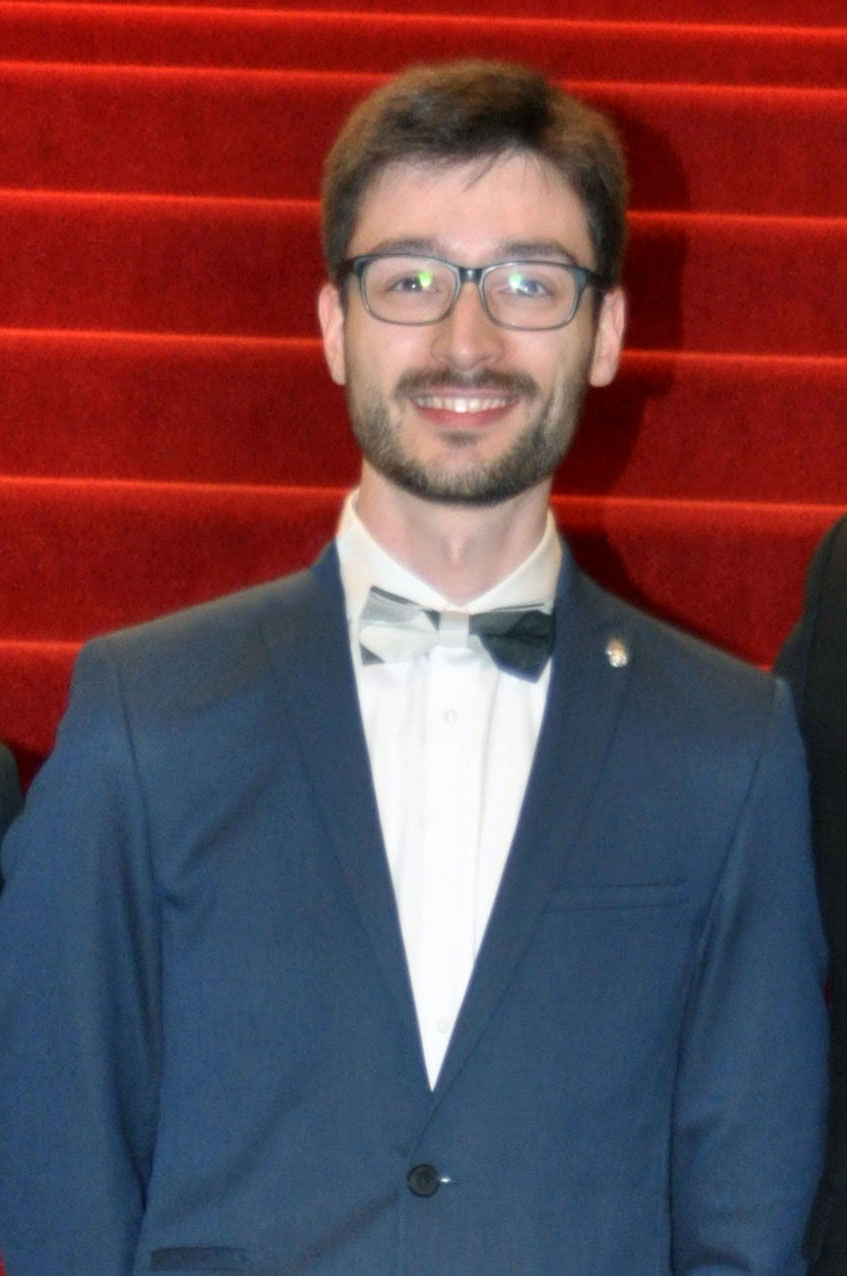
François Pirot is an Associate Professor (Maître de Conférences) at Université Paris-Saclay since September 1, 2021. He conducts research at the LISN laboratory within the GALaC team and teaches at the Faculty of Science of Orsay. PhD in Mathematics (Radboud University) and Computer Sciences (Université de Lorraine), 2019 Postdoctoral experience: ULB (2019), G-SCOP (2019-2020), Inria Sophia Antipolis (2020-2021) His research focuses on graph coloring problems in diverse contexts such as graph powers, locally sparse graphs, and distributed algorithms, utilizing probabilistic methods and connections to bio-informatics through circular codes. He has advanced bounds for h -conflict-free coloring, acyclic coloring, and dichromatic numbers in oriented graphs, with applications to minor-closed families and geometric group theory. Scientific contributions include: Asymptotically tight bounds for chromatic numbers in sparse graphs Efficient fractional coloring algorithms for K_t-minor-free graphs Structural analysis of comma-free and mixed circular codes in genetic alphabets Charles Delorme Prize for outstanding thesis in Graph Theory (2019) Collaborations span institutions like ULB, G-SCOP, Inria, and cross-disciplinary fields from computer science to mathematical biology.
Slava Rychkov is a Permanent Professor at the Institut des Hautes Études Scientifiques (IHES) since 2017, with a part-time affiliation at École Normale Supérieure (ENS) in Paris. He is Deputy Director of the Simons Collaboration on Nonperturbative Bootstrapping and holds the Jacques Solvay International Chair in Physics (2025) . Ph.D., Princeton University (2002) Junior Member, University Institute of France (2012-2017) Research Interests: He works on strongly coupled quantum and conformal field theories , including applications to high-energy physics, statistical physics, and condensed matter. His major contributions include: Linking Deligne categories to lattice loop symmetries Developing analytic continuation methods for Euclidean CFT to Lorentzian spacetime Advancing the conformal bootstrap for non-perturbative solutions Exploring Parisi-Sourlas supersymmetry in disordered systems Proving lightcone bootstrap predictions rigorously Connecting complex CFTs to walking RG flows Scientific Awards: New Horizons in Physics Prize (2014) Grand Prix Mergier-Bourdeix (2019) Jacques Solvay International Chair in Physics (2025) Advising: Mentored numerous Ph.D. students including Jiaxin Qiao (EPFL postdoc), Bernardo Zan (now at Università di Genova), and Benoit Sirois (Québec classe préparatoire). Articles Trends: His recent work spans gauge theory bootstrap , logarithmic CFTs , minimal surfaces in AdS , and geometrical approaches to Potts models , with a focus on mathematical rigor and cross-disciplinary applications between high-energy and condensed matter physics.
Professor Warren Potts is a full-time faculty member at Rhodes University's Department of Ichthyology and Fisheries Science. He serves as a researcher, lecturer, supervisor, and course coordinator while leading the Southern African Fisheries Ecology Research Lab. His work bridges freshwater and marine ecosystems across Africa, with a focus on climate change impacts and recreational fisheries sustainability. Education: BSc (Hons), MSc, PhD from Rhodes University Research Interests: Environmental drivers of fish production in African freshwaters Climate change effects on coastal fish distribution and reproduction Marine citizen science initiatives Recreational fisheries' economic and ecological impacts Ecophysiology and movement ecology of coastal fishes Sclerochronology for fish growth analysis Publication Trends: Recent work focuses on climate change impacts, recreational fisheries innovations, and physiological responses of marine species to environmental stressors, with interdisciplinary collaborations spanning marine heatwaves, drone fishing, and socio-economic analyses. Future Directions: Continued emphasis on climate change research, marine citizen science, and optimizing recreational fishery sustainability in developing economies.
Dr. Viresh Patel is a Lecturer in Optimisation at the School of Mathematical Sciences, Queen Mary University of London. His research focuses on extremal and probabilistic combinatorics, graph polynomials, phase transitions, and approximation algorithms. University: Queen Mary University of London School: School of Mathematical Sciences Email: viresh.patel@qmul.ac.uk Research Interests: Patel’s work bridges combinatorics, graph theory, and statistical physics. Key areas include Hamiltonian cycles in dense graphs, algorithmic approaches to graph polynomials, and complexity analysis of physical models. Publication Trends: Recent articles address structural graph theory (cycle/path decomposition), computational complexity (Potts/Ising models), and approximation algorithms using probabilistic and Taylor series methods. Collaborations: Regular co-authorship with researchers like Guus Regts, Allan Lo, and Matthew Jenssen indicates strong interdisciplinary engagement.
Meik Hellmund is a theoretical physicist and Research Fellow at the Numerical Mathematics group in the School of Mathematics at University of Leipzig. He also serves as the administrator of the institute's computer network. His research spans multiple areas in theoretical physics, including Quantum Physics (quant-ph) Statistical Mechanics (cond-mat.stat-mech) High Energy Physics - Theory (hep-th) Mesoscale and Nanoscale Physics (cond-mat.mes-hall) High Energy Physics - Phenomenology (hep-ph) His publications focus on quantum entanglement, high-temperature series expansions for lattice models, and topological defects in field theories. Key trends include entanglement quantification, critical phenomena in spin systems, and effective mass analysis in quantum Hall systems. Meik Hellmund has no recorded scientific awards in the provided texts, but his work is supported by the Simons Foundation.
Antonio Blanca Pimentel is an Associate Professor in Computer Science and Engineering. His research focuses on theoretical aspects of computer science, probability theory, and statistical physics, particularly in the development and analysis of algorithms. His work explores Markov Chain Monte Carlo (MCMC) algorithms , Spin Systems , and Cluster Dynamics , with a strong emphasis on computational complexity and mathematical modeling. Recent publications highlight his contributions to Potts models , random-cluster dynamics , high-dimensional identity testing , and sampling algorithms for subgraphs and polymer systems . These papers demonstrate his expertise in bridging theoretical computer science with statistical physics. Dr. Pimentel secured an NSF grant (2019–2021) for research on MCMC algorithms for spin systems, reflecting his leadership in advancing algorithmic theory.
Richard Potts serves as Curator of Biological Anthropology and holds the Peter Buck Chair of Human Origins at the Smithsonian Institution's National Museum of Natural History. As founder and director of the Human Origins Program, he leads ongoing archaeological excavations in partnership with the National Museums of Kenya, focusing on the Rift Valley of southern Kenya and the Homa Peninsula. His interdisciplinary research bridges anthropology, earth sciences, and paleontology to investigate the relationship between environmental dynamics and human evolutionary adaptations. Dr. Potts received his B.A. from Temple University and earned his Ph.D. in biological anthropology from Harvard University in 1982. After teaching at Yale University, he joined the Smithsonian in 1985, where he has maintained a distinguished career spanning nearly four decades. He also serves as curator of the Smithsonian's Hall of Human Origins, which presents the story of human evolution to the public. Potts' research centers on the environmental variability hypothesis, which proposes that fluctuating environmental conditions were a key selective pressure driving human evolution. His work examines how ecological instability shaped hominin adaptations including tool use, dietary flexibility, and social behaviors. Through extensive fieldwork in East Africa, particularly in Kenya's Rift Valley, he has documented how shifting landscapes and climate patterns influenced early human development and dispersal patterns. His approach integrates geological, paleontological, and archaeological evidence to reconstruct ancient environments and their relationship to hominin evolution. Analysis of Potts' recent publications reveals a consistent focus on environmental dynamics and human evolution, with particular attention to Oldowan tool technology, hominin behavioral adaptations, and Pleistocene environmental reconstruction. His work increasingly incorporates interdisciplinary approaches, combining archaeological evidence with geological, paleontological, and climate data to build comprehensive models of human evolutionary processes. The geographic focus remains primarily on East Africa, with significant contributions to understanding the paleoenvironmental context of key hominin sites in Kenya. As director of the Human Origins Program, Potts has mentored numerous researchers and students, fostering collaborative international research projects that have advanced our understanding of human evolution. His work has been supported by multiple research grants that have enabled extensive fieldwork and laboratory analysis, contributing significantly to the development of paleoanthropological methodologies and theoretical frameworks. Potts leads active research teams conducting fieldwork in Kenya's Rift Valley, where they investigate Pleistocene archaeological sites and reconstruct ancient environments. His program collaborates with Kenyan institutions and researchers, maintaining long-term partnerships that support capacity building and knowledge exchange. The Human Origins Program also develops educational resources and public exhibits that translate complex scientific findings about human evolution for broader audiences.
Vishal Agarwal is an Associate Professor in the Department of Chemical Engineering at Indian Institute of Technology Kanpur (IIT Kanpur). His research focuses on developing molecular-level understanding of complex systems in catalysis, biomass conversion, and nucleation processes. Dr. Agarwal received his PhD from the University of Massachusetts Amherst in 2012, followed by postdoctoral research at the University of California Santa Barbara from 2012-2016. He also holds an M.Tech from IIT Bombay (2006) and a B.Tech from Panjab University (2003). His research interests span Catalysis, Biofuels, Nucleation, Gas-Surface and Liquid-Surface Interactions, Molecular Simulation, Ab initio Molecular Dynamics, Density Functional Theory, Rare-Event Simulations, and Reaction Rate Theory. Dr. Agarwal's work primarily employs computational methods to investigate atomic-level processes that govern molecular transformations in various chemical systems. Analysis of his publication record shows a strong focus on computational chemistry applied to catalysis and materials science, particularly in the areas of zeolite chemistry, cellulose pyrolysis, and oxygen vacancy formation in metal oxides. His work bridges theoretical computational methods with practical applications in energy and materials. Research on cellulose decomposition highlighted in BioBased Digest and North American Clean Energy RG Madhudhane M. Tech. Best Masters Research Thesis Award, IITB, 2006 1st Prize in Technical Paper Presentation, Eureka-2002, PU, 2002 Dr. Agarwal has mentored several graduate students and has been involved in significant research projects related to computational chemistry and materials design. His laboratory at IIT Kanpur focuses on developing and applying advanced computational methods to understand complex chemical processes at the molecular level. The research group maintains active collaborations with institutions worldwide and has made notable contributions to the understanding of catalytic processes, biomass conversion mechanisms, and nucleation phenomena.
Antonio Moro is an Associate Professor of Mathematics at Northumbria University's School of Engineering Physics and Mathematics. He co-founded the Mathematics of Complex and Nonlinear Phenomena (MCNP) group and previously held research roles at the University of Salento, University of Loughborough, SISSA Trieste, and University of Milano-Bicocca. PhD in Physics (University of Salento, 2004) Former Senior Lecturer at Northumbria (2013–present) His research focuses on nonlinear partial differential equations, integrable systems, and critical phenomena in statistical mechanics. He develops unified approaches to complex systems across nonlinear mathematics , integrable systems , dispersive hydrodynamics , and random matrix theory . Recent articles explore biaxial nematic systems, KP equation reductions, and phase transitions in mean-field models. Scientific contributions include Fellow of the Higher Education Academy Member of the London Mathematical Society Fellow of the Institute of Mathematics and its Applications Organizer, Isaac Newton Institute thematic programs (2022) As Head of Mathematics and Statistics (2019–2022), he restructured undergraduate programs and introduced Northumbria's first Mathematics MSc. He teaches with a research-led approach connecting classical problems to contemporary research.
Jesper Lykke Jacobsen is a Professor of Theoretical Physics at the Laboratoire de Physique Théorique at École Normale Supérieure in Paris, with additional affiliation at Université Pierre et Marie Curie (now part of Sorbonne University). He is also a member of the prestigious Institut Universitaire de France, which recognizes outstanding researchers in France. His research focuses on statistical physics, particularly disordered systems, conformal field theory, and exactly solvable models. His work spans critical phenomena, phase transitions, loop models, and the Potts model, with significant contributions to our understanding of two-dimensional systems. He has made important advances in understanding the critical behavior of the Potts model with random couplings and the statistical properties of compact polymers. Analysis of his recent publications reveals a strong focus on critical loop models, conformal field theory applications, and exactly solvable systems. His work often bridges mathematical physics with condensed matter theory, exploring the deep connections between symmetry groups, critical exponents, and universal behavior in statistical systems. Many of his papers involve collaborations with leading researchers in the field, demonstrating his central role in the theoretical physics community. Institut Universitaire de France membership (prestigious research distinction) Professor Jacobsen has advised numerous PhD students, including Romain (thesis defense 2013) and Etienne (thesis defense 2019), as evidenced by group photos from their dissertation defenses. He has organized and participated in significant research conferences and workshops, such as those at Les Houches on exact methods in low-dimensional statistical physics and conformal field theory applications. His research has been supported by various academic institutions and likely research grants, though specific grant details aren't provided in the source material. He leads or participates in research teams focused on statistical physics, as shown by his regular seminars and the group photos featuring multiple researchers working in related areas. His informal statistical physics seminar series provides a venue for ongoing research discussion and collaboration.