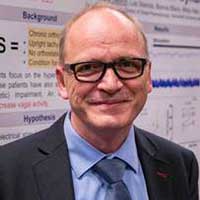
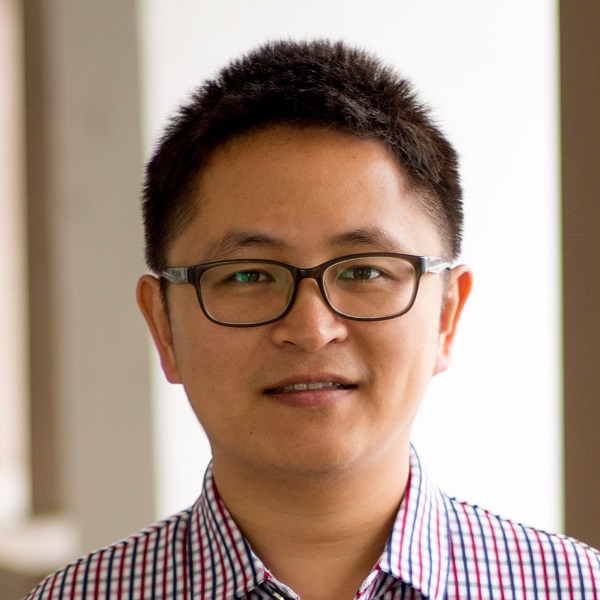
André Diedrich is Research Professor of Medicine and Biochemical Engineering at Vanderbilt University Medical Center and a Paul Dudley White International Scholar. His research focuses on autonomic nervous system function, cardiovascular control, and blood pressure regulation, with clinical applications in dysautonomia. Education: PhD, Charité Hospital, Humboltd University (1991) MD, 2nd Medical Institute Moscow (1985) BA, Math/Physics, Martin Luther University (1979) Awards: Paul Dudley White International Scholar (AHA, 2018)
Dr. Gordon Chalmers is a Professor of Kinesiology at Western Washington University (WWU), where he has taught since 1996. He holds a Ph.D. in Kinesiology from the University of California, Los Angeles (UCLA), specializing in neuromuscular function and adaptation. Before joining WWU, he held positions including Post-Doctoral Fellowships at Simon Fraser University and the University of California, San Diego, and served as a Lab Instructor at UCLA. His research focuses on neuromuscular physiology, biomechanics, and motor control, with particular emphasis on gait analysis, proprioception, and neuromuscular adaptation in aging populations. He has published extensively in journals like Journal of Biomechanics , Sports Biomechanics , and Human Movement Science . Dr. Chalmers has authored book chapters on neurotrophic cell grafting and contributed to presentations at international conferences such as the International Society of Biomechanics. His work bridges clinical applications, such as Kinesio tape efficacy and elderly mobility, with fundamental research in muscle physiology and reflex modulation. His advising and grants section highlights roles in collaborative studies on creatine supplementation and exercise interventions for maternal health. While no formal awards are listed, his sustained academic contributions since the 1990s underscore his scholarly impact.
Dr. Jonathan Robinson is a Senior Lecturer in Research Methods at Teesside University's School of Health and Life Sciences, affiliated with the Centre for Rehabilitation. He holds a PhD in Rehabilitation from Teesside University (2015), following an MSc in Physiotherapy (2009) and BSc in Sports Therapy (2006). His research focuses on exergaming technology for rehabilitation, particularly in multiple sclerosis (MS), balance training, and virtual rehabilitation. He teaches research methods across clinical programs and leads modules on systematic reviews. Robinson has been Postgraduate Tutor since 2018, supporting PhD students and serving on the Postgraduate Research Assessment Board. Education: Bachelor of Science (BSc), Sports Therapy, Teesside University (2006) Master of Science (MSc), Physiotherapy, Teesside University (2009) Doctor of Philosophy (PhD), Rehabilitation, Teesside University (2015) Research Interests: Exergaming and virtual rehabilitation for MS patients Balance and gait training interventions Systematic review methodology Clinician burnout and sleep patterns Recent Research Themes: His work spans VR-based exercise trials, infection control for preterm infants, and food insecurity in mental health populations. Collaborative projects include the NIHR Research Design Service and interdisciplinary studies on neonatal care. Awards: 2023 Outstanding Teaching Award (Teesside University). Advisory Roles: Advisor for NIHR Research Design Service (NENC), Postgraduate Research Assessment Board member, and reviewer for Gait & Posture and Frontiers in Aging Neuroscience . Labs/Teams: Involved in the Research Centre for Rehabilitation and SHLS Research & Innovation Sub-Committee.
Kevin Shockley is Professor of Psychology at the University of Cincinnati, focusing on haptic perception, interpersonal coordination, affordance perception, and nonlinear time series analysis. He teaches courses including Research Methods in Perception & Action and Computational Approaches to Perception at undergraduate and graduate levels. His research program investigates coordination dynamics across multiple domains including interpersonal postural coordination, dual-task performance, and the perception of action capabilities. Recent work examines intermittent control mechanisms in grip dynamics and fractal patterns in exploratory movements. NSF Grant: Multi-modal Heaviness Perception ($202,747) NSF Grant: Collaborative Research: Dynamics of Interpersonal Coordination ($418,808) DoD Grant: Objective Markers of Postural Stability ($115,214) His lab employs motion capture and nonlinear analysis to study complex motor behaviors in ecological contexts, with applications to clinical populations and athletic performance.
Val Andrade is an Assistant Professor in the Department of Psychology at the University of Cincinnati. She holds a Ph.D. in Experimental Psychology from the University of Cincinnati (2024), an M.Sc. in Rehabilitation Science from Universidade Federal de Minas Gerais (2019), and a Physical Therapy degree from the same institution (2017). Her research examines motor control, rehabilitation, and disability through ecological psychology frameworks. Andrade has received numerous awards including the Wearable Robotics Innovation Challenge finalist designation (2022) and University of Cincinnati's Outstanding International Student Award (2022). She teaches courses including Introduction to Psychology, Research Methods, and Sensation & Perception. Her publications focus on motor coordination across diverse populations, with recent work exploring postural dynamics, force production, and disability models. Research employs biomechanical analysis and ecological approaches to understand movement challenges.
Julie Weast is an Associate Professor in the Department of Psychology at the University of Cincinnati. She holds a PhD in Psychology from the same institution (2013). Her research focuses on perception, affordance perception, and kinematic information analysis, particularly in contexts involving athletic expertise and interpersonal perception. Though not currently active in research, her work has explored how movement patterns and physical capabilities are perceived in others. She has authored/co-authored peer-reviewed publications in journals like Quarterly Journal of Experimental Psychology and Psychonomic Bulletin and Review, and co-edited conference proceedings such as Studies in Perception and Action XIII . She has held progressive academic roles since 2013, including Visiting Assistant Professor (2013-2015) and Assistant Professor (2015-2020). Her academic affiliations include the Center for Cognition, Action and Perception and the Perceptual Motor Dynamics Laboratory. Her professional contributions span experimental psychology, motor control, and perceptual-motor systems integration.
Jason Longhurst, Ph.D., PT, DPT, NCS, is an Assistant Professor in the Department of Physical Therapy and Athletic Training at the Doisy College of Health Sciences, Saint Louis University. His work focuses on neurodegenerative diseases, particularly Parkinson’s disease, and the interplay between gait/postural control and cognition. He leads the Neuroimaging and Behavior Lab, which employs neuroimaging techniques like functional near-infrared spectroscopy (fNIRS) and biomechanical measurements to study disease progression and patient outcomes. Education: Doctor of Philosophy in Interdisciplinary Health Sciences (Rehabilitation Sciences), University of Nevada, Las Vegas Doctor of Physical Therapy, University of Nevada, Las Vegas Bachelor of Science in Exercise Science, Brigham Young University Research Interests: Dr. Longhurst investigates fear of falling avoidance behavior, community engagement in neurodegenerative patients, and early disease identification. His lab examines cortical activation during movement, dual-task performance, and the impact of cognitive decline on motor function. Recent studies address freezing of gait, amyotrophic lateral sclerosis (ALS), and the use of telerehabilitation in Parkinson’s care. Labs/Teams: Neuroimaging and Behavior Lab (specializing in gait analysis, cognitive-motor interactions, and neuroimaging techniques). Advising/Grants: While no specific grants or advisees are listed, his research emphasizes translational applications in physical therapy and clinical rehabilitation for neurodegenerative disorders.
Andrew Novak is a Professor at George Mason University's Department of Criminology, Law and Society. He holds a Ph.D. from Middlesex University, J.D. from Boston University, and advanced degrees in African Politics and International Affairs. Specializing in international and comparative law, his research focuses on death penalty abolition in Africa, executive clemency, and human rights litigation. He has published extensively on topics including transnational human rights advocacy, constitutional jurisprudence in Sub-Saharan Africa, and colonial legal systems. Current projects include a comparative study of tribal court convictions in the U.S. and a book on HIV criminalization. He teaches courses like International Crimes & Accountability, Human Rights and Justice, and Capital Punishment. His legal licenses in NY and DC complement his academic work. Notable publications include *The Death Penalty in Africa* (2014) and *Comparative Executive Clemency* (2015). He collaborates with global institutions on justice reform initiatives. Research interests span LBGTQ+ rights litigation, constitutional law in post-colonial states, and sport history in colonial Zimbabwe. He advises students on topics intersecting law, criminology, and human rights. Recent work explores transnational litigation strategies and the role of legal advocacy in death penalty abolition.
Dr. Jeffrey Fernandez is an Adjunct Professor at George Mason University and Managing Principal at JFAssociates, Inc. He holds a PhD and MS in Industrial Engineering from Texas Tech University and a BE in Mechanical Engineering from NED University. His expertise spans occupational ergonomics, industrial engineering, and human factors. He served as a professor at Wichita State University and held roles at Exponent, Inc. and the National Institute for Occupational Safety and Health (NIOSH). Dr. Fernandez specializes in ergonomic evaluations, workplace safety, and industrial systems design. He has authored/co-authored over 190 articles, co-authored textbooks like Applied Occupational Ergonomics , and served on editorial boards for journals such as the International Journal of Industrial Ergonomics . He is a Fellow of the Institute of Ergonomics & Human Factors and a member of multiple professional societies. Dr. Fernandez’s research focuses on ergonomics in manufacturing, healthcare, and retail sectors. His work includes developing ergonomic guidelines, assessing musculoskeletal risks, and improving workplace design. He has conducted studies on vibration exposure, repetitive strain injuries, and age-related ergonomic challenges. His recent articles emphasize psychophysical methods in ergonomics, workplace injury prevention, and data management frameworks in office environments. He has received the distinction of Fellow from the Institute of Ergonomics & Human Factors. His consulting experience spans sectors like aerospace, healthcare, and defense, addressing ergonomic compliance, safety training, and litigation support. Currently, he contributes to the Board of Certification in Professional Ergonomics (BCPE) and advises on certification standards.
Dr. Craig Tokuno is a Professor in the Department of Kinesiology at Brock University. His research program focuses on the neurophysiological and biomechanical control of human movement, particularly how the central nervous system manages postural and locomotor tasks. His investigations examine how aging and neuromuscular deficits affect movement mechanisms. Through experimental studies, he analyzes how physiological systems adapt to maintain balance and mobility under various conditions. Professor Tokuno teaches courses in biomechanics and motor control. His work contributes to understanding movement disorders and developing interventions for mobility challenges across the lifespan.
Michael Bogart is an Adjunct Professor at George Mason University (GMU) and the University of Maryland, Global Campus (UMGC), specializing in Intelligence Theory, Threat Assessment, and Protective Intelligence. With over 17 years of experience in national security, cyber intelligence, and corporate security, he has held roles at major financial institutions and cybersecurity firms. He teaches courses in intelligence analysis, criminal justice, and digital forensics. Education: MS in Administration of Justice and Applied Intelligence from Mercyhurst University; BA in Philosophy/Pre-Law with a psychology concentration from St. Bonaventure University. Research focuses on intelligence methodologies, analytical techniques, and applications in threat management. His work bridges academic contributions with industry expertise, particularly in cybersecurity and protective intelligence strategies. Recent research includes advancements in nanotechnology for biomedical applications and mRNA vaccine delivery systems. Advising and grants: While no formal advisees are listed, his work on drug discovery at GMU and collaborations in mRNA vaccine development reflect active research engagement. He co-developed BST-CarGel technologies for cartilage repair. Labs/Teams: Collaborates with biomedical engineering teams on tissue repair solutions and nanomedicine projects at GMU.
Dr. Christopher Ramezan is an Assistant Professor of Cybersecurity at West Virginia University's John Chambers College of Business and Economics, where he teaches courses on Network Security, Information Security Assurance, and Cybercrime Management. He serves as Executive Director of the Cyber-Resilience Resource Center and coordinates the Business Cybersecurity Management programs. His research spans cybersecurity workforce development, machine learning applications in remote sensing, and information security governance. Dr. Ramezan holds a Ph.D. in Remote Sensing from West Virginia University and maintains multiple industry certifications including CISSP and CASP+. His interdisciplinary work bridges geospatial analysis and cybersecurity, with recent publications focusing on closing cyber skills gaps and leadership qualifications in security roles. His research integrates technical and managerial perspectives in cybersecurity, examining workforce development challenges and machine learning applications for geospatial data analysis. Earlier work pioneered methods for land cover classification using satellite imagery and deep learning. Dr. Ramezan's publications show a distinct progression from remote sensing applications (2013-2022) to contemporary cybersecurity workforce studies (2023-2025). This evolution reflects his transition from geospatial machine learning to security leadership research. As Executive Director of the Cyber-Resilience Resource Center, he leads initiatives to enhance organizational security postures and develops cybersecurity curricula. His professional background includes eight years as Information Security Officer for WVU's largest college.
Dr. Iván González is a Senior Lecturer at the University of Castilla-La Mancha (UCLM), affiliated with the Faculty of Social Sciences and Information Technologies. He holds a M.Sc. and Ph.D. in Advanced Computer Technologies from UCLM. As a member of the MAmI Research Group, his work focuses on Assistive Technologies, Smart Health, and IoT-based solutions for healthcare monitoring. He has authored 16 JCR articles and supervised 2 PhD theses with 4 ongoing. Education: M.Sc. in Advanced Computer Technologies, UCLM Ph.D. in Advanced Computer Technologies, UCLM His research interests emphasize Quantitative Gait Analysis, Frailty assessment, and Mild Cognitive Impairment screening using wearable sensors and mobile technologies. Recent projects include the EU-funded TAICare initiative (2021-2023) and Just Move! (2022), focusing on movement analysis and cognitive health monitoring. Key Contributions: - Developed a 3D motion capture system for gait automation - Created emotion recognition algorithms using gait patterns - Designed energy-efficient wearable data storage systems - Pioneered conversational agents for IADL monitoring Academic Service: 2nd Academic Year Coordinator (2020, 2024–present) Computer Engineering Degree Coordinator (2020–2024) Lab Affiliation: MAmI Research Group (specializing in Ambient Intelligence and IoT solutions).
Changqi Liu is Professor at San Diego State University's School of Exercise and Nutritional Sciences, College of Health and Human Services. He earned his Ph.D. in Nutrition and Food Sciences from Florida State University (2016), M.S. in Animal and Food Sciences from University of Kentucky (2011), and B.E. in Food Quality and Safety from Sichuan Agricultural University (2008). His research spans food allergen detection, protein functionality, sustainable food systems including edible insects, and nutritional biochemistry. Research integrates food chemistry with immunology, focusing on allergen characterization and mitigation strategies. Recent publications demonstrate innovation in alternative protein sources and sustainable food technologies. Honors include International Union of Food Science Oral Presentation Award (2018), IFT Graduate Student Paper Competition awards, and Phi Tau Sigma induction. Teaching includes Advanced Food Science, Experimental Food Technology, and co-instruction of cross-disciplinary courses in sustainable agriculture. Administrative roles include founding member of the Center for Better Food Futures and graduate program coordination. Grant funding secured from university programs and foundations including NATA Research and Education Foundation.
Jaeho Jang is an Assistant Professor in the Department of Kinesiology at the University of Texas at El Paso (UTEP), affiliated with the College of Health Sciences. His research focuses on biomechanics, particularly musculoskeletal modeling and simulation techniques to address chronic ankle instability (CAI). He investigates vibration-based interventions, ankle joint loading mechanics, and sensory integration strategies to improve mobility and reduce healthcare costs associated with CAI. Expertise: Biomechanical modeling, musculoskeletal injuries, posttraumatic osteoarthritis Key techniques: Motion capture, computational simulations, MRI analysis Dr. Jang's work bridges clinical practice and research, emphasizing patient-centered care and evidence-based rehabilitation. His publications (2019–2025) explore gait biomechanics, sensorimotor adaptation, and predictive modeling of joint loading in CAI patients. His research has implications for developing targeted interventions and reducing the burden of chronic musculoskeletal disorders. His research trends highlight a focus on: enhancing sensorimotor feedback mechanisms, evaluating novel therapeutic techniques like plantar massage, and applying advanced imaging (T1ρ MRI) to assess functional outcomes. Articles from 2023–2025 emphasize computational modeling and real-time interventions to mitigate ankle loading.