Nelly Pante is a Professor in the Department of Zoology at the University of British Columbia, Faculty of Science. Her research focuses on nucleocytoplasmic transport, particularly the nuclear import of viral genomes and the molecular characterization of nuclear pore complexes (NPCs). Education: Ph.D. from Brandeis University; M.Sc. from The Venezuelan Institute for Scientific Research (IVIC); B.Sc. (Hons.) from Simon Bolivar University Research highlights include: Investigating bidirectional macromolecular transport through NPCs using cellular and molecular techniques, fluorescence, and electron microscopy Studying viral nuclear import of Influenza A, Hepatitis B, baculoviruses, and parvoviruses to develop antiviral strategies Developing the Xenopus oocyte model system for high-resolution nuclear transport studies Structural analysis of nucleoporins like Nup153 and Nup358/RanBP2 in NPC architecture Her lab employs advanced imaging methods and has contributed to understanding how viruses exploit nuclear transport mechanisms and how NPCs maintain cellular function in health and disease. Contact: pante@zoology.ubc.ca
Jean-Philippe Gratton is a Full Professor and Director of the Department of Pharmacology and Physiology at the Université de Montréal's Faculty of Medicine. He heads the Endothelial Cell Biology Unit at the Montreal Clinical Research Institute (IRCM), a position he has held since 2002. His dual appointments reflect his significant contributions to both academic medicine and clinical research in vascular biology. Dr. Gratton earned his Bachelor's degree in Biochemistry (1992), followed by a Master's (1995) and Doctorate (1998) in Pharmacology, all from the University of Sherbrooke. He completed his post-doctoral training at Yale University School of Medicine in 2002, establishing the foundation for his career in vascular biology research. His research focuses on endothelial cell biology, particularly the cellular mechanisms controlling endothelial cell proliferation, survival, and differentiation. Using molecular and cellular biology techniques combined with modern pharmacology, Dr. Gratton investigates intracellular signaling of endothelial growth factors, especially VEGF receptor dynamics and their influence on nitric oxide release. His work spans cardiovascular diseases and tumor angiogenesis, with particular interest in plasma membrane lipid microdomains, eNOS regulation, and endothelial dysfunction. His laboratory's findings have significant implications for understanding both vascular health and cancer progression. Analysis of his recent publications reveals a consistent research trajectory centered on endothelial cell signaling mechanisms, with increasing focus on the intersection between vascular biology and cancer immunology. His work demonstrates how endothelial signaling pathways influence tumor microenvironments and can be targeted to improve cancer therapies, particularly through modulation of AXL receptor signaling and angiogenic processes. Université de Montréal Research Chair in Endothelial Cell Signaling and Angiogenesis (2013-present) Merck Canada Chair in Pharmacology at the University of Montreal Dr. Gratton leads a productive research program with consistent funding and numerous collaborations across institutions. His laboratory serves as a training ground for the next generation of vascular biologists and pharmacologists, contributing significantly to understanding endothelial cell function in health and disease. The Endothelial Cell Biology Unit at IRCM maintains state-of-the-art facilities for molecular and cellular analysis of vascular processes.
Dr. Matthew James Smith is an Associate Professor at the Faculty of Medicine , University of Montreal , leading the Department of Pathology and Cell Biology within the Institute for Research in Immunology and Cancer (IRIC) . His lab integrates structural biology , biophysics , and evolutionary bioinformatics to decode RAS GTPase signaling in cancer contexts. Research Themes : RAS protein networks, cancer mutations, structural dynamics, and effector validation Technologies : NMR spectroscopy, X-ray crystallography, proteomics, and cell-based assays Recent studies (2025-2024) highlight MRAS as a pseudoinactive GTPase , ARF interactome spatial organization , and RASSF-YAP signaling crosstalk . His work reveals how disease mutations alter signaling hierarchies and binding specificities. Scientific Recognition : Canada Research Chair in Cancer Signaling and Structural Biology Recipient of $4M research chair funding (2020) Contact : matthew.james.smith@umontreal.ca | smithlabiric@gmail.com
Lars Konermann is a Professor in the Department of Chemistry at Western University's Faculty of Science. His research bridges biophysics, biochemistry, and analytical chemistry. Education: Ph.D. (Max Planck Institute, University of Düsseldorf); Postdoctoral Fellow (University of British Columbia) Research Focus: Protein folding, conformational dynamics, drug interactions, and aggregation mechanisms using electrospray mass spectrometry (ESI-MS), ion mobility spectrometry (IMS), and molecular dynamics (MD) simulations. His lab investigates electrospray ionization physics and biomolecular structure preservation in vacuum environments. Publication Trends: Recent works emphasize computational/experimental synergy in protein dynamics, redox chemistry, and electrospray plume behavior. Keywords include Biophysics, Biochemistry, Mass Spectrometry . Scientific Awards: Distinguished University Professor (2023) Fellow of the Royal Society of Canada (2018) Canada Research Chair (Tier 2, 2004-2014) Multiple teaching and research excellence awards Teaching: Courses in thermodynamics, biophysical chemistry, protein folding, and mass spectrometry.
Dr. Michael R. Hayden is a University Killam Professor in the Department of Medical Genetics at the University of British Columbia's Faculty of Medicine. He serves as a Senior Scientist at the Centre for Molecular Medicine and Therapeutics/BC Children's Hospital Research Institute and directs the Centre for Huntington Disease. His research spans multiple prestigious institutions including BC Children's Hospital Research Institute, BC Diabetes Research Network, and Centre for Brain Health. Dr. Hayden's research focuses on genetic medicine, particularly Huntington disease, neurodegenerative disorders, and gene therapy. His laboratory investigates silencing the mutant huntingtin gene, modulating huntingtin post-translational modifications, discovering novel neuroprotective targets, and studying population genetics of Huntington disease mutations. Additionally, his work extends to lipoprotein lipase deficiency gene therapy development. His research philosophy emphasizes that 'sick people depend on us and others for new therapies,' driving his team's commitment to developing treatments that can slow or reverse disease progression. Analysis of Dr. Hayden's recent publications reveals a strong focus on Huntington disease therapeutics, particularly gene silencing approaches and biomarker development. His work spans basic molecular mechanisms to clinical applications, with increasing emphasis on translational research that bridges laboratory findings to patient treatments. The publications demonstrate a multidisciplinary approach combining genetics, neuroscience, and molecular pharmacology to address neurodegenerative conditions. Doctor of Science in Medicine (DSc(Med)) (honoris causa), University of Cape Town, South Africa (2024) Best Scientist in the World, Ranked #860 & Best Scientist in Canada, Ranked #19 Award by Research.com (2023) Lifetime Achievement Award, Huntington Study Group, USA (2023) Induction to the Canadian Medical Hall of Fame (2017) Order of Canada (2010) Killam Prize, Canada Council of the Arts (2011) Dr. Hayden has trained over 86 postdoctoral fellows and 45 graduate students, with nearly all holding competitive funding and winning prestigious awards. His lab provides exceptional resources through over 100 collaborations with world-class investigators and industrial partners. Trainees benefit from sophisticated laboratory facilities, administrative support, and access to seminars and workshops hosted by multiple research institutions. His mentorship philosophy emphasizes communication skills, critical thinking, and preparing trainees for future research leadership. The Hayden Lab operates within the Centre for Molecular Medicine and Therapeutics at BC Children's Hospital Research Institute, providing access to advanced facilities including the Bioinformatics Assistance Centre, Huntington Disease BioBank, Imaging Core Facility, and specialized mouse research resources. The lab maintains strong connections with the Centre for Brain Health and other UBC research networks, creating a collaborative environment focused on translating genetic discoveries into therapeutic interventions for neurodegenerative and metabolic diseases.
Hugh Clarke, PhD is a Senior Scientist at the RI-MUHC, Glen site and a Professor in the Department of Obstetrics and Gynecology at McGill University 's Faculty of Medicine and Health Sciences. His research focuses on oocyte development within ovarian follicles. Research Interests: Oocyte growth and maternal molecule storage Germ cell-somatic cell communication Environmental toxin effects on oocyte quality Intercellular signaling mechanisms mRNA regulation during maturation Chromatin remodeling at fertilization Publications (2015-2024) reveal expertise in reproductive biology, with key projects examining: EGFR signaling in follicular decoupling mTOR pathway in follicle communication CNOT6-mediated mRNA deadenylation Transzonal projection architecture Epigenetic inheritance patterns Actin's role in meiotic processes Location: Lab F3-50, Royal Victoria Hospital, Montreal, QC H3A 1A1
Dr. Yufeng Tong is an Associate Professor in the Department of Chemistry and Biochemistry at the University of Windsor. He holds a Ph.D. from the Chinese Academy of Sciences, Beijing. His research focuses on structural biology and biochemical mechanisms, particularly the molecular regulation of ubiquitination pathways and stress response signaling. Dr. Tong employs techniques such as X-ray crystallography, NMR spectroscopy, and biochemical assays to study enzymes like E3 ligases, deubiquitinases, and small GTPases. His work aims to develop tool molecules (e.g., ubiquitin variants) to modulate enzyme activities, with applications in understanding disease-relevant pathways. Dr. Tong’s research emphasizes the conserved stress response mechanisms in cells, exploring how cells adapt to environmental and metabolic stresses through post-translational modifications and gene expression regulation. His lab contributes to advancing diagnostic methods, such as wastewater surveillance for viral detection (e.g., SARS-CoV-2), and developing platforms for protein interaction analysis. Collaborative projects include multi-modal data-driven health surveillance tools and structural insights into critical proteins like ubiquitin-specific proteases. Dr. Tong maintains an active research group, though student names are not listed here. His lab is affiliated with the Faculty of Science and engages in interdisciplinary work at the interface of biochemistry, structural biology, and biotechnology.
Rikard Blunck is an Accredited Professor in the Department of Physics at the University of Montreal, affiliated with the Faculty of Arts and Sciences. His research focuses on ion channel biophysics, membrane protein dynamics, and structural biology. He employs advanced techniques like fluorescence spectroscopy, molecular dynamics simulations, and single-molecule imaging to study voltage-gated potassium channels, mechanosensitive channels, and disease-related mutations in ion channels. Key research interests include the structural determinants of ion channel function, mechanisms of channel inactivation, and the impact of genetic variants on channel physiology. His work spans from fundamental biophysics to clinical implications in neurology and cardiology, particularly in channelopathies linked to epilepsy, migraine, and ataxia. Notable contributions include studies on the Shaker Kv channel, TACAN pain sensors, and structural analysis of Kv2.1/Kv6.4 heterotetramers. His methodologies include voltage-clamp fluorometry, single-subunit counting, and computational modeling to probe conformational changes during channel activation and inactivation. Blunck has published extensively, with recent work investigating cooperative C-type inactivation mechanisms, KCNG4 genetic variants in migraine, and stoichiometry determinations of ion channel complexes. His research bridges molecular mechanisms with clinical applications, aiming to identify therapeutic targets for channel-linked disorders.
Jocelyn Côté is a Full Professor in the Department of Cellular and Molecular Medicine at the University of Ottawa, holding a concurrent role as Assistant Dean, Research and Special Projects in the Faculty of Medicine. His research focuses on the role of arginine methylation in RNA-binding proteins and its implications in neurodevelopmental disorders, neuromuscular diseases, and cancer. He leads studies on the molecular pathways underlying spinal muscular atrophy, myotonic dystrophy, and cancer progression, with particular emphasis on Tudor domain-containing proteins and PRMT enzymes. Education: B.Sc. Biochemistry (Université de Sherbrooke, 1992), Ph.D. Molecular Biology (Université de Sherbrooke, 1998), Postdoctoral Fellowships at Washington University and McGill. Research interests include: (1) arginine methylation regulation in RNA processing, (2) Tudor domain protein functions in disease, and (3) cancer-related epigenetic pathways. His work integrates cell biology, molecular genetics, and proteomics to identify novel therapeutic targets. Publications emphasize RNA biology and disease mechanisms, with recent work highlighting Staufen1's role in myotonic dystrophy and PRMT7's contribution to breast cancer metastasis. While no awards are explicitly listed, his research has implications for neuromuscular and oncological therapies. He collaborates with the Centre for Neuromuscular Diseases and the uOttawa Brain & Mind Research Institute, advancing translational research in neurodegenerative and neuromuscular disorders.
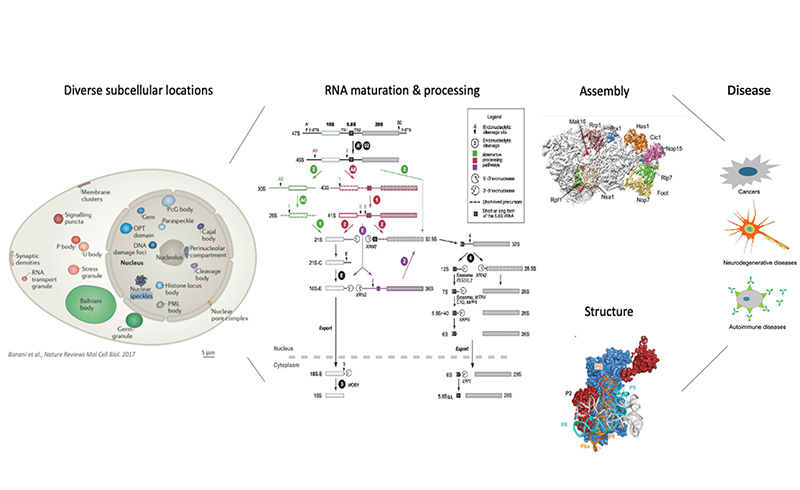
Marlene Oeffinger is an Associate Professor at the Faculty of Medicine, University of Montreal and holds a cross-appointment at the Division of Experimental Medicine, McGill University . She serves as Research Director of the Ribonucleoprotein Biochemistry Research Unit at the Montreal Clinical Research Institute (IRCM). Her research focuses on RNA maturation pathways, ribosome biogenesis, and their links to neurodegenerative diseases like Alzheimer's and ALS through RNA-protein complex dynamics. Education : Master's in Cell Biology (University of Vienna), PhD in Molecular Biology (University of Edinburgh). Training : Postdoctoral work in David Tollervey's lab (Edinburgh) and Mike Rout's lab (Rockefeller University). Her work combines proteomics , biochemical assays , and computational approaches to map RNA maturation networks and their connections to DNA damage repair. Recent articles highlight discoveries in archaeal ribosome evolution, mRNA export mechanisms, and RNA structure probing in yeast. She has received prestigious awards including the CIHR New Investigator Award , FRQ-S Junior Scholar Fellowships , and Revson Foundation Biomedical Fellowship . Marlene's lab trains students and researchers in RNA biology, with current members like Master's student Mauricio Hernandez Magana. Her affiliations span multiple platforms at the IRCM, including bioinformatics , proteomics , and molecular biology . She leads grants from CIHR , FRQNT , and Brain Canada , advancing understanding of RNA's role in disease etiology.
Lewis Kay is a University Professor at the University of Toronto, holding a primary appointment in the Department of Biochemistry and a cross-appointment in the Department of Chemistry. His research focuses on developing novel NMR methodologies to study complex biological systems, particularly the molecular dynamics of phase-separated condensates and large biomolecular machines like the proteasome. The Kay Lab emphasizes understanding how dynamic processes regulate biological functions, with applications in drug discovery and disease mechanisms. Education backgrounds are not explicitly listed, but his work demonstrates expertise in biochemistry and physical chemistry. Research interests include NMR spectroscopy, protein dynamics, biomolecular condensates, and the role of molecular motion in cellular processes. Recent articles highlight advancements in NMR techniques for studying high-molecular-weight systems, phase separation in biomolecules, and allosteric regulation of proteasome function. These studies address critical gaps in understanding dynamic protein behaviors and their implications for health and disease. No scientific awards are explicitly mentioned in the provided text. Advising and grants are not detailed here, but his lab's focus on interdisciplinary research suggests significant grant support. The Kay Lab actively explores molecular mechanisms in health and neurodegenerative diseases, leveraging cutting-edge NMR innovations to push the boundaries of structural biology.
Logan W.F. Donaldson is a Full Professor in the Department of Biology at York University, affiliated with the Faculty of Science. His research focuses on understanding how transcription factors and enzymes modify their conformation and partnerships in response to signals such as ligand binding or post-translational modifications like phosphorylation. He employs nuclear magnetic resonance (NMR) spectroscopy to determine atomic-level structures of protein complexes, complemented by molecular biology, biochemistry, and computational methods (UNIX-based systems). Sub-disciplines include Cell Biology, Protein Biochemistry, and Structural Biology. His work emphasizes collaborative projects integrating experimental and computational approaches. Representative publications include structural studies of AIDA1 PTB domains, bacteriophage proteins, and NMR-based computational methodologies. No scientific awards are explicitly listed, though his contributions to structural biology are evident in his publication record. He is eligible to supervise students in the Biology Graduate Program and leads a lab emphasizing collaborative research with computational and biochemical components.
Daniel LÉVESQUE is a Professor at the University of Montreal's Faculty of Pharmacy, where he also serves as Director and Associate Vice-Rector for Graduate and Postdoctoral Studies. His leadership extends to membership in three key research groups: Neural Signalling and Circuitry (SNC), University Research Group on Medicines (GRUM), and the Interdisciplinary Research Centre on the Brain and Learning (CIRCA). He holds a PhD in Pharmacy from Université Laval (1991) and completed postdoctoral training in Neuroscience at INSERM U109 in France (1995). LÉVESQUE's research focuses on therapeutic target discovery for central nervous system disorders, with expertise in Parkinson's disease, neurodegenerative diseases, and pharmacotherapy. His work investigates molecular mechanisms of antipsychotic drugs, dopamine dysregulation, and nuclear receptors (Nur77/RXR). Key areas include tardive dyskinesia pathology, L-Dopa-induced dyskinesia management, and neural adaptations in addiction. His 15 most recent publications (2017–2022) predominantly explore Parkinson's disease mechanisms, tardive dyskinesia, antipsychotic drug effects, and Nur77 receptor biology. These studies employ diverse methodologies from molecular biology to primate neuropathology, emphasizing translational neuropharmacology. He has supervised 8 graduate students (5 PhD, 3 Master's) between 2012–2023, with projects spanning Nur77 modulation, tardive dyskinesia characterization, and antipsychotic mechanisms. Major grants include funding from IRSC, FRQS, and Medicament Québec for projects such as: Nur77/RXR modulation for Parkinson's dyskinesia (IRICoR, 2020–2023) Mechanisms of antipsychotic-induced dopamine supersensitivity (IRSC, 2013–2021) Infrastructure support for neural circuitry research (FRQS, 2002–2020) LÉVESQUE leads collaborative projects with researchers like Sylvie Mader and Claude Rouillard, working within dedicated teams at SNC, GRUM, and CIRCA to advance neuropharmacology and therapeutic development.
Julie D. Forman-Kay is a Professor in the Department of Biochemistry at the University of Toronto and Program Head/Senior Scientist at the Molecular Medicine Program of the Research Institute of The Hospital for Sick Children. Her research focuses on the dynamic properties of proteins, particularly intrinsically disordered proteins (IDPs), and their functional roles in diseases like cystic fibrosis and neurological disorders. Her work integrates nuclear magnetic resonance (NMR) spectroscopy, computational modeling, and biophysical techniques to study protein structure, folding, and interactions. Key areas include phase separation of disordered proteins, post-translational modifications such as phosphorylation, and the structural dynamics of CFTR, the protein implicated in cystic fibrosis. The Forman-Kay lab has pioneered tools like the ENSEMBLE program for modeling disordered protein states and has made significant contributions to understanding dynamic complexes in ubiquitin ligases and translational regulation. Current projects explore RNA processing bodies, CFTR regulation, and the interplay between protein disorder and function. 2016–2023: Canada Research Chair in Intrinsically Disordered Proteins (Tier 1) 2013–2014: Zellers Senior Scientist Award 2012: CSMB Jeanne Manery Fisher Memorial Lectureship 2000–2005: CIHR Scientist Award 1999–2004: Ontario Premier’s Research Excellence Award 1994–1999: MRC of Canada Scholarship Julie Forman-Kay’s lab collaborates extensively with researchers such as Lewis Kay, Christine Bear, and Nahum Sonenberg. Her group trains graduate students and postdoctoral fellows in advanced techniques like NMR, fluorescence, ITC, and computational modeling. She co-chairs the CFTR Structure Consortium of the US Cystic Fibrosis Foundation Therapeutics.
Chantal Autexier is a Professor in the Department of Anatomy and Cell Biology at McGill University, affiliated with the Lady Davis Institute for Medical Research and Jewish General Hospital. Her work centers on telomere biology, focusing on telomerase regulation and its role in cancer cell immortalization, genome integrity, and premature aging disorders like dyskeratosis congenita. Using cell culture models, she investigates telomere maintenance mechanisms and their implications in disease. BSc (Concordia University), PhD (McGill University) Her recent research explores telomerase-telomere interactions, epigenetic regulation (e.g., R-2-hydroxyglutarate and KDM4A), and the impact of dyskerin mutations on telomerase function. Articles from 2019–2025 emphasize molecular biology, cancer therapeutics, and aging-related pathways, with sub-fields spanning DNA repair, replication stress, and RNA-protein dynamics. She also contributes to geroscience initiatives, such as the Canadian Translational Geroscience Network (2025). Her lab employs advanced techniques in cell imaging and molecular genetics to study telomere integrity in cancer and aging diseases.