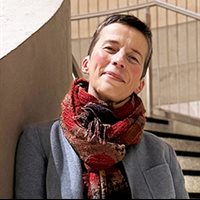
Harsha Ram is an Associate Professor in the Department of Comparative Literature at the University of California, Berkeley. His research focuses on Russian and European Enlightenment, modernist literature, and the cultural histories of the Caucasus region. He holds dual B.A. Honors degrees in Italian and Russian from the University of Sydney and University of New South Wales, and a Ph.D. in Comparative Literature from Yale University. His work bridges literary theory, post-colonial studies, and geopoetics, with a particular emphasis on Georgia's literary modernism and its intersections with Russian imperial culture. Key themes include spatial theory, peripheral modernisms, and the transnational dimensions of cultural production. Recent work examines the role of ritual feasts in Georgian national identity and the geopoetics of Eurasian avant-garde movements. Ram has published extensively on figures like Velimir Khlebnikov and Boris Pasternak, exploring their engagement with imperial legacies and revolutionary aesthetics. His book The Imperial Sublime: A Russian Poetics of Empire (2003) remains a seminal study of Russian imperial poetics. Current projects include studies on Georgian literary encounters with Russian culture and the symbolic dimensions of Caucasus representations. His scholarship frequently appears in leading journals such as Modernism/Modernity , Slavic Review , and Ab Imperio . He has held visiting positions at institutions globally and actively participates in interdisciplinary dialogues between literary studies, history, and cultural geography.
Abby Innes is an Associate Professor of Political Economy at the European Institute, London School of Economics , where she has been a faculty member since 1997. Her academic career includes a Visiting Fellowship at MIT (1995–1997) and a Jean Monet Fellowship at the European University Institute (2001–2002) . She has received multiple teaching awards , including the LSE Teaching Prize and European Institute Departmental Teaching Prize, and currently serves as the Teaching Chair of her institute. Research Interests : Dr. Innes specializes in the political economy of Central Europe , neoliberalism , and materialist utopias . Her work explores state capture , systemic transitions , and comparative capitalism , with a focus on the UK’s neoliberal transformation. Recent research addresses the political economy of the green transition and neoliberal institutional failures . British Academy Mid-Career Fellowship (2017-2018) LSE Teaching Prize (2002) LSE/ASRC Excellence in Education Award (2020) European Institute Departmental Teaching Prize (2011, 2013, 2015) Nominee for LSE Student-Led Teaching Excellence Awards (2014, 2020) Publications : Her 2023 book Late Soviet Britain: Why Materialist Utopias Fail argues that UK neoliberalism parallels Soviet economic dogma, leading to institutional rigidity , democratic erosion , and governance crises . She has published in journals such as The Review of International Political Economy and Comparative Politics , alongside frequent contributions to LSE Blogs and The London Review of Books .
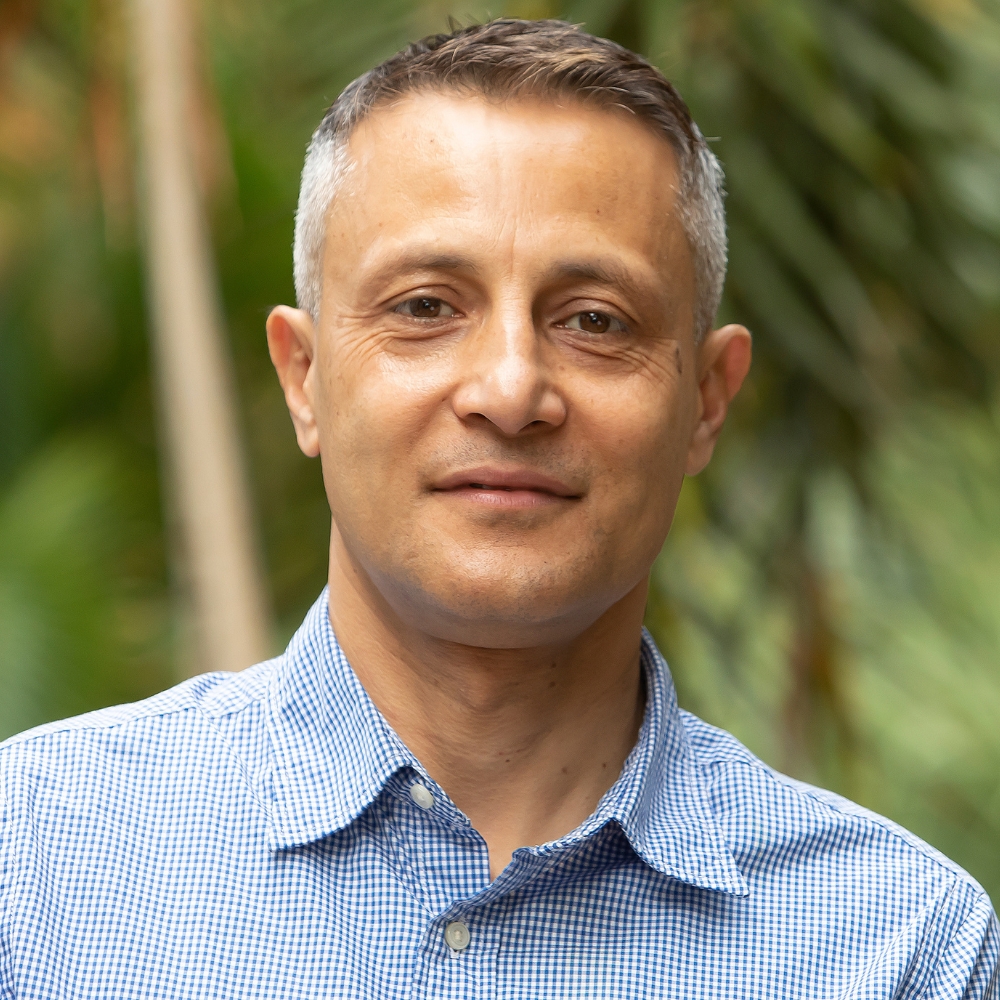
Pawan Adhikari is a Professor of Accounting at Essex Business School, University of Essex , where he serves as Director of Impact and Enterprise and Director of Essex Accounting Centre . He is an Associate Editor of the Journal of Public Budgeting, Accounting and Financial Management and a Executive Board Member of the Comparative International Governmental Accounting Research Network (CIGAR) . Previously, he led accounting reforms at Nepal’s Accounting and Auditing Standards Board and lectured at Nord University, Norway. PhD, Nord University Business School Fellow of the Higher Education Academy His research focuses on public sector accounting in developing countries, particularly accounting reforms , public value creation , and climate accountability . He explores how accrual accounting and participatory budgeting can enhance transparency in South Asian and African contexts. His work has influenced policy-making in Nepal and is recognized with the 2023 Best International Research Impact award by the University of Essex. Recent publications analyze wellbeing economies (2025), NGO accountability in disasters (2024), and climate budgeting (2023). He collaborates with institutions like the World Bank , European Commission , and British Academy , focusing on projects related to financial resilience , circular economy , and health sector accountability . Supervising 8 current PhD students, his advisees have produced work on topics like accrual accounting in Bangladesh and NGO accountability in Palestine . World Bank/PEFA Research Award African Accounting and Financial Association (AAFA) Award ESRC IIA Impact Fund GCRF and SeNSS Grants 2019 Best Postgraduate Supervisor (Essex)
Kyle Bellucci Johanson serves as a Visiting Critic in Cornell University's College of Architecture, Art, and Planning, Department of Art. Holding an MFA from California Institute of the Arts and a BA in Art and Reconciliation Studies from Bethel University, he merges artistic practice with critical theory through performance architecture and collaborative media. Whitney Independent Study Program (2022–23) Founding fellow at land's edge free school (Los Angeles) Teaching experience at SAIC, UIC, CUNY, and Cooper Union His research investigates: Power structures through spatial interventions Critical theory applications in art practice Post-capitalist imaginaries Hauntology and historical materialism Transdisciplinary approaches to social critique Project trends reveal: Reinterpretation of Soviet design principles Investigation of worker identity in post-industrial contexts Temporal and spatial dislocation in artistic practice Monument critique through performative methods Quantum theory-inspired architectural concepts Reimagining of common spaces as political sites Scientific awards include: Creative Research Grant (2025) Whitney ISP participation (2022–23) Automata Studio Residency (2022) Artists Run Chicago Grant (2021) BOLT Residency (2020–21) Through projects like KLUB WRKR —a nomadic workers' club reimagined for the gig economy—and table (2018–2022), a Chicago-based experimental space for artistic practice, he interrogates institutional frameworks while fostering community through discursive meals and collaborative exhibitions.
Odd Arne Westad is the Elihu Professor of History at Yale University, specializing in modern international and global history with a focus on East Asia since the 18th century. He previously held positions at Harvard University and the London School of Economics. His research bridges Cold War studies, empire/colonialism, and China's economic reforms. Education: BA in History, Philosophy, and Modern Languages (University of Oslo) Graduate Degree in US/International History (University of North Carolina at Chapel Hill) Research Interests: Global Cold War dynamics and post-colonial transformations China’s international history and imperial trajectories Economic reforms in late 20th century China and their global impact Key Publications: The Cold War: A World History (2017) Restless Empire: China and the World Since 1750 (2012) The Global Cold War (2007) Awards: Fellow of the British Academy Fellow of multiple national academies Professional Activities: Active in global history networks, advising doctoral students on Cold War and Asian history. Teaches courses on empire, decolonization, and modern East Asia.
Musa Yavuz Alptekin serves as Associate Professor in the Department of Sociology at Karadeniz Technical University's Faculty of Letters, where he has taught since 2010 after initially joining the Faculty of Economics and Administrative Sciences in 2006. He led the Sociology Department from 2010 to 2016, establishing its academic structure and graduate programs. His educational journey includes: Primary and secondary education in Bayburt Master's (2000) and PhD (2006) in Sociology at Istanbul University, specializing in Social Structure-Social Change Alptekin's research integrates Political, Ethnic, and Urban Sociology through global investigations of migration, diaspora formation, nationalism, and social stratification. His methodology blends theoretical frameworks with extensive ethnographic fieldwork across five continents, examining urban transformation, ethnic-state tensions, and integration processes in diverse geopolitical contexts from the Middle East to Southeast Asia. His scholarly contributions are recognized through: Postdoctoral Research Scholarship of the Higher Education Institution (USA, 2010) KTU Overseas Research Scholarship (Malaysia, 2013) TÜBİTAK Post-Doctoral Research Scholarship (UK, 2017) TÜBİTAK Post-Doctoral Research Scholarship (Germany, 2021) With six thesis advisories and 48 research projects, Alptekin directs fieldwork across international contexts while editing two journals through BİLGİTOY Association—the TR-indexed IMGELEM Journal of Imagination and HABITUS Journal of Sociology. His current research in Uzbekistan examines social structure, folklore, and ethnography, continuing his longitudinal analysis of cultural dynamics in post-Soviet spaces.
Dr. Galina Miazhevich is a Senior Lecturer at the School of Journalism, Media and Culture (JOMEC) at Cardiff University, UK. Previously, she served as a lecturer at the University of Leicester's School of Media, Communication and Sociology (2013-2017) and as the Gorbachev Media Research Fellow at the University of Oxford (2008-2012). Her academic career focuses on media representations in post-communist contexts, with particular expertise in Russian and Eastern European media landscapes. Dr. Miazhevich earned her PhD from the University of Manchester, where she subsequently worked for two years as a Research Associate on an AHRC-funded project examining representations of Islam as a security threat. Her educational background has informed her research trajectory, which bridges media studies, political communication, and cultural analysis of post-Soviet societies. Dr. Miazhevich's research spans several interconnected domains: media representations of Islam and multiculturalism in Europe; media and democracy in post-communist Europe; gender, media, and emergent forms of post-Soviet identity; feminism; Eurovision and popular culture; and diaspora, transnationalism, and media. Her work consistently examines how media shapes and is shaped by political transitions, identity formation, and social movements in post-Soviet contexts, with particular attention to marginalized voices and resistance practices. Analysis of Dr. Miazhevich's recent publications reveals a consistent focus on resistance, identity, and power dynamics in post-Soviet media environments. Her work increasingly examines gender and sexuality as political categories, particularly through the lens of feminist and LGBTQ+ resistance to authoritarian regimes. The Eurovision Song Contest serves as a recurring analytical framework for understanding cultural diplomacy and nation-branding strategies. More recently, her research has pivoted toward documenting anti-war resistance following Russia's invasion of Ukraine, examining how celebrities and media figures navigate political dissent under authoritarian conditions. Dr. Miazhevich has received several notable recognitions for her scholarly contributions: AHRC Leadership grant 'A Quiet Revolution: Discursive Representations of Non-heteronormative Sexuality in Russia' (2018-2020, £250,960) Visiting Fellowship at the Davis Centre for Russian and Eurasian Studies, Harvard University (Fall 2023) Fellow of the Higher Education Academy (FHEA) Associate Editor for the Oxford Encyclopedia of Race, Ethnicity, and Communication (2024) Dr. Miazhevich actively mentors the next generation of scholars, currently co-supervising PhD students Diyana Dobreva (with Professor Martin Innes) and John Tasker (with Professor Paul Bowman). She welcomes PhD proposals in areas including digital culture and resistance, media management and misinformation, media and democracy, representation of minority groups, post-communist identity politics, gender and feminism, Eurovision and popular culture, and geopolitics and nation-branding. Her grant portfolio demonstrates sustained success in securing competitive research funding, including leadership of an AHRC grant and participation in the Academy of Finland project FEMCORUS (2021-2025). Dr. Miazhevich is deeply engaged with academic communities, serving as co-convenor of the (Digital) Media and Culture group at the British Association for Slavic and East European Studies (BASEES) since 2016 and as a member of the Advisory Board of the European Communication Research and Education Association (ECREA) since 2021. Her work extends beyond academia through public engagement, including invited talks at prestigious institutions like Harvard University and participation in policy-relevant events at Chatham House addressing LGBTQ+ politics in Russia.
Barbara Zanchetta is a Senior Lecturer in the Department of War Studies at King’s College London, affiliated with the Faculty of Social Science & Public Policy. She specializes in Cold War history, American foreign policy, and transatlantic relations. Her work examines US-Soviet détente, nuclear arms control, and the strategic implications of post-Cold War policies. She is the author of The Transformation of American International Power in the 1970's and co-author of Transatlantic Relations since 1945 . Currently, she is researching US policies toward the Persian Gulf and their role in the collapse of the Soviet Union. Her teaching includes courses on international history, US national security, and the War on Terror. She is affiliated with the Sir Michael Howard Centre for the History of War, the Latin American Security Research Group, and the Centre for Grand Strategy. Her research explores the intersections of diplomacy, conflict, and security policy, with a focus on Cold War legacies and modern geopolitical challenges. Zanchetta has organized international conferences, including a hybrid event in Paris on the consequences of the Cold War’s end. Her commentary on contemporary issues, such as NATO’s expansion and Russia’s aggression in Ukraine, reflects her expertise in historical and strategic analysis.
Cora Schmidt-Ott is a Postdoctoral Researcher at the Chair of Modern and Contemporary History (Prof. Dr. Jan Eckel) at the University of Freiburg . Her work focuses on the intellectual biography of Samuel P. Huntington and the broader intellectual history of the 20th century, particularly in relation to political stability, globalization, and the American Century. She collaborates with institutions like the German Historical Institute, Washington DC , and has led DFG-funded projects. Education: MA in Comparative Modern History (University of Freiburg & University of Bologna); BA in History and American Studies (University of Freiburg & Connecticut College) Her research explores the intersections of political theory, Cold War liberalism, and transnational historical processes, with a particular emphasis on Huntington's influence on postcolonial state-building and global order. She has contributed to debates on migration, museum narratives, and post-war societal transformations. Recent publications and lectures highlight her expertise in political history, American studies, and Cold War-era intellectual networks. She has received scholarships from the Bavaria Graduation Scholarship , Max Weber Fellowship , and Erasmus Program , among others. Scientific Awards: Bavaria Graduation Scholarship (2016) Max Weber Fellowship (2015) Erasmus Scholarship (2013) Baden-Württemberg Scholarship (2011) Cora Schmidt-Ott contributes to academic discourse through her leadership in workshops, teaching roles in seminars on decolonization and 20th-century history, and her ongoing project funded by the German Research Foundation on Samuel Huntington's intellectual legacy.
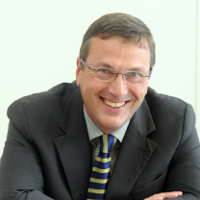
Stuart Croft is Vice-Chancellor & President of the University of Warwick and Professor of International Security in the Department of Politics and International Studies (PAIS). Since joining Warwick in 2007 he has served as Pro-Vice-Chancellor for Research (Arts & Social Sciences), Provost, and since February 2016 as the University’s chief executive, leading 5,500 staff across all disciplines. Education & Career: 18 years at the University of Birmingham, latterly Professor of International Relations and Head of the School of Social Sciences. Appointed Professor of International Security, University of Warwick, January 2007. Pro-Vice-Chancellor for Research (Arts & Social Sciences) 2011-2013. Provost 2013-2016. Vice-Chancellor & President from February 2016. Research Interests: Professor Croft’s scholarship lies at the intersection of security studies and political culture, using constructivist and narrative approaches to analyse how identities and discourses shape security policy. He has published extensively on the War on Terror, NATO transformation, European security governance, and the securitisation of Islam in Britain. His work combines large-scale funded empirical projects with theoretical innovation in International Relations. Publications & Grants Trend: Over the past two decades his output has clustered around three themes—cultural narratives of terrorism and counter-radicalisation, institutional governance of Euro-Atlantic security (NATO/EU), and arms-control regimes—moving from traditional strategic studies toward critical security approaches that foreground identity, discourse and governance. Scientific Awards & Fellowships: Academician, Academy of Social Sciences (2006) Fellow, Royal Society of Arts (2006) International Studies Association – International Security Section Book Award short-list 2007 Doctoral Supervision & Mentoring: He has successfully supervised 21 PhD students at Birmingham and Warwick, examined 25 UK PhDs as external examiner, and currently supervises 6 doctoral researchers. He has mentored 9 ESRC, EU and British Academy post-doctoral fellows. Editorial & Professional Leadership: Editor of the Palgrave ‘New Security Challenges’ book series since 2005; co-editor of Contemporary Security Policy 1989-2004; editorial board member of Critical Studies on Terrorism and Dynamics of Asymmetric Conflict . Chair (2009-2011) and President (2011-2013) of the British International Studies Association.
Jochen Hellbeck is a Distinguished Professor of History and Vice Chair for Graduate Education in the Department of History at Rutgers University's School of Arts and Sciences, where he has been teaching since 2003. He holds a Ph.D. from Columbia University and specializes in the history of the Soviet Union, with particular focus on individual life stories and the shaping of the self in modern Europe. Professor Hellbeck's research centers on the place and self-understandings of individuals during cataclysmic 20th century events, including the Russian Revolution, Stalin's terror regime, and World War II. His work examines how narratives of redemptive violence and transformation attached themselves to individuals on the ground, revealing how authors of diaries and personal texts became co-authors of the revolutionary script. More recently, he has explored comparative and transnational aspects of how Soviet, German, and British states mobilized citizens during World War II, highlighting the centrality of the Soviet war effort to the broader history of the conflict. His acclaimed book Stalingrad: The City that Defeated the Third Reich (2015) was the first Western study to probe the meaning of the Battle of Stalingrad for Soviet soldiers and civilians. The book draws on dozens of oral histories recorded by Moscow historians during and after the battle. Hellbeck's research consistently focuses on personal narratives and eyewitness accounts to provide grounded perspectives on major historical events. Morphomata Fellowship, Cologne (2019) Guggenheim Fellowship (2017) Short list, non-fiction prize of the Moscow Book Fair (2017) Davis Center Fellowship, Princeton (2016) Damals prize for best historical monograph (2013) American Academy in Berlin Fellowship (2009) Rutgers Board of Trustees Fellowship for Scholarly Excellence (2007) Michigan Society of Fellows (1997-1999) As a member of the Rutgers graduate faculty, Professor Hellbeck works with students interested in modern Russia and the Soviet Union, and in transnational explorations of Communism, World War II, and the Cold War. He encourages prospective graduate students to contact him before application deadlines. His website, Facing Stalingrad , features portraits and voices of veterans he interviewed during his research.
Dr Vera Axyonova is an Assistant Professor at the University of Birmingham's Department of Political Science and International Studies within the School of Government. Holding a PhD from the University of Bremen and Jacobs University Bremen, she has held prestigious positions including Marie Skłodowska-Curie REWIRE Fellow at the University of Vienna and Hurford Next Generation Fellow at the Carnegie Endowment. PhD: University of Bremen & Jacobs University Bremen (2013) MA: Fulda University of Applied Sciences (2008) Diploma: East Kazakhstan State University (2006) Her research focuses on international crisis management, cross-border norm transfer, and knowledge production in conflict environments. Recent projects examine European normative engagements in Eastern Europe and academic freedom challenges during forced migration. Her publications appear in top-tier journals like Peacebuilding and European Security . Notable awards include the Marie Skłodowska-Curie REWIRE Fellowship and Carnegie Endowment's Hurford Next Generation Fellowship. She co-chairs the ECPR Research Network on Statehood and Sovereignty and has held visiting positions at European University Institute, Freie Universität Berlin, and George Washington University.
Denis Kozlov is an Associate Professor in the Department of History at Dalhousie University, specializing in modern Russian and Soviet history. His academic journey includes a BA from Herzen Russian State Pedagogical University, an MA from the University of Massachusetts Amherst, and a PhD from the University of Toronto. He holds appointments within Dalhousie's Faculty of Arts and Social Sciences and maintains an active research profile focused on cultural and intellectual transformations in the Soviet Union. His educational background reflects deep engagement with Russian studies: BA: Herzen Russian State Pedagogical University MA: University of Massachusetts Amherst PhD: University of Toronto Kozlov's research centers on Soviet cultural and intellectual history during the post-Stalin era (1953-1991), with particular emphasis on memory practices, reading audiences, and migration. His work examines how Soviet citizens processed historical trauma through literature and media, especially during the Thaw period, and explores transnational migrations from the USSR in the 1970s-1980s. He investigates intersections between literature, society, and historical consciousness, revealing how cultural production shaped Soviet identity and social change. Analysis of his 15 most recent publications shows consistent focus on Soviet cultural history, with dominant themes including reading practices during de-Stalinization, migration as political expression, and memory politics. His methodology combines archival research with cultural analysis, increasingly incorporating transnational perspectives in recent works on Soviet Jewish migration and Eastern European identity. His scholarly recognition includes significant awards: SSHRC Insight Grant (2019-2024) Andrew W. Mellon Fellowship at Institute for Advanced Study, Princeton (2010-2011) Harvard University Postdoctoral Fellowships (2008-09) Faculty of Arts and Social Sciences Teaching Award (2014-2015) Kozlov actively supervises graduate research in Soviet history while securing major grants including SSHRC and NEH funding. His teaching spans introductory surveys to advanced seminars on Soviet Russia and comparative cultural history, with recent courses including HIST 2021F (Soviet Russia) and HIST 3088F (History & Memory Russia and West) for 2024-2025. While no dedicated research labs are mentioned, his collaborative projects like the NEH-funded conference "The Thaw: Soviet Society and Culture during the 1950s and 1960s" demonstrate his role in building scholarly networks. Current work focuses on Soviet migration patterns and their ideological implications.
Professor Maia Chankseliani is Professor of Comparative and International Education at the University of Oxford and a Governing Body Fellow of St Edmund Hall. She serves as Editor-in-Chief of the International Journal of Educational Research and Chair of the Executive Committee of the Education and Development Forum (UKFIET), and is a Trustee of the University of Bahrain. She leads the International Mobility and World Development research project funded by the U.S. Department of State. Her educational background includes: BA and MA from Tbilisi State University MA from the University of Warwick EdM from Harvard University PhD from the University of Cambridge Professor Chankseliani's research explores the public role of tertiary education in diverse settings, examining how universities contribute to social, economic, and political development, and how international engagement shapes both institutions and societies. Her work spans international student mobility and its developmental impact, academic freedom, university contributions to sustainable development, and higher education in post-Soviet contexts. Her monograph What Happened to the Soviet University? (OUP, 2022) offers insights beyond the former Soviet context, addressing contemporary debates around academic freedom and institutional autonomy. Her major international study International Mobility and World Development represents the first global mixed-methods project examining how international education contributes to societal development. Her recent publications (2023-2025) demonstrate a consistent focus on the ripple effects of international student mobility, particularly examining poverty reduction mechanisms, intercultural competence development, and systemic impacts on home countries. Based on extensive qualitative data from over 700 interviews across 70 countries combined with quantitative analysis, her research reveals how internationally mobile individuals become agents of change through knowledge transfer, policy influence, and institutional reform. This body of work shows that returnees adapt, translate, and embed reform through multiple mechanisms far beyond simple skill transfer. Professor Chankseliani has secured significant research funding from diverse sources including the U.S. Department of State, UKRI/ESRC, British Council, World Bank, Qatar Foundation, and European Commission. Her research has informed policy dialogue in areas such as poverty reduction, education and health systems, gender equality, and civic life. She regularly engages with governments and international audiences, and her work is frequently featured in global media outlets including Nature and University World News. At Oxford, Professor Chankseliani convenes the Comparative and International Education Research Group and previously led the department's MSc in Comparative and International Education from 2017 to 2024. She supervises multiple doctoral students and has worked on numerous externally funded research projects involving UK government departments, international organizations, and academic institutions. Her current research portfolio includes examining how international education experiences translate into societal development outcomes, with particular emphasis on poverty reduction mechanisms and the long-term impacts of mobility on home countries.
Saule Burkitbayeva is a Research Fellow at the ANU College of Law , focusing on intersections of climate change , agriculture , and policy . Her work emphasizes embedded emissions accounting and carbon footprinting in agri-food systems. PhD in Economics (KU Leuven) MSc in Agricultural Economics (University of Saskatchewan) Bachelor in Agricultural Economics (University of Saskatchewan) Her career spans research institutes and international organizations in Canada, Belgium, Germany, Ukraine, Kazakhstan, and Australia, with fieldwork in Central and South Asia. Current research themes include: Climate Change & Climate Finance Environmental Law International Economic Law Law & Economics She has collaborated with the World Bank , Asian Development Bank , and UNDP , and her publications appear in high-impact journals and edited volumes.