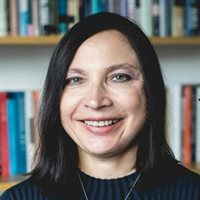
Prof. Dr. Olena Palko is a historian specializing in Eastern Europe, the Soviet Union, and Ukraine. She holds the SNSF Professorship at the University of Basel's Department of History, focusing on East European History. Her research emphasizes Soviet minority policies, cultural politics, and national identity formation in interwar Ukraine. She is a leading scholar with notable works including Making Ukraine Soviet (2021), awarded the 2023 Alexander Nove Prize. Her current SNF-funded project, Red Tower of Babel , examines Soviet minority experiments in Ukraine. Education: PhD from University of East Anglia (2017); Kandydat nauk from National Academy of Sciences of Ukraine (2013). Research Interests: Soviet nationality policy, minority history, Ukrainian twentieth-century history, transnational border dynamics. Her work bridges archival analysis with transnational perspectives, addressing contested borderlands between Poland and the USSR. Key publications include co-edited volumes like Making Ukraine (2022) and Ukraine's Many Faces (2023). She actively contributes to academic governance roles, including co-convening the BASEES Study Group for Minority History and serving on the Scientific Advisory Council of the Council of Europe's history observatory.
Norman M. Naimark serves as the Robert & Florence McDonnell Professor of East European Studies and Professor of History at Stanford University, with courtesy appointments in German Studies. He holds senior fellowships at both the Hoover Institution and Freeman Spogli Institute for International Studies, and is affiliated with The Europe Center and the Center on Democracy, Development and the Rule of Law. Education: Ph.D. in History, Stanford University (1972) Naimark specializes in Soviet-era Eastern European history, with dual research pillars: Soviet policies in post-WWII Europe and 20th-century genocide/ethnic cleansing phenomena. His work bridges historical analysis with contemporary human rights discourse, emphasizing geopolitical power dynamics and systematic violence against civilian populations. Methodologically, he combines archival rigor with comparative frameworks across national contexts. His publication trajectory from 1979–2019 reveals evolving focus from Marxist movements in partitioned Poland to Soviet occupation mechanics, culminating in comprehensive genocide studies. The 2019 monograph on Stalin's postwar European sovereignty struggles synthesizes decades of research into Soviet imperial practices. Scientific awards: Officer's Cross of the Order of Merit of the Federal Republic of Germany (1996) Richard W. Lyman Award for outstanding faculty volunteer service (1995) Stanford Dean's Teaching Award (1991-92, 2002-3) Naimark's academic leadership includes directing Stanford's Global Studies Division, Bing Overseas Studies Program, and Center for Russian, East European, and Eurasian Studies. His research informs current policy discussions on authoritarianism and democratic resilience, as evidenced by recent engagements with Belarusian democracy movements and U.S.-Russia relations. He collaborates extensively through Stanford's interdisciplinary centers, particularly contributing historical perspectives to The Europe Center's sovereignty research and the Center on Democracy, Development and the Rule of Law's governance initiatives.
London School of Economics and Political Science (LSE)United Kingdom
Abby Innes is an Associate Professor of Political Economy at the European Institute, London School of Economics , where she has been a faculty member since 1997. Her academic career includes a Visiting Fellowship at MIT (1995–1997) and a Jean Monet Fellowship at the European University Institute (2001–2002) . She has received multiple teaching awards , including the LSE Teaching Prize and European Institute Departmental Teaching Prize, and currently serves as the Teaching Chair of her institute. Research Interests : Dr. Innes specializes in the political economy of Central Europe , neoliberalism , and materialist utopias . Her work explores state capture , systemic transitions , and comparative capitalism , with a focus on the UK’s neoliberal transformation. Recent research addresses the political economy of the green transition and neoliberal institutional failures . British Academy Mid-Career Fellowship (2017-2018) LSE Teaching Prize (2002) LSE/ASRC Excellence in Education Award (2020) European Institute Departmental Teaching Prize (2011, 2013, 2015) Nominee for LSE Student-Led Teaching Excellence Awards (2014, 2020) Publications : Her 2023 book Late Soviet Britain: Why Materialist Utopias Fail argues that UK neoliberalism parallels Soviet economic dogma, leading to institutional rigidity , democratic erosion , and governance crises . She has published in journals such as The Review of International Political Economy and Comparative Politics , alongside frequent contributions to LSE Blogs and The London Review of Books .
Elias Dinas is a Full-time Professor in the Department of Political and Social Sciences at the European University Institute (EUI). He holds the Swiss Chair in Federalism, Democracy, and International Governance. His research focuses on political socialization, authoritarian legacies, and research methodology. Dinas earned his PhD in Political Science from the EUI in 2010. His research interests include the impact of historical traumas on political attitudes, experimental methods, and the dynamics of norm change. He collaborates with institutions like the Graduate Institute in Geneva through seminars, conferences, and methodological workshops. Recent work explores topics such as ideology mapping via AI, the electoral effects of early voting experiences, and the interplay between migration crises and public policy. His research has been published in top journals like the American Political Science Review and highlighted in outlets like The New York Times. Received the Michael Wallerstein Award (2019) for his work on migration and hostility. Supervises 14 students researching memory politics, norm change, and intergroup relations. Leads projects on post-authoritarian ideologies, German political identity, and elite-driven norm erosion. His teaching and supervision emphasize causal inference, experimental design, and quantitative methods, reflecting his commitment to rigorous political analysis.
Lyubov Zhyznomirska is an Associate Professor of Political Science at Saint Mary's University, specializing in European studies, migration governance, and democratization processes. She holds a PhD in Political Science from the University of Alberta (2012), with a focus on EU migration cooperation with Eastern neighbors. Her current research examines the reception of war-displaced Ukrainians in Canada, the UK, and Germany. She has held a Jean Monnet Post-Doctoral Fellowship and is active in research networks such as the European Community Studies Association-Canada and the Migration Research Network. Teaching focuses on comparative politics, European Union politics, and migration studies. Recent SSHRC-funded projects include studies on Ukrainian refugee integration in Nova Scotia and the impact of temporary status on newcomer youth. Awards include the Jean Monnet Post-Doctoral Fellowship (2011-2012). Research interests include forced displacement, post-war societies, and EU-Ukraine-Russia dynamics. She co-edited The Routledge Handbook of the Politics of Migration in Europe (2019) and publishes in journals such as Comparative European Politics . Professional roles include Treasurer of ECSA-Canada (2021-2024) and President of the Atlantic Provinces Political Science Association (2022-2023).
London School of Economics and Political Science (LSE)United Kingdom
Tomila Lankina is a Professor of Politics and International Relations at the London School of Economics (LSE), specializing in democratization, popular protest, and Russian and Eastern European politics. She holds a DPhil from the University of Oxford and has held research appointments at institutions such as Stanford University and Humboldt University in Berlin. Her work examines historical legacies of social structure and their implications for democracy, inequality, and political regimes. Her groundbreaking book The Estate Origins of Democracy in Russia (Cambridge University Press, 2022) explores how pre-communist social stratification in Russia shapes contemporary political outcomes. The book has received major accolades, including the 2023 J. David Greenstone Prize and Davis Center Book Prize. Lankina’s research also addresses modern issues like Russian media manipulation, post-communist social resilience, and the impact of historical institutions on modern governance. Active in supporting Ukrainian scholars during Russia’s invasion of Ukraine, Lankina co-founded an LSE Taskforce to assist displaced students and researchers. She has been recognized for her excellence in PhD supervision by LSE and has published widely in top journals like the American Political Science Review and World Politics . Her interdisciplinary approach combines historical analysis with contemporary political dynamics, emphasizing the persistence of social hierarchies and their role in shaping autocracy and democracy. Current projects include a book on Russian dissent history and comparative studies of post-colonial and post-communist societies.
Dr. Galina Miazhevich is a Senior Lecturer at the School of Journalism, Media and Culture (JOMEC) at Cardiff University, UK. Previously, she served as a lecturer at the University of Leicester's School of Media, Communication and Sociology (2013-2017) and as the Gorbachev Media Research Fellow at the University of Oxford (2008-2012). Her academic career focuses on media representations in post-communist contexts, with particular expertise in Russian and Eastern European media landscapes. Dr. Miazhevich earned her PhD from the University of Manchester, where she subsequently worked for two years as a Research Associate on an AHRC-funded project examining representations of Islam as a security threat. Her educational background has informed her research trajectory, which bridges media studies, political communication, and cultural analysis of post-Soviet societies. Dr. Miazhevich's research spans several interconnected domains: media representations of Islam and multiculturalism in Europe; media and democracy in post-communist Europe; gender, media, and emergent forms of post-Soviet identity; feminism; Eurovision and popular culture; and diaspora, transnationalism, and media. Her work consistently examines how media shapes and is shaped by political transitions, identity formation, and social movements in post-Soviet contexts, with particular attention to marginalized voices and resistance practices. Analysis of Dr. Miazhevich's recent publications reveals a consistent focus on resistance, identity, and power dynamics in post-Soviet media environments. Her work increasingly examines gender and sexuality as political categories, particularly through the lens of feminist and LGBTQ+ resistance to authoritarian regimes. The Eurovision Song Contest serves as a recurring analytical framework for understanding cultural diplomacy and nation-branding strategies. More recently, her research has pivoted toward documenting anti-war resistance following Russia's invasion of Ukraine, examining how celebrities and media figures navigate political dissent under authoritarian conditions. Dr. Miazhevich has received several notable recognitions for her scholarly contributions: AHRC Leadership grant 'A Quiet Revolution: Discursive Representations of Non-heteronormative Sexuality in Russia' (2018-2020, £250,960) Visiting Fellowship at the Davis Centre for Russian and Eurasian Studies, Harvard University (Fall 2023) Fellow of the Higher Education Academy (FHEA) Associate Editor for the Oxford Encyclopedia of Race, Ethnicity, and Communication (2024) Dr. Miazhevich actively mentors the next generation of scholars, currently co-supervising PhD students Diyana Dobreva (with Professor Martin Innes) and John Tasker (with Professor Paul Bowman). She welcomes PhD proposals in areas including digital culture and resistance, media management and misinformation, media and democracy, representation of minority groups, post-communist identity politics, gender and feminism, Eurovision and popular culture, and geopolitics and nation-branding. Her grant portfolio demonstrates sustained success in securing competitive research funding, including leadership of an AHRC grant and participation in the Academy of Finland project FEMCORUS (2021-2025). Dr. Miazhevich is deeply engaged with academic communities, serving as co-convenor of the (Digital) Media and Culture group at the British Association for Slavic and East European Studies (BASEES) since 2016 and as a member of the Advisory Board of the European Communication Research and Education Association (ECREA) since 2021. Her work extends beyond academia through public engagement, including invited talks at prestigious institutions like Harvard University and participation in policy-relevant events at Chatham House addressing LGBTQ+ politics in Russia.
Sarah Shirazyan is a Lecturer in Law at Stanford Law School , where she designed the Interpol-Stanford Policy Lab. She also serves as Director and Head of Meta's GenAI Product Policy work, overseeing responsible AI development across Meta's platforms. Doctor of Juridical Sciences (J.S.D.) from Stanford Law School LL.M. from SOAS/UCL, University of London Her research focuses on the intersection of national security , public policy , and international law , particularly examining: Effectiveness of UN Security Council responses to WMD terrorism Framework for regional organization collaboration in WMD prevention Platform content policy development and misinformation governance Responsible AI implementation under legal frameworks Key publication themes include: Platform algorithmic accountability Media capture in digital domains Content policy development during crises UN Security Council institutional limitations Regional organization synergies in security Recipient of Gerald J. Lieberman Award for research, teaching, and community service Professional affiliations: Stanford Law School Stanford Center for International Security and Cooperation (CISAC) INTERPOL European Court of Human Rights Council of Europe United Nations
Dorota Jarecka is an Adjunct Professor at the Institute of Literary Research of the Polish Academy of Sciences (PAN), specializing in the social history of art and visual culture. She is also the director of Warsaw’s Galeria Studio since 2016, and a renowned curator and author. Her work focuses on 20th-century art, surrealism, and gender studies in Eastern Europe. Key professional roles include: Adiunkt (Adjunct Professor) at PAN’s Institute of Literary Research Kurator of major exhibitions including the Erna Rosenstein series (2011–2014) Editor of monographs on artists like Krystiana Robb-Narbutt, Natalia LL, and Ewa Zarzycka Research highlights include her 2021 monograph analyzing surrealism, realism, and Marxism in post-war Polish art, and a 2013 interview with Anda Rottenberg. Her 2022 article on Helena Berlewi explores avant-garde movements and gendered artistic identity. Her exhibitions and publications emphasize underrepresented female artists and political contexts shaping art production in communist Poland.
Balázs Trencsenyi is Professor in the Department of Historical Studies at Central European University (CEU) and serves as Director of the CEU Institute for Advanced Study in Budapest. He is also Co-Director of Pasts Inc., Center for Historical Studies, and a Member of the 'Democracy in History' Working Group at the CEU Democracy Institute. His academic leadership includes directing the Erasmus Mundus+ Program 'History in the Public Sphere' (2019–2023) and heading the History Department (2017–2020). His educational background includes a PhD in Comparative History from CEU (2004), an MA in Nationalism Studies from CEU (1998), and an MA in Philosophy from Eötvös Loránd University (1997). Trencsenyi is a leading scholar in the intellectual and political history of East Central Europe, with a focus on transnational and comparative approaches. His research examines political modernity, crisis discourses, nationalism, national characterology, anti-modernism, and the conceptual history of identity and temporality. He has directed major collaborative projects such as the ERC-funded 'Negotiating Modernity' and 'European Regions and Boundaries: A Conceptual History.' His influential publications include the multi-volume A History of Modern Political Thought in East Central Europe (Oxford University Press) and Intellectuals and the Crisis of Politics in the Interwar Period and Beyond (2025). His recent articles reflect sustained engagement with crisis discourses, authoritarian regime-building, transnational intellectual history, and the politics of memory in East Central Europe. Themes across his work include the fragility of democracy, the legacy of state socialism, and the interplay between nationalism and modernity. CEU Community Service Excellence Award (2023) Fellow of Wissenschaftskolleg zu Berlin (2020) Member of Academia Europaea (2011) ERC Starting Grant (2008–2013) Trencsenyi has supervised numerous doctoral students in political thought, nationalism, and intellectual history. He has led research clusters such as 'Crises of Democratization' under the CIVICA project and co-organizes the 'Invisible University for Ukraine' initiative. He is Editor of East Central Europe (Brill) and has served on editorial boards and peer-review panels for major academic institutions and journals. His teaching covers comparative history, political modernity, crisis discourses, and counter-cultural movements under socialism.
Jasmina Lukic is a Professor in the Department of Gender Studies at Central European University (CEU). She serves as the Principal Investigator for the HORIZON TMA MSCA Doctoral Network project EUTERPE (2022-2026), focusing on European Literatures and Gender in Transnational Perspective. Her academic work spans transnational feminism, post-Yugoslav literature, and interdisciplinary research methodologies. Education: Ph.D. in Comparative Literature, University of Belgrade. Research Areas: Gender Studies, Transnational Literature, Post-Yugoslav Societies, Interdisciplinary Methods. Projects: EUTERPE (2022-2026), STINT (2016-2019), Research Integration (2004-2006). Courses: Traveling Concepts in Gender Studies, Narrating Worlds, Feminism and Community, Strategies of Reading. Her recent publications explore themes such as feminist transnational convergences, literary transduction, memory politics in Dasa Drndić’s work, and gendered approaches to realism. Articles like The Transnational Turn and Scherezade in Exile (forthcoming, 2023) emphasize cross-border solidarity and feminist reinterpretation of literary genres. Her work bridges feminist theory, comparative literature, and post-conflict analysis. Notable affiliations include co-editing Times of Mobility: Literature and Gender in Translation (2019) and contributing to debates on War, Literature, and Ethics (2019). She actively engages in academic events like the book launch Soul, Body, and Gender in Late Antiquity (2024) and feminist conferences.
Rev. Dr. hab. Waldemar Żurek, Professor at the John Paul II Catholic University of Lublin, serves at the Center of Ecclesiastical Archives, Libraries and Museums (ABMK) within the Faculty of Theology. His academic career spans decades of dedicated research and publication in church history, particularly focusing on Eastern European Catholicism and the Salesian Order. As an active scholar, he continues to contribute significantly to ecclesiastical documentation and historical research. Professor Żurek's research interests center on ecclesiastical archives, parish documentation, and the history of religious orders, with particular emphasis on the Salesian Order's activities in Poland and Eastern Europe. His work explores the intersection of religious life with historical events, particularly during challenging periods like the communist era in Poland. He has developed expertise in analyzing parish inventories, visitation records, and chronicles to reconstruct religious life and administration across different historical periods. His extensive publication record demonstrates a consistent focus on documenting church history through meticulous examination of primary sources. The most recent works reveal trends toward comprehensive chronicles of religious institutions, detailed parish records analysis, and biographical studies of clergy members. His research spans multiple disciplines including religious studies, historical documentation, and Eastern European studies, with particular attention to regions like Pinsk, Lutsk, and Volhynia that have complex religious histories across changing political borders. Scientific Awards: Gold Medal for Long Service Professor Żurek has supervised numerous diploma theses including master's work on topics such as 'Social activities of Bishop Adolf Piotr Szelążek.' His editorial work includes significant publications like 'Kult Matki Bożej Ostrobramskiej w historii narodu polskiego' (The Cult of Our Lady of the Gate of Dawn in the History of the Polish Nation) and 'Ojciec Profesor Henryk Damian Wojtyska 1933-2009. Pasjonista, historyk Kościoła i dydaktyk' (Father Professor Henryk Damian Wojtyska 1933-2009. Passionist, Church Historian and Educator). He serves on the Scientific Council of the biannual journal 'Archives, Libraries and Church Museums' and is a member of the Theological Society of Józef Bilczewski in Ukraine. His work with the Center of Ecclesiastical Archives, Libraries and Museums represents a significant contribution to preserving and analyzing religious heritage. Through his leadership and scholarship, Professor Żurek has helped establish important methodologies for working with ecclesiastical documentation and has fostered international collaboration in church historical studies, particularly between Polish and Ukrainian scholars.
Joanna Inglot serves as the Edith M. Kelso Associate Professor of Art History at Macalester College, where she teaches courses spanning modern and contemporary art, gender studies, and transnational art history. Her research focuses on feminist art, art in former Eastern Europe, and the intersections of art with gender politics and historical memory. Dr. Inglot's research interests encompass modern and contemporary art within global contexts, with a particular emphasis on feminist art movements and the art of Eastern Europe during and after communism. She explores transcultural dialogues, the body in performance art, and the role of art in political resistance, especially in post-communist societies. Her recent scholarly work reveals a strong focus on feminist art in Eastern Europe, examining figures like Natalia LL and Magdalena Abakanowicz, and extending to diasporic artists such as Shirin Neshat. Themes of memory, gender, and the political dimensions of art consistently thread through her publications. Dr. Inglot has received numerous prestigious awards and grants, including: Fulbright Fellowship American Council of Learned Societies Grant International Exchanges Commission Grant (IREX) National Endowment of the Humanities Grant Faculty Exceptional Performance Award (2022-23) Mellon Periclean Faculty Leadership Grant in the Humanities (2024-25) As an active researcher and curator, she has directed symposia at institutions like Tate Modern and is currently editing a volume on Abakanowicz and writing a book on feminism in the post-communist world. Her work is supported by significant grants that enable her to advance scholarship in art history and feminist studies.
Stefanos Katsikas is an Associate Professor of Modern and Contemporary History of Southeastern Europe (18th-21st centuries) at the University of Cyprus. He holds tenure and is affiliated with the Department of History and Archaeology. Previously, he served as Associate Director of the Center for Hellenic Studies at the University of Chicago (2019–2023) and held roles at UIUC, Goldsmiths College, and other institutions. His research focuses on nationalism, religious conversion, minority policies, and diplomatic history in the Balkans. He earned his PhD from University College London (2006) and has authored multiple books including Islam and Nationalism in Modern Greece (Oxford UP, 2021). Key academic contributions include studies on Muslim conversions during the Greek War of Independence, post-1897 Greek political trauma, and Bulgarian foreign policy. He has been honored by Marquis Who's Who (2023) and the Scouloudi Foundation (2011). His teaching spans modern Greek history courses in both English and Greek, emphasizing nation-building, minorities, and Cold War dynamics. Administrative roles include program-building in Modern Greek Studies and fundraising for academic initiatives. Current projects include an Oxford Handbook of Modern Greek History and studies on post-civil war reconciliation in Greece and Cyprus.
Dr. Gëzim Krasniqi is a Lecturer in Nationalism and Political Sociology and Programme Co-Director of the MSc Nationalism in Global Perspective at the University of Edinburgh's School of Social and Political Science. His work focuses on nationalism, citizenship, and state-building in Southeast Europe, particularly Kosovo and the Balkans. He holds a PhD from the University of Edinburgh and has taught courses like Theorising Nationalism and Nationalism, Populism and Democracy . Education: PhD in Sociology, University of Edinburgh MA in Sociology, Central European University MA in Sociology, University of Sarajevo and University of Bologna BA in Sociology, University of Prishtina Research Interests: Dr. Krasniqi specializes in political sociology and nationalism, with emphasis on citizenship in contested states, ethnic conflicts, and post-Yugoslav state-building. His work examines how nationalism shapes intra-group power dynamics and citizenship policies in liminal polities like Kosovo and Northern Cyprus. He is an Associate Editor of Identities and Book Review Editor of Nations and Nationalism . Key Themes in Publications: His articles analyze EU-Kosovo relations, citizenship laws, and the geopolitical role of Great Powers in the Balkans. Recent work explores the EU's influence on state-building and the socio-political implications of passports for marginalized groups. Awards & Grants: No explicitly listed awards, but he has secured institutional support for research projects on Kosovo policy-making and EU integration. Labs/Teams: He co-leads the ASEN Edinburgh branch, advancing studies on ethnicity and nationalism. His supervision includes PhD projects on Romani activism, digital ID systems, and micro-level nationalism.