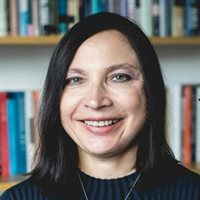
Prof. Dr. Sakibe Nalan BÜYÜKKANTARCIOĞLU is a Professor at Çankaya University, Faculty of Arts and Sciences, Department of Translation and Interpreting Studies (English). She previously served as Professor (2007–2019), Associate Professor (2000–2007), and Assistant Professor (1997–2000) at Hacettepe University, Department of English Linguistics. PhD in English Linguistics (Hacettepe University, 1991) MA in English Language Teaching (Middle East Technical University, 1985) BA in English Teaching (Istanbul University, 1978) Her research spans Linguistics, Cognitive Linguistics, Discourse Analysis, Psycholinguistics, Sociolinguistics, Translation Studies , with a focus on figurative language, interjections, political discourse, and endangered languages. She received the European Language Award (2011) and has supervised numerous PhD and MA theses, including work on Turkish idioms, gender representation, and language awareness. A prolific editor and conference participant, she has contributed to interdisciplinary projects and publications on Turkish sociolinguistics.
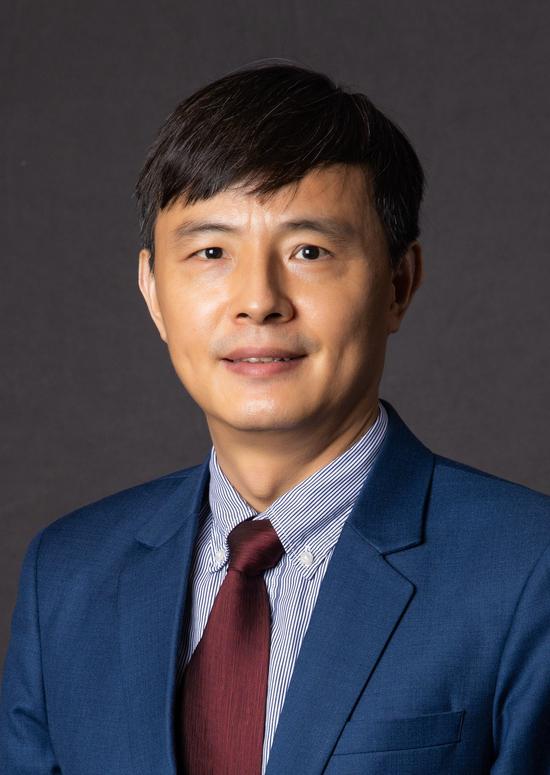
Prof. Dr. Alexander Stroh-Steckelberg is Professor of Political Science with a focus on African Politics & Development Policy at the University of Bayreuth since 2022. He serves as Deputy Head of the Bayreuth International Graduate School of African Studies (BIGSAS) until 2025 and has held prior roles as Junior Professor and Senior Fellow at BIGSAS (2015–2021). His academic career includes research associate positions at the GIGA German Institute of Global and Area Studies (2006–2015) and teaching roles at the Universities of Abomey-Calavi, Heidelberg, and Lüneburg. Stroh-Steckelberg’s research spans comparative democracy studies , judicial politics , electoral systems , political party dynamics , and development policy in Africa, with regional expertise in Francophone West Africa and Rwanda . His work emphasizes institutional diffusion, informal networks in courts, and the interplay between formal and informal governance structures. Recent publications reveal a focus on judicial appointment policies , electoral manipulation , and local governance challenges across Africa. He contributes to methodological advancements in comparative area studies and network analysis , particularly in non-Western democracies. Stroh-Steckelberg is actively involved in academic communities including the American Political Science Association , German Political Science Association , and Association for African Studies in Germany .
Yochai Benkler is the Berkman Professor of Entrepreneurial Legal Studies at Harvard Law School and faculty co-director of the Berkman Klein Center for Internet and Society at Harvard University. He specializes in Law and Political Economy, Technology Law and Policy, Communications Law, and Access to Knowledge. His work bridges academia and activism, focusing on the intersection of technology, collaboration, and societal structures. Benkler's research emphasizes decentralized collaboration, information commons, and the impact of technology on democracy. He has advised governments and international organizations on innovation policy and telecommunications. His notable works include The Wealth of Networks (2006), which explores social production in the digital age, and Reconstructing Class Analysis (2024), co-authored with Talha Syed, which rethinks class dynamics within capitalism. He has received numerous awards, including the Oxford Internet Institute Lifetime Achievement Award (2012), Ford Foundation Visionaries Award (2011), and Electronic Frontier Foundation Pioneer Award (2007). His work is publicly accessible at benkler.org . Benkler serves on the boards of the Open Society Foundations and the Freedombox Foundation. His research spans law, political economy, and technology, addressing issues like fake news, network propaganda, and the role of the internet in governance.
Jose Apesteguia is an ICREA Research Professor at the Department of Economics and Business, Universitat Pompeu Fabra, Barcelona, Spain. His research focuses on behavioral economics, decision theory, experimental economics, and game theory, with particular emphasis on topics such as behavioral heterogeneity, rationality measures, stochastic choice models, and social preferences. Apesteguia has collaborated extensively with scholars like Miguel A. Ballester and Jörg Oechssler, producing influential work on topics ranging from imitation dynamics to the impact of language on moral decisions. His research integrates theoretical frameworks with experimental methods, exploring how individuals make decisions under uncertainty, time preferences, and social contexts. Key contributions include the development of measures of rationality and welfare, as well as analyses of behavioral adaptation and the role of information in competitive environments. His work frequently bridges economic theory with empirical validation, addressing real-world issues such as rule compliance in public institutions and team performance in organizations. Apesteguia’s publications span top journals including the American Economic Journal: Microeconomics , Journal of Economic Theory , and Econometrica . He teaches advanced courses on bounded rationality and behavioral decision theory at the undergraduate and graduate levels. His research has been applied to fields like finance (e.g., copy trading behavior) and public policy (e.g., promoting compliance in libraries).
Ceren Budak is an Associate Professor at the University of Michigan School of Information and holds a joint appointment as Associate Professor of Electrical Engineering and Computer Science in the College of Engineering. Her work bridges computer science, statistics, and social sciences through computational social science approaches. Her educational background includes a PhD in Computer Science from the University of California, Santa Barbara (2012) and a Bachelors degree in Computer Science from Bilkent University in Turkey (2007). Prior to joining the University of Michigan faculty, she was a Postdoctoral Researcher at Microsoft Research New York. Professor Budak's research centers on computational social science, with particular emphasis on analyzing large-scale datasets to address questions with social, political, and policy implications. Her work spans several interconnected domains: News Media Production & Consumption (examining bias in news outlets and reader preferences), Social Movements & Media (using social media data to study collective action), Social Networks (understanding information diffusion processes), and Measuring and Promoting the Quality of Online Discussions (developing tools to improve online conversations). She teaches SI 608 (Networks) and SI 618 (Data Manipulation and Analysis) at the School of Information. Her publication record demonstrates consistent contributions to understanding how online information ecosystems operate, with recent work focusing on AI-human collaboration, misinformation dynamics, social movement framing, and the application of computational methods to political communication. Her research shows a clear trajectory from foundational work on social network diffusion to increasingly sophisticated analyses of contemporary information challenges. Among her service activities, she has served as Registration chair for COSN (ACM Conference on Online Social Networks) 2015 and as Program Committee Member for numerous prestigious conferences including WWW, ICWSM, WebSci, AAAI, and others. She has also been involved in organizing the MSR NYC Data Science Seminar Series and instructing the Microsoft Research Data Science Summer School.
Dr Olga Petri is an Assistant Professor in Human Geography at the Department of Geography, University of Cambridge. She is a Bye-Fellow and Director of Studies in Geography (Part II) at Jesus College, and a Leverhulme/Newton Trust Early Career Research Fellow. Her research bridges cultural and historical geography, queer studies, and more-than-human geographies, with a focus on urban modernity in non-Western contexts. Born in St Petersburg, Olga holds a BA and MA in Geography from Saint-Petersburg State University, an MSc in Urban Studies from University College London (merit), and a PhD in Geography from the University of Cambridge. Olga's research explores four key areas: Queer Geographies in authoritarian urban spaces, More-than-Human Geographies analyzing human-animal relationships, Russian Arctic Studies examining environmental and geopolitical transformations, and Migration Urbanism studying cities as hubs for political refugees. Her work on Beastly St Petersburg and Winged Worlds reconfigures urban history through animal and queer lenses. Scientific awards include the Leverhulme/Newton Trust Early Career Research Fellowship and a 2020 shortlisting for Student-Led Teaching Award . She is a Junior Research Fellow at Wolfson College since 2018. Olga leads postdoctoral research on human-animal dynamics in imperial Russia. She supervises graduate students in cultural/historical geography and urban studies. Her work features in Vital Geographies research group at Cambridge.
Professor Shoon Murray is a distinguished faculty member at American University's School of International Service, specializing in American foreign policy and civil-military relations. Holding a PhD in political science from Yale University, she teaches foundational courses including Analysis of US Foreign Policy (SISU-230) and Foreign Policy: Theory and Decision Making (SIS-689). Education: PhD in Political Science, Yale University Research Focus: Dr. Murray's scholarship critically examines war powers, decision-making theory, and the interplay between public opinion, media, and foreign policy formation. Her work analyzes how political leaders navigate security crises, congressional-authority tensions in military actions, and institutional shifts in diplomatic practices amid global power diffusion. She investigates enduring phenomena like the “rally ‘round the flag’” effect while documenting the post-9/11 militarization of U.S. strategic approaches. Publication Trends: Recent research centers on the evolution of the 2001 AUMF, combatant commanders' diplomatic roles, and State Department-DoD institutional competition. Her scholarship reveals how military actors increasingly shape foreign policy narratives while traditional diplomatic channels erode, with implications for democratic accountability and strategic coherence in counterterrorism operations.
Professor Andrew Chadwick is a leading scholar in political communication and digital media studies at Loughborough University, where he directs the Online Civic Culture Centre (O3C). He holds a BSocSc from Birmingham, MSc and PhD from the London School of Economics. His research focuses on hybrid media systems, disinformation dynamics, and digital politics. Key contributions include conceptualizing hybrid media events and analyzing misinformation in personal messaging platforms. His work has been recognized with prestigious awards, including the APSA Best Book Award. He supervises numerous PhD students exploring topics like social media influence, public opinion, and digital disinformation. Current projects include the Leverhulme-funded Everyday Misinformation Project examining numerical disinformation on messaging apps. His media engagements span BBC Radio 4 to The Washington Post. Research highlights include studies on misinformation warnings' ineffectiveness, vaccine hesitancy, and the role of celebrities in political representation. O3C serves as a hub for interdisciplinary research on digital civic culture. Chadwick’s academic leadership includes roles in editorial boards for top journals and international conference keynotes.
Alexander I. Platt is the Earl B. Shurtz Research Professor of Law and Director of the Polsinelli Transactional Law Center at the University of Kansas School of Law. He specializes in securities regulation, corporate law, and administrative law, with a focus on regulatory frameworks, corporate governance, and legal ethics. Platt teaches Contracts, Securities Regulation, Business Organizations, and Due Diligence in Business Transactions. Platt earned his B.A. in Philosophy and Political Science (magna cum laude) from Columbia University in 2006 and his J.D. from Yale Law School in 2012, where he served as an Articles Editor on the Yale Law Journal. He clerked for Judges Stephen F. Williams (D.C. Circuit) and Royce C. Lamberth (D.D.C.) and practiced law at Boies Schiller Flexner LLP before joining KU. He is admitted to multiple U.S. courts, including the District of Columbia and New York. His research explores the intersection of regulatory enforcement, corporate transparency, and legal accountability. Notable works include critiques of SEC whistleblower programs and analyses of IPO regulatory frameworks. His 2024 article on mandatory disclosure was recognized as one of the Top 10 Corporate & Securities Law Articles of the year. Platt advocates for balanced legal guardrails to address modern market challenges like unicorn valuations and short seller dynamics. Research Highlights : SEC enforcement mechanisms and transparency Whistleblower incentives and corporate accountability IPO regulatory bureaucracy Corporate governance structures Awards : Top 10 Corporate & Securities Law Articles of 2024 Platt’s work has been cited by SEC Commissioners and featured in major media outlets like the Wall Street Journal and Bloomberg, underscoring the practical impact of his scholarship on legal and regulatory policy.
Kyle Bellucci Johanson serves as a Visiting Critic in Cornell University's College of Architecture, Art, and Planning, Department of Art. Holding an MFA from California Institute of the Arts and a BA in Art and Reconciliation Studies from Bethel University, he merges artistic practice with critical theory through performance architecture and collaborative media. Whitney Independent Study Program (2022–23) Founding fellow at land's edge free school (Los Angeles) Teaching experience at SAIC, UIC, CUNY, and Cooper Union His research investigates: Power structures through spatial interventions Critical theory applications in art practice Post-capitalist imaginaries Hauntology and historical materialism Transdisciplinary approaches to social critique Project trends reveal: Reinterpretation of Soviet design principles Investigation of worker identity in post-industrial contexts Temporal and spatial dislocation in artistic practice Monument critique through performative methods Quantum theory-inspired architectural concepts Reimagining of common spaces as political sites Scientific awards include: Creative Research Grant (2025) Whitney ISP participation (2022–23) Automata Studio Residency (2022) Artists Run Chicago Grant (2021) BOLT Residency (2020–21) Through projects like KLUB WRKR —a nomadic workers' club reimagined for the gig economy—and table (2018–2022), a Chicago-based experimental space for artistic practice, he interrogates institutional frameworks while fostering community through discursive meals and collaborative exhibitions.
London School of Economics and Political Science (LSE)United Kingdom
Tomila Lankina is a Professor of Politics and International Relations at the London School of Economics (LSE), specializing in democratization, popular protest, and Russian and Eastern European politics. She holds a DPhil from the University of Oxford and has held research appointments at institutions such as Stanford University and Humboldt University in Berlin. Her work examines historical legacies of social structure and their implications for democracy, inequality, and political regimes. Her groundbreaking book The Estate Origins of Democracy in Russia (Cambridge University Press, 2022) explores how pre-communist social stratification in Russia shapes contemporary political outcomes. The book has received major accolades, including the 2023 J. David Greenstone Prize and Davis Center Book Prize. Lankina’s research also addresses modern issues like Russian media manipulation, post-communist social resilience, and the impact of historical institutions on modern governance. Active in supporting Ukrainian scholars during Russia’s invasion of Ukraine, Lankina co-founded an LSE Taskforce to assist displaced students and researchers. She has been recognized for her excellence in PhD supervision by LSE and has published widely in top journals like the American Political Science Review and World Politics . Her interdisciplinary approach combines historical analysis with contemporary political dynamics, emphasizing the persistence of social hierarchies and their role in shaping autocracy and democracy. Current projects include a book on Russian dissent history and comparative studies of post-colonial and post-communist societies.
Gustavo J. Bobonis is a Professor in the Department of Economics at the University of Toronto, with affiliations at the Munk School of Global Affairs and Public Policy. He holds a Ph.D. from the University of California, Berkeley (2005) and a B.A. from the University of Puerto Rico at Rio Piedras (2000). He co-directs the Forward Society Lab and is actively involved in research on development, labor, political economy, and economic history. Research Interests: His work focuses on development economics, particularly the impact of public policies on poverty, violence, education, and governance. He employs rigorous empirical methods, including field experiments and quasi-experimental designs, to analyze issues such as intimate partner violence, corruption, clientelism, and human capital accumulation. His research is geographically concentrated in Latin America and Puerto Rico. Recent Research Trends: His recent publications and working papers (2022–2025) demonstrate a strong focus on institutional reform, including anti-corruption audits, domestic violence courts, and education management. He also investigates long-term social impacts of welfare programs and climate adaptation strategies. His interdisciplinary approach bridges economics, public policy, and social science. Scientific Awards: U of T Department of Economics Faculty Award for Excellence in Undergraduate Teaching, 2015 John C. Polanyi Prize in Economic Science, 2009 National Academy of Education / Spencer Foundation Postdoctoral Fellow, 2008 Advising and Grants: While specific student names are not listed, he advises graduate students through the Honours Essay and research workshops. He leads collaborative research projects funded through grants and affiliations with J-PAL and BREAD, often involving large interdisciplinary teams. His work includes randomized evaluations and long-term follow-ups, suggesting sustained funding and research support. Labs and Teams: He co-directs the Forward Society Lab, which likely supports policy-relevant research on social development. He frequently collaborates with economists such as Paul Gertler, Marco Gonzalez-Navarro, Simeon Nichter, and Luis R. Cámara Fuertes. His affiliations with J-PAL and BREAD indicate integration into major global research networks focused on development and poverty alleviation.
Astrid Wagner is a Senior Scientist and Deputy Director at the Institute of Philosophy (IFS) of the Spanish National Research Council (CSIC) in Madrid. She holds a PhD in Philosophy from Technische Universität Berlin, recognized by the National University of Distance Education (UNED), and previously served as professor for 20 years at TU Berlin. Her research focuses on philosophy of culture, science epistemology, and digital society challenges. Key interests include philosophy of language, perception phenomenology, pragmatism, and ethical implications of digital transformation. Recent work examines uncertainty dynamics, trust frameworks, post-truth phenomena, infodemics, conspiracy theories, cognitive vulnerability, and digital citizenship. Wagner leads major research initiatives including the INconRES project on ethical-epistemological keys to digital social dynamics (2021-2025), the ORTEGA-CM interdisciplinary innovation consortium on José Ortega y Gasset's legacy (2024-2026), and previously directed the RESPONTRUST project combating COVID-19 disinformation (2021-2023). She co-leads the DESTERRA project analyzing disinformation's societal foundations (2022-2025) and participates in UCM's Rationality, Knowledge and Action research group. She serves on Spain's Committee of Experts for National Security against disinformation, advises the Congressional Science Office, and holds editorial positions at the Journal of Ortega Studies. Wagner contributes to GENET Association's Gender Studies Network and juries for the Princess of Asturias Award and Javier Muguerza Philosophy Prize.
Li Mingjiang serves as Associate Professor and Provost's Chair in International Relations at Singapore's S. Rajaratnam School of International Studies (RSIS), Nanyang Technological University. He concurrently holds leadership roles as PhD Programme Coordinator, Deputy Head of Graduate Studies at RSIS, and Deputy Chair of NTU's 8th Senate, while maintaining a nonresident scholar position at Carnegie China. His academic foundation includes: Ph.D. in Political Science from Boston University Specializing in Chinese foreign policy , China-ASEAN relations , and Asia-Pacific security dynamics , he has authored or edited 15 books including China’s Economic Statecraft (2017) and New Dynamics in US-China Relations (2014). His research spans global governance frameworks and Sino-U.S. strategic competition through publications in journals like Journal of Contemporary China and Chinese Journal of International Politics . Recent publications (2023-2025) reveal concentrated analysis on emerging geopolitical flashpoints including U.S.-China tensions in Southeast Asia, South China Sea confrontations, cyber nationalism commercialization, and technology policy conflicts - demonstrating consistent engagement with real-time strategic developments in the Indo-Pacific region. In his capacity as PhD Programme Coordinator, Li Mingjiang oversees graduate academic development and research supervision at RSIS, though specific student details and grant information remain unreported in public sources.
Jennifer Pan is a Professor of Communication at Stanford University, with courtesy appointments in Political Science and Sociology. Her research bridges political communication, digital media, and authoritarian politics, focusing on how censorship, propaganda, and information manipulation operate in the digital age. She employs experimental and computational methods to analyze large-scale political activity datasets, exploring how authoritarian and democratic regimes shape public preferences and behaviors through digital strategies. Her work extends to algorithmic effects on political attitudes and cross-national media dynamics. Key research areas: Authoritarian resilience, digital repression, social media manipulation, censorship mechanisms, computational political communication Methodologies: Experimental design, big data analysis, computational modeling, field studies in authoritarian contexts Her recent publications examine topics like disguised repression through non-political legal actions, gender compliance in authoritarian settings, and algorithmic amplification of political news. These studies often utilize randomized experiments and social media platform data.