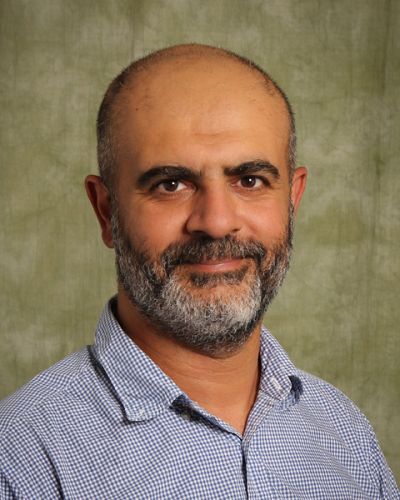
Amir Ahmadi Arian is an Iranian-American writer and Assistant Professor in the Department of English, General Literature and Rhetoric at Binghamton University (College of Arts and Sciences). He holds a PhD in Comparative Literature from the University of Queensland, Australia, an MFA in Creative Writing from New York University, and a BSc in Metallurgy Engineering from the University of Tehran, Iran. His research and teaching focus on creative writing, world literature, postcolonial novels, and Persian poetry. He has published two novels, a story collection, and a nonfiction book in Persian, and translated works by E.L. Doctorow, Paul Auster, P.D. James, and Cormac McCarthy into Persian. His English-language publications include fiction in Harper’s , The Paris Review , The New York Times , and other prestigious venues. His debut English novel Then the Fish Swallowed Him (HarperVia/HarperCollins, 2020) received critical acclaim from The New Yorker , Publishers Weekly , and Kirkus Reviews for its political themes and interior portrayal of oppression.
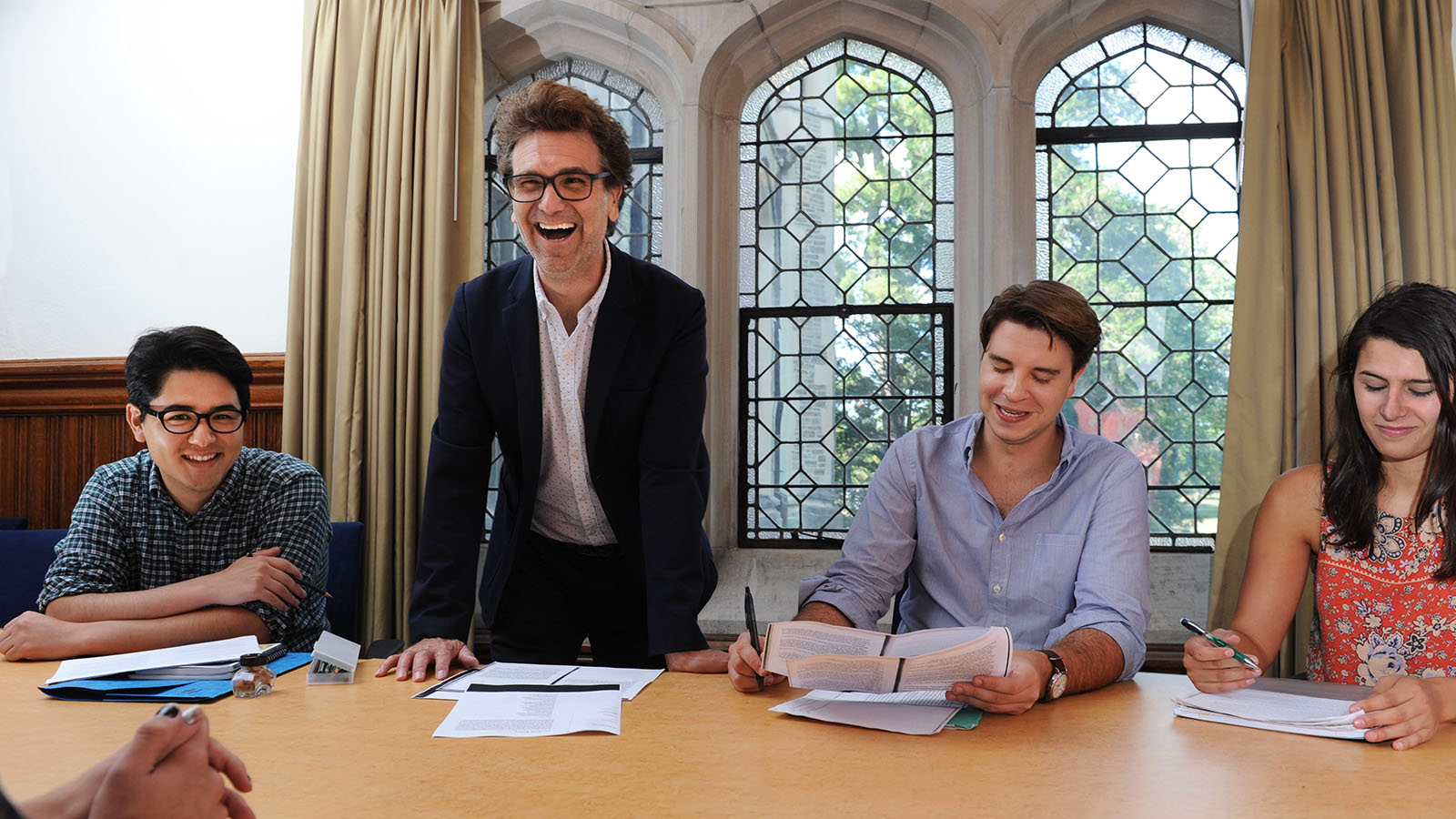
David Means is a Visiting Associate Professor of English at Vassar College, where he has taught since 2001. He holds a BA from The College of Wooster and an MFA in poetry from Columbia University. His academic work centers on creative writing, modern and contemporary fiction and poetry, and American culture. Education: BA, The College of Wooster MFA, Columbia University in the City of New York Means is a celebrated author of short fiction and novels, known for his lyrical prose, experimental narrative structures, and deep exploration of trauma, memory, and redemption. His work frequently appears in The New Yorker , Harper’s , The Paris Review , and other prestigious literary journals. His writing often returns to themes of violence, loss, and the quiet grace that emerges in their aftermath, drawing comparisons to Flannery O’Connor and Denis Johnson. His stories are marked by a nonlinear sense of time and a profound empathy for marginalized or broken characters. His recent publications include the story collection Instructions for a Funeral (2019) and Two Nurses, Smoking , with his novel Hystopia longlisted for the Man Booker Prize. His forthcoming non-fiction book, Pivot: Ruminations in the Shadow of Death , reflects on mortality and personal reflection. Selected Awards and Honors: Guggenheim Fellowship (2013) Three O. Henry Prizes Three Pushcart Prizes Los Angeles Book Prize for Fiction Finalist, National Book Critics Circle Award Finalist, Frank O’Connor International Short Story Prize Longlisted, Man Booker Prize Means has advised and influenced many emerging writers through his teaching and public readings. While specific students are not named in the sources, his role as a mentor is evident in his sustained presence in creative writing programs. He has no known research grants or lab affiliations, as his work is primarily literary and individual. He continues to publish and engage in public discourse on the nature of storytelling, including critiques of AI-generated fiction.
Timothy Hampton is a Professor of French and Comparative Literature at the University of California, Berkeley , and serves as Director of the Doreen B. Townsend Center for the Humanities . He was previously the Director of the Designated Emphasis in Renaissance and Early Modern Studies and co-chairs the Democracy, Free Speech, and Values study group. His research explores intersections of literature and politics , poetry and song , and the history of emotion and diplomacy in Renaissance and early modern periods. Recent projects include a 2022 France-Berkeley Fund grant on poetry translation and a Diebold Foundation grant for interdisciplinary cultural studies. Notable publications include Bob Dylan: How the Songs Work (2019) and Cheerfulness: A Literary and Cultural History (2022). Upcoming works address premodern colonialism and American education through memoir and cultural critique. His scholarship appears in MLN , Critical Inquiry , and public venues like Salon and Aeon/Psyche .
Dr. Heather Inwood serves as University Associate Professor in Modern Chinese Literature and Culture within the Faculty of Asian and Middle Eastern Studies at the University of Cambridge. She is also a Fellow and Director of Studies at Trinity Hall, maintaining dual institutional affiliations that support her teaching and research activities across undergraduate and postgraduate programs. Her educational background includes a BA in Chinese Studies from the University of Cambridge (Trinity Hall), followed by advanced studies at Tsinghua University and Peking University, culminating in a PhD in modern Chinese literature from SOAS, University of London in 2008. Prior academic appointments include Assistant Professor at The Ohio State University (2008-2013) and Lecturer in Chinese Cultural Studies at the University of Manchester before returning to Cambridge in 2016. Professor Inwood's research program investigates the dynamic interactions between digital media and literary production in contemporary China, with particular focus on poetry communities, genre fiction, and transmedia storytelling. Her work bridges traditional literary analysis with digital humanities approaches, examining how online platforms transform authorship, reception, and cultural value. She has pioneered scholarship on internet poetry scenes, demonstrating their vitality despite public perceptions of poetry's decline in modern China. Her publication trajectory reveals a clear evolution from early work on poetry communities ( Verse Going Viral: China's New Media Scenes , 2014) toward broader investigations of digital narrative forms, game studies, and Sinophone cyberspace. Recent publications increasingly engage with science fiction, transmedia storytelling, and the algorithmic structures shaping literary production, reflecting both the changing digital landscape and her expanding methodological toolkit. Professor Inwood actively supervises five PhD students working on diverse projects spanning Misty poetry, queer narratives, gender studies, and poetic animality, demonstrating her commitment to nurturing next-generation scholarship in Chinese literary studies. Her research has been supported by British Academy Small Grants and similar funding mechanisms that enable sustained fieldwork and publication. Her teaching responsibilities include undergraduate courses on East Asian media and popular culture, Modern Chinese texts, and Modern Chinese literature, connecting classroom instruction directly to her research expertise. She also maintains public engagement through Chinese-language columns for BBC China and other media outlets, bridging academic and public discourse on contemporary Chinese culture.
Laura Maria Lojo Rodriguez is a Professor in the Department of English and German Philology at the University of Santiago de Compostela , specializing in British literature and modernist/postmodernist fiction. She leads the Discourse and Identity research group (GI DI-1924), focusing on English language, literature, and culture through interdisciplinary frameworks. Her work intersects with the Humanities Research Institute (iHUS) . Her research spans: Gender and identity in Woolfian studies Migration narratives in contemporary short fiction Postcolonial themes in British-Irish literature Ecocritical and posthuman anxieties in Johnson's works Recent publications examine border politics, maternal discourses, and cross-cultural literary bonds. She has also contributed to translation studies, particularly Woolf's Spanish reception. Her academic output bridges literary theory with socio-political analysis.
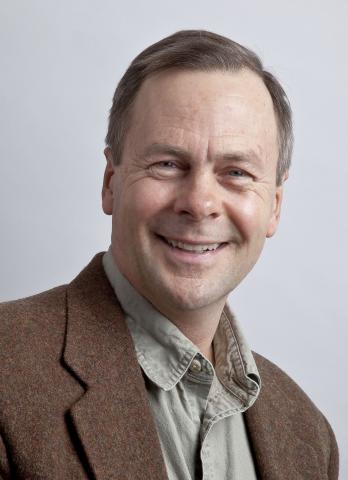
Stephen Cushman is the Robert C. Taylor Professor at the University of Virginia, specializing in American literature and poetry. His interdisciplinary work bridges Civil War studies, 19th-century poetry, and environmental literature. He earned his Ph.D. (1982), M.Phil. (1981), and M.A. (1980) from Yale University, and a B.A. from Cornell University (1978). His research explores how literary forms shape historical understanding, particularly through works like *The Generals' Civil War* (2021) and *Belligerent Muse* (2014). He has edited major volumes such as *The Princeton Handbook of Poetic Terms* (2016) and *Civil War Writing* (2019). His poetry collections include *Keep the Feast* (2022) and *Hothead* (2018), blending personal reflection with historical inquiry. Cushman has received prestigious awards including the Cavaliers' Distinguished Teaching Professorship (2014–2016) and the All-University Teaching Award (1992). His writing often intersects with Virginia’s literary landscape, as seen in *After Great Pain, Dickinson in Charlottesville* (2018). He actively engages with environmental themes in works like *Pope Francis, Laudato Si’, and U.S. Environmentalism* (2017). His articles critically analyze figures like Lincoln, Sherman, and Thoreau, while exploring modernist engagements with biblical texts and Civil War memory. He serves as a leading voice in American literary history, emphasizing the interplay between form, content, and cultural context.
Manex Aguirrezabal Zabaleta is an Associate Professor in the Department of Nordic Studies and Linguistics at the University of Copenhagen. He previously held positions as a Postdoc (2017-2019) and Assistant Professor at the same institution. His educational background includes: PhD in Natural Language Processing from the University of the Basque Country (UPV/EHU), conducted at the IXA NLP group. Master's degree in Natural Language Processing from UPV/EHU. Bachelor's degree in Computer Science (5 years) from UPV/EHU. Dr. Aguirrezabal's research focuses on the computational analysis of poetry , particularly stress patterns in English. He explores whether computers can effectively analyze poetic structures, a field with roots in the 1980s but revitalized by modern techniques. Additionally, he investigates language generation , computational morphology and phonology , and finite-state methods . His work bridges traditional linguistic inquiry with cutting-edge natural language processing. Recent publications (2023-2024) demonstrate a diverse engagement with computational linguistics, including poetry generation, multimodal corpus development, clickbait analysis, and fact-checking. His research often employs zero-shot learning and language models, reflecting current trends in AI-driven linguistic analysis. He has contributed to international collaborations such as ParlaMint (multilingual parliamentary corpora) and the GEHM Zoom corpus. While specific grant details are not provided, his active publication record indicates ongoing research support. Dr. Aguirrezabal maintains a strong connection to his Basque heritage, having pursued his early education in the Basque language.
Rebecca Dyer is a **Professor of English** at **Rose-Hulman Institute of Technology**, where she has been affiliated since 2002. Her academic career includes teaching Technical and Professional Communications, film, and literature courses, with a focus on transnational, postcolonial, and British studies. She holds a PhD in English from the University of Texas at Austin (2002), an MA from the University of Tulsa (1995), and a BS in Journalism from Oklahoma State University (1989). Her research explores class, power, and anticolonial dynamics in literature and film. Notable projects include analyses of works by Graham Greene, Harold Pinter, Mahmoud Darwish, and filmmakers like Jean-Luc Godard. She conducted Fulbright-funded research in Lebanon (2007–08), producing scholarship on servant narratives and Lebanese cultural studies. Her work frequently intersects with migration, displacement, and transnational identities. Dr. Dyer’s awards include the **Fulbright Traditional Scholars Award** (Lebanon) and **Rose-Hulman’s Scholar of the Year Award** (2007). Her teaching and research span global literatures, with a particular emphasis on British and Arabic texts. She has also taught at France’s Université d’Orléans (2015–16) and contributed to cultural studies courses abroad. Her publications address themes like servant-worker depictions, postcolonial cinema, and memorialization of conflicts. Current research includes forthcoming analyses of Bong Joon Ho’s *Parasite* and Steven Zaillian’s *Ripley* series, exploring parasitic power dynamics.
Rachel Fell McDermott is Professor of Asian and Middle Eastern Cultures at Barnard College, Columbia University, specializing in South Asian religions, particularly the Hindu goddess traditions of Bengal in India and Bangladesh. Her work bridges religious studies, human rights, and comparative religion, with a strong focus on Kali, Durga Puja, and the literary legacy of Kazi Nazrul Islam. Education: A.B., Religious Studies, University of Pennsylvania, 1981 M.Div., Harvard Divinity School, 1984 A.M., Study of Religion, Harvard University, 1986 Ph.D., Study of Religion, Harvard University, 1993 Her research centers on the religious and cultural dynamics of Bengal, exploring themes such as goddess worship, ritual practices, religious poetry, and the intersection of religion with politics and identity. She is deeply engaged in comparative religion, examining how religious themes like suffering, sacrifice, and divine femininity manifest across traditions. Her scholarship also addresses diasporic religious experiences, digital religion, and interfaith dialogue, particularly between Hindu and Christian communities. The 15 most recent publications reflect a sustained scholarly engagement with goddess traditions, especially Kali and Durga, as well as broader themes in South Asian religion, including Tantric symbolism, festival culture, and the reception of Hindu deities in the West. Her work spans ethnographic, historical, and textual analysis, often highlighting the contested and evolving nature of religious canons. She frequently contributes to major academic anthologies and journals in religious studies, South Asian studies, and comparative theology. Scientific Awards: No specific awards listed in the provided text. As a senior professor and managing editor of major academic volumes, she has likely advised numerous graduate students and secured research funding, though specific names and grants are not mentioned. She teaches courses such as “Why Do Bad Things Happen to Good People?” that explore theodicy across religions. She is currently on leave for the 2024–2025 academic year, indicating ongoing active involvement in academic life. She is involved in significant editorial projects, including the third edition of The Sources of Indian Traditions , and is working on translations and a monograph on Kazi Nazrul Islam. Her scholarly presence includes invited lectures at institutions such as Princeton, the University of Connecticut, and the Bangla Academy in Dhaka, reflecting her international recognition in the field of South Asian religious studies.
Adrienne Raphel is a Lecturer in the Department of English at Baruch College, part of the Weissman School of Arts and Sciences at The City University of New York (CUNY). She holds a Ph.D. in English Literature from Harvard University, an M.F.A. in Creative Writing (Poetry) from the University of Iowa, and a B.A. in English Literature and Creative Writing from Princeton University. Her research and creative work intersect contemporary culture, poetry, and the history of wordplay. She explores modernist literature, dark academia, and the evolution of puzzles like crosswords and board games as cultural artifacts. Raphel's recent publications highlight crosswords, poetry, and literary criticism, reflecting her interests in generational trends, linguistic innovation, and urban themes. Her articles analyze cultural phenomena through the lens of games, literature, and media. She has received prestigious awards, including: Visiting Fellowship at the American Library in Paris (2023) James Merrill Writer in Residence (2023) Writer in Residence at The Mastheads (2018) Raphel serves on the Awards and Honors Committee and teaches courses such as Writing II and Great Works of Literature I. She has contributed to media outlets like The New Yorker , The New York Times , and The Paris Review .
Vladimir Golstein is Professor of Slavic Studies and Interim Chair of Slavic Studies at Brown University. He has previously held teaching positions at Oberlin College (1990–1993) and Yale University (1993–2003), where he taught a wide range of courses on Russian and Western literary traditions. Ph.D. in Slavic Languages and Literatures, Yale University, 1992 B.A. in Philosophy, Columbia University, 1982 M.S. in Computers, Moscow Institute of Management His research centers on Russian culture, religion, philosophy, and poetry from the 19th and 20th centuries. He has published extensively on major Russian authors including Pushkin, Gogol, Tolstoy, Dostoevsky, Chekhov, Tsvetaeva, and Bulgakov. His book Lermontov's Narratives of Heroism (1998) explores heroism in 19th-century Russian literature. He is currently completing a monograph on generational conflict in Russian society. The recent publications reflect a consistent engagement with Russian intellectual and cultural history, blending literary analysis with philosophical and religious inquiry. His work often examines the moral and spiritual dimensions of literature, particularly in relation to the role of the intelligentsia and artistic expression under political pressure. There are no scientific awards listed in the provided text. Professor Golstein has supervised graduate and undergraduate students and teaches courses such as Russian Culture: From Peter the Great to Putin , Dostoevsky , Russian Poetry: Silver Age , and Roaring Twenties: Literature, Arts, and Politics in Post-Revolutionary Russia . While specific grant information is not mentioned, his ongoing research and publication record suggest active scholarly engagement. He is deeply involved in the academic life of the Department of Slavic Studies at Brown, contributing to curriculum development and leadership as Interim Chair. His interdisciplinary approach connects literature with philosophy, religion, and visual arts, fostering a holistic understanding of Russian cultural evolution.
David Mimno is an Associate Professor and Chair of the Department of Information Science at Cornell University. He holds a PhD from the University of Massachusetts Amherst and previously worked at the Perseus Project and Princeton University. His research focuses on computational social science, natural language processing, and historical text analysis. Mimno is known for developing the MALLET toolkit, a widely used Java-based platform for machine learning in text processing. He teaches courses such as INFO 4940: How LLMs Work and INFO 6150/CS 6788: Advanced Topic Modeling. His work has been supported by the Sloan Foundation, NEH, and NSF. Mimno advises PhD students in Information Science and Computer Science, emphasizing interdisciplinary research at the intersection of computing and humanities/social sciences. He also contributes to initiatives like AI for Humanists, making large language models accessible for text-as-data research. Bachelor’s degree: Not explicitly stated in text PhD: University of Massachusetts Amherst Research Interests: Mimno explores large language models, topic modeling, cross-lingual semantics, and ethical AI applications in humanities and legal domains. His recent work addresses data curation practices for language models, LLM memorization of poetry, and generative AI’s societal impacts. He co-authored reports on generative AI in academic research and education. Grants & Collaborations: His projects include the Text as Data (TADA) conference and collaborations on generative AI law workshops. Mimno’s MALLET toolkit supports document classification, clustering, and topic modeling, with applications in cultural analytics and computational historiography.
Massachusetts Institute of TechnologyUnited States
Nick Montfort is a Professor of Digital Media at Massachusetts Institute of Technology (MIT) and Professor II & Principal Investigator at the University of Bergen 's Center for Digital Narrative. He directs MIT's Trope Tank lab/studio and contributes to platform studies, critical code studies, and electronic literature. Ph.D. in Computer and Information Science from University of Pennsylvania (2007) M.A. in Creative Writing (Poetry) from Boston University (2001) S.M. in Media Arts and Sciences from MIT (1998) B.S./B.A. in Computer Science and Liberal Arts from University of Texas at Austin (1995) Montfort's research focuses on computational creativity and digital poetics , particularly through exploratory programming and constraint-based writing . He has developed over ten computer-generated print books and co-edited MIT Press volumes like The Future and The New Media Reader . His work bridges computer science and literary arts , emphasizing algorithmic expression and platform-specific creation. His recent computational works include All the Way for the Win (2025), written entirely in three-letter words, and collaborations like The Deletionist and Sea and Spar Between . Notable books cover interactive fiction ( Twisty Little Passages ), platform studies ( Racing the Beam ), and generative literature ( 10 PRINT ). He also co-edits the Hardcopy and Using Electricity book series. Montfort's academic contributions span digital narrative systems , creative code , and computer-generated literature . His 101 BASIC Poems and Output: An Anthology of Computer-Generated Text exemplify his focus on code as cultural artifact and algorithmic literary practice . He has presented at major conferences including ELO, C&C, and Digital Arts and Culture, addressing topics from minimalist computational poems to narrative modeling . Through collaborations with institutions like University of Bergen and MIT's Comparative Media Studies/Writing, Montfort explores digital storytelling , machine-generated poetry , and platform-specific creativity . His academic leadership includes directing the Trope Tank and co-founding Bad Quarto press.
Sandro Zanetti, Full Professor of General and Comparative Literature at the University of Zurich's Faculty of Arts and Humanities, specializes in avant-garde research, artistic production processes, and poetics of (im)probability. He studied German, History, and Philosophy at Basel, Freiburg, and Tübingen (1993-1999), earned his PhD in 2005 at Basel's SNSF project, and held positions including Junior Professor at Hildesheim (2008-2011) and DFG network head (2010-2014). Since 2011 at UZH, he progressed from Assistant to Full Professor (2022) and serves as Co-Dean of Studies since 2021. Current affiliations: Department of General and Comparative Literature (UZH), Center for Arts and Cultural Theory (ZKK), Literary Radio Zurich Former roles: ZGW Center (2010-2022), SNF project leader (2015-2019), Co-editor of History of the Present (2016-present) His research explores: Avant-garde genealogies and postwar literary modernity Time perception and aesthetic temporality Writing as cultural technique Interdisciplinary intersections with philosophy, media studies, and art Publications reveal trends in: 2022-2024: Dada historiography, AI-generated literature, Paul Celan's late works 2019-2021: Aesthetic theory, transactuality, Barthesian concepts 2014-2017: Improvisation networks, multilingualism, collaborative writing He co-founded interdisciplinary platforms and maintains editorial roles across 15 anthologies since 2004.
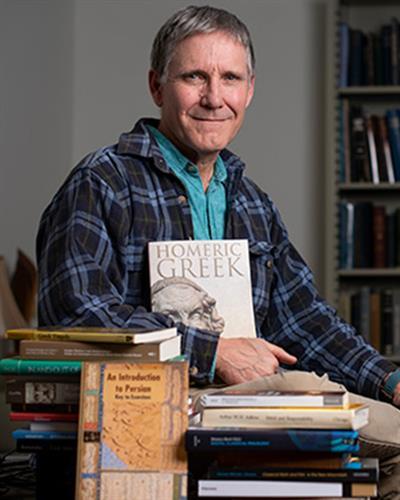
Gregory Crane is Professor of Classical Studies and Computer Science at Tufts University, where he holds the Winnick Family Chair in Technology and Entrepreneurship and serves as Chair of the Classical Studies Department. He also maintains a professorship in the School of Engineering's Computer Science department. Previously, he was Alexander von Humboldt Professor of Digital Humanities at Leipzig University in Germany from 2013-2019. PhD in Classical Philology, Harvard University (1985) BA in Classics, Harvard University (1979) Crane's research bridges traditional classical scholarship with digital technology. His work in classical studies focuses on ancient Greek authors, particularly Thucydides, with two major books published on the subject. Simultaneously, he has been a pioneer in digital humanities, beginning work on digital tools for classics as a graduate student in 1982. He is the Editor-in-Chief of the Perseus Project, which he has directed since 1985, developing morphological analysis systems and overseeing the project's evolution through multiple generations of digital library technology. His recent publications demonstrate a strong trend toward integrating artificial intelligence with classical language studies, developing next-generation digital libraries, and exploring new methods for engaging with classical texts in the digital age. Crane's work increasingly focuses on making ancient languages more accessible through technology, with research spanning digital philology, language learning tools, and corpus-based approaches to historical languages. Winnick Family Chair in Technology and Entrepreneurship Alexander von Humboldt Professor of Digital Humanities Crane has secured substantial research funding from major organizations including the National Endowment for the Humanities, the Andrew W. Mellon Foundation, the National Science Foundation, and Google. His current and recent projects include "Reinventing the study of ancient languages" and "Beyond Translation -- new possibilities for reading in a digital age." He has advised numerous students through senior honors theses and directed dissertation research in Classical Studies at Tufts University. Crane leads the Perseus Digital Library research program, which has evolved through multiple generations of technology to become a leading resource for classical studies. His work has established critical infrastructure for digital classics, including named entity identification systems and morphological analysis tools that have shaped the field of digital humanities.