Mick Filmer is a Senior Lecturer at Curtin University's School of Earth and Planetary Sciences (EPS) within the Faculty of Science and Engineering. He serves as Curtin's representative on the Land Surveyors Licensing Board of Western Australia and holds a PhD (Curtin University) and a Bachelor of Geoinformatics and Surveying (University of South Australia). His research focuses on InSAR technology, vertical land motion, height systems, and coastal sea surface topography, with over 30 peer-reviewed publications since 2007. Teaching responsibilities include Survey Law Ethics Practice, Cadastral Surveying, and Applied Geodetic Surveying. Research contributions span geodetic datum development (e.g., AUSGeoid09), InSAR deformation analysis, and land subsidence monitoring in the Perth Basin and Latrobe Valley. He collaborates with organizations like the International Association of Geodesy and European Geosciences Union. Key projects include evaluating Australia’s AUSHYDROID vertical datum model (2024), integrating InSAR with terrestrial reference frames (2021), and analyzing ocean tide signals in coastal zones (2023). His work bridges geodesy, remote sensing, and hydrogeology, addressing challenges in vertical land motion monitoring and geodetic infrastructure planning.
Steven Greybush is an Associate Professor in the Department of Meteorology and Atmospheric Science at Pennsylvania State University, College of Earth and Mineral Sciences. He is based in University Park, PA, and his research bridges atmospheric science, climate modeling, and interdisciplinary applications. He leads and contributes to major research initiatives involving AI-enhanced weather forecasting, planetary meteorology, and climate impacts on water and health systems. His research interests include Atmospheric Science , Climate Modeling , Data Assimilation , Planetary Meteorology (especially Mars) , Lake-Effect Snowbands , Tropical Cyclones , and Climate-Health Interactions . His work applies advanced techniques such as the Ensemble Kalman Filter (EnKF), Local Ensemble Transform Kalman Filter (LETKF), and AI-driven models to improve predictions of weather and climate phenomena. His recent publications (2021–2025) reveal a strong trend in integrating satellite and radar data into numerical models, enhancing forecasts of convection, hurricanes, and snowstorms. He also explores Martian atmospheric dynamics and the impact of climate variability on public health in Africa. His work is supported by major grants from NASA and NSF, including a $1.23 million NASA grant to improve AI satellite weather forecasting and an NSF grant for AI-powered weather pattern understanding. $1.23 million NASA grant for AI satellite weather forecasting NSF grant for AI-powered weather pattern understanding Penn State part of $6.6M consortium to improve weather forecasting Reducing Uncertainty in River System Forecasts to Maximize Nuclear and Hydro Generation Greybush collaborates with interdisciplinary teams and participates in field campaigns such as IMPACTS (Investigation of Microphysics and Precipitation for Atlantic Coast-Threatening Snowstorms). He advises or co-advises graduate students and researchers, though specific advisees are not listed. His work is published in top journals including Journal of Geophysical Research , Monthly Weather Review , JAMA Network Open , and PNAS .
Klaus Wallmann is a Professor and Head of the Research Unit Marine Geosystems at GEOMAR Helmholtz Centre for Ocean Research Kiel and the Christian-Albrechts-University (CAU) Kiel. His research focuses on marine biogeochemistry, particularly gas hydrates, fluid flow, nutrient cycling, and the geochemical evolution of oceans and atmosphere. He leads major research initiatives including the Cluster of Excellence 'The Future Ocean' and coordinates EU projects such as MIGRATE and GEOSTOR. Dipl. Chemistry, Philipps University of Marburg (1986) Dr. Ing., TU Hamburg-Harburg (1990) PD Dr. habil (Geosciences), CAU Kiel (1999) His research interests center on marine biogeochemical processes, including the microbial degradation of organic matter, gas hydrate formation, nutrient recycling, isotopic trends in marine carbonates, and numerical modeling of ocean-atmosphere evolution. He investigates cold seeps, mud volcanoes, and subduction zones to understand volatile cycling and seafloor dynamics. His recent publications reveal a strong focus on carbon cycling and climate mitigation, particularly through sub-seabed CO₂ storage, seafloor alkalinity enhancement, and the impact of anthropogenic activities on marine carbon storage. His work combines field observations, experimental data, and advanced numerical models to explore long-term geochemical trends and modern environmental challenges. Scholarship from the Evangelical Study Foundation, Haus Villigst (1982–1986) Wallmann has supervised numerous students and collaborators, contributing to major discoveries in marine methane dynamics, gas hydrate systems, and ocean deoxygenation. His research is supported by extensive fieldwork, ocean expeditions, and leadership in collaborative programs such as SFB 574 and SFB 754. He has played a central role in assessing the environmental impacts of CO₂ storage and natural gas hydrate exploitation. He leads research in marine geosystems at GEOMAR, focusing on biogeochemical feedbacks, fluid-sediment interactions, and climate-relevant gas cycling. His team integrates geochemical data, isotopic analyses, and modeling to study processes from molecular to global scales.
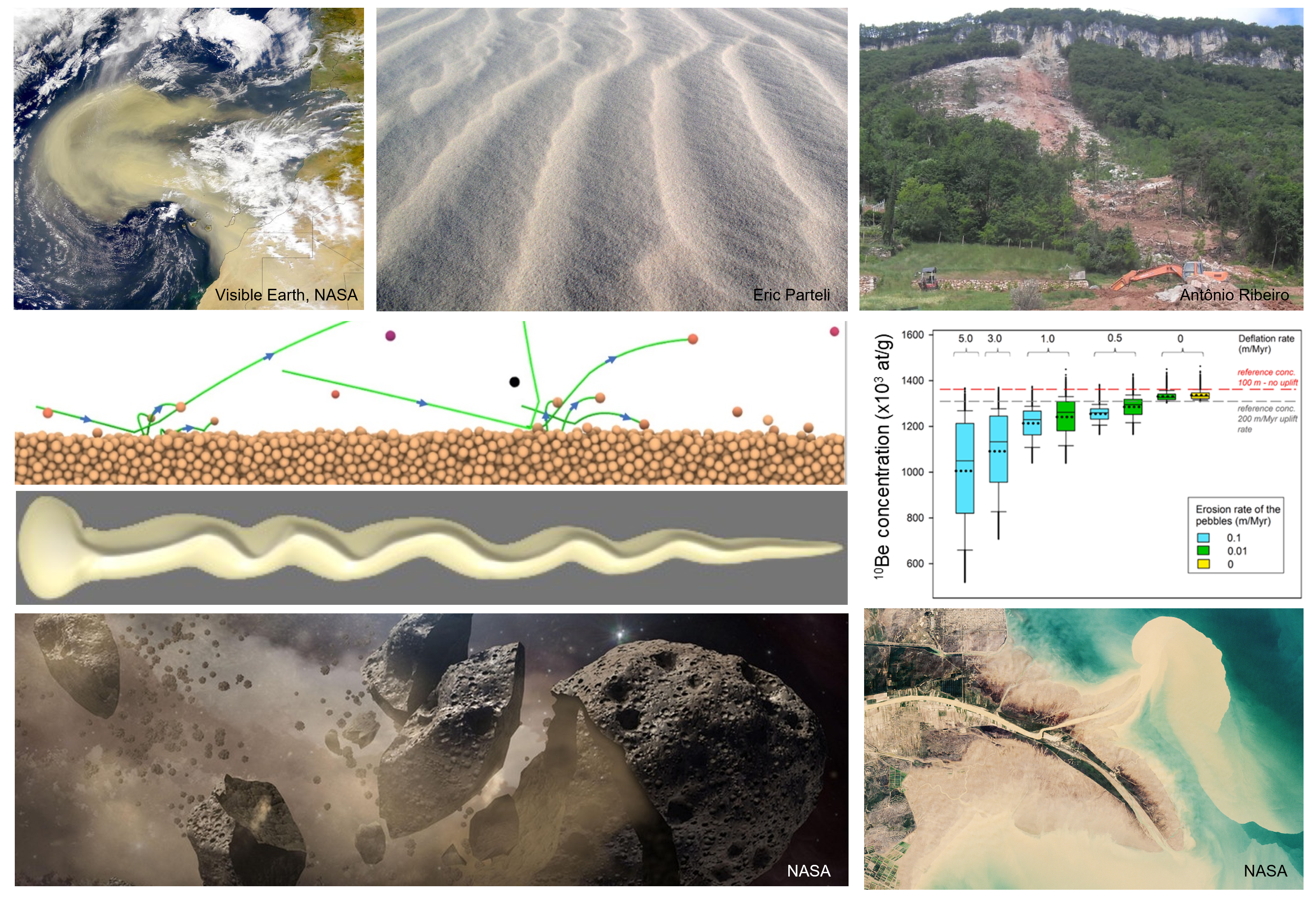
Dr. Eric Parteli is a Heisenberg Group Leader at the Faculty of Physics, University of Duisburg-Essen , with affiliations to the University of Cologne (Computational Geosciences) and The University of Alabama . He leads research on Earth surface particulate materials and their dynamics under wind, fluvial processes, and gravitational forces. Current and former students include PhD candidates, Master/Bachelor candidates, and research assistants like Cong Jiang , Maria Determann , Mateusz Kryger , and Joel Jankowiak . His group develops computational tools to model particle interactions and feedbacks with geomorphology, biosphere, and atmosphere across scales, with applications in climate science, planetary geophysics, and natural hazard risk assessment. Key research themes include aeolian processes , hydrological modeling , granular material behavior , and coupled Earth surface systems . No scientific awards are explicitly mentioned in the provided texts. His lab operates from Room MG 364 at the University of Duisburg-Essen and collaborates with the Computational Geosciences department at the University of Cologne. Recent publications highlight anomalous scaling in sand transport , angle of repose modeling , and regional hydrological systems in arid environments.
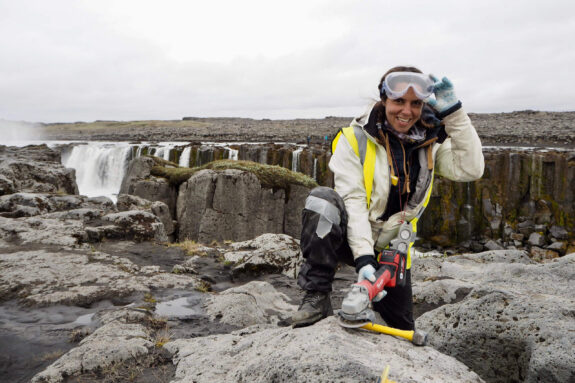
Gaia Stucky de Quay is an Assistant Professor of Earth and Planetary Sciences at the Massachusetts Institute of Technology (MIT), appointed to the Department of Earth, Atmospheric and Planetary Sciences (EAPS) in 2023. She holds the Peter Puster (1995) and Paula Waschbusch (1994) Career Development Professorship, effective January 1, 2025. Her research investigates the driving forces behind the formation, evolution, and decay of planetary surfaces across the solar system, with particular focus on Mars and Earth analogs. Dr. Stucky de Quay's research interests span planetary surface processes including fluvial systems, lakes & hydrology, volcanic terrains, glaciated landforms, icy satellites, uplift & dynamic support, climate-land links, and landscape evolution. She employs a multi-faceted approach combining theoretical studies, field work, remote sensing, and laboratory analyses to quantify the interactions between fluvial erosion, climate, and tectonics across various spatial and temporal scales. Her work seeks to understand whether Mars had conditions suitable for life by examining ancient river systems and lake formations. Her publication record demonstrates expertise in Martian paleoclimate studies, with significant contributions to understanding precipitation constraints from paleolakes on Mars and the persistence of climate-driven runoff in Mars' history. She also conducts important research on Earth's post-glacial landscape evolution, particularly in Iceland, which serves as an analog for understanding Martian surface processes. Early Career Grant, British Society for Geomorphology (2020) Ralph Brown Expedition Award, Royal Geographical Society (2020) Dr. Stucky de Quay's research bridges Earth and planetary sciences, with implications for understanding both planetary habitability and natural hazards on Earth. Her lab investigates volcanic islands as accessible analogs for Martian terrain, examining how climate shapes landscapes over geological time. She is building a research group focused on planetary analog studies that transfers knowledge between different planetary bodies while integrating multiple techniques from field work to computational analysis.
Tal Cohen is an Associate Professor in the Department of Civil and Environmental Engineering at the Massachusetts Institute of Technology (MIT), School of Engineering. He joined MIT as an assistant professor in November 2016 after working at Harvard's School of Engineering and Applied Sciences, and was granted tenure in May 2023. He leads the Cohen's Mechanics Group, which focuses on understanding material behavior under extreme conditions including large deformations, dynamic loading, and growth. His educational background includes a Ph.D. (2014), M.Sc. (2011), and B.Sc. (2007) from the Faculty of Aerospace Engineering at the Technion, Israel. Professor Cohen's research centers on nonlinear solid mechanics, material growth, and material instabilities. His work combines theoretical modeling with experimental approaches to explore how materials behave at their extremes. Key research areas include understanding material instabilities (what triggers them, how they can be harnessed or avoided), extreme dynamic loading (shock wave propagation, energy dissipation), and material growth with chemical coupling (how growth leads to residual stresses and morphological changes). His research has significant implications for protective structures, understanding planetary impacts, and biological systems. Analysis of his recent publications (2015-2025) reveals a consistent focus on nonlinear mechanics of soft materials, with increasing emphasis on biological applications in recent years. His work spans theoretical frameworks for material growth, experimental characterization of soft material properties, and computational modeling of complex material behaviors. Key themes include cavitation phenomena, fracture mechanics in soft materials, and the mechanics of biological growth processes. MIT Arthur C. Smith Award, 2024 Eshelby Mechanics Award for Young Faculty, 2023 NSF CAREER Award, 2020 ONR Young Investigator Award, 2020 ARO Young Investigator Award, 2019 MIT-Technion Post-Doctoral Fellowship, 2013-2014 Zonta International Amelia Earhart Fellowship, 2011-2012 Professor Cohen has advised numerous students through their PhD, Master's, and undergraduate research projects. His group includes current PhD candidates working on topics related to material growth, biological mechanics, and extreme loading conditions. He has successfully placed former postdocs in faculty positions at institutions including Harvard, UNH, and Central South University in China. His research has been supported by significant grants including the NSF CAREER Award and Young Investigator Awards from ONR and ARO. The Cohen Mechanics Group maintains an active research program with connections to multiple disciplines including civil engineering, mechanical engineering, materials science, and biomechanics.
Eric Hetland is an Associate Professor in the Department of Earth and Environmental Sciences at the University of Michigan. His research focuses on geophysical natural hazards, particularly earthquake dynamics from a geodetic perspective. He investigates fault loading processes during interseismic and postseismic periods, and collaborates on modeling volcanic eruption conditions with Prof. Becky Lange. His work integrates machine learning methods into geodetic data analysis, addressing climate studies and hazard vulnerability. Applied mathematics and computational science are central to his interdisciplinary approach. Education: PhD in Geophysics from MIT (2006), MA in Geology from SUNY Binghamton (2000), BS in Physics from UC Santa Cruz (1996) Research Interests: Seismology, Geodesy, Crustal Deformation, Geodynamics, Magmatism and Volcanism Lab/Teams: Active collaborations with interdisciplinary teams, leveraging geodetic and computational tools His recent publications emphasize coseismic slip distribution modeling, Bayesian stress inversion, and transient strain analysis using advanced statistical methods. He has no listed scientific awards but maintains an active research program funded through collaborative grants. Advising focuses on graduate student training in geophysical hazards and computational geophysics.
Claire Currie, PhD, is a Professor in the Department of Physics at the University of Alberta and Associate Dean, Graduate, within the Faculty of Science. She holds a B.Sc. from the University of Western Ontario (1999), a Ph.D. from the University of Victoria (2004), and completed a post-doctoral fellowship at Dalhousie University (2005–2007). Her research focuses on lithosphere structure, mantle dynamics, and the evolution of convergent plate margins, employing numerical modeling to explore processes like continental tectonics and subduction zone dynamics. Currie teaches GEOPH 110: Introduction to Earth and Planetary Physics, covering geophysical methods for imaging planetary interiors, resource exploration applications, and geophysical hazards. Her work bridges theoretical modeling with observational data, addressing questions about plate tectonics, mantle flow, and crustal deformation. Her recent publications (2022–2024) emphasize geodynamic modeling of cratonic basins, flat-slab subduction impacts, and mantle dynamics in regions like the Andes, Cascadia, and the Canadian Cordillera. Research trends highlight interdisciplinary approaches linking tectonics, magmatism, and surface processes. While no explicit awards are listed, her extensive publication record reflects sustained academic contribution. Currie’s advising and grant activities are not detailed in the provided texts, but her academic roles suggest leadership in graduate education and research administration within the Faculty of Science.
Aaron Diefendorf is a Professor of Geosciences at the University of Cincinnati within the College of Arts and Sciences. His research focuses on the application of organic geochemical techniques to address questions in paleoclimatology, biogeochemistry, and environmental science. He directs the University of Cincinnati Stable Isotope Laboratory, where his team analyzes biomarkers from sedimentary archives to reconstruct past climate and environmental conditions. Dr. Diefendorf's research interests center on isotope geochemistry, biogeochemistry, organic geochemistry, biomarkers, and stable isotope geochemistry. His work particularly emphasizes plant-derived biomarkers such as leaf waxes (n-alkanes) and diatom-derived highly branched isoprenoids (HBIs) as proxies for reconstructing past hydrological conditions. He investigates how these biomarkers form in modern ecosystems, their preservation in sediments, and their application to paleoclimate reconstruction across various timescales from the Holocene to deep time. His research spans diverse environments including midcontinental North America, the Sierra Nevada, Falkland Islands, and Arctic regions. The analysis of his recent publications reveals a strong focus on methodological development for biomarker analysis, seasonal and spatial variability studies of biomarker production, and their application to specific paleoclimate questions. His work increasingly integrates multi-proxy approaches, combining plant wax and diatom biomarkers with other geochemical indicators to provide more robust paleoenvironmental reconstructions. Recent research shows growing interest in applying these techniques to understand hydrological changes during significant climate transitions including the Little Ice Age and Holocene. Extensive research on plant wax n-alkanes as paleohydrological proxies Pioneering work on diatom-derived HBIs for paleoclimate reconstruction Studies on biomarker production in modern ecosystems to improve paleo-interpretations Applications to major climate events including the Paleocene-Eocene Thermal Maximum Development of analytical methods for biomarker extraction and analysis Dr. Diefendorf has established productive collaborations across multiple institutions and disciplines, working with researchers in geology, biology, environmental science, and climate science. His research has been supported by multiple NSF grants, including collaborative projects focused on biomarker development and paleoclimate applications. He actively engages in public science communication, including outreach at local farmer's markets in the Cincinnati community. His laboratory work focuses on the Stable Isotope Laboratory at the University of Cincinnati, where his team processes sediment samples, extracts organic compounds, and analyzes isotopic compositions using state-of-the-art instrumentation. The lab serves as a hub for interdisciplinary research, training graduate and undergraduate students in geochemical techniques while advancing methodological approaches in biomarker paleoclimatology.
Dr. Éric Hébrard is a Senior Lecturer in Astrophysics at the University of Exeter since 2018, with prior academic roles including NASA Goddard Senior Research Fellow and CNRS Research Associate. His work bridges planetary atmospheres, astrochemistry, and combustion modeling with expertise in 3D chemical simulations. PhD in Physics and Chemistry of Planetary Atmospheres, Université Paris 7 (2006) Magna cum laude Magistère Interuniversitaire de Chimie, ENS Paris (2003) Research focuses on: Exoplanetary atmosphere modeling (hot Jupiters, TRAPPIST-1e) Photochemical kinetics and UV absorption Coupling of atmospheric circulation and chemistry Cross-disciplinary combustion-atmosphere analogs Chemical validation strategies for model accuracy Scientific contributions include: NASA-funded research on organic-rich habitable zones Development of KIDA kinetic database for astrochemistry STFC Consolidated Grant for multi-dimensional chemical models Quantum chemistry integration for Titan atmosphere studies Awards: Higher Education Academy Fellowship (ASPIRE program) NASA Postdoctoral Fellowship (2015-2017) CNES Postdoctoral Fellowship (2007-2009)
Ethan Williams is an Assistant Professor at the University of California, Santa Cruz, Department of Earth & Planetary Sciences. His research focuses on distributed acoustic sensing (DAS) applications in seismology, oceanography, and environmental monitoring, particularly studying wave dynamics, subduction geohazards, and ocean-solid Earth interactions. Ph.D. in Geophysics, California Institute of Technology (2023) M.S. in Geophysics, California Institute of Technology (2019) B.S. in Geophysics and B.A. in Music, Stanford University (2017) Research Interests: Williams specializes in DAS technology, subduction zone geohazards, surface wave dynamics, and ocean-solid Earth coupling. His work bridges seismic monitoring, marine geophysics, and environmental sensing. Publication Trends: His recent articles emphasize DAS innovation for offshore seismic monitoring, wave propagation analysis, and integrating fiber-optic data with conventional measurements. Themes include earthquake detection, climate change impacts, and multi-scale ocean dynamics. Scientific Awards: 2022 SSA Student Presentation Award for 'Continuous seismic monitoring of a building over 20 years' Advising & Collaboration: Williams collaborates with institutions like the University of Washington and Caltech, working on NSF-funded projects such as the Ocean Observatories Initiative. He invites prospective students/postdocs to contact him via email.
Catherine Neish is an Associate Professor in the Department of Earth Sciences at The University of Western Ontario. She serves as the Associate Director of Research for Western Space and is a Co-Investigator on NASA's Dragonfly mission to Titan. Her research focuses on planetary radar observations, impact cratering processes, and the geological evolution of planetary surfaces, particularly on the Moon, Titan, and other Solar System bodies. Ph.D. in Planetary Sciences, University of Arizona (2008) B.Sc. in Combined Honours Physics and Astronomy, University of British Columbia (2004) Her recent publications highlight studies on lunar impact crater thermophysics, Titan's impact melt dynamics, and radar-based analyses of planetary surfaces. She has contributed to missions including Lunar Reconnaissance Orbiter (Mini-RF), Cassini RADAR, and Dragonfly. Scientific Awards: College of New Scholars, Royal Society of Canada (2021) Early Researcher Award, Ontario (2017) Minor Planet 16972 Neish (2017) AGU Ron Greeley Award (2014) NASA Postdoctoral Fellowship (2012) NASA Group Achievement Award (2010) NSERC Postgraduate Scholarship (2005-2008) Julie Payette-NSERC Research Scholarship (2004-2005) Dr. Neish supervises a dynamic lab with current and former students investigating planetary geology, impact cratering, and remote sensing. Her work bridges field studies (e.g., Earth analogs), laboratory experiments, and spacecraft data analysis.
Ralf Jaumann is a Professor at the Free University of Berlin within the Institute of Geological Sciences, Department of Planetary Sciences and Remote Sensing . He serves as Deputy Director of the Institute of Planetary Research and previously led the Planetary Geology Department at the German Aerospace Center (DLR) in Berlin-Adlershof until January 2020. As Principal Investigator of the High Resolution Stereo Camera (HRSC) on ESA's Mars Express mission (2013-2021), he has significantly contributed to Mars geology studies. Co-PI of Mastcam-Z on NASA's Mars 2020 mission Co-I on instruments for Rosetta , Cassini , Dawn , and ExoMars missions Coordinated global Mars color mosaics and long-term surface change detection using HRSC data His research focuses on planetary geology , remote sensing , and space mission instrumentation , particularly analyzing geological processes on Mars, asteroids, and icy satellites. Recent publications examine spectral properties of asteroid regolith, Martian aeolian processes, and hydration dynamics on the Moon. Despite his extensive involvement in mission operations, no specific student advisement records or scientific awards are mentioned in the provided data. Jaumann teaches Planetary Exploration: Space Missions and Planetologie Literaturseminar at the graduate level.
Frans van Lunteren is a Professor of History of Natural Sciences at Leiden University, specializing in the Dutch natural sciences between 1815 and 1940, particularly physics. His research examines science-society interactions, institutional roles of universities and research institutes, and the cultural dimensions of scientific progress. He holds a PhD awarded at Teylers Museum at age 68, demonstrating late-career academic achievement. His work bridges historical analysis with modern scientific communication, emphasizing the role of instruments and internationalization in scientific development. Education: PhD in History of Science (Teylers Museum, 2017) Affiliations: Leiden Observatory, Navegar Foundation (Portugal), European planetary science networks Research focuses on determinism debates in early 20th-century science, KNMI and KNAW institutional roles, and the material culture of scientific instruments. He has advised five PhD students and pioneered fulldome planetarium shows like Camping with the Stars , blending education and entertainment. His publications span peer-reviewed journals, popular science articles, and international astronomy outreach programs like IYA2009. Key contributions include the International Year of Astronomy 2009 Final Report and Venus Express mission analysis. His work highlights interdisciplinary approaches to science history, combining archival research with public engagement initiatives.
Brian Walsh is an Associate Professor of Mechanical Engineering at Boston University, with affiliations in the Departments of Astronomy and Electrical and Computer Engineering. He holds a Ph.D. in Mechanical Engineering from Boston University (2011) and a B.A. from Colgate University (2006). His research focuses on experimental space physics and spacecraft instrumentation, particularly studying solar wind-magnetosphere interactions, magnetopause reconnection, and X-ray imaging techniques. His work investigates energy transfer from the Sun to Earth's space environment, with a primary focus on the magnetopause. Walsh develops instruments for NASA and ESA missions, including the LEXI lunar X-ray imager and the CuPID CubeSat. He has contributed to missions like SMILE and pioneered compact solar energetic particle telescopes. His research spans CubeSat-based observations and large-scale space missions, emphasizing cross-scale coupling and global magnetospheric dynamics. Key research interests include plasma turbulence, magnetosheath dynamics, and exosphere variability. Walsh collaborates on projects like the Trans-Heliospheric Survey and the Magnetospheric Constellation (MagCon), aiming to advance understanding of heliospheric plasma behavior. His work also addresses space weather prediction and instrument calibration, such as the Carruthers Observatory Student Solar Monitor (COSSMo). Walsh's recent studies explore solar wind acceleration, ionospheric outflow asymmetry, and the role of recirculated plasmasphere material in ring current dynamics. His contributions to instrumentation and mission design highlight his dual role as a researcher and engineer in aerospace and space physics.