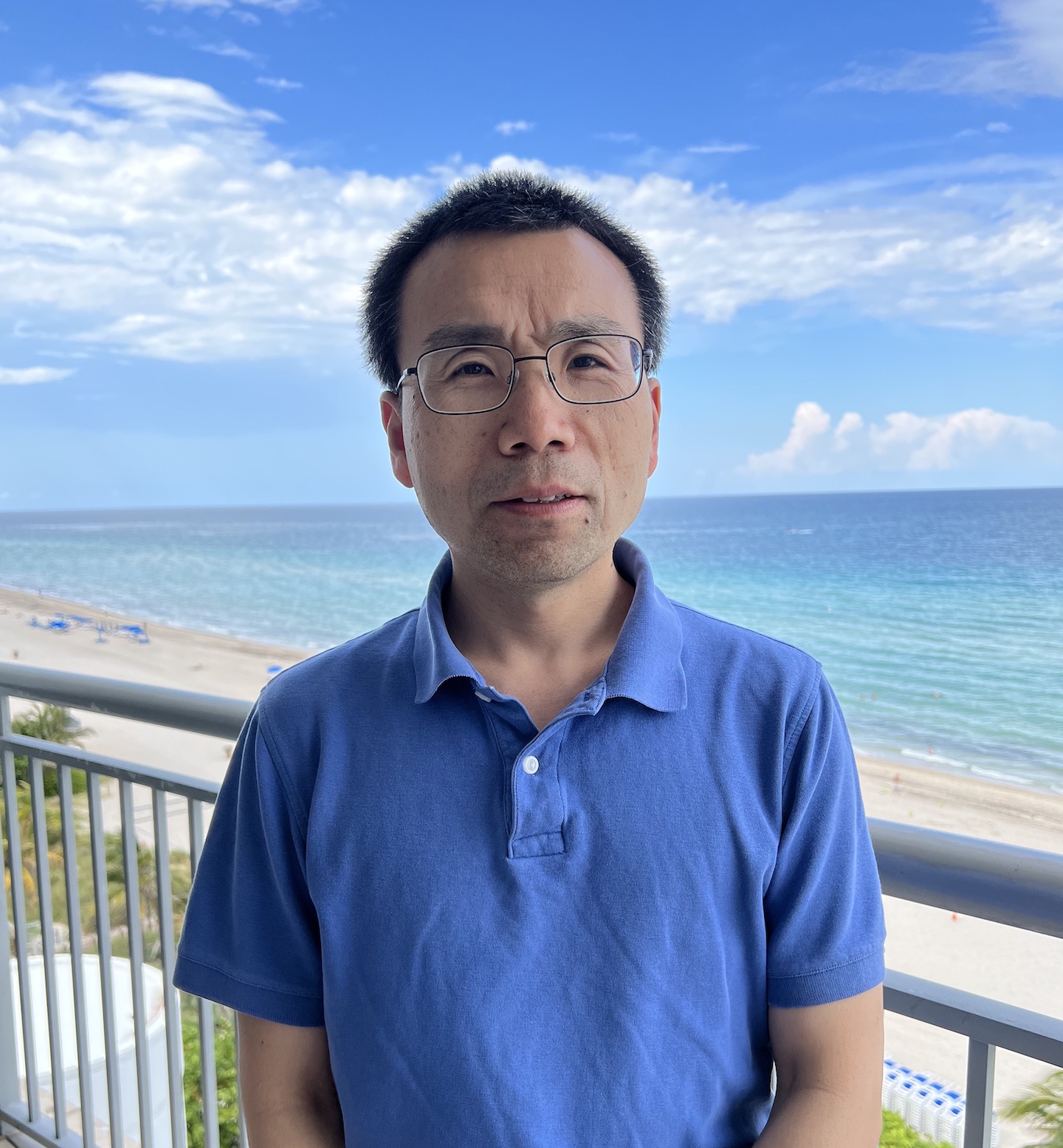
Philip Johnson is a Professor and Chair of the Department of Physics at American University (AU), where he has been since 2006. He also serves as Director of the Integrated Space Science and Technology Institute (ISSTI), supporting over 20 AU faculty and external partners like NASA's Goddard Space Flight Center. His research focuses on quantum computing, superconducting qubits, ultracold atoms, and effective interactions in few-body systems. He holds a PhD in Theoretical Physics from the University of Maryland and completed postdoctoral work at NIST and the University of Maryland's superconducting quantum computing group. His academic leadership roles include Associate Dean of Research for AU's College of Arts and Sciences and service on the American Physical Society's council. His research explores quantum control, nonequilibrium dynamics, and applications in quantum sensing and metrology. Key areas include ultracold bosons in optical lattices, nonlocal interactions, and hybrid machine learning approaches for quantum systems. He collaborates with institutions like the Joint Quantum Institute and Johns Hopkins Applied Physics Laboratory. Johnson's recent work advances theoretical frameworks for few-atom systems and superconducting qubits, with publications addressing topics like topological properties of interactions and correlations in quantum systems. His contributions span experimental and theoretical physics, emphasizing interdisciplinary applications in space science and technology through ISSTI.