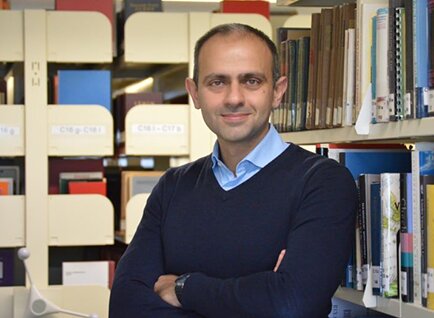
Amir Ahmadi Arian is an Iranian-American writer and Assistant Professor in the Department of English, General Literature and Rhetoric at Binghamton University (College of Arts and Sciences). He holds a PhD in Comparative Literature from the University of Queensland, Australia, an MFA in Creative Writing from New York University, and a BSc in Metallurgy Engineering from the University of Tehran, Iran. His research and teaching focus on creative writing, world literature, postcolonial novels, and Persian poetry. He has published two novels, a story collection, and a nonfiction book in Persian, and translated works by E.L. Doctorow, Paul Auster, P.D. James, and Cormac McCarthy into Persian. His English-language publications include fiction in Harper’s , The Paris Review , The New York Times , and other prestigious venues. His debut English novel Then the Fish Swallowed Him (HarperVia/HarperCollins, 2020) received critical acclaim from The New Yorker , Publishers Weekly , and Kirkus Reviews for its political themes and interior portrayal of oppression.
Gül Şen is a Senior Lecturer and Privatdozentin at the Institute of Oriental and Asian Studies, University of Bonn, and also serves as a Lecturer at the University of Heidelberg. Her academic work focuses on premodern Ottoman history, historiography, and the dynamics of dependency, particularly in maritime contexts such as galley slavery and war captivity. She is actively involved in major research programs including the DFG-Priority Program 'Transottomanica' and the Bonn Center for Dependency and Slavery Studies. Her research areas include: Premodern Ottoman historiography and narrative strategies Legitimacy of rule and political transitions Maritime unfree labor and galley slavery War captivity and captivity narratives in the 18th century Dependency and asymmetrical power relations in the early modern Mediterranean Her recent publications reveal a strong thematic trend centered on the interplay between narrative construction and social power, particularly in contexts of slavery and captivity. She investigates how historical actors used storytelling to assert legitimacy, cope with crises, and negotiate identity. Her work bridges literary analysis with social history, offering nuanced understandings of agency within systems of dependency. She frequently collaborates with leading scholars like Stephan Conermann and contributes to major edited volumes and series in Ottoman studies. Her scientific awards include: DAAD Award for outstanding academic achievements (2012) Postdoctoral Scholarship from the Fritz Thyssen Foundation (2012–2013) Postdoctoral Fellowships at the Annemarie Schimmel Kolleg (2015–2016, 2018–2019) Postdoctoral Scholarship from the University of Bonn (2019–2020) She has supervised numerous B.A. and M.A. theses at the University of Bonn and Heidelberg and has secured third-party funding, including a DFG project (€192,000) from 2016–2018 and Fritz Thyssen Foundation grants. She is co-editor of the 'Ottoman Studies' and 'Otto Spies Memorial Series' book series, and holds leadership roles in the Society for Turkic, Ottoman and Turkish Studies (GTOT) and the International Association for Ottoman Social and Economic History (IAOSEH). Her academic activities are deeply embedded in collaborative and interdisciplinary research environments. She is affiliated with the Bonn Center for Dependency and Slavery Studies and contributes to the DFG-Priority Program 'Transottomanica,' where she examines mobility dynamics and captivity narratives. Her work is supported by a strong network of international collaborations and editorial engagements.
Walid Magdy is a Professor at the School of Informatics, The University of Edinburgh, where he is a faculty member at the Institute for Language, Cognition and Computation (ILCC). He holds a PhD from Dublin City University's School of Computing and has been a faculty fellow at The Alan Turing Institute. With substantial industry experience, he has worked for Qatar Computing Research Institute (QCRI), Microsoft, and IBM, where he filed nine patents. His research spans computational social science and natural language processing. In computational social science, he focuses on social content analysis, political bias detection, polarization, and users' behavior analysis/prediction, with particular attention to understudied communities. His natural language processing work centers on social applications including sentiment analysis, sarcasm detection, and hate-speech identification, with specialized expertise in Arabic and its dialects as well as Persian. Professor Magdy's recent publications demonstrate a consistent focus on Arabic language processing and social media analysis, with growing attention to cultural factors in NLP systems. His work bridges computational methods with social science questions, particularly regarding misinformation, cultural differences in online behavior, and the impact of platform policies on diverse linguistic communities. He has expanded his research to include Persian language processing and continues to explore social dynamics across different cultural contexts. His significant contributions have been recognized with multiple awards: Best Demo Award for TwiXplorer at CSCW 2024 Outstanding Paper Award at ACL 2024 Best Paper Award Runner-up at SocInfo 2022 Best Paper Award at WANLP-EMNLP 2022 Best Paper Award at AIRS 2015 Best Dataset Award at ICWSM 2013 Professor Magdy serves as an editor for Springer's Social Network Analysis and Mining journal and has held leadership roles in major conferences including ACL 2023, ArabicNLP 2023, ICWSM 2022, and ASONAM 2022. He has co-organized numerous shared tasks focused on Arabic language processing and social media analysis, contributing significantly to community resources and benchmarks. He founded and directs the Social Media Analysis and Support for Humanity (SMASH) research group at the University of Edinburgh, which has organized the Summer School in Computational Social Science (SICSS-Edinburgh) in 2022, 2023, and 2025, training researchers in computational social science methodologies.
Prof. Stefan Müller is a Professor at the Institute for German Language and Linguistics , part of the Faculty of Languages and Literature at Humboldt University. His research focuses on syntax, formal grammar theories (especially Head-Driven Phrase Structure Grammar), and computational linguistics. He leads the CoreGram Project , developing cross-linguistic grammars using HPSG formalisms. His work includes analyses of German syntax, constituent order, anaphoric binding, and register phenomena. He is also involved in open-access publishing initiatives through Language Science Press . Contact: St.Mueller@hu-berlin.de . Education and academic background details are not explicitly stated in the provided text, but his professional trajectory indicates deep expertise in theoretical linguistics. His research spans multiple languages including German, Mandarin, and Persian, with a focus on grammar implementation and syntax-semantics interfaces. Key contributions include the Head-Driven Phrase Structure Grammar Handbook (2024), analyses of headless nominal structures in German (2022), and exploration of large language models' theoretical implications (2024). He actively engages in interdisciplinary projects bridging formal grammar and computational methods.
Purnima Dhavan is an Associate Professor of History at the University of Washington's College of Arts & Sciences, holding the Giovanni and Amne Costigan Endowed Professorship. She specializes in early modern South Asia (1500-1800), focusing on religious and cultural identity, Mughal institutions, and literary networks. Her research integrates interdisciplinary methods, with adjunct affiliations in Near Eastern Languages and the Jackson School's South Asia Center. Education: PhD in South Asian History from the University of Virginia (2003), MA (1998), and BA (1996) from the University of Michigan. She has taught at multiple institutions, including the College of St. Benedict/St. John’s University and Bowdoin College. Research Interests: Mughal literary culture, Sikh warrior traditions, gender in pre-colonial societies, and environmental history. Notable works include her book *When Sparrows Became Hawks* (2011) on Sikh militarization and a forthcoming project on literary associations in Mughal urban centers. Publications span peer-reviewed journals and edited volumes, emphasizing pre-colonial South Asia’s intellectual and socio-political dynamics. Awards include the Howard Keller Chair and NEH fellowships. Service: Extensive contributions to academic governance at UW, including roles in the Faculty Senate, departmental leadership, and national professional organizations like the American Historical Association and Association of Asian Studies. Languages: Native Hindi speaker, advanced Urdu/Persian/Punjabi, and proficient in Spanish.
Piotr Głogowski is a researcher at the Institute of History, University of Wrocław, specializing in ancient epigraphy and Near Eastern studies. His work bridges the Hellenistic, Roman, and Persian periods, with a focus on the Levant and Phoenicia. Education: BA & MA in History and Classical Philology (University of Wrocław, 2012-2015); Erasmus exchanges at Bilkent University (2013/2014, 2016/2017); PhD in History (University of Wrocław, 2021). Research areas include ancient epigraphic cultures, Phoenician identity, Achaemenid Persia, and Greco-Persian military dynamics. His publications analyze inscriptions as cultural markers and explore historical narratives in Diodorus. Notable grants: Principal investigator for the National Science Center's Preludium project (2021-2024) on Near Eastern epigraphic culture, and internal grants for studies on Phoenician regional identity and Cappadocian politics. Scientific Awards: Gerda Henkel Foundation Scholarship (2020)
Prof. Dr. Kianoosh Rezania is a Professor of West Asian Religious History and Director of the Käte Hamburger Kolleg Dynamics of Religious History at Ruhr University Bochum. His research focuses on Zoroastrianism, Iranian religions, and the history of religions, with a particular emphasis on ancient Iranian languages and interreligious dynamics. He holds a Ph.D. from Georg-August University Göttingen and has conducted extensive research on topics such as Zoroastrian cosmology, Sasanian-Zoroastrian interactions, and the transmission of religious texts. His work combines philological analysis with historical and cultural studies approaches. Rezania's academic career includes roles as a research associate at Göttingen University and his habilitation project on spatial concepts in early Zoroastrianism. He has directed major research initiatives like the Graduate School of Metaphor and Religion (GSMR) and the Käte Hamburger Kolleg. His publications span monographs, edited volumes, and peer-reviewed articles exploring themes such as religious economics, Middle Persian lexicography, and cross-cultural exchanges between the Safavid and Mughal empires. His current projects include the 'Zoroastrian Middle Persian: Digital Corpus and Dictionary' initiative and studies on Pahlavi literature's interreligious context. He collaborates internationally, leading interdisciplinary teams and contributing to digital humanities efforts in religious studies.
Stephan Conermann serves as Professor of Islamic Studies and Dean of the Faculty of Arts and Humanities at the University of Bonn, where he has held continuous academic appointments since 2003. His institutional leadership includes directorship of the Annemarie Schimmel Kolleg (2010-2022), Bonn Center for Transcultural Narratology, and significant administrative roles culminating in his current deanship since 2023. Academic Background: Doctorate in Oriental Philology/Islamic Studies (Kiel University, 1996, magna cum laude) Magisterstudium in Asian History, Oriental and Slavic Philology (Kiel University, 1992) Conermann's research examines pre-modern Islamic societies through narrative strategies in historiography, with specialized focus on Mamluk Sultanate governance (1250-1517), Delhi Sultanate/Mughal transitions, and Transottomanica mobility dynamics. His work uniquely connects asymmetrical dependencies (particularly slavery systems), power structures, and global entanglements across South Asia, Middle East, and Eastern Europe. His extensive publication portfolio shows consistent thematic evolution toward comparative frameworks analyzing slavery beyond Eurocentric models, narrative construction of power across cultures, and mobility as historical catalyst. Recent scholarship increasingly integrates transcultural methodology with digital humanities approaches. Academic Leadership: Supervised 290+ theses (59 PhD, 96 Magister, 47 Master, 88 Bachelor) Acquired ~9 million euros in third-party funding (DFG, BMBF, DAAD) Editor of 15+ publication series including Mamluk Studies and Dependency and Slavery Studies Conermann directs the Bonn Center for Transcultural Narratology and co-leads the EXC 2036 'Beyond Slavery and Freedom' cluster, fostering interdisciplinary research on pre-modern dependency systems through international collaborations across Europe, Asia, and the Americas.
Reyhan Durmaz is an Associate Professor of Religious Studies at the University of Pennsylvania, affiliated with the School of Arts & Sciences and multiple interdisciplinary programs. Her research focuses on Syriac Christianity, medieval religious dynamics, and the intersection of Christianity and Islam in late antiquity. She holds a Ph.D. from Brown University (2019) and has received prestigious fellowships such as the Dumbarton Oaks Junior Fellowship and the Charlotte Newcombe Dissertation Fellowship. Her seminal book Stories between Christianity and Islam (2022) examines the transmission of saints' stories between religious traditions, earning Honorable Mention from the Middle East Medievalists. Current projects include a study of rural Christianity in the medieval Middle East through soldier-monk narratives and an analysis of the 19th-century Arabic newspaper Kawkab America . She co-leads the Digital Photograph Archive project Visualizing Countryside , documenting medieval religious sites. Dr. Durmaz teaches courses on global Christianity, material culture, and late antiquity, and serves as co-chair of the Philadelphia Seminar on Christian Origins. Her work bridges historical analysis, textual scholarship, and digital humanities, addressing themes of religious identity, cultural exchange, and marginalized communities.
Alexander Key is an Associate Professor of Comparative Literature at Stanford University, specializing in Classical Arabic literature and the intellectual history of Arabic and Persian-speaking worlds from the 7th century onwards. His scholarship focuses on the philosophy of language, literary theory, and cross-cultural translation. Ph.D. in Arabic and Islamic Studies from Harvard University (2012) Current research: Arabo-Persian linguistic intersections, poetics in translation, and pre-modern theories of syntax and affect His articles span diverse eras and topics, including: Medieval Arabic language philosophy (5th–11th century) Modern Arabic political poetry analysis (20th–21st century) Comparative methodologies bridging Islamic and Western traditions A key editorial role includes: Board Member of Stanford University Press Advisory roles at Habib University and Stanford’s Markaz Resource Center His work bridges academic publication with public discourse through: Contributions to Arcade Colloquy Interviews on poetics, religion, and contemporary politics Podcasts and literary salon discussions
Ali Mousavi is Assistant Professor of Iranian Archaeology in UCLA’s Department of Near Eastern Languages and Cultures and a core faculty member of the Cotsen Institute of Archaeology. A Berkeley PhD and former fellow of the Smithsonian, Maison de l’Orient and Global Heritage Fund, he has directed excavations and UNESCO World-Heritage projects at Pasargadae, Bam, Susa, Sultaniyeh and Turang Tepe and authored prize-winning volumes Ancient Iran from the Air and Persepolis: Discovery and Afterlife of a World Wonder . Education PhD, Near Eastern Studies (Archaeology), University of California, Berkeley (2005) MA, Archaeology, History and Languages of Old World Civilizations, Université Lyon II, France (1997) BA, Archaeology and Art History of Europe and the East Mediterranean, Université Lyon II, France (1996) Research interests span the archaeology and art history of Iran from the Neolithic to the early-20th century, with particular focus on Achaemenid and Sasanian monumental architecture, ancient irrigation (qanats), landscape archaeology, digital heritage, and the modern historiography of Iranian archaeology. His field projects integrate remote sensing, epigraphy, GIS and conservation science to investigate imperial capitals, rock-cut monuments and water-management systems across the Iranian plateau. Across more than 30 peer-reviewed articles and book chapters, Mousavi has re-examined dating criteria for Achaemenid stone monuments, analysed royal inscriptions as visual displays, traced medieval Persian pilgrims’ graffiti at ancient sites, and produced synthetic archaeological surveys of the Sasanian empire and the Central Alborz Iron-Age cultures. The corpus reflects a sustained engagement with primary field data, archival research and critical historiography of 19th- and 20th-century excavations. Selected honours Ehsan Yarshater Book Award (2014) Iranian Ministry of Culture World Book Award (2014) Leon Levy – Shelby White publication grant (2008) UNESCO award for World-Heritage nomination files (2003) Iran Heritage Foundation field-work award (2003) Guitty Azarpay Fellowship, UC Berkeley (2000-2003) IFRI Fellowship, Paris (1998) At UCLA he offers undergraduate courses “Archaeology of Iran” and “Ancient Cities of Iran (4000 BC-AD 1900)” and mentors graduate researchers in the Cotsen Institute. His grants and fellowships from NSF-equivalent European and American agencies underwrite both field seasons and publication of critical archaeological corpora, while his service on Iranian, UNESCO and international heritage boards continues to link scholarly output with heritage-management policy.
Zaur Gasimov is a Lecturer at Johannes Gutenberg University Mainz and currently serves as DAAD Departmental Coordinator and Co-Head at the Faculty of Economics and Administrative Sciences, Turkish-German University. He holds a habilitation in Modern History and Eastern European History, with a focus on Eastern European History, political science, and sociology. Education : B.A. in International Relations from Baku State University; M.A. from Catholic University of Eichstätt-Ingolstadt; Doctorate in Eastern European history Research : Concentrates on Russian-Turkish relations, nationalism in Eastern Europe, cultural transfer processes, and historical narratives. His habilitation thesis analyzed Polish-Turkish anti-Soviet alliances. Publications : Authored monographs on Prometheism, Azerbaijani historiography, and Russification policies. Collaborated on comparative studies of cultural transfer and Ottoman-Russian entanglements.
Fahad Ahmad Bishara is an Associate Professor at the University of Virginia , specializing in the economic and legal history of the Indian Ocean and Islamic world . His work bridges global capitalism, international law, and historical narratives of mobility. Key Books: A Sea of Debt (Cambridge, 2017) and Monsoon Voyagers (UC Press, forthcoming) Awards: Hurst Prize, Jerry Bentley Prize, Peter Gonville Stein Book Award Research Focus: Explores debt, legal systems, and trade through microhistories of ships and merchant families, with recent interests in narrative scales and conceptualizations of law in global history. Academic Collaborations: Co-authored works with Nandini Chatterjee, Hollian Wint, and others, emphasizing Persianate and Indian Ocean interconnections. Scientific Awards: J. Willard Hurst Prize (Law and Society Association) Jerry Bentley Prize (World History Association) Peter Gonville Stein Book Award (American Society for Legal History)
Wael B. Hallaq is the Avalon Foundation Professor in the Humanities at Columbia University’s Department of Middle Eastern, South Asian, and African Studies. His work focuses on Islamic law, intellectual history, and the socio-political impacts of modernity. He critiques Orientalist paradigms and explores the interplay between moral theory and legal history in Islamic traditions. His research spans structural dynamics of legal change in pre-modern law, moral theory’s role in Islamic legal history, and the critique of modern state sovereignty. His influential books include *The Impossible State* (2013), which earned Columbia University Press’s Distinguished Book Award, and *Shari‘a: Theory, Practice, Transformations* (2009). Education: No explicit educational details provided in text. His writings bridge legal theory, history, and political thought, challenging Eurocentric frameworks in Islamic studies. His analyses of pre-modern legal systems and modernity’s moral dilemmas have been translated into multiple languages, including Arabic, Hebrew, and Persian. Awards: Columbia University Press Distinguished Book Award (2013–2015) No grants, labs, or advising details explicitly mentioned in the text.
Rahim Shayegan is an Assistant Professor of Iranian at the University of California, Los Angeles (UCLA) Department of Near Eastern Languages and Cultures, and serves as Director of the Pourdavoud Center for the Study of the Iranian World and the Program of Iranian Studies. His research spans multiple historical periods and linguistic traditions of Iran. Education PhD in Iranian Philology & Ancient History, Harvard University MA in Old Iranian Philology & Ancient History, Sorbonne University BA in Philosophy, Comparative Philology, and History, University of Cologne His expertise includes Sasanian history, Iranian epigraphy, and comparative philology, with significant contributions to understanding ancient Iranian religions and historiography. He has received prestigious awards for his scholarship, including the Ehsan Yarshater Book Award and Guggenheim Fellowship. Academic Leadership Director, Pourdavoud Center (2017–present) Jahangir and Eleanor Amuzegar Chair (2013–present)