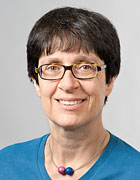
Prof. Dr. Nina Gantert is a distinguished Professor of Probability Theory at the Technical University of Munich (TUM) , affiliated with the TUM School of Computation, Information and Technology . She has held faculty positions at Karlsruhe Institute of Technology and the University of Münster prior to joining TUM in 2011. Her research focuses on probability theory , particularly stochastic processes , large deviations , and random media . She investigates random walks in random environments as models for transport in disordered systems and explores applications in physics and biology . Recent publications highlight her work on branching random walks , mixing times , biased random walks , and large deviation principles for complex stochastic systems. She has co-authored studies on random walks in dynamical percolation , interacting edge-reinforced processes , and extremal point processes in branching models. Scientific Awards: Elected fellow of the IMS (2016) Her academic career spans institutions including ETH Zürich, University of Bonn, Technical University of Berlin, and TUM. She has supervised numerous Bachelor’s and Master’s theses on topics ranging from mixing time analysis to percolation theory , often collaborating with international co-authors.
Brett Kolesnik is a Research Fellow in the Department of Statistics at the University of Warwick. His research focuses on probability theory, random structures, bootstrap percolation, and interactions with combinatorics. He has held postdoctoral fellowships at UC Berkeley, San Diego, and the University of Oxford, and was a Senior Demy at Magdalen College. His work includes organizing workshops on bootstrap percolation and collaborating with leading researchers in probability and combinatorics. Education: PhD in Mathematics from the University of British Columbia (advised by Omer Angel). Notable awards include the NSERC Postdoctoral Fellowship and the Florence Nightingale Bicentennial Fellowship in Statistics. Research interests span bootstrap percolation models, random graph dynamics, and stochastic processes. Recent work includes studies on Brownian map geometry, tournament score sequences, and Coxeter group structures. Selected articles explore topics such as critical beta-splitting processes, Catalan percolation, and random walks on algebraic structures. His publications appear in top journals like Electronic Journal of Probability and Annals of Applied Probability . Awards include the Florence Nightingale Fellowship and NSERC Postdoctoral Fellowship. Professional involvement includes organizing the 2024 BIRS workshop on Bootstrap Percolation and contributing to interdisciplinary collaborations in probability and combinatorics.
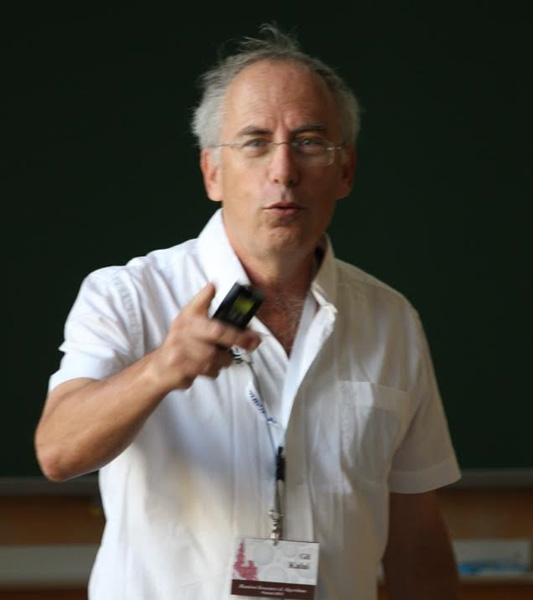
Gil Kalai is a Professor of Mathematics at the Hebrew University of Jerusalem since 1992, where he holds the Henry and Manya Noskwith Chair. He also serves as an Adjunct Professor of Mathematics and Computer Science at Yale University since 2004 in a long-term part-time visiting position. His academic career includes visiting positions at prestigious institutions including MIT, Cornell, IAS Princeton, Berkeley, Bell-labs, IBM, and Microsoft. Professor Kalai's research spans multiple areas within mathematics and theoretical computer science. His work in combinatorics encompasses geometric, probabilistic, and topological approaches. He has made significant contributions to the study of convex sets and polytopes, linear programming, and theoretical computer science. His influential 1988 paper with Kahn and Linial on Boolean functions pioneered applications of Fourier analysis in theoretical computer science. Kalai's research has evolved to include the application of Fourier analysis to thresholds, influences, symmetries, noise, percolation, and social choice. He has developed theories in algebraic shifting and studied face-numbers and other combinatorial invariants of polytopes. His work on the diameter of polytopes and randomized simplex algorithms has been influential in optimization theory. In 1993, his collaboration with Kahn produced a groundbreaking counterexample to Borsuk's Conjecture in 1325 dimensions. Professor Kalai's publications reveal a consistent focus on the intersection of combinatorics, geometry, and theoretical computer science. His work shows a progression from foundational combinatorial geometry to increasingly sophisticated applications of harmonic analysis in discrete mathematics. The recurring themes across his 30+ year career include Boolean functions, polytope theory, and probabilistic methods in combinatorics, demonstrating remarkable coherence in his research trajectory. 2016 European congress of Mathematics, plenary speaker 2013 ERC advanced grant 2012 Rothschild Prize 1994 International Congress of Mathematicians invited section talk, Zurich 1994 Fulkerson Prize 1993 Erdos Prize 1992 Polya Prize Though specific details of his advising are not provided in the source material, Kalai has written over 70 scientific papers and maintains an active research blog entitled "Combinatorics and More." His 2013 ERC advanced grant indicates significant research funding for his work. His extensive collaborations with researchers across multiple institutions suggest a robust research program with numerous PhD students and postdoctoral researchers, though specific names are not mentioned in the provided texts. Professor Kalai maintains active research connections across multiple institutions including Hebrew University, Yale, and various research centers worldwide. His work bridges pure mathematics and theoretical computer science, creating a unique interdisciplinary research environment that influences both fields.
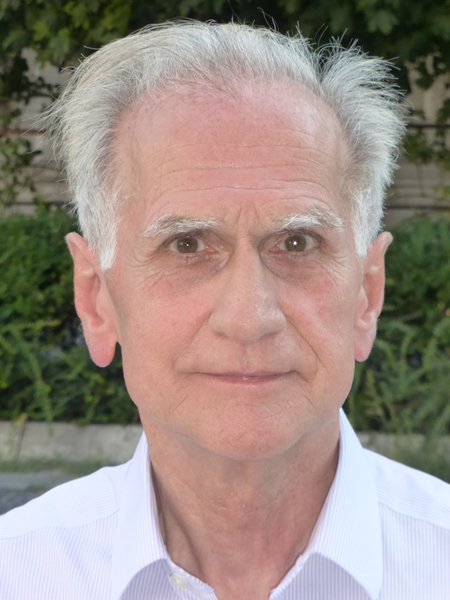
Béla Bollobás is a renowned mathematician affiliated with the University of Memphis as the Jabie Hardin Chair of Excellence in Combinatorics and the University of Cambridge as a Fellow of Trinity College and Honorary Professor at the Centre for Mathematical Sciences. His work spans combinatorics, probability theory, and graph theory, with significant contributions to percolation and random graphs. Dr. Rer. Nat. (Budapest, 1967) Ph.D. (Cambridge, 1972) Sc.D. (Cambridge, 1984) Bollobás pioneered extremal graph theory, random graphs, and probabilistic combinatorics. He introduced novel graph polynomials and advanced bootstrap percolation models, impacting both theoretical mathematics and statistical physics. His research includes inhomogeneous random graphs and cellular automata in random environments. His selected publications reveal a focus on percolation thresholds, graph invariants, and stochastic processes. Notably, he derived sharp thresholds for bootstrap percolation and defined critical probabilities for Voronoi percolation. Senior Whitehead Prize (2007) Fellow of the Royal Society (2011) Foreign Member, Hungarian Academy of Sciences (1990) Foreign Member, Polish Academy of Sciences (2013) Honorary Doctorate, Adam Mickiewicz University (2013) Szechenyi Prize (2017) Bollobás has supervised over 50 Ph.D. students and authored over 450 publications, including 10 books. He co-founded the journal Combinatorics, Probability and Computing and served on eight editorial boards. He organized numerous conferences, including Bill Tutte and Paul Erdős events.
Alan Hammond is a Professor in the Department of Statistics at the University of California, Berkeley. His research focuses on rigorous mathematical probability techniques applied to problems in statistical mechanics, including percolation theory, polymer models, and random growth processes. He has contributed to understanding critical phenomena, phase transitions, and universality classes in stochastic systems. Hammond's work spans topics such as KPZ universality, Brownian motion, and the geometry of random media. He has investigated models like last passage percolation, self-avoiding walks, and tug-of-war games, often uncovering deep connections between stochastic processes and nonlinear PDEs. His teaching includes courses on stochastic processes and statistical theory at both graduate and undergraduate levels. Notable research highlights include studies on fractal properties of Airy processes, stability in dynamical last passage percolation, and the behavior of geodesics in random environments. His contributions bridge probability theory with applications in physics and combinatorics.
Ron Peled is a Full Professor in the School of Mathematical Sciences at Tel Aviv University , currently on leave to serve as the Brin Professor in the Department of Mathematics at the University of Maryland starting summer 2024. During 2022–2024 he was a Member at Princeton University and the Institute for Advanced Study . Education & Career: While explicit degrees are not listed, his trajectory shows appointments at NYU (2009–2010), UC Berkeley and Tel Aviv University as a teaching assistant, followed by faculty positions culminating in full professorship. Research Interests: His work lies at the intersection of probability theory, statistical physics, and combinatorics . Key themes include: Disordered systems and random environments (random-field Ising, spin glasses) First-passage percolation and random metrics Random surfaces and height functions Loop models and critical phenomena Random matrices and band matrices Geometric probability and allocation problems Publications & Impact: With over 70 papers in top journals such as Annals of Mathematics , Annals of Probability , Inventiones Mathematicae , and Communications in Mathematical Physics , his recent work explores minimal surfaces in random environments, localization in random band matrices, and quantitative disorder effects in low-dimensional spin systems. Grants & Awards: Research has been continuously funded by: Israel Science Foundation (grants 1048/11, 861/15, 1971/19, 2340/23) ERC Starting Grant LocalOrder ERC Consolidator Grant Transitions Marie Skłodowska-Curie International Reintegration Grant SPTRF Teaching & Mentoring: Prof. Peled has taught a broad spectrum of courses at Tel Aviv University (Brownian motion, probability, percolation, random matrices, stochastic calculus) and NYU (combinatorics, discrete mathematics). He has supervised 13 post-doctoral fellows and 8 graduate students (PhD & MSc) to date. Service & Outreach: He co-organizes the Joint Israeli Probability Seminar and has organized numerous international workshops and conferences including at Oberwolfach, Technion, and Tel Aviv University.
Noam Berger Steiger is a Professor of Stochastic Processes at the Technical University of Munich (TUM), within the School of Computation, Information and Technology and the Department of Mathematics. His office is located at Parkring 11, Garching bei München, and he can be contacted at noam.berger@tum.de. His research focuses on stochastic processes in random environments, percolation theory, and random walks. Key contributions include asymptotic analysis of preferential attachment graphs, quenched invariance principles for non-elliptic random walks, and slowdown phenomena in ballistic random motion. His work bridges theoretical probability with applications in complex systems. Analysis of his 2012-2014 publications reveals consistent focus on random walk dynamics in disordered media, with significant results on ballisticity conditions, trail detection in random scenery, and distributional limits. His research employs advanced probabilistic techniques published in top-tier journals including Annals of Probability and Probability Theory and Related Fields . Professor Berger has supervised 11 theses: 5 bachelor's theses at TUM covering Brownian motion properties and investment strategies for risk-averse investors, and 6 master's theses (3 at TUM, 3 at Hebrew University) on topics including return times for random walks, mass transport principles, and spin-glass percolation. His current teaching includes Markov Chains, Probability on Graphs, and Brownian Motion seminars. He is an active member of TUM's Probability Theory research group, which participates in the TUM-ICL Mathematical Sciences Hub and Exzellenzcluster MCQST. The group collaborates on quantum science initiatives while maintaining strong foundations in classical probability theory and stochastic analysis.
Perla Sousi is a Professor of Probability at the University of Cambridge's Statistics Laboratory, part of the Department of Pure Mathematics and Mathematical Statistics (DPMMS). She is also a Fellow of Emmanuel College. Her research focuses on Probability Theory, Stochastic Processes, and their applications, including Random Walks, Brownian Motion, Mixing Times of Markov Chains, Percolation Theory, and Dynamical Systems. Notably, she explores phase transitions in stochastic models, cutoff phenomena in Markov chains, and the interplay between geometry and probability. Her work often involves collaboration with leading researchers in the field, addressing questions in both theoretical and applied stochastic processes. She has taught courses such as Probability IA, Percolation and Random Walks on Graphs, Advanced Probability, and Applied Probability. Her research has been published in top-tier journals like Annals of Probability , Probability Theory and Related Fields , and Communications in Mathematical Physics . Key contributions include studies on mixing times in dynamic environments, phase transitions in random walks, and capacity analysis in high-dimensional settings. Her articles highlight advancements in understanding stochastic systems' behavior, with a focus on cutting-edge topics like dynamical percolation, branching processes, and cutoff phenomena in complex networks. She actively contributes to both foundational theory and applications in stochastic modeling.
Daniel Kious is a Reader at the University of Bath, where he serves as Head of the Statistics and Probability Group and is affiliated with the Prob-L@B research center. His work focuses on advanced probability theory, including random walks, branching processes, and reinforcement models. Research Interests: Random walks with self-interaction Random walks in dynamic random environments Branching processes and tree structures Reinforcement learning applications in probability Article Trends: His recent publications emphasize trapping phenomena, reinforcement mechanisms, and phase transitions in random processes. Key themes include spatial non-local branching, once-reinforced walks, and connections to statistical physics. Advising: Co-supervised PhD students: Wilfred Armfield, Pawel Rudnicki, Carlo Scali Postdoc supervision: Guillaume Conchon-Kerjan (EPSRC-funded), Umberto De Ambroggio (co-supervised with Matt Roberts) Organizational Contributions: Co-organized conferences like CUWB IV: Frontiers in Statistics and Probability, CUWB II: Probability-on-sea, and the Random Walks in Bath conference. Active in the Prob-L@B research center. Personal Interests: Brazilian Jiu Jitsu practitioner (blue belt at Gracie Barra Frome); contributed to mathematics popularization through a 2016 article for the French Committee for the Popularization of Mathematics (CIJM).
Michele Salvi is an Associate Professor in Mathematics at Università degli Studi di Tor Vergata in Rome. He previously held a Marie Skłodowska-Curie fellowship, conducting research in Berlin, Munich, and Paris. His work focuses on Probability Theory, with emphasis on random processes in random media, random graphs, and statistical mechanics, bridging applications in Physics, Computer Science, and Biology. Random processes in random media Random graphs Mathematics of Neural Networks Stochastic homogenization Mixing times for Markov chains Statistical mechanics Salvi’s recent publications highlight interdisciplinary trends, particularly in the spectral analysis of deep neural networks, scale-free percolation dynamics, and spanning tree geometry in random environments. His collaborations span Europe, with projects involving probabilistic models in epidemiology, reinforcement learning, and stochastic homogenization. He has received the Marie Skłodowska-Curie fellowship, reflecting his international research experience. His work is aligned with the Department of Mathematics at Tor Vergata, which holds the "Department of Excellence" MatMod@TOV 2023-2027 grant.
Jason P. Miller is a Professor in the Statistics Laboratory at the Department of Pure Mathematics and Mathematical Statistics (DPMMS), University of Cambridge, and a Fellow of Trinity College, Cambridge. He previously held the Poincaré Chair at IHP in the 2015-2016 academic year and was a post-doctoral researcher at MIT and Microsoft Research. Miller's research focuses on probability theory, particularly stochastic interface models, random surfaces, Schramm-Loewner evolutions (SLE), Liouville quantum gravity, and random planar maps. His work bridges mathematical physics and probability, exploring deep connections between random geometry, conformal field theory, and statistical mechanics. He has made fundamental contributions to understanding the relationship between Liouville quantum gravity and the Brownian map, and has extensively studied the properties of Schramm-Loewner evolutions in various contexts. Miller's publication record shows a consistent focus on the intersection of probability theory and mathematical physics, with a particular emphasis on scaling limits of discrete models to continuum objects. His work often involves collaborations with prominent researchers like Scott Sheffield and Ewain Gwynne, and demonstrates a progression from foundational work on SLE and the Gaussian free field to more recent breakthroughs in Liouville quantum gravity and its connections to random planar maps. Scientific Awards Rollo Davidson Prize, 2015 Poincaré Chair, 2015-2016 academic year Whitehead Prize, 2016 Clay Research Award, 2017 ICM invited speaker (probability and statistics), 2018 Doeblin Prize, 2018 Eisenbud Prize, 2023 Fermat Prize, 2023 Miller has supervised numerous PhD students (though specific names aren't listed in the provided text) and has been involved in significant research grants supporting his work in random geometry and probability theory. His editorial service includes positions on the boards of Probability Theory and Related Fields and Bernoulli journals. While specific laboratory details aren't provided, Miller's research appears to be theoretical in nature, focusing on mathematical analysis of random geometric structures. His work has significant implications for theoretical physics, particularly in understanding quantum gravity and critical phenomena in statistical mechanics.
Dr Jon Warren is a Reader in Statistics at the University of Warwick, specializing in probability theory. His research spans stochastic flows, random matrices, and properties of Brownian motion, with significant contributions to understanding complex stochastic systems. Research Interests: Dr Warren's work is centered on probability theory, particularly in the areas of stochastic flows, random matrices, and Brownian motion. His research delves into the intricate behaviors of these systems, exploring their properties and applications in various mathematical contexts. Publications: His recent publications cover a wide range of topics within probability theory, including stochastic heat equations, Dyson Brownian motion, and random matrix theory. These works highlight his expertise in both theoretical developments and practical applications of stochastic processes. Teaching: He teaches ST910 Introduction to graduate probability, demonstrating his commitment to educating the next generation of statisticians and probabilists. Contact: Dr Warren can be reached at J.Warren@warwick.ac.uk for academic inquiries or collaboration opportunities.
Balint Toth is a distinguished academic with dual affiliations: a Research Professor at the Alfréd Rényi Institute of Mathematics in Budapest and a Professor of Probability (Heilbronn Chair) at the University of Bristol 's School of Mathematics. His work bridges Probability Theory , Mathematical Physics , and Statistical Mechanics , focusing on stochastic dynamics, random walks in complex environments, and scaling limits. Key Roles: Co-Editor-in-Chief of Probability Theory and Related Fields , organizer of probability seminars in Budapest-Vienna and Bristol, and former leader of the BME Stochastics Seminar (1999–2020). Teaching: Delivers advanced courses like Probability 2 , Stochastic Differential Equations , and Percolation , emphasizing rigorous mathematical foundations. Research Themes include hydrodynamic limits, self-interacting random walks, diffusion in random media, and symmetry breaking in spin systems. His recent publications explore non-equilibrium stochastic models, anomalous diffusion, and connections between probability and physics. Teaching Materials span bilingual resources (Hungarian/English) for undergraduate and graduate courses in probability and stochastic analysis.
Scott Armstrong is a Professor of Mathematics at the Courant Institute of Mathematical Sciences, New York University. His research focuses on partial differential equations, calculus of variations, and probability theory, with a specialization in stochastic homogenization of PDEs in random media and related statistical mechanical systems. He holds a Ph.D. from UC Berkeley (2009) and a B.S. from Texas A&M University (2002). Education: Ph.D. in Mathematics, University of California, Berkeley, USA (2009) B.S. in Mathematics, Texas A&M University, USA (2002) Research Interests: Scott's work addresses fundamental questions in homogenization theory, including quantitative estimates for elliptic and parabolic equations in random media, renormalization group methods, and applications to statistical mechanics. His contributions bridge analysis, probability, and mathematical physics, with a focus on rigorous mathematical frameworks for understanding macroscopic behavior from microscopic models. Publications: His recent work includes studies on anomalous diffusion, renormalization group techniques, and quantitative homogenization in high-contrast media. Over 50 peer-reviewed articles highlight his expertise in stochastic PDEs, elliptic regularity, and variational methods. Awards: No specific awards listed in the provided text. Advising & Grants: No student advisees or grant details explicitly mentioned in the text. Labs/Teams: No dedicated labs or collaborative teams explicitly noted, though his research likely involves interdisciplinary collaborations within the Courant Institute.
Gérard Ben Arous is a Silver Professor of Mathematics at New York University's Courant Institute of Mathematical Sciences, where he has served as Director and Vice Provost for Science and Engineering Development since 2011. He holds a PhD in Mathematics from the University of Paris VII (1981) and has previously taught at the University of Paris-Sud, École Normale Supérieure, and the Swiss Federal Institute of Technology in Lausanne. His research focuses on probability theory, stochastic analysis, and their applications to physics and industrial problems, particularly exploring complex systems' long-time behavior and aging phenomena in disordered media. Education: PhD in Mathematics, University Paris 7, France (1981) M.Sc. in Statistics, University Paris-Sud Orsay, France (1979) B.S. in Mathematics, École Normale Supérieure (Paris), France (1978) His research interests bridge probability with partial differential equations, dynamical systems, and statistical mechanics. Key contributions include studies on random media, random matrices, and the interplay between complexity, disorder, and aging in physical systems. He has held leadership roles in academic institutions, including directing the mathematics departments at Orsay and École Normale Supérieure, and founded Lausanne's Bernoulli Center. Notable awards include Fellow of the Institute of Mathematical Statistics and the Montyon Prize from the French Academy of Sciences. His work is published in top journals like Annals of Probability and Communications in Pure and Applied Mathematics , and he co-edits Probability Theory and Related Fields . Ben Arous has advised numerous researchers and contributed to interdisciplinary projects, including studies on machine learning landscapes and financial mathematics. His lab focuses on stochastic modeling and its applications across disciplines.