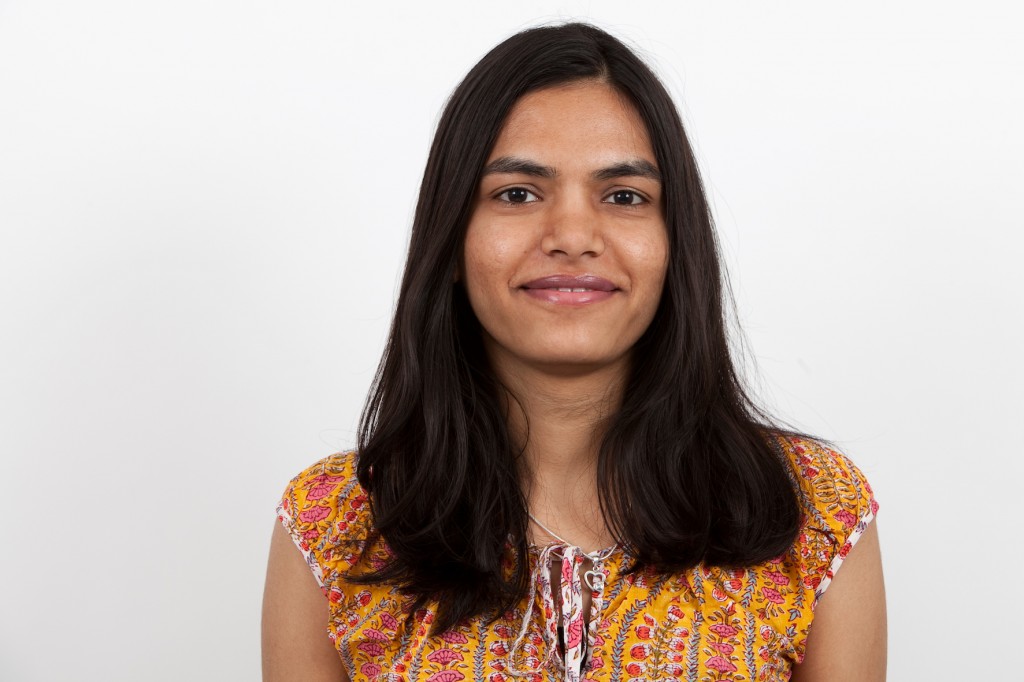
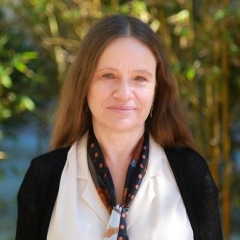
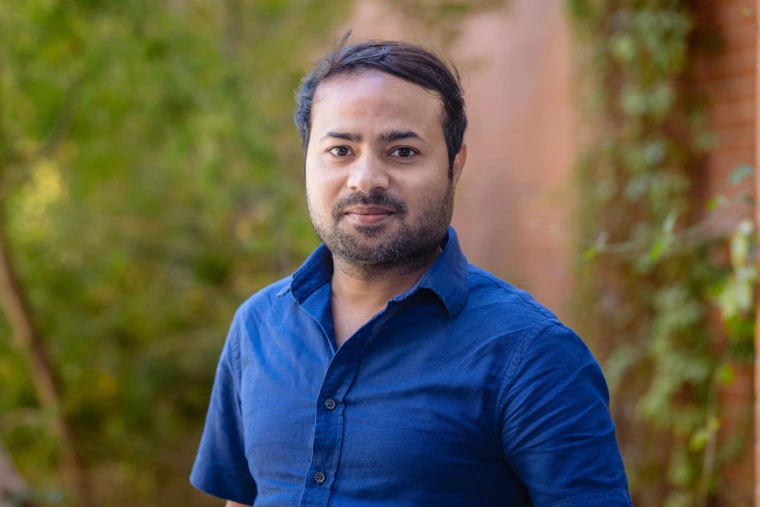
Neha Lodha is a researcher in the Institut für Logic and Computation at TU Wien. Her work focuses on algorithms, complexity theory, and SAT/SMT solving techniques. She has contributed to graph encodings for combinatorial optimization problems and parameterized complexity analysis. Key research areas include SAT-based approaches for graph decomposition (branchwidth, treewidth), SMT methods for fractional hypertree width, and algorithm engineering for constraint satisfaction problems. Her work bridges theoretical foundations with practical algorithmic implementations. Notably, she received the 2016 SAT Conference Best Student Paper Award for her work on SAT encodings of branchwidth. This research was later expanded into a 2019 ACM Transactions publication. Her publications span conferences like IJCAI, CP, and SAT, with a focus on advancing the theoretical and practical aspects of computational logic and algorithm design.
Eduard Eiben is associated with the Algorithms and Complexity group at the Institut für Logic and Computation, Technische Universität Wien. He completed his PhD under advisors Stefan Szeider, Robert Ganian, and Georg Gottlob. His research focused on exploiting structural properties for fixed-parameter tractability, supported by the Austrian Science Fund (FWF) through projects X-Tract (FWF P26696) and the LogiCS Doctoral College (FWF W1255). In 2018, he received the Award of Excellence for his outstanding PhD thesis from the Austrian Ministry of Education, Science and Research (BMBWF).
Florian Zuleger is an Associate Professor at TU Wien's Department of Formal Methods in Systems Engineering (E192-04). He has a 100% research focus and serves as Curriculum Coordinator for the Master’s program in Verification and Automated Reasoning. His work emphasizes automated methods for termination analysis, resource-bound estimation, verification of programs with dynamic data structures, parameterized systems, and automated feedback for introductory programming tasks. He has led projects funded by the European Commission (2024–2027), Austrian Science Fund (FWF), Amazon Research Awards, and Vienna Science and Technology Fund. Research Interests: Automated Program Verification Formal Methods for Concurrent Systems Separation Logic and Decision Procedures Resource and Complexity Analysis Parameterized Model Checking Inductive Logic in Verification Grants & Advising: Zuleger’s recent grants explore verification of safety-critical applications and automated cost analysis. He has advised numerous students on topics ranging from verified data structures to fault-tolerant algorithms. His projects include collaboration with Amazon, the European Commission, and FWF. Labs/Teams: Involved with the LogiCS Research Group, focusing on logical methods in computer science, and contributes to tool development (e.g., ATLAS, SpecBMC, SL-COMP competitions).
Stefan Szeider is a full professor and chair of the Algorithms and Complexity Group at the Faculty of Informatics, Technische Universität Wien (TU Wien). He also serves as a visiting scientist at UC Berkeley's Simons Institute for the Theory of Computing. His academic journey includes positions at the University of Durham (UK) and the University of Toronto (Canada), and he earned his Mathematics PhD from the University of Vienna in 2001. Dr. Szeider's research focuses on designing efficient algorithms for problems in Artificial Intelligence, automated reasoning, and combinatorial optimization. He leads several initiatives, including the Vienna Center for Logic and Algorithms (VCLA), and has secured funding from the ERC, EPSRC, FWF, and others. His Erdős number is 2, reflecting his collaborative network in mathematics and computer science. Key achievements include the first ERC Starting Grant awarded to an Austrian computer scientist (2009), and awards such as the Highlighted Paper Award at SAT 2023 and Best Paper at CP 2020. He advises numerous PhD students and postdocs, fostering the next generation of researchers in algorithms and complexity. Notable contributions extend beyond academia to public outreach, including initiatives like the 'Algorithms Think Differently' educational program and the 'Algorithms in 60 Seconds' video competition. His work bridges theoretical foundations and practical applications, influencing both academic and real-world computational challenges.
Thomas Depian is a PreDoc Researcher affiliated with the Faculty of Informatics at Technische Universität Wien, specializing in the Department of Algorithms and Complexity. His research focuses on computational geometry, graph algorithms, parameterized complexity, and data visualization, with particular emphasis on boundary labeling, dynamic map labeling, and linear layout optimization. Current projects: Engineering Linear Ordering Algorithms for Optimizing Data Visualizations (2020–2025) Past projects: HumAlgo (2018–2023) His work spans theoretical algorithm design, complexity analysis, and practical applications in geographic information systems and data visualization. Publications include contributions to top-tier conferences such as ISAAC, GD, GIScience, and WALCOM. Areas of investigation include constraint satisfaction, geometric optimization, and parameterized algorithm frameworks. Depian completed his Diploma Thesis at TU Wien in 2023, focusing on grouping and ordering constraints in boundary labeling. His academic output demonstrates expertise in solving complex computational problems with interdisciplinary applications.
Alexander Dobler is a PreDoc Researcher at the Algorithms and Complexity Department of Technische Universität Wien. His research focuses on algorithmic visualization, graph drawing, and combinatorial optimization. He contributes to optimizing layout algorithms for diagrams, treemaps, and storylines, with a particular emphasis on minimizing crossings and corners in geometric representations. Key projects include 'Engineering Linear Ordering Algorithms' (2020–2025) and participation in the PACE competition with solver 'Touiouidth'. His work bridges theoretical computer science with practical visualization challenges, addressing both discrete mathematics and computational geometry. Education: BSc, Dipl.-Ing. (engineering degree) Labs/Teams: Part of the Algorithms and Complexity group at TU Wien Grants: Involved in HumAlgo (2018–2023) and REVEAL-AI (2020–2024) His recent publications (2023–2025) address topics like cluster vertex splitting complexity, hoop diagrams for set visualization, and optimizing linear diagrams. He has supervised Marcel Holzmüller’s 2025 diploma thesis on expanding planar storyplan problems.
Jie He is a PreDoc Researcher at the Department of Cyber-Physical Systems, Technische Universität Wien. His research spans computational social choice, algorithmic game theory, and formal methods in robotics and IoT systems. He works on multidisciplinary problems involving complexity analysis, fair division, and preference modeling. Current projects: EdgeAI (2022–2025), TAIGER (2023–2027), ADEX (2020–2024) Key collaborations: Research with R. Grosu, E. Bartocci, D. Nickovic Research interests focus on computational aspects of collective decision-making , including fair division, matching problems, and preference modeling. He works on both theoretical foundations (e.g., parameterized complexity) and practical applications (e.g., robotic-IoT systems). His publication history reveals deep expertise in computational complexity of social choice problems, with recent work on 3D stable roommates , fair division in graph-structured settings , and preference modeling through Euclidean and Manhattan geometries. As an advisor, he supervised diploma theses on: Optimization strategies for 5G transceivers Dynamic object detection in multi-agent systems His work appears in top conferences like ACM/IEEE DAC, ICSE, and various computational social choice venues.
Marek M. Karpinski is a Chair Professor of Computer Science at the University of Bonn and a founding member of the Hausdorff Center for Mathematics . He has held visiting or professorial positions at institutions such as Princeton University, Carnegie-Mellon University, and the University of Edinburgh. His affiliations also include the B-IT Research School on Applied Informatics and the Lab for Foundations of Computing . His research spans efficient algorithms , combinatorial optimization , computational complexity , randomized approximation techniques , and applications in network design , quantum computation , and molecular biology . Recent work focuses on approximation hardness for NP-hard problems, graph algorithms , and algebraic computational complexity . His scientific contributions include polynomial time approximation schemes for dense NP-hard problems and key publications in randomized algorithms , VC dimension , and network optimization . He has advised numerous researchers and received honors such as the Humboldt Research Award and the Max Planck Research Prize .
Jan Snellman is a Researcher and Visitor (Faculty) in the Department of Computer Science at the University of Helsinki. His roles include affiliation with the Kaski Kimmo group and the Professorship Korpi-Lagg Maarit. He holds a Doctoral degree (2015) and Master's degree (2008) in Natural Sciences from the University of Helsinki's Faculty of Science. His research focuses on interdisciplinary modeling of socio-economic systems, epidemic dynamics, and networked agent behavior. Key interests include agent-based simulations of epidemic spread, socio-economic feedback mechanisms, and the formation of social structures through game-theoretic interactions. Recent work emphasizes computational social science applications, such as pandemic modeling in regional contexts and the interplay between economic activity and disease transmission. Snellman's publications (2017–2024) explore topics ranging from ultimatum game dynamics to socio-economic pandemic modeling. His research often involves collaboration with groups like the Kaski Kimmo team, focusing on statistical mechanics and complex systems approaches. His work bridges computer science, economics, and public health through computational frameworks analyzing real-world societal challenges. Professional activities span postdoctoral research and collaborative projects within the Department of Computer Science. His current focus includes advancing agent-based models for policy analysis and understanding systemic risks in socio-technical systems.
Chun-Hung Liu is an Associate Professor at Texas A&M University, affiliated with the College of Arts & Sciences. His research focuses on structural graph theory, combinatorics, and discrete mathematics, with a particular emphasis on graph minors, coloring problems, treewidth, and algorithmic aspects of graph theory. He has contributed significantly to understanding extremal graph properties, metric dimensions, and well-quasi-ordering in graph structures. His work often intersects theoretical computer science, exploring algorithmic solutions to graph partitioning, coloring, and decomposition challenges. Recent trends in his publications highlight advancements in conflict-free coloring, asymptotic dimensions of graph families, and structural characterizations of graphs excluding specific minors or subgraphs. Liu’s research also delves into phase transitions in degeneracy and the interplay between graph parameters like treewidth and layered treewidth. His studies on quasi-tree partitions and product structures further illustrate his expertise in graph decomposition techniques. While no awards are explicitly listed, his prolific publishing record indicates sustained contributions to the field. His advising and grant activities, though not detailed in the provided texts, likely align with his research focus on foundational and applied graph theory problems. Collaborations and lab affiliations remain unspecified in the available information.
Dr. William Pettersson is a Researcher at the School of Computing Science, University of Glasgow, focusing on optimization and algorithmic research. He leads projects like the EPSRC-funded IP-MATCH initiative, addressing resource allocation challenges such as kidney exchange and student-doctor hospital placement systems. His work bridges theoretical contributions (e.g., integer programming, graph decomposition) and practical software development, including the Regina topology tool and kep_solver for kidney exchange analysis. Prior to Glasgow, he specialized in parallel algorithms and combinatorial topology in Australia. Key Projects: IP-MATCH (EPSRC), Regina software, kidney exchange optimization Research Themes: Combinatorial optimization, parameterized complexity, high performance computing Publications span graph theory, operations research, and algorithm design, with notable contributions to kidney exchange program modeling and spatial correlation analysis. Active collaboration with Prof. David Manlove and international teams in healthcare and computational topology.
Samson Wang is an IQIM Postdoctoral Scholar Research Associate in Theoretical Physics at Caltech, focusing on quantum computational complexity and algorithm design. His research bridges quantum information theory and practical algorithm development for near-term quantum devices. Key research themes include: 1) Diagnosing and mitigating trainability challenges in variational quantum algorithms; 2) Developing resource-efficient quantum linear algebra methods; 3) Characterizing quantum kernel methods in machine learning; and 4) Designing error-mitigated algorithms for imperfect hardware. Recent publications establish frameworks for partial error correction (2023) and analyze barren plateau phenomena (2021-2025). Office location: Annenberg IST Center; contact: 626-517-6999.
Olmo Zavala Romero is an Assistant Professor in the Department of Scientific Computing at Florida State University. His research focuses on applying machine learning techniques to solve complex problems in medical imaging and earth sciences. He specializes in developing neural network-based models for oceanographic data assimilation, environmental forecasting, and medical image segmentation. His expertise includes integrating satellite observations and ocean models to study Gulf of Mexico circulation patterns, marine litter dynamics, and vertical mixing processes. He has also contributed to clinical applications such as automated tumor segmentation in cervical and prostate cancers using deep learning algorithms. Dr. Zavala Romero has developed tools like the NcDashboard software for ocean dataset visualization and the KPP_DNN parameterization framework for turbulence modeling. Key research themes include: Machine learning for environmental modeling and prediction Medical image analysis using deep learning techniques Data assimilation in oceanographic systems Software development for scientific data exploration His recent work emphasizes interdisciplinary applications, combining geoscience and biomedical challenges with cutting-edge machine learning solutions. No scientific awards have been explicitly mentioned in the provided materials.
Linda Petzold is the Mehrabian Distinguished Professor in Computer Science and Mechanical Engineering at the University of California, Santa Barbara (UCSB). Her roles span academic leadership, research, and interdisciplinary collaboration. She holds affiliations with the National Academy of Engineering, National Academy of Sciences, and multiple UCSB centers including the Institute for Collaborative Biotechnologies, Center for Bioengineering, and Center for Control, Dynamical Systems & Computation. Dr. Petzold earned her PhD and BA in Computer Science and Mathematics from the University of Illinois. Her research focuses on modeling, simulation, and software development for multiscale systems in biology, materials, and social networks. Notable projects include the Stochastic Simulation Service (StochSS), a cloud-based platform for biological modeling, and collaborations on topics like circadian rhythms, coagulopathy, and social sentiment analysis. She also leads work in computational neuroscience, including studies of neuronal activity in brain organoids. Her scientific contributions are recognized through prestigious awards, including the Sidney Fernbach Award and ACM Prize in Computational Science. Petzold’s research emphasizes bridging computational methods with experimental data, fostering interdisciplinary partnerships to address complex challenges in healthcare, ecology, and materials science. Her lab develops algorithms for stochastic systems, with applications ranging from trauma patient outcomes to fibrinolytic mechanisms. Publications highlight advancements in numerical methods, machine learning, and systems biology. Key themes include neural ordinary differential equations, prompt tuning for LLMs, and multimodal scientific datasets. Her work integrates computational tools with real-world biomedical and ecological problems, reflecting a commitment to translational research. Dr. Petzold advises students and collaborates extensively, with grants supporting projects like Bayesian neural networks for parameter inference and GAN-based imputation for medical data. Her leadership in academic and professional societies underscores her role as a visionary in computational science and engineering.
Aniket Gupta is a Research Fellow at the University of Arizona, specializing in hydrology and climate science. His work focuses on snow hydrology, soil moisture dynamics, and the application of machine learning in environmental modeling. He holds a Ph.D. in Ocean, Atmosphere, Hydrology and Climate from UGA-IGE, France (2022). Research interests include improving streamflow predictions in arid regions, evapotranspiration estimation using advanced models, and understanding the impacts of climate change on water resources. His recent studies address soil moisture memory mechanisms, the role of vegetation dynamics in hydrological fluxes, and the integration of remote sensing data (e.g., SWOT, ECOSTRESS) into hydrological frameworks. Key contributions include developing hyper-resolution modeling frameworks for alpine catchments and assessing atmospheric convection trends in India. Gupta collaborates with institutions worldwide, advancing critical zone modeling and machine learning applications in hydrology.