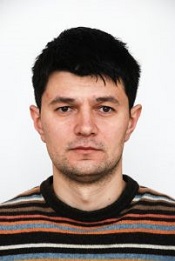
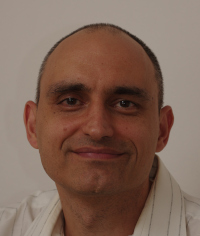
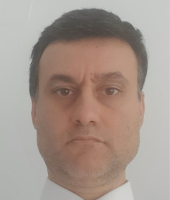
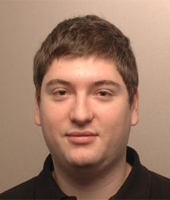
Dr. Eugen Dumitrascu is a Lecturer at the University of Craiova within the Faculty of Automatic Control, Computers and Electronics. He earned his PhD in Cybernetics and Economic Statistics in 2007 from the Academy of Economic Studies in Bucharest and holds an engineering degree in Computer Science from the same university (2000). Teaching: Digital Systems Design, Logical Design of Computers, Assembly Programming Research Focus: Programming languages, distributed systems, computer architecture, and English-Medium Instruction (EMI) in higher education Industry Experience: Worked at CS Romania (2004-2007) and Hella Electronics Romania (2007-present) His research spans both technical and educational domains, with over 35 scientific publications and 5 books. He has participated in 6+ national/international projects including TEMPUS-CECEN and ViRec e-Initiative, focusing on resource allocation optimization, multimedia applications, and human resource policies. Despite his technical background, recent work emphasizes EMI challenges in Romanian universities.
Cristina MARINESCU is an Associate Professor at the Politehnica University of Timisoara, Faculty of Automation and Computer Science. She holds a Dr. Eng. degree in Software Engineering from the same institution. Her research focuses on software quality assessment, empirical software engineering, and object-oriented design. She has contributed to projects like Methods and Tools for Continuous Quality Assurance in Complex Software Systems and Quality Assurance for Distributed Software Systems . Her academic roles include teaching Object-Oriented Programming and Algorithms for Parallel Computing labs. She has been involved in research groups like LOOSE and eAustria Institute Timisoara. Notably, she received the Best Reviewer Award at SCAM 2011. Her work spans publications in conferences like IEEE SCAM, ICSM, and WCRE, addressing topics from design flaws detection to cloud-based quality assessment. Her projects emphasize software evolution, design flaw mitigation, and distributed systems analysis. She has collaborated internationally, including with Swiss teams under the NOREX project. Her teaching and research activities reflect a commitment to advancing software engineering practices and education.
Матвій Борисович Ільяшенко is an Associate Professor at the Department of Computer Systems and Networks, Faculty of Computer Science and Technologies, Zaporizhzhia Polytechnic National University. He holds a Ph.D. in Computer Engineering from the Institute of Modeling Problems in Energy (NAS of Ukraine, Kyiv) and graduated from ZNTU with honors in 2005. Ph.D. in Computer Engineering (2008) Specialty: Computer Systems and Networks (2005) His research focuses on graph algorithms, combinatorial optimization, and artificial intelligence systems. Recent publications explore blockchain integration in digital twins, neuroevolution for anomaly detection, and spiking neural network synthesis with probabilistic coding. His work spans distributed computing, medical diagnostics, and industrial cybersecurity. Key trends in his publications include: 1) Advanced graph isomorphism algorithms for resource allocation; 2) Neuroevolutionary techniques in time series analysis; 3) Blockchain-enhanced digital twin architectures; 4) Stochastic programming for big data reduction; 5) Probabilistic neural models with neuropattern mechanisms. He teaches Fundamentals of optimization of computer systems and networks and has contributed to specialized digital systems semantic analysis, GRID network resource reservation, and communication channel efficiency optimization. His work bridges theoretical algorithms with practical implementations in industrial and medical domains.
Vadim Olegovich Rybin serves as a Senior Lecturer at the Faculty of Computer Science and Technology , Department of Computer Systems and Networks, at Zaporizhzhia Polytechnic National University. His academic career began in 1985, and he holds a diploma in "Design and production of radio equipment" from Zaporizhia Machine-Building Institute. Languages: Ukrainian, Russian Teaching subjects: System integration and optimization of computer equipment, Mobile communication technologies Research focuses on: Coding and identification of speech signals Data transmission methods in cellular networks Integration of optical connections in neural network computer models His recent publications emphasize software development for statistical analysis, speech signal optimization, and optical computing applications. Collaborative works include studies on polynomial regression tools and neural network hardware modeling. Contact: Office 53b, Room 362, Zaporizhzhia Polytechnic University (Address: Zhukovsky St., 64, Zaporizhzhia, Ukraine).
Dr. Belean Ioan Bogdan serves as an Established Researcher (R3) at the National Institute for Research and Development of Isotopic and Molecular Technologies (INCDTIM) in Cluj-Napoca, Romania. He is affiliated with the Department of Materials, Energy and Advanced Technologies within the Hi-Tech Engineering and Advanced Technologies research team. His office is located in Building Cetatea, Room 1.2, with contact available via (+40)264-584037 extension 241. Dr. Belean's research expertise spans multiple interdisciplinary domains: Advanced signal and image processing techniques Bioinformatics applications in healthcare FPGA-based digital logic design Partial differential equations for modeling Parallel and distributed computing systems His research program demonstrates consistent innovation in computational methodologies applied to real-world problems. Dr. Belean has secured significant research funding through multiple national and international projects, showing particular strength in medical imaging applications and hardware-accelerated computing solutions. Dr. Belean's academic foundation includes: MSc in Signal Processing (2007) from Technical University of Cluj-Napoca PhD in Electronics and Telecommunications (2010) from Technical University of Cluj-Napoca
Dr. Victor Asavei is a Lecturer in the Faculty of Automatic Control and Computers at the Politehnica University of Bucharest. His research spans interdisciplinary areas including virtual reality, medical imaging, and high-performance computing. He is affiliated with the 3DUPB Lab, focusing on 3D virtual environments and GPU optimizations for massive multiplayer online systems. His work integrates computer graphics, signal processing, and network engineering, with notable contributions to 3D Smith chart theory, medical image processing for orthopedic applications, and real-time 3D reconstruction techniques. Collaborations include projects on augmented reality in surgery, distributed file systems, and immersive virtual rehabilitation systems. Key research directions include: Virtual Reality (VR) and Augmented Reality (AR) applications in healthcare and education GPU-accelerated algorithms for medical imaging and deferred rendering RF/microwave engineering with focus on nonlinear circuits and impedance analysis Software-Defined Networking (SDN) architectures for data centers Notable publications highlight advancements in 3D Smith chart visualization, real-time depth map processing on mobile devices, and scalable server architectures for 3D virtual spaces. He actively contributes to conferences such as IEEE Microwave Symposium and RoEduNet. Research infrastructure includes collaborations with medical institutions for computer-aided surgery tools and partnerships with industry on nearshore software development methodologies.
Alin-Adrian Anton is a Lecturer at the Department of Computer Science at Politehnica University Timisoara. His research spans interdisciplinary domains, including computer security, computational fluid dynamics (CFD), and ethical implications of technology. PhD in Engineering (Dr. Eng.) with a thesis on space-time window reconstruction in CFD simulations. Developed Bunker jails, a hardened BSD security framework implementing Bell-LaPadula model principles. Created SWIRL2D, an algorithm for simulating swirling flows with stagnant regions. Focus on privacy engineering, reverse engineering, and subversive/disruptive technologies. His recent work includes lightweight encryption for IoT devices (SIMECK-T) and secure syslog protocols over fiber optics. While not explicitly listing awards, he received recognition in 2020. He advocates for free software and ethical technology practices.
Flavius Opriţoiu is a Lecturer at the Department of Computer Science, Politehnica University of Timişoara. His research focuses on cryptographic hardware implementations , system reliability , and parallel computing architectures . Degree: Dr. Eng. Contact: Room B420/B520, flavius.opritoiu@cs.upt.ro Research areas include: Computing architectures Reconfigurable systems Information security Neural networks Cryptanalysis Recent research trends show focus on AES cryptographic systems , with emphasis on error detection , BIST (Built-In Self Test) , and hardware reliability in cryptographic implementations.
Radu-Lucian LUPŞA serves as a Lecturer at Babeş-Bolyai University's Faculty of Mathematics and Computer Science in Romania. His academic career spans over two decades with a consistent focus on computer science, particularly in image processing and graph algorithms. His teaching responsibilities include courses on Graph Algorithms and Parallel and Distributed Programming, demonstrating his expertise across theoretical and applied computer science domains. LUPŞA's research interests center around image processing, with significant contributions to compression methods, dithering algorithms, and multiresolution analysis. His work bridges theoretical computer science with practical applications in graphics and healthcare optimization. The evolution of his research shows a progression from fundamental image compression techniques in the late 1990s to more specialized applications in medical imaging and transportation logistics by the late 2000s. Analysis of his publications reveals strong expertise in computational geometry, algorithm design, and optimization problems. His research demonstrates consistent application of mathematical rigor to practical computing challenges, particularly in the areas of image representation and processing. The interdisciplinary nature of his work is evident in publications spanning computer graphics, healthcare logistics, and mathematical optimization. LUPŞA completed his PhD in 2006 with the dissertation titled Contributions to the analysis, processing and representation of images , which serves as a foundation for his subsequent research trajectory. His academic output shows a period of high productivity between 1996-2008 with publications in respected venues including IEEE conferences and academic journals. As an educator, LUPŞA has developed comprehensive teaching materials for graph algorithms, including lecture notes, practical assignments, and evaluation methods. His teaching approach emphasizes both theoretical foundations and practical implementation, as evidenced by the detailed laboratory assignments and programming tasks he has designed for students.
Lecturer Dr. Alexandru Vancea is a faculty member at the Faculty of Mathematics and Computer Science , Babeș-Bolyai University , teaching the course Computer Systems Architecture for both Romanian and English tracks in the 2024-2025 academic year. He coordinates online course materials via MS Teams and manages course logistics, examinations, and grading policies.
Alina Itu is an Associate Professor at the Department of Automation and Information Technology, Faculty of Electrical Engineering and Computer Science, Transilvania University of Brașov, Romania. Her academic work spans artificial intelligence, cloud computing, and industrial process optimization. Research Interests Artificial intelligence Cloud computing Constraint satisfaction problems Optimization of industrial processes Publications Trends Alina’s research focuses on service-oriented architectures, GPU acceleration, and constraint satisfaction frameworks. Recent work applies these technologies to food processing, geodesic monitoring, and biomedical computations, highlighting interdisciplinary integration of AI and industrial engineering. Publications 2019: Industrial Service Oriented Architecture in milk processing 2019: Enterprise Service Bus for geodesic monitoring 2017: GPU acceleration in medical hemodynamics 2014: Service-oriented architecture for industrial optimization
Anca Dinu is a Lecturer at the Faculty of Foreign Languages, University of Bucharest, with a dual academic background in Computer Science (PhD, 2011) and Theoretical Linguistics (MSc, 2004). Her work bridges computational methods with linguistic analysis, focusing on Romanian language processing and Romance language comparisons. PhD in Computer Science (University of Bucharest, 2011) MSc in Theoretical Linguistics (Faculty of Foreign Languages, 2004) Bachelors in Mathematics and Computer Science (University of Bucharest, 2003) Bachelors in Electrical Engineering (Politechnica University, 2002) Her research spans computational linguistics, natural language processing, and historical linguistics. Key areas include collocation detection, stress assignment in Romanian, temporal text classification, and linguistic creativity assessment. She contributes to digital humanities through tools like CoToHiLi for historical linguistics. Recent publications examine large language models (LLMs) in creativity comparison with humans, automatic victim-blaming detection, and literary text analysis. Her work integrates formal semantics, syntax, and quantitative methods across 20 years of scholarly output.
Adrian Marius DEACONU is an Associate Professor at the Department of Mathematics and Computer Science, Faculty of Mathematics and Computer Science, University of Brașov. His research focuses on combinatorial optimization, network flow analysis, inverse problems in networks, graph theory, and algorithm design with applications in transportation networks, photovoltaic systems, disaster logistics, and computational epidemiology. Recent work includes developing GPU-accelerated algorithms for maximum flow problems, fuzzy optimization approaches for disaster relief logistics, and parameter estimation methods for photovoltaic cells. He has contributed to theoretical advancements in inverse flow problems and pathfinding algorithms under constraints such as network losses and adversarial disruptions. His publications span diverse applications including vaccination efficacy modeling, robust vehicle routing under attacks, and geomagnetic map construction using inverse methods. He maintains an active research agenda in network optimization with a focus on bridging theoretical mathematics and practical engineering solutions.
Cătălin Bogdan CIOBANU is a Lecturer at the Electronics and Computers Department within the Faculty of Electrical Engineering and Computer Science at the Technical University of Brașov. His research focuses on advanced computing architectures, including SIMD designs, reconfigurable systems, embedded systems, and supercomputing. He is affiliated with the university’s main campus at Politehnicii St, no 1, Brașov, România, and can be contacted via email at catalin.ciobanu@unitbv.ro or phone +40 711 928 609. His research interests revolve around optimizing computational hardware for high-performance tasks. Key areas include the design of polymorphic registers for efficient matrix operations, high-bandwidth memory systems for digital signal processors, and accelerating algorithms using AVX2 and CUDA. He has contributed to projects like the SARC architecture and the EXTRA platform for reconfigurable HPC. CIOBANU has published extensively in journals like IEEE Micro and conferences such as IEEE International Conference on Computational Science and Engineering. His work often bridges theoretical computer architecture with practical applications in embedded and supercomputing systems. No scientific awards are explicitly mentioned in the provided text. His advising activities and grants are not detailed here, but his involvement in academic research and development at the university is central to his role.
Magdalena BARBU is a Lecturer at the Department of Engineering and Industrial Management, Faculty of Technological Engineering and Industrial Management, Transilvania University of Brașov. Her research focuses on production system design, flexible manufacturing systems, and computer-aided design. She has contributed to advancements in automation, tool management, and 3D printing process optimization. Her work bridges theoretical frameworks with practical applications in manufacturing processes and industrial systems. Key research interests include: Automation of assembly processes and robotics integration 3D printing techniques and process management Tool flow dynamics and manufacturing system perturbations Green manufacturing and eco-friendly lubrication systems Kanban-based inventory and production control methodologies Publications emphasize industrial automation, sustainable manufacturing, and mathematical modeling for technical-economic forecasting. Her work spans journals like RECENT and METALURGIA INTERNATIONAL , with a notable book on manufacturing equipment systems (2020). No scientific awards or grants are explicitly listed in the provided materials. Her advisory role is currently unspecified, though her research themes suggest involvement in industrial collaborations.