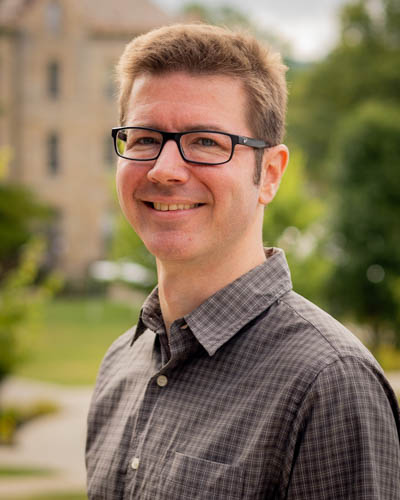
Dr. Daniel J. Cross is a Professor in the Physics and Mathematics department at Geneva College. He teaches courses including Acoustics, Classical Mechanics, College Physics, and Modern Physics. He holds a Ph.D. in Physics from Drexel University (2010) and dual bachelor's degrees in Mathematics and Physics from Cedarville University (2002). His research integrates mathematical and computational approaches, with emphasis on: Topology and group theory in nonlinear dynamics Chaos theory and electromagnetism Relativity and GPU-accelerated computations Current projects investigate magnetic field line topology, gravitational dynamical systems, and parallel computing applications. He received the AAPT Reviewer Excellence Award (2020) and mentors students including NOYCE scholars Emerson Spear and Peter Lewis (2023). He serves as faculty advisor for the Anime Club and is a member of the American Physical Society (APS), American Scientific Affiliation (ASA), and Sigma Pi Sigma (ΣΠΣ) Physics Honor Society.
Marc Gonzalez Tallada is a researcher at the Universitat Politècnica de Catalunya (UPC), affiliated with the Department of Computer Architecture within the Barcelona School of Informatics (FIB). He is a member of the MGT Research Group, focusing on Programming Models and high-performance computing systems. His research interests lie in the domain of computer architecture and programming models, with a strong emphasis on parallel and distributed computing, performance optimization, and system-level software. His work contributes to the design and implementation of efficient programming models that exploit modern parallel architectures. The recent publications (2010–2024) reflect a consistent focus on programming models, particularly in the context of high-performance computing. Key themes include task-based programming, runtime systems, compiler optimization, memory management, and performance analysis. The research spans computer architecture, system software, and compiler design, demonstrating a multidisciplinary approach to solving challenges in parallel computing. Scientific Awards and Recognitions: Premi o reconeixement Advising and Grants: While specific student names are not listed, his involvement in competitive R&D+i projects indicates active participation in funded research. These projects suggest leadership or collaboration in grant-supported initiatives related to programming models and computer systems. His role in innovation and research projects highlights contributions to both academic and applied domains. Labs and Research Teams: He is a core member of the MGT (Programming Models) research group at UPC, which focuses on advancing the state-of-the-art in programming models for parallel and distributed systems.
Yolanda Becerra Fontal is a faculty member at the Universitat Politècnica de Catalunya (UPC), affiliated with the Department of Computer Architecture within the Barcelona School of Informatics (FIB). She is actively involved in research projects and collaborations, notably with the Barcelona Supercomputing Center, and is a member of prominent research groups such as the High Performance Computing Group (CAP) and CROMAI (Computing Resources Orchestration and Management for AI). Research Interests: Her research spans a broad spectrum of computer systems, with a consistent focus on performance, efficiency, and scalability. Key areas include Computer Architecture , High-Performance Computing (HPC) , Distributed and Cloud Systems , Resource and Energy Management in virtualized environments, and Data-Intensive Computing . More recently, her work has centered on innovative time-series database systems and data management for edge and cloud analytics. Publication Trends: Her recent scholarly output (2020-2022) shows a strong emphasis on time-series data management, proposing novel database architectures like NagareDB and strategies for polyglot persistence. Earlier work (2009-2013) was pivotal in MapReduce workload management, energy accounting for virtualized systems, and optical data center networks, demonstrating a long-standing contribution to foundational distributed computing challenges. Scientific Contributions: Her work has been published in top-tier journals and conferences such as Future Generation Computer Systems , IEEE Transactions , and Nucleic Acids Research . She has also contributed to significant competitive R&D projects and holds patents related to data flow management and distributed indexing. Advising and Grants: Dr. Becerra Fontal has served as a thesis advisor for doctoral students. Her research has been funded through competitive grants from national and regional programs, including Spanish State Research Plans (Plan Estatal de Investigación) and Catalonia's RIS3CAT strategy, supporting projects on high-performance computing and data management. Research Groups and Labs: She is a core member of the CAP - High Performance Computing Group and the CROMAI - Computing Resources Orchestration and Management for AI group at UPC. Her work is closely associated with the Barcelona Supercomputing Center (BSC) , one of Europe's leading supercomputing facilities, indicating access to advanced computational infrastructure.
J.A. La Poutré is a Full Professor at Delft University of Technology and a Scientific Staff Member at CWI (Centrum Wiskunde & Informatica) in the Intelligent and Autonomous Systems group. He holds part-time positions and is involved in research on multi-agent systems and computational intelligence for smart energy systems, with a focus on market-based optimization and fairness in network congestion management. PhD in computer science (Utrecht University, 1991) MSc in mathematics (TU Eindhoven, 1986) His research spans algorithm design, game theory, and reinforcement learning applied to energy systems, particularly smart grids and market mechanisms. Recent publications address cybersecurity threats in power networks, auction-based energy trading, and AI integration in media sectors. The 2019–2025 publications highlight his work in combining game theory with smart grid optimization , covering topics such as topology attacks , demand-side bidding , and fair congestion management . Papers frequently involve reinforcement learning , metaheuristics , and market mechanisms . Scientific Awards : Best paper award at GECCO-2015 KNAW fellow (Utrecht University, 1991–1997) He has led funded projects like Computational Capacity Planning in Electricity Networks (STW program) and co-chairs the Commit2Data Energy division. La Poutré also serves as Vice President of ERCIM (European Research Consortium for Informatics and Mathematics).
Ole Madsen is a Professor at the Department of Materials and Production within The Faculty of Engineering and Science at Aalborg University . His research focuses on Robotics and Automation , particularly in 5G Smart Production , AI for Manufacturing , and Industry 4.0 applications. He also holds a part-time position at Adding Robotics , applying his expertise in robot integration for industrial and healthcare settings. Research Interests : Robotics, Automation, AI, Sensor Systems, Modular Manufacturing, Welding Technology, Digital Twins, Human-Centered Robotics, Industry 4.0 His work spans 35+ years with over 205 publications , emphasizing smart production systems and robot-assisted processes . Key contributions include Swarm Production Architectures , 5G-Enabled Robotics , and Human-Robot Collaboration frameworks. He has supervised 10 PhD students and led major projects like RAU (Robot-Assisted Ultrasound) and GINP: Robotics & AI Innovation Network . Scientific Awards : SCAP2020 Best Presentation Award (2020) Ole's 31 projects include AP2030: Aseptic Factory 2030 (pharma production), AddSmart (robotics R&D), and 5G-Enabled Autonomous Systems . His 127 press/media mentions highlight advancements in robotic welding , industrial metaverse , and swarm production . He maintains an ORCID: 0000-0003-2133-2541 with extensive publication records across Swarm Robotics , Modular Manufacturing , and AI-Driven Production .
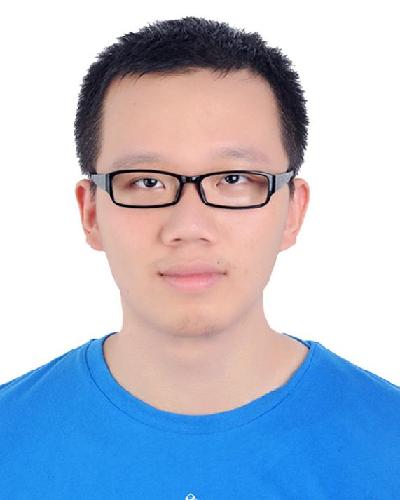
Yuanchao Xu is an Assistant Professor in the Department of Computer Science and Engineering at the University of California Santa Cruz. He earned his Ph.D. from North Carolina State University, advised by Dr. Xipeng Shen and Dr. Yan Solihin, and is a student researcher at SystemResearch@Google since 2021. His research spans computer architecture, security, and ML systems.
Alan D. Fekete is a Professor at the University of Sydney's Department of Computer Science, specializing in database systems, distributed data management, and consistency models. His work spans transaction processing, cloud computing, and query optimization, with recent focus on enhancing database concurrency and serializable execution. Key Research Areas: Database Concurrency & Transaction Isolation Multicore Scalability & Distributed Systems Cloud Data Consistency & Replication Query Optimization & NoSQL Performance Recent publications (2023-2025) explore transactional frameworks for analytical interfaces, DB-OS co-design for data ingestion, and mixed isolation levels for serializable execution. Earlier works (2018-2014) address scalable lock managers, coordination avoidance in databases, and consistency properties in cloud storage. He has contributed to educational initiatives, including a data-centric computing curriculum (2021) and teaching threading concepts (2008). Collaborations include co-authors like Nancy Lynch, Uwe Röhm, and Joseph Hellerstein.
Nuno Santos is an Associate Professor in the Department of Computer Science and Engineering at Instituto Superior Técnico (IST), University of Lisbon, and a senior researcher at INESC-ID Lisbon, where he leads the SysSec team within the Distributed, Parallel and Secure Systems (DPSS) group. He is an active member of the international security community, serving as Program Vice Co-Chair for USENIX Security 2025 and on program committees for top venues such as IEEE S&P, CCS, and USENIX Security. Education: Ph.D. in Computer Science, 2013 – Max Planck Institute for Software Systems (MPI-SWS) & Saarland University Research internships at Microsoft Research Redmond (2010), Vrije Universiteit Amsterdam (2018), and Technical University of Munich (2024) Research Interests Nuno Santos’s research centers on the security and privacy of computer and networked systems, with particular emphasis on trusted execution environments, secure systems design, and the intersection of machine learning with security. His group investigates vulnerabilities and defenses in widely deployed platforms, including TrustZone, JavaScript runtimes, and cloud infrastructures. Additional themes include censorship-resistant communication, privacy-preserving analytics, and automated exploit generation. Recent Publication Trends Over the past five years, his work has increasingly targeted emerging threat models in confidential computing (AMD SEV-SNP, Intel TDX), large-language-model integration into web applications, and automated security analysis of JavaScript ecosystems. These publications consistently appear in the most selective venues (PLDI, SIGMETRICS, ICSE, NDSS, S&P, USENIX Security), evidencing strong empirical evaluation and real-world impact. Awards & Honors IST Outstanding Teaching Award (2019/2020) ISOC.PT Best Portuguese Internet Research Award (2024) Prémio Científico Universidade de Lisboa / Caixa Geral de Depósitos (2024) Multiple IST Teaching Excellence Awards Advising & Service Nuno Santos has supervised numerous MSc and PhD students whose theses span secure systems, network privacy, and trustworthy computing. Recent defenses include Bernardo Ribeiro, Cristi Savin, Hugo Mantinhas, João Aragonez, João Sá, and Tomás Tavares. He actively participates in doctoral committees and mentors junior researchers within the DPSS group. Labs, Teams & Collaborations He leads the SysSec team inside the Distributed, Parallel and Secure Systems (DPSS) group at INESC-ID Lisbon. The team maintains strong collaborative ties with MPI-SWS, VUSec at VU Amsterdam, the Systems Research Group at TU Munich, and multiple industry partners including Microsoft Research.
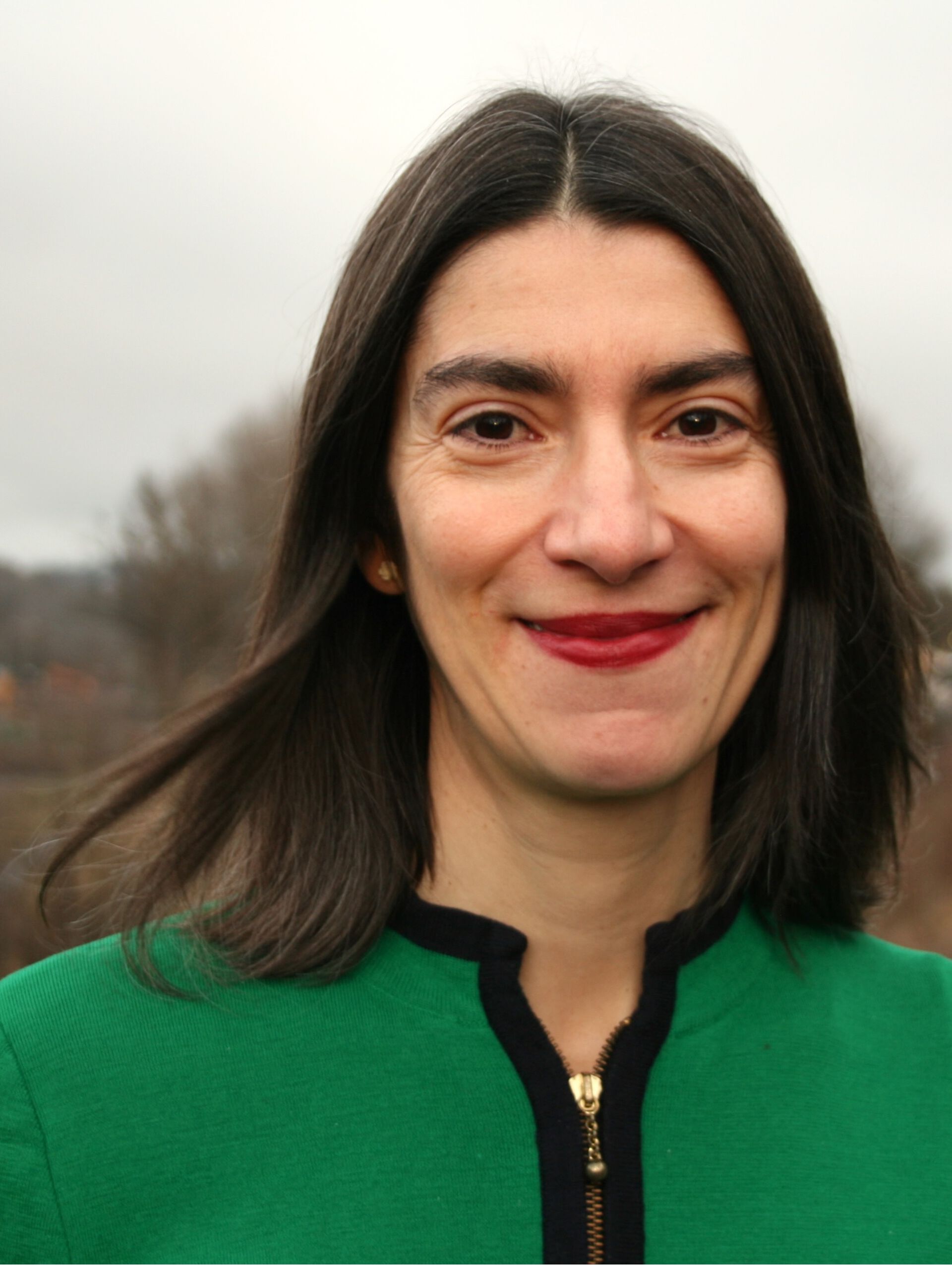
Alejandra Mancilla is a Professor at the Department of Philosophy, History of Ideas and Art, and Classical Languages at the University of Oslo. Her work bridges political philosophy , environmental ethics , and territorial rights , with a focus on Antarctic studies and the right of necessity in global poverty contexts. Research Groups : Oslo Political Theory (OPT), Research Network Practical Philosophy Projects : DynamiTE (Dynamic Territory), Laboratory for landscapes with interacting species Her recent publications analyze climate justice , decolonization in Antarctic governance, and ecoregion guardianship . Themes include territorial sovereignty , environmental policy , and historical colonialism in geopolitical treaties. Key Contributions : 2024: Co-edited Colonialism and Antarctica with Peder Roberts 2023: Article on Climate justice and territory in Wiley Interdisciplinary Reviews 2021: Greening Global Egalitarianism? in Global Justice: Theory Practice Rhetoric
Salma Emara is an Assistant Professor in the Department of Electrical and Computer Engineering at the University of Toronto within the Faculty of Applied Science & Engineering. Her academic journey includes a B.Sc. in Electronics and Communications Engineering from the American University in Cairo (2018) and a Ph.D. in Computer Engineering from the University of Toronto (2022), supervised by Professor Baochun Li. Her research spans two domains: (1) technical work in reinforcement learning for computer networking , including adaptive bitrate selection, edge caching, and congestion control; and (2) pedagogical work focused on debugging skill development for beginner programmers and leveraging natural language processing in engineering education . She emphasizes hands-on learning through in-class activities and problem-solving assignments. Publication trends reveal a focus on reinforcement learning in networking (2018–2023) and a parallel interest in educational technology (2024). Her recent work (e.g., TextCraft ) explores NLP-driven resource recommendation for textbooks, while earlier projects (e.g., Cascade , Pareto ) address network optimization through machine learning. Scientific awards include: Faculty of Applied Science & Engineering Early Career Teaching Award (2025) Departmental Teaching Awards (2022–2024) Shortlisted for TATP Teaching Assistant Excellence (2022)
Giuseppe Pascazio serves as a Full Professor in the Department of Mechanics, Mathematics & Management at the Polytechnic University of Bari, Italy. His research spans computational fluid dynamics with dual focus on aerospace applications and biomedical engineering, particularly in hypersonic flow phenomena and microwave ablation technologies for cancer therapy. His primary research interests include fluid dynamics, computational methods for high-enthalpy flows, thermochemical non-equilibrium modeling, turbulent boundary layer analysis, and biomedical device optimization. Pascazio develops advanced numerical techniques including high-order schemes, state-to-state kinetics implementations, and GPU-accelerated solvers to address complex flow physics in atmospheric entry and medical applications. His work bridges fundamental gas dynamics with practical engineering solutions for spacecraft thermal protection and minimally invasive cancer treatments. Analysis of his recent publications (2021-2025) reveals three dominant research thrusts: (1) High-fidelity simulation of hypersonic flows with detailed chemistry using state-to-state kinetics, (2) Development of robust numerical methods for shock-capturing in thermochemically non-equilibrium flows, and (3) Biomedical applications focusing on microwave ablation probe design and microcapsule transport in vascular systems. His aerospace work emphasizes atmospheric reentry physics while biomedical research targets cancer therapy optimization. Pascazio has participated in significant research projects including "PrInCE" (Innovative Processes for Energy Conversion) and "INNOVHEAD" (Advanced technologies for reduction of polluting emissions in Heavy Duty engines). His collaborative work involves industrial partnerships in aerospace and medical device sectors, though specific grant details beyond project names aren't provided. He maintains active research output with over 50 publications demonstrating consistent contributions to high-speed aerodynamics and biomedical fluid dynamics.
Edgar Vadimovich Vatamanitsa serves as an Assistant Professor in the Department of Computer Science at Chernivtsi National University, specializing in cross-platform software development and cloud computing applications. His work bridges academic research with industry practice through active engagement in both university teaching and commercial software development. Education: Yuriy Fedkovych Chernivtsi National University (2013): Systems Software, Software Engineer Dr. Vatamanitsa's research centers on Java/Android pattern development, client-server architectures, and distributed systems. He pioneers practical implementations of design patterns in cloud environments, with significant contributions to optical field simulation, semiconductor modeling, and intelligent transportation systems. His methodology emphasizes cross-platform efficiency and real-world applicability of theoretical computing concepts. Analysis of his 2022-2024 publications reveals dominant themes in cloud-based optical computation (AWS infrastructure), Java pattern implementation for Android, and cross-platform solutions for traffic management and semiconductor physics. His work consistently integrates distributed systems with domain-specific challenges in optics, printing technology, and educational analytics, demonstrating exceptional versatility across engineering disciplines. Professional Activities: Member of Bukovina Information Technology Cluster (since 2022) Senior Software Developer at EPAM SYSTEMS Certificate in Cross-platform Programming and Information Security (Ternopil National Technical University, 2023) Tech Summer Bootcamp for Teachers participant (2023)
Kamesh Madduri is an Associate Professor in the Department of Computer Science and Engineering at Pennsylvania State University, with affiliations to the Huck Institutes of the Life Sciences. His research focuses on graph analytics, parallel algorithms, and high-performance computing for large-scale data analysis. NSF CAREER Award (2013) His work contributes to the development of scalable graph partitioning algorithms, extreme-scale sparse data analytics, and heterogeneous computing frameworks. Recent projects include multilayer network analysis (NetSplicer) and GPU-accelerated graph processing (Jet). Key research areas include network science, computational biology, and distributed-memory graph algorithms. His publications highlight applications in genomic workflows, advertising keyphrase recommendation (Graphite/BroadGen), and large-scale hydrology data management. Collaborative Research: CCRI (2021-2023) SHF: Medium: NetSplicer (2020-2024) PPoSS: Extreme-scale Sparse Data Analytics (2018-2022) XPS: Genomic Workflows Acceleration (2014-2020) EAGER: SME Manufacturing Integration (2024-2026)
Nikolaos Papaspyrou is a Professor at the School of Electrical and Computer Engineering of the National Technical University of Athens (NTUA) and a member of the Software Engineering Laboratory . His research focuses on the theory and implementation of programming languages, including semantics, type systems, compilers, static analysis, and formal verification. Since October 2021, he has been on leave from NTUA, working as a Software Engineer for Google in the memory management team for the V8 JavaScript and WebAssembly engine. He previously served as Director of the Division of Computer Science (2017-2019) and was on sabbatical with Google's compiler group in Munich (2015-2016). His work includes the RELEASE project (EU FP7 STREP) for reliable large-scale server software and uncertainty handling in distributed databases (European Social Fund). Ph.D. and Diploma in Electrical and Computer Engineering from NTUA M.Sc. in Computer Science from Cornell University His research interests span programming languages , software engineering , and formal verification , with recent publications on coinductive proofs in Liquid Haskell, concurrency semantics, and quantum compilation. He has supervised over 50 diploma projects and mentored numerous students now at institutions like MIT, Princeton, and UC Berkeley. Awards include conference organizing and program committee roles, though no formal scientific prizes are listed.
Dr. Ramon Antonio Rodriguez Zalepinos is an Associate Professor at the Department of Software Engineering, Faculty of Computer Science, National Research University Higher School of Economics (HSE). With 16+ years of scientific and teaching experience, he specializes in geospatial data systems, distributed databases, and high-performance computing. Doctor of Science in Computer Science (2024) Candidate of Technical Sciences (2013) Master's in Computer Science (2008, Donetsk National Technical University) His research focuses on geospatial array databases , distributed systems , and Big Earth Data engineering , particularly through his ChronosDB and Quantum Tensor DBMS projects. He has pioneered cloud-native solutions for multi-terabyte environmental datasets and developed novel approaches for in-database road traffic simulations. Key publication trends show 7+ years of contributions to VLDB and SIGMOD conferences, with special emphasis on: Quantum-enhanced geospatial processing Web-based array database systems Cellular automata integration High-speed raster data aggregation Scientific recognition includes: Best Teacher award (2017-2021, 2023) HSE Personnel Reserve member Additional post-doctoral funding (2024-2027) Multiple publication bonuses (2019-2023) He supervises student research in geospatial data science and leads projects on satellite data processing systems, with implementations at major institutions including Amazon and Planet Labs.