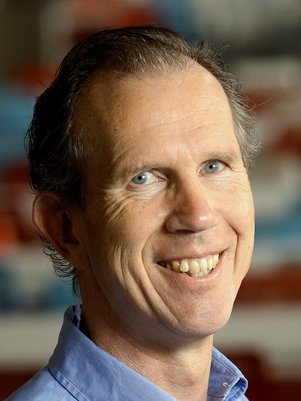
D. Spinellis is a Professor at Athens University of Economics and Business with continuous affiliation since 2000, specializing in Software Engineering within the broader field of Computer Science. His research spans critical domains: Software Engineering Computer Science Data Engineering Artificial Intelligence Cybersecurity High-Performance Computing Recent publications (2024-2025) demonstrate consistent focus on practical system-level challenges including Linux analysis on supercomputers, graph processing efficiency, AI-generated content ethics, security system modernization, and data workflow engineering. These works bridge theoretical research with real-world software applications. Professor Spinellis actively engages public discourse through media coverage of his 2025 study on AI-generated publication fraud, which received significant attention across news outlets, academic platforms, and social media including X, Facebook, and Bluesky.
Dr. Edwin van Leeuwen (Utrecht University, Faculty of Science) is an Assistant Professor in Animal Behaviour and Cognition. His research focuses on primate social structures, cultural transmission in great apes, and implications for understanding human evolutionary origins. Affiliated with the Environmental Biology department, he teaches primatology and ethology to behavioral science students. Current Research: Cultural variation in chimpanzee/bonobo sociality Key Themes: Social learning, cooperation, prosocial behavior Methodology: Observational studies, controlled experiments His recent articles (2023-2025) explore topics like group-specific prosocial behavior , cultural transmission mechanisms , and sexual dynamics in Pan species. Studies span from chimpanzee tool use to bonobo social tolerance and cross-species comparisons . While no formal scientific awards are listed, his work is widely cited across primatology and evolutionary anthropology. Van Leeuwen combines field observations with experimental approaches to investigate the cognitive foundations of animal behavior. His teaching emphasizes both theoretical frameworks and practical methodologies in primate studies.
J.E.M. Kolk is a Professor at the University of Amsterdam , affiliated with the Amsterdam Business School . Her research focuses on Corporate Social Responsibility , Sustainable Development , and International Business , particularly examining the intersection of sustainability, ethics, and global value chains. Key research areas: CSR, energy transition, sharing economy, GVCs Recent publications analyze digital platforms, circular economy, and FDI sustainability Notable awards: Academy of International Business Fellow, EABIS Lifetime Achievement, Elsevier Atlas Award She has supervised over 28 PhD students and serves as Area Editor for Journal of International Business Studies and Consulting Editor of Journal of International Business Policy . Her work bridges academic research with practical implications for multinationals and policy-making.
Dr. Vinh Dang is an Assistant Professor at the Operations, Planning, Accounting & Control (OPAC) group within the Department of Industrial Engineering and Innovation Sciences at Eindhoven University of Technology (TU/e). His research focuses on automating manufacturing processes, material handling, and the integration of autonomous mobile robots (AMRs) and automated guided vehicles (AGVs) in smart factories, warehouses, and healthcare environments. He has contributed to projects such as Advanced Manufacturing Logistics and Green Transportation Delta, emphasizing sustainable and efficient industrial systems. Education: PhD in Operations Research, Aalborg University (2014) M.Sc. in Industrial Engineering, Pusan National University (South Korea) B.Eng. in Industrial Systems Engineering, Ho Chi Minh City University of Technology (Vietnam) Research Interests: Dr. Dang’s work centers on algorithmic methodologies for planning/scheduling automated systems, particularly in smart industries. He explores robotics integration, energy-efficient logistics, and real-time decision-making frameworks. His research combines operations research techniques with multi-agent systems and reinforcement learning to enhance manufacturing and service sector efficiency. Key Projects: DigiTwop: Digital Twin-based warehouse optimization (2025–2028) Green Transport Delta – Electrification: Sustainable transportation solutions (2021–2024) Decentralized Distribution: Logistics sector disruption analysis (2023–2025) Teaching: Courses include Manufacturing Integration , Modeling and Analysis of Manufacturing Systems , and Engineering Design Expertise , aligning with UN Sustainable Development Goals such as Industry, Innovation & Infrastructure (SDG 9). Labs/Teams: Collaborates on digital twin frameworks for AGV communication and energy management systems, emphasizing practical industry applications like smart hospitals and high-tech logistics.
Mircea Lazar is an Associate Professor in the Control Systems group at Eindhoven University of Technology. His research spans constrained control, model predictive control (MPC), and stability analysis of hybrid systems, with applications in power systems, smart grids, and precision mechatronics. Research highlights include: Development of data-driven predictive control methods Stability guarantees for nonlinear and hybrid systems Applications in water networks, power converters, and mechatronics He has received the EECI PhD Award and NWO VENI grant. Recent publications focus on real-time MPC implementations, physics-guided neural networks, and optimization for large-scale systems. Collaborations include ASML, DAF, Philips, and Ford. He chairs the IEEE CSS Technical Committee on Hybrid Systems and has supervised 9 PhD students.
Dmitry Bagaev is a Researcher at Eindhoven University of Technology's Signal Processing Systems department, specializing in Bayesian inference and probabilistic programming. His work develops computational tools like RxInfer.jl and ReactiveMP.jl for scalable probabilistic modeling. Research spans Bayesian inference frameworks, reactive programming architectures, and applications in computational immunology. Recent publications focus on probabilistic programming languages (GraphPPL.jl), multi-agent trajectory planning, and SARS-CoV-2 T-cell receptor databases. Articles demonstrate consistent innovation at the intersection of computational statistics, biological data analysis, and real-time systems engineering. Awards and advising roles are not documented in available records. Research occurs within the BIASLab group, focusing on signal processing systems and probabilistic AI.
Sacheendra Talluri is a Visiting Fellow at the Faculty of Science, Vrije Universiteit Amsterdam, affiliated with the Network Institute. His research focuses on distributed systems, serverless computing, and GPU-accelerated data processing. Current affiliation: Faculty of Science, Computer Science Department, Vrije Universiteit Amsterdam Research areas: Distributed Systems, Serverless Computing, GPU Programming, Performance Engineering Talluri's recent work investigates large language model service reliability , serverless computing overheads , and GPU-optimized data processing . His research output includes methodologies for Kubernetes configuration analysis and serverless event triggers, contributing to cloud infrastructure optimization. He participates in the project 'Extreme and Sustainable Graph Processing for Urgent Societal Challenges in Europe' (2023–2025), collaborating with researchers like Alexandru Iosup and R. van Bakel.
C Giuffrida is an Associate Professor at the Faculty of Science, Vrije Universiteit Amsterdam, with affiliations to the Network Institute and the Systems and Network Security group. His research focuses on computer systems security, hardware vulnerabilities, and software reliability. Giuffrida holds a PhD in Computer Systems from Vrije Universiteit Amsterdam (2014). His academic contributions span multiple areas including transient execution attacks, fuzzing techniques, and hardware-software co-design for security. Research Interests: Hardware Security: Investigating vulnerabilities like Spectre, Rowhammer, and speculative execution risks. Software Security: Focusing on memory safety, compiler optimizations, and exploit mitigation strategies. Systems Research: Developing tools like BinRec for binary analysis and VPS for C++ vulnerability protection. His work has been recognized with awards such as the Distinguished Paper Award in 2021. Giuffrida supervises advanced courses in operating systems and hardware security, and has guided 16 PhD theses to completion.
Lin Wang is an Assistant Professor at the Department of Computer Science, Vrije Universiteit Amsterdam, and an Adjunct Professor at TU Darmstadt. His research focuses on networked systems, edge computing, cloud computing, and optimizing computer systems for applications like augmented reality. He holds a PhD from Chinese Academy of Sciences and has postdoctoral experience at SnT Luxembourg. His work contributes to UN Sustainable Development Goals related to innovation and infrastructure. Education: PhD in Computer Science (ICT, CAS), Postdoc at SnT Luxembourg Previous Roles: Head of Smart Urban Networks group at TU Darmstadt's TK Lab (2016-2018) Research interests include edge computing, in-network processing, novel network protocols, and energy efficiency. Recent work addresses latency in edge networks, IoT synchronization, and congestion mitigation in data centers. Supervised 2 PhD theses and collaborates internationally. Active in labs like the Telecooperation (TK) Lab. No ancillary activities declared.
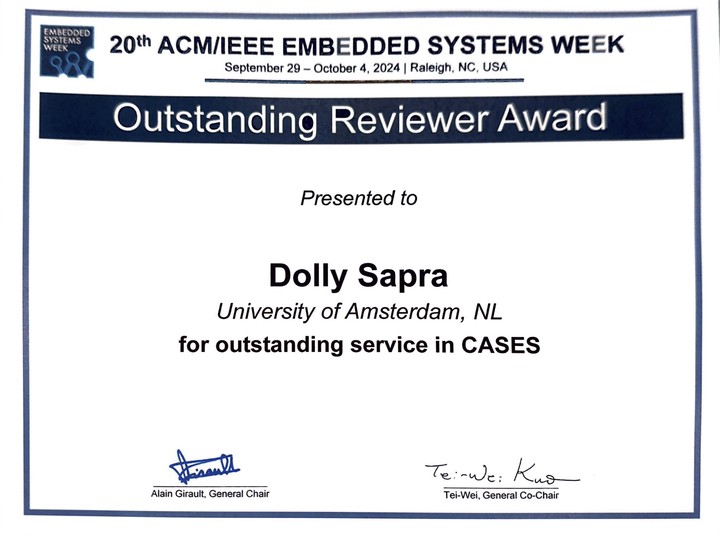
Dolly Sapra is a researcher at the University of Amsterdam , affiliated with the Department of Computer Science under the Faculty of Science . Her work focuses on adaptive deep learning, secure neural inference, energy-efficient computing, and fault-aware systems. She received the IEEE/ACM CASES '24 Outstanding Reviewer Award . Her research spans Machine Learning , Edge Computing , and Embedded Systems , with a focus on Model elasticity for CNNs Privacy-preserving edge intelligence Power-efficient inference Transformer optimization Climate-aware computing . The 15 most recent articles highlight her leadership in adaptive neural architectures , secure multi-party inference , and sustainable computing , with applications in embedded systems and real-time environments .
Bas Luttik is an Associate Professor in the Department of Mathematics and Computer Science at Eindhoven University of Technology (TU/e), with a secondary appointment as an EAISI Foundational Associate Professor. His research focuses on concurrency theory, process algebra, and formal methods applied to railway systems. He holds an MSc and PhD from the University of Amsterdam, followed by postdoctoral work at Vrije Universiteit Amsterdam. His academic contributions include foundational work on parallel decomposition, process algebra semantics, and the integration of concurrency theory with automata theory, notably through the theory of Reactive Turing machines. Education background: MSc Computer Science (1996), University of Amsterdam PhD Computer Science (2002), University of Amsterdam (supervised by Jan Friso Groote at CWI) Research interests emphasize formal verification, process algebra, and practical applications in railway safety. Notable awards include the FMICS Best Paper Award (2018). He teaches courses like Logic and Set Theory, developing innovative digital tools for self-paced learning and homologation recommendation systems. Active in conference organization, he has chaired program committees for EXPRESS/SOS (2011–2013) and contributed to CONCUR, TTCS, and others. His work bridges theoretical foundations (e.g., bisimulation, executability) with applied systems (e.g., EULYNX railway interfaces). Supervised 30+ students, though specific names are not listed here. Research collaborations span international teams, focusing on concurrency, automata, and formal methods in critical systems.
Paul van de Laar is a Full Professor and Endowed Professor in the Department of History at the Erasmus School of History, Culture and Communication, Erasmus University Rotterdam. His work bridges academic research and public engagement, focusing on urban history, cultural heritage, and the evolution of port cities, particularly Rotterdam. His research interests include: Urban History and Waterfront Development Migration and Identity in Dutch Cities Sustainable Transitions in Culture & Societies (STiCS) Heritage & Identity (HI) Port Cities and Economic Inequality Public and Participatory Museums His publications reflect a deep engagement with the historical transformation of urban landscapes, especially waterfronts, and the sociocultural dynamics of port cities. He explores themes such as modernity, migration, and public space, often linking past developments to contemporary urban challenges. His work appears in journals like Urban Planning and Journal of Urban History , as well as in books and public-facing media. Recent articles highlight trends in: Historical urban planning and infrastructure (e.g., shipping canals, tunnels) Migration narratives and identity in Rotterdam The role of museums in community engagement Economic inequality mapped through historical waterfront development Public commemorations and media commentary on urban history He is actively involved in academic and public discourse, contributing to editorial boards, conferences, and media outlets such as NOS and RTV Rijnmond. His work in the European Journal of Creative Practices in Cities and Landscapes underscores his interdisciplinary approach. Paul van de Laar supervises academic work and contributes to research clusters including STiCS and HI. He has delivered numerous talks and presentations on Rotterdam’s past, present, and future, emphasizing the city’s evolving identity. His outreach includes public lectures, library events, and television appearances, making history accessible beyond academia.
Jan Friso Groote is a Full Professor and Chair of the Formal System Analysis group in the Department of Mathematics and Computer Science at Eindhoven University of Technology (TU/e). He also holds professorial roles in the EAISI Foundational and EAISI High Tech Systems institutes. Since 2016, he has been working part-time at ASML, contributing his expertise in formal verification to industrial applications. Education: Born in 1965, studied Computer Science at Twente University of Technology (now University of Twente), 1983–1988. PhD in 1991 from the University of Amsterdam with thesis 'Process algebra and structured operational semantics', based on research at CWI (Centrum Wiskunde en Informatica). Jan Friso Groote is a leading researcher in formal methods and software verification. His work focuses on enabling the development of flawless software through rigorous formal analysis. Key research areas include structural operational semantics, model checking, branching bisimulation, protocol verification, and the development of the mCRL2 toolset. His current goal is to integrate formal techniques into complete software system design, improving both development speed and quality. His research has demonstrated that formal methods can reduce development time by a factor of three and increase quality tenfold, with potential for zero-defect software. His recent publications demonstrate sustained contributions in formal verification, including work on mutual exclusion algorithms, industrial control system modeling, probabilistic systems, and efficient bisimulation algorithms. The articles span topics such as tunnel control systems, simulation lower bounds, and formal methods for critical systems, reflecting both theoretical depth and practical application. Scientific Awards: Best Paper Award FACS 2018 FMICS-AVoCS Best Paper Award (2017) Jan Friso Groote has held significant leadership roles in education, including Director of Education for Computer Science (2000–2010) and for multiple bachelor’s and master’s programs. He has advised numerous researchers and supervised a large body of research output (over 320 publications). He leads the Formal System Analysis group and has been involved in projects such as 'Composable Embedded Systems for Healthcare'. His work bridges academia and industry, particularly through collaborations with ASML and Rijkswaterstaat, and he has been a visiting researcher at institutions across Europe and China. He is a key contributor to the mCRL2 toolset, which supports modeling and verification of software behavior with data, time, and probabilities. His research fingerprints highlight strong expertise in model checking, transition systems, software design, and process algebra. He teaches courses such as System Validation, Embedded Software, and Capita Selecta in Formal System Analysis.
Farhad Arbab is a researcher at the Centrum Wiskunde & Informatica (CWI) in Amsterdam, Netherlands, affiliated with the Computer Security department. His work focuses on formal methods for modeling and analyzing cyber-physical systems (CPS) and coordination models. Current affiliation: Researcher at CWI's Computer Security department Research areas: Cyber-Physical Systems, Formal Methods, Workflow Modeling, Constraint Automata Arbab's research develops component-based semantic models for CPS using constraint automata and the Reo coordination language. His framework enables: Algebraic composition of cyber-physical components Formal modeling of priority constraints in workflows Runtime composition with lazy expansion techniques Verification via Maude rewriting logic system Recent publications analyze: Parallel composition of constraint automata (2025) Concurrency in rule-based machines (2025) Runtime composition techniques (2023) Formal frameworks for distributed CPS (2022) Awards & Projects: FACS Best Paper Award (2015) Bronzen Achievement Award (2009) EU/NWO-funded initiatives: COMPAS (2008), WoMaLaPaDiA (2007), CREDO (2006)
Prof. Jan Dirk Jansen (Delft University of Technology) specializes in systems and control theory applied to subsurface flow and geomechanics. His research spans induced seismicity , geothermal energy , reservoir simulation , and data assimilation . Current projects include co-leading the NWO-funded NEPTUNUS initiative on transient induced seismicity and previously researching seismicity mitigation in Dutch gas fields through the Science4Steer program. Expertise in numerical reservoir simulation History matching & model-order reduction Optimization of fluid injection/production He authored the textbook Nodal Analysis of Oil and Gas Production Systems , with significant contributions to closed-form geomechanical solutions and scalable numerical schemes . Contact: J.D.Jansen@tudelft.nl